

Sirmium was one of the capitals of the late Roman Empire, and most of it lies under the streets of Sremska Mitrovica. The main thing to visit is part of the imperial palace, excavated and roofed over in the town centre; the town museum adds Roman stonework and a mosaic floor.
What is there today
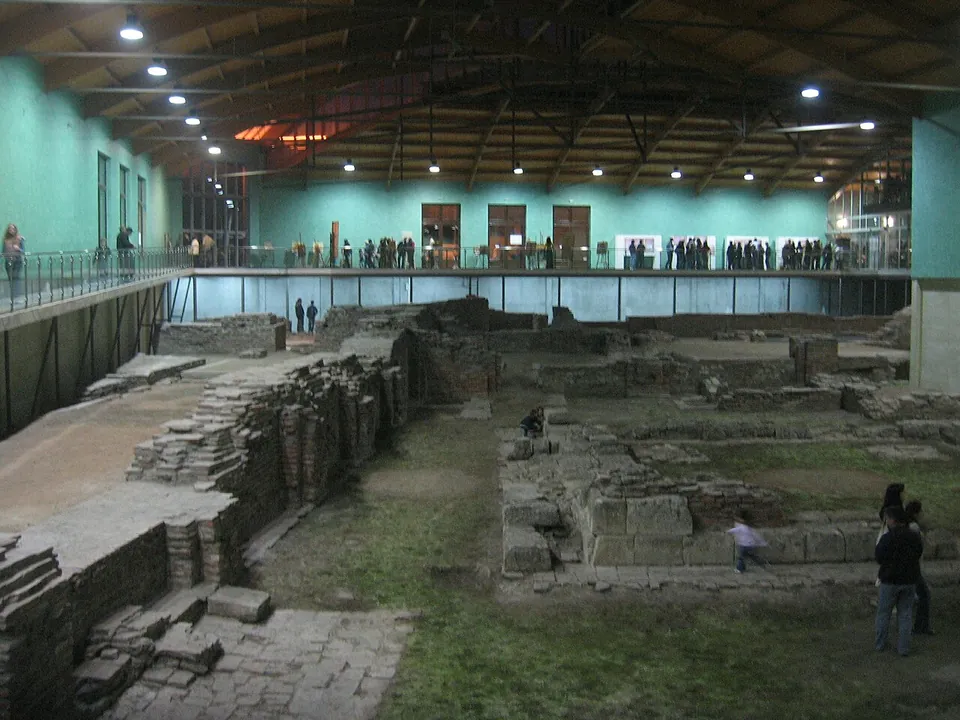
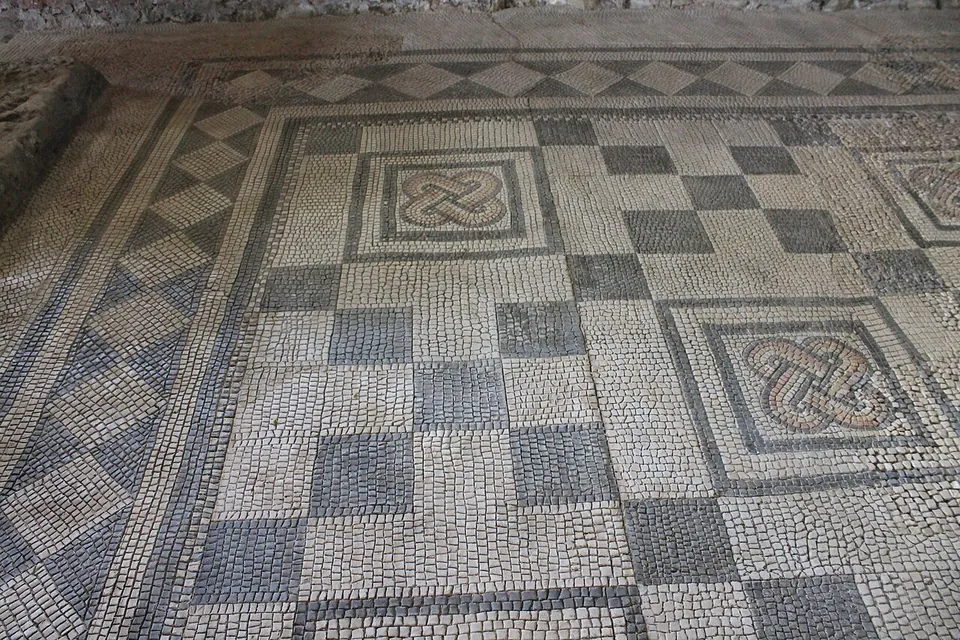
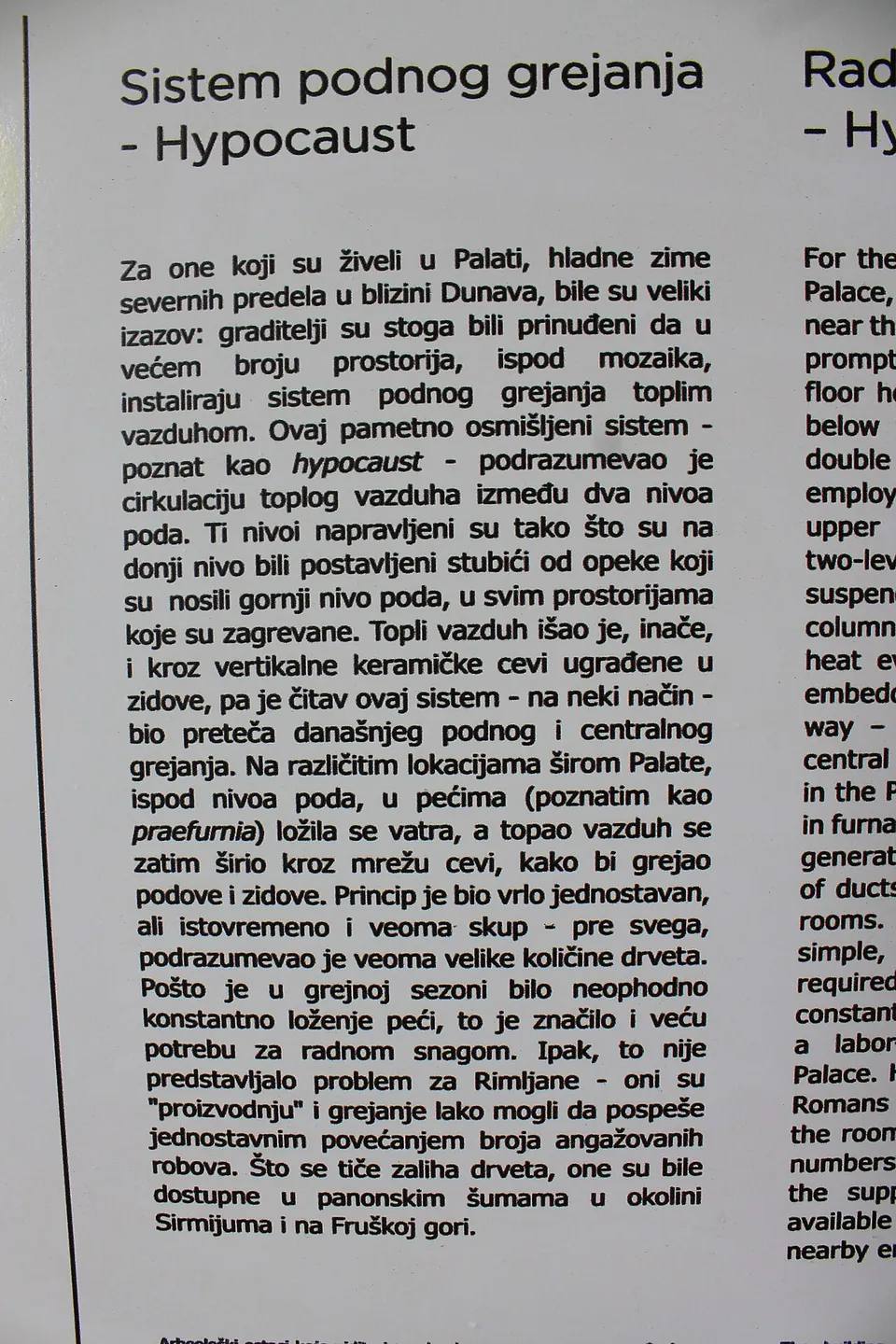
The palace is the main sight. A modern hall covers the excavation, about 2,680 m², and walkways lead from the entrance level down to the level of the excavated site (carskapalata.rs). Only part of the imperial complex is on show, mostly its living quarters: walls and floors, mosaic, and the hot-air heating that was found under almost every room. About 350 m² of mosaic floor has been found in the palace, most of it geometric patterns from building phases between the end of the 3rd century and the middle of the 4th. Only one mosaic with a figure survives, showing the god Mercury. Mosaic floors at several levels, one above another, and many alterations show how long the palace was lived in (carskapalata.rs). The visitor centre has a gallery level, an information desk, a souvenir shop and a café, and most of it is accessible to wheelchair users (carskapalata.rs).
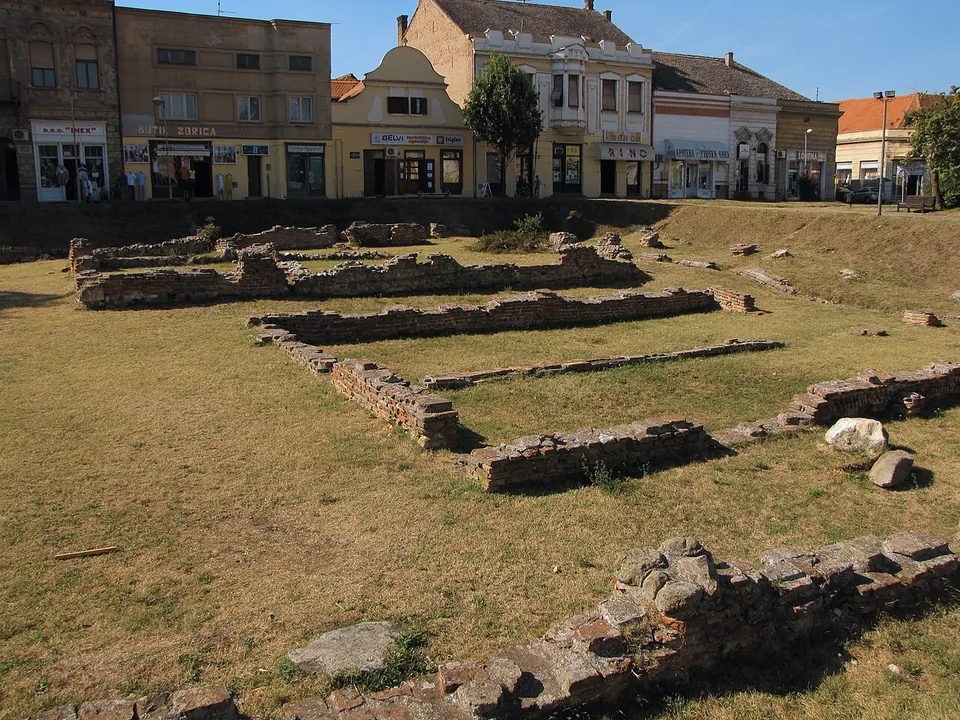
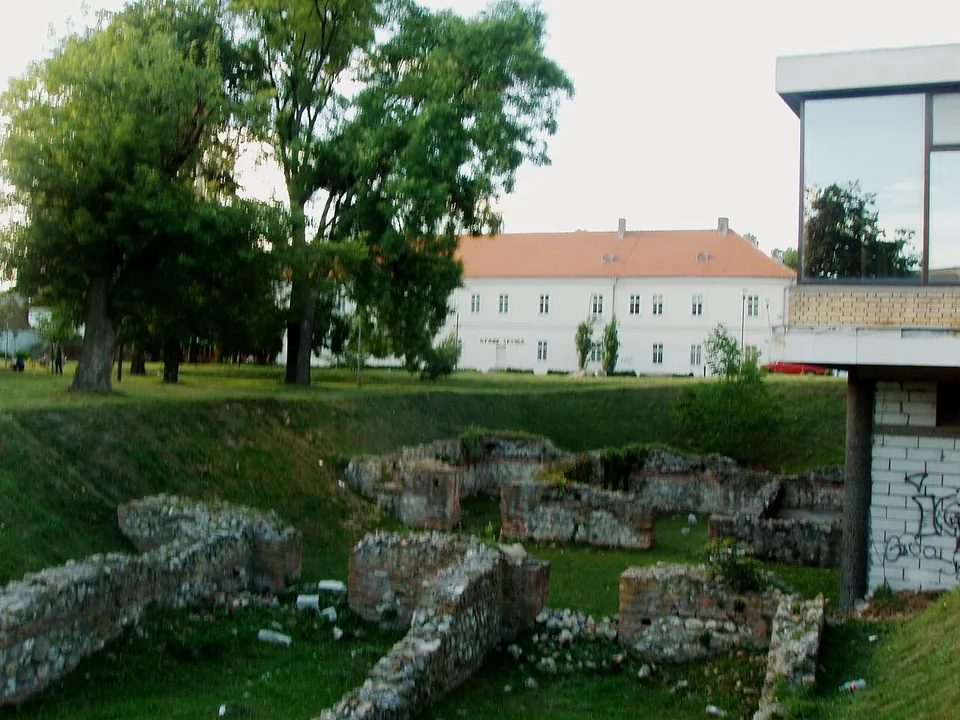
Most of the rest of the city stays out of sight. The Roman ground level is about 2–4 m below today’s streets (en.wikipedia), and the national heritage register counts 85 sites of the Roman city recorded and investigated so far. It names three places where remains have been conserved as part of modern buildings: the palace, part of the granary and the church of St Demetrius (nasledje.gov.rs). Neither the granary nor the church has published opening times. The circus where chariots raced, some 450–500 m long and 150 m wide, stood beside the palace; it lies directly under the town centre and has not been excavated (en.wikipedia; sr.wikipedia).
Two more things are worth seeing in town. The Museum of Srem displays stone monuments, most of them Roman, in the corridor and courtyard of its building on Trg Svetog Stefana: tombstones with portraits and inscriptions, about ten carved sarcophagi of marble and limestone, and the funerary altar of the centurion Titus Cominius Severus, who was born in Vienne in Roman Gaul. Its courtyard also holds one room of a Roman town house, a reception hall with underfloor heating, shown for its geometric mosaic floor in a style typical of the early 4th century (muzejsrema.com). About 600 m west of the palace, an excavation takes up most of Žitni trg, a square in the town centre (tosmomi.rs; OpenStreetMap). It was part of the city’s craft and trading quarter, where excavation found workshops with glass furnaces, shops, storerooms and streets with porticoes and drains (Zavod za zaštitu spomenika kulture).
Is it worth the trip?
For the history, yes. For the ruins alone, only if you are nearby. Emperors lived in Sirmium and several were born there, and the palace hall takes you down among its rooms and mosaic floors, under a roof. But the remains are modest: low walls and floors rather than standing buildings, and a covered site, a museum courtyard and an excavated square rather than a ruined city to explore. For Roman walls that still stand high, Felix Romuliana is the place in Serbia.
The visit itself is cheap and easy. A ticket costs 150 dinars, about €1.30, and all three places are within about 600 m of each other in a town 55 km west of Belgrade (en.wikipedia). The one thing to plan around is the time: the palace closes at 16.00 every day.
Getting there
Sremska Mitrovica is on the river Sava, 55 km west of Belgrade (en.wikipedia). The palace visitor centre is at Pivarska 2 in the town centre (carskapalata.rs). OpenStreetMap maps a car park about 70 m away, a paid municipal car park with 30 spaces and a free one with 15, both about 200 m away, and a bus stop about 200 m away. The Museum of Srem’s buildings are mapped 150–400 m west of the palace (OpenStreetMap).
The palace is open every day from 08.00 to 16.00, and the operator asks visitors to arrive at least an hour before closing. Groups must book ahead on +381 22 618 817. A ticket is 150 RSD, about €1.30; in groups of more than ten it is 100 RSD each (zavodsm.rs, read 30 September 2026; check before travelling, since prices change). The Museum of Srem is open Monday to Friday from 08.00 to 15.00 and at weekends from 09.00 to 17.00 (muzejsrema.com). It does not publish its admission price online.
Visiting details
- Opening hours
- Daily 08.00–16.00. The operator asks visitors to arrive at least an hour before closing. Groups must book ahead on +381 22 618 817, and the hours can be adjusted for larger groups that have booked.
- Tickets
- 150 RSD (about €1.30); 100 RSD each (about €0.85) in groups of more than ten.
- Parking
- A car park about 70 m from the palace (OSM way/1489563433); a paid municipal car park with 30 spaces (way/785247954) and a free one with 15 (node/11268044450) are both about 200 m away.
Before you go
- The palace closes at 16.00 every day, and the operator recommends arriving by 15.00.
- The Museum of Srem keeps its own hours (Monday to Friday 08.00–15.00, weekends 09.00–17.00) and does not publish its admission price online.
Hours and prices checked 30 September 2026 on the operator's own site. Confirm before travelling.
History
The site was settled before the Romans came. The city is first mentioned in the 4th century BC, and its first inhabitants were Illyrians and Celts (en.wikipedia). It came under Roman control in the last decades BC; published dates for the conquest range from 34 BC to 9 BC. Under the Flavian emperors it became a colony (carskapalata.rs; nasledje.gov.rs). From 103 it was the capital of Pannonia Inferior (en.wikipedia). Its peak came at the end of the 3rd century and through the 4th, when it was one of the capitals of the Roman Empire (carskapalata.rs). Marcus Aurelius, Septimius Severus, Diocletian and Constantine the Great were among the emperors who stayed there (carskapalata.rs). Published counts of emperors born in or near the city range from five to ten (carskapalata.rs; en.wikipedia). The 4th-century historian Ammianus Marcellinus called it the glorious and populous mother of cities (carskapalata.rs; muzejsrema.com).
The palace was built at the end of the 3rd century or the beginning of the 4th, in the elite south-eastern quarter of the city beside the Sava, protected by a newly built city wall. Circuses built beside palaces like this one were where the ruler appeared ceremonially before his people. Stone for the palace’s decoration came from Egypt, Asia Minor, Greece and Italy, among other places (carskapalata.rs). Systematic excavation of Sirmium began with the palace in 1957. The site was found while ground was being prepared for a block of flats, and building stopped for good once massive walls, remains of the heating system and mosaic floors appeared. The discovery of the circus close by settled that the building was the imperial palace (carskapalata.rs). The hall over the excavation opened as a visitor centre in December 2009 (tosmomi.rs).
The city fell in stages. The Huns took it in 441, and for more than a century afterwards it was held by other peoples, among them the Ostrogoths and Gepids. The Eastern Roman Empire regained it after 567, and in 582 the Avars conquered and destroyed it (en.wikipedia). The modern town takes its name from St Demetrius (en.wikipedia).
More photographs


Sources
Every fact on this page comes from the records below, each used under the licence noted.