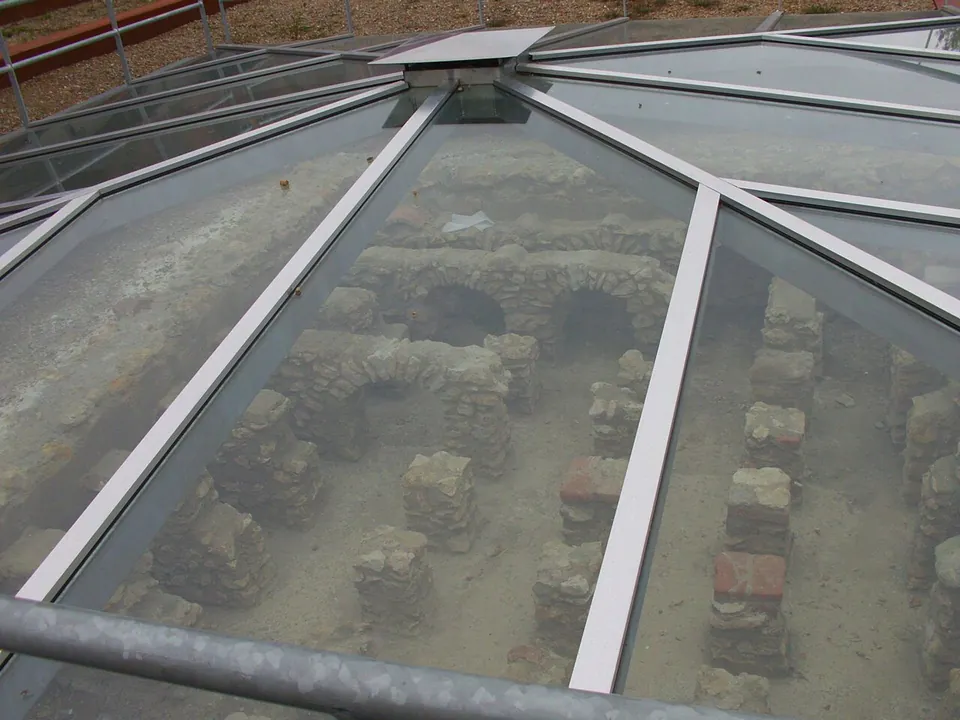
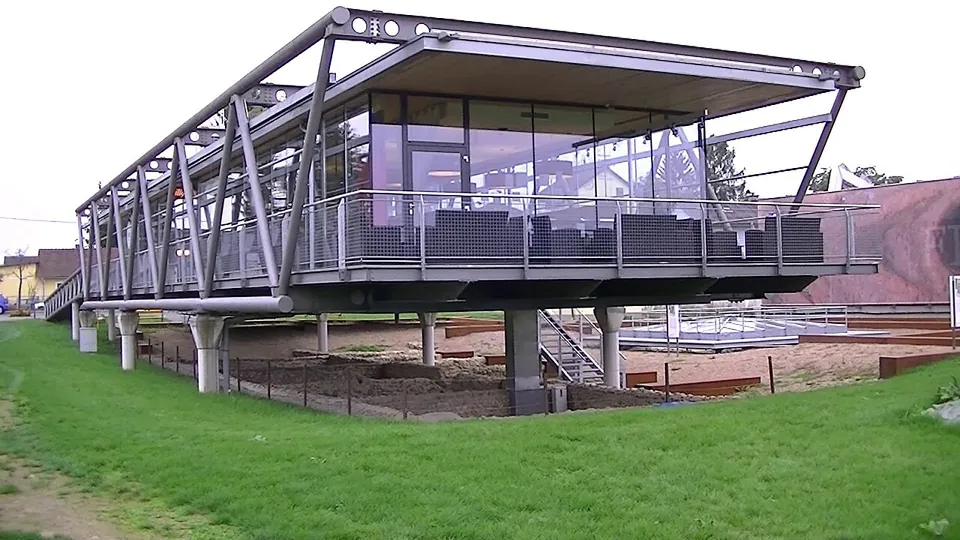
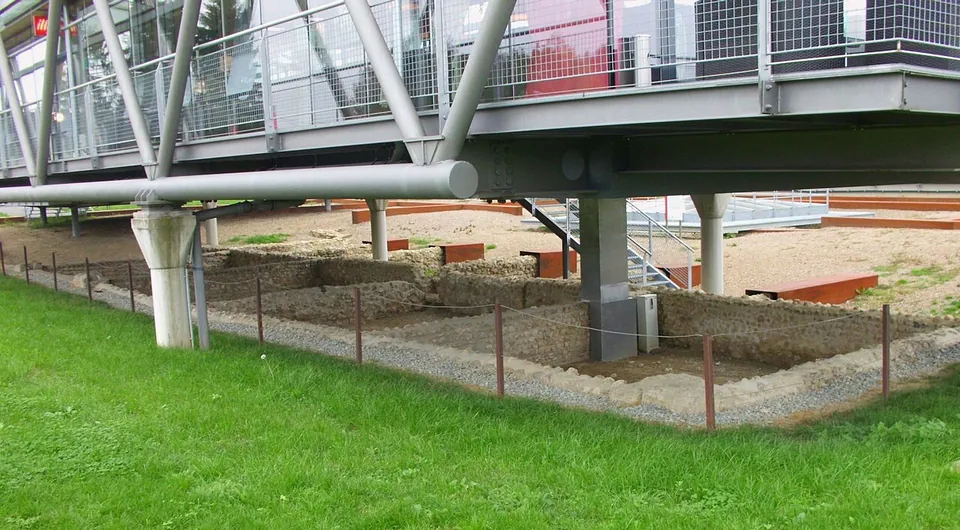
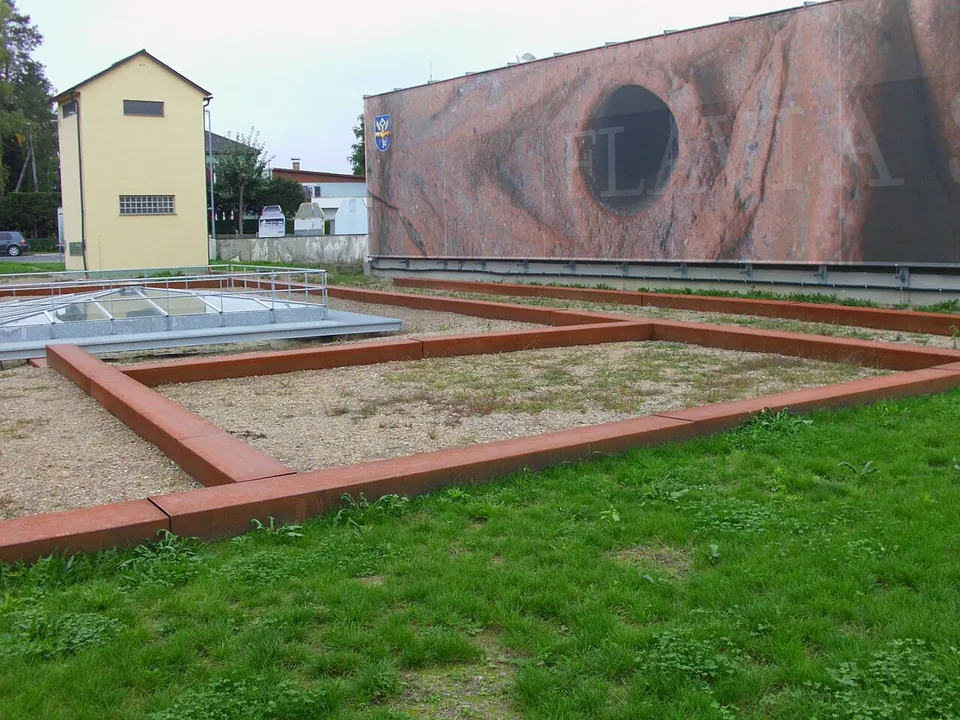
Flavia Solva was the only Roman town in what is now Styria, laid out as a planned town under Vespasian on the River Mur near Leibnitz. Little of it shows today: a few foundations of houses under a pavilion on stilts, the underfloor heating of a house under glass, and the outlines of walls marked out on the field. It is free and open at any hour.
What is there today
Only a few foundations are visible, on the edge of Wagna. They are built over by a pavilion on stilts, which houses a café and an ice-cream parlour, and can be viewed; the remains of the underfloor heating of a Roman house are protected from the weather and from vandalism by a glass roof, and metal edging on the excavation field traces the lines of walls and blocks of houses (de.wikipedia). The Joanneum calls the pavilion “a shop window into Roman times”: you walk round it and over the site, with information at several points (the operator). In the courtyard of Schloss Seggau near Leibnitz many Roman gravestones can be seen (de.wikipedia).
Of the town’s public buildings excavation has found only a long oval amphitheatre; the forum and the baths are thought to lie in insulae 25 and 26, and about 30 built-up insulae are known, with workshops north of the forum and spacious houses to the south (de.wikipedia).
Is it worth the trip?
Only as a short stop. It is free, it never closes, and it is the only Roman town in Styria, but what is visible amounts to some low foundations and a hypocaust under glass on the edge of a modern town. If you are driving south from Graz, it is worth half an hour; it is not worth a journey on its own.
Getting there
The site is at Marburgerstraße 111 in Wagna (the operator), about 40 km south of Graz (de.wikipedia). There is a car park about 40 m away and the bus stop “Kleinwagna” about 90 m (OpenStreetMap). The excavation field and the outside of the pavilion are open free of charge around the clock, every day of the year (Joanneum, read 5 October 2026).
Visiting details
- Opening hours
- Open at all times, all year - the excavation field and the outside of the pavilion.
- Tickets
- Free.
Hours and prices checked 5 October 2026 on the operator's own site. Confirm before travelling.
History
A first settlement was laid out here in the time of Augustus, in a region once thought to be the land of the Noric tribe of the Uperacii, and grew into a village of timber houses; in the reign of Claudius the people of the nearby hill settlement on the Frauenberg were probably moved down to it (de.wikipedia). Vespasian made it a town, Municipium Flavia Solva, named after his family, the Flavians, along with several Pannonian settlements that had stayed loyal in the year of the four emperors, 69; Solva was the old name of the river Sulm. The old settlement was levelled and rebuilt as a planned town on the Italian model, with stone buildings in the centre, and probably without a town wall (de.wikipedia).
A layer of burning from around 170 was long blamed on the Marcomannic Wars, but that reading is disputed and the fire affected only parts of the town; the population probably fell in those years with the plague. After 275 there was major rebuilding, and around 300 a revival brought houses with luxurious fittings; the town was lived in at least into the second half of the 4th century. By the early 5th century it was largely deserted, its people perhaps withdrawn to nearby hills such as the Frauenberg, though two lead seals of the emperor Marcian (450–457) show that some settlement went on (de.wikipedia).
More photographs
Nearby
45 km · temple · Ptuj
Mithraeum III of Ptuj
The foundations of the shrine, under a protective building, with its original fittings: altars, reliefs, cult images and scenes of the Mithras legend (heritage register).
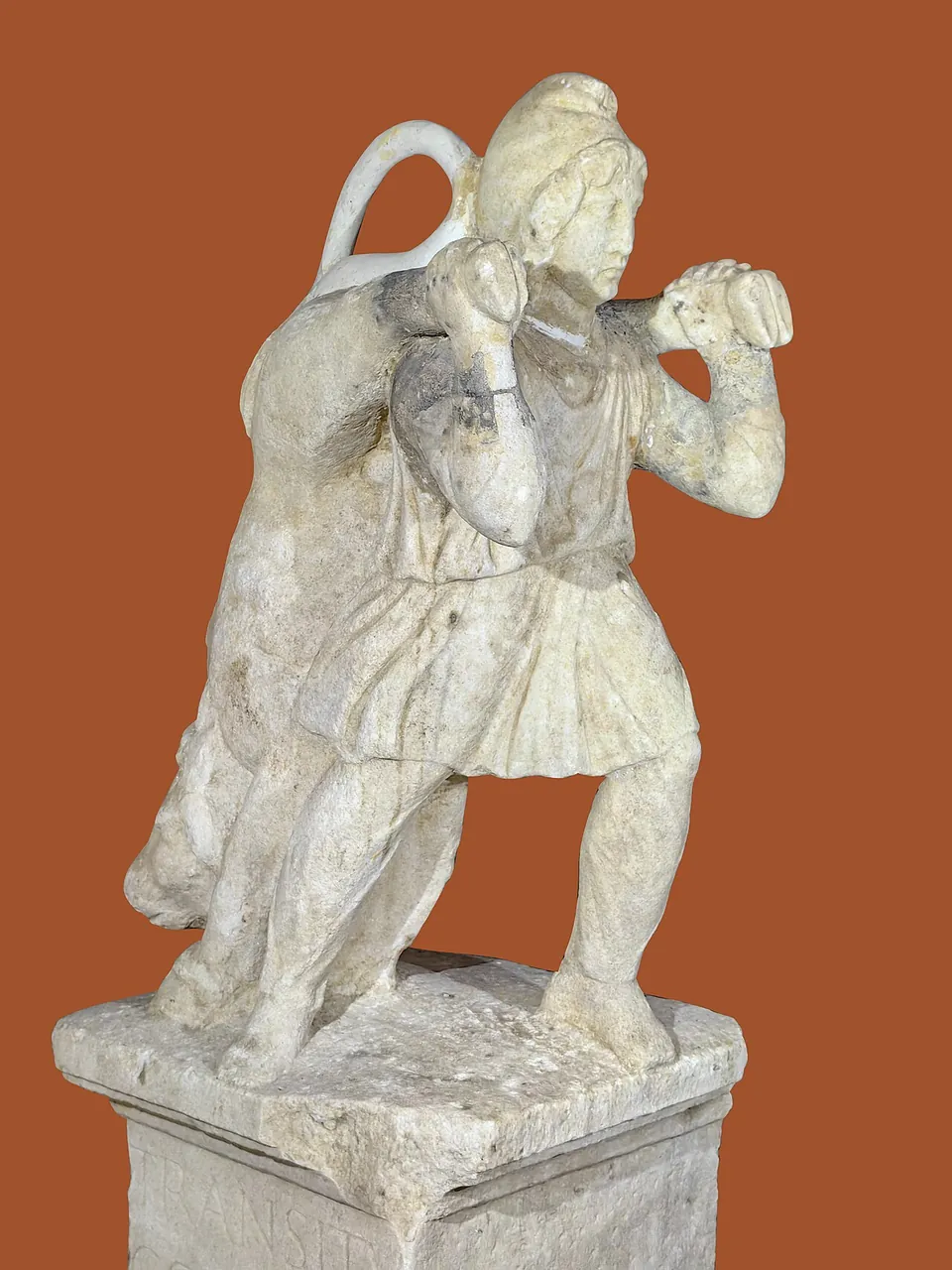
Photo: Primož Jakopin · CC BY 4.0 · Commons
45 km · temple · Hajdina
Mithraeum I of Ptuj
A protective building covers the foundations of the shrine, with its floors and its altars in place — the register lists altars to Mithras and to his torch-bearers Cautes and Cautopates.
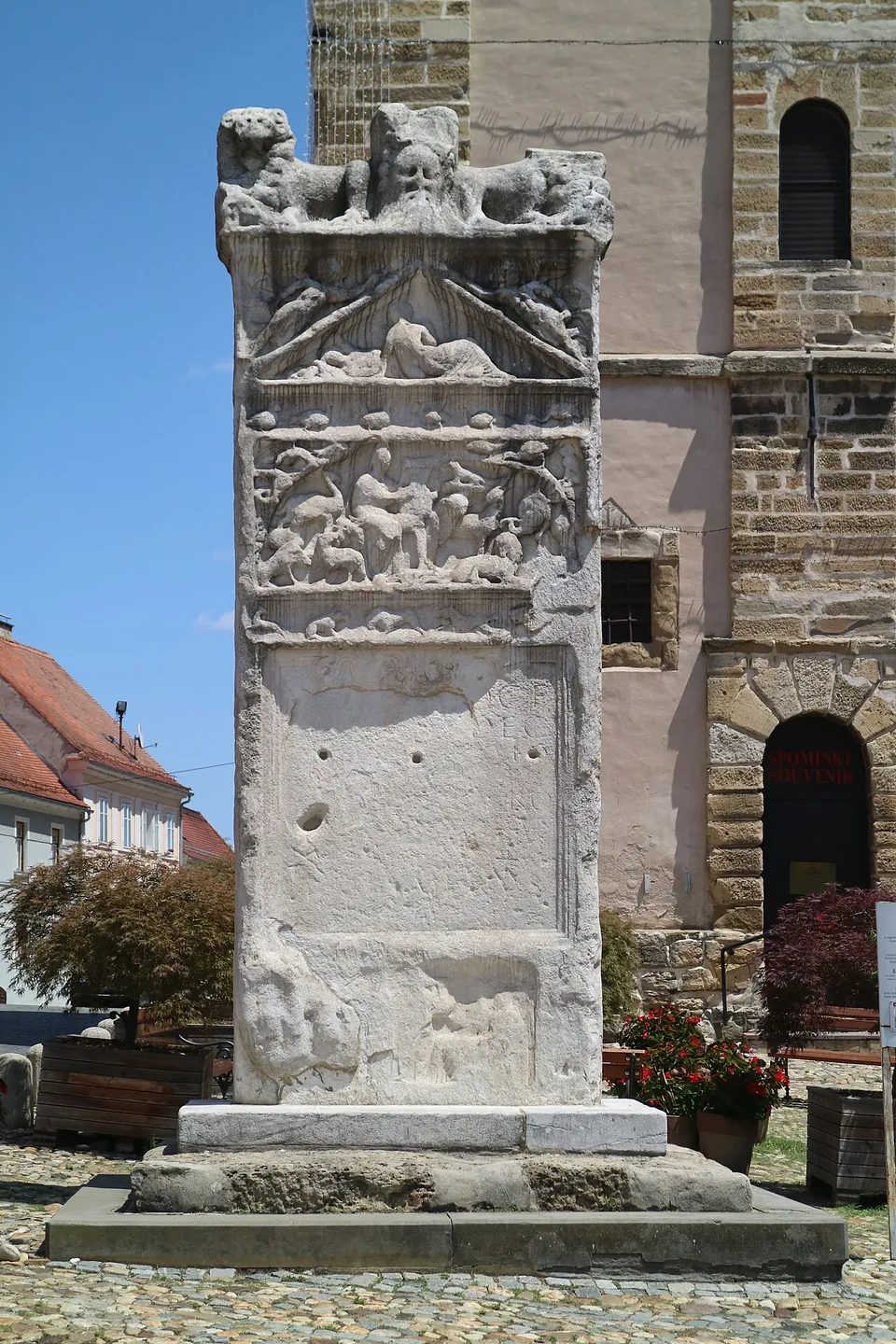
Photo: Clemens Stockner · CC BY-SA 4.0 · Commons
45 km · city · Ptuj
Poetovio – Ptuj
The Orpheus Monument stands on Slovenski trg in front of the Town Tower, where it has always stood: it is the oldest public monument in Slovenia still in its original place, and the largest known monument from the Roman province of Pannonia Superior (en.wikipedia).
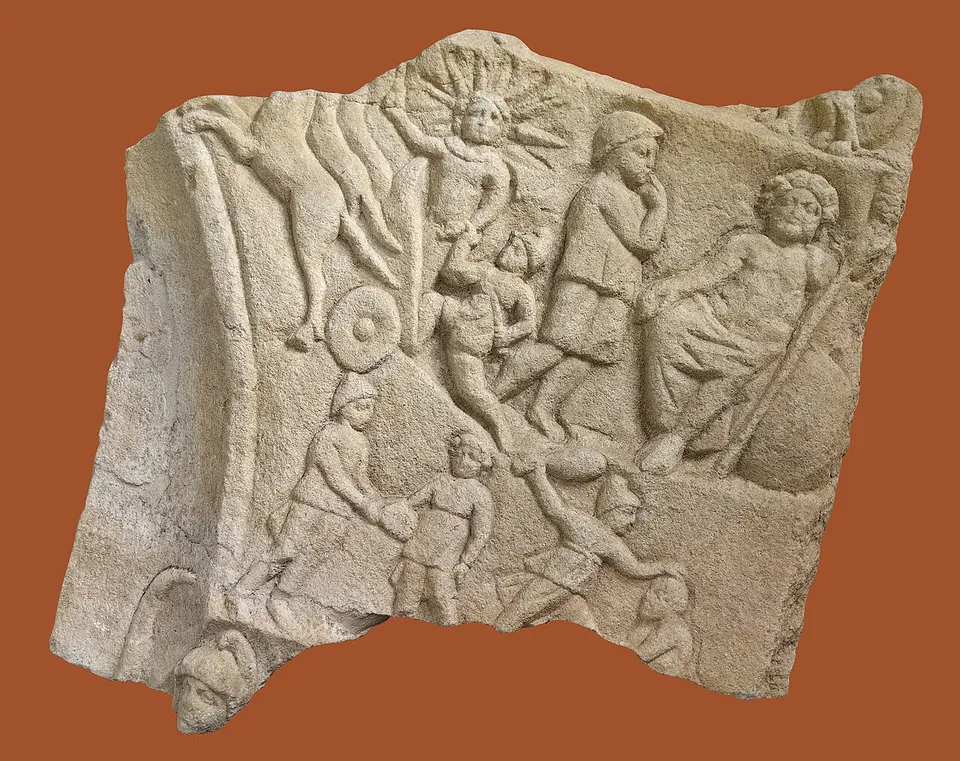


Straight-line distances.
Sources
Every fact on this page comes from the records below, each used under the licence noted.
| Source | Licence |
|---|---|
| Pleiades 197273 | CC BY |
| Wikidata Q201001 | CC0 |
| OpenStreetMap way/26930813 | ODbL |
| Pleiades — Flavia Solva amphitheatre | licence not recorded |
| Wikipedia (de) — Flavia Solva | CC BY-SA 4.0 |
| Wikipedia (en) — Flavia Solva | CC BY-SA 4.0 |
| Universalmuseum Joanneum — Flavia Solva (the operator) | licence not recorded |