

What is there today
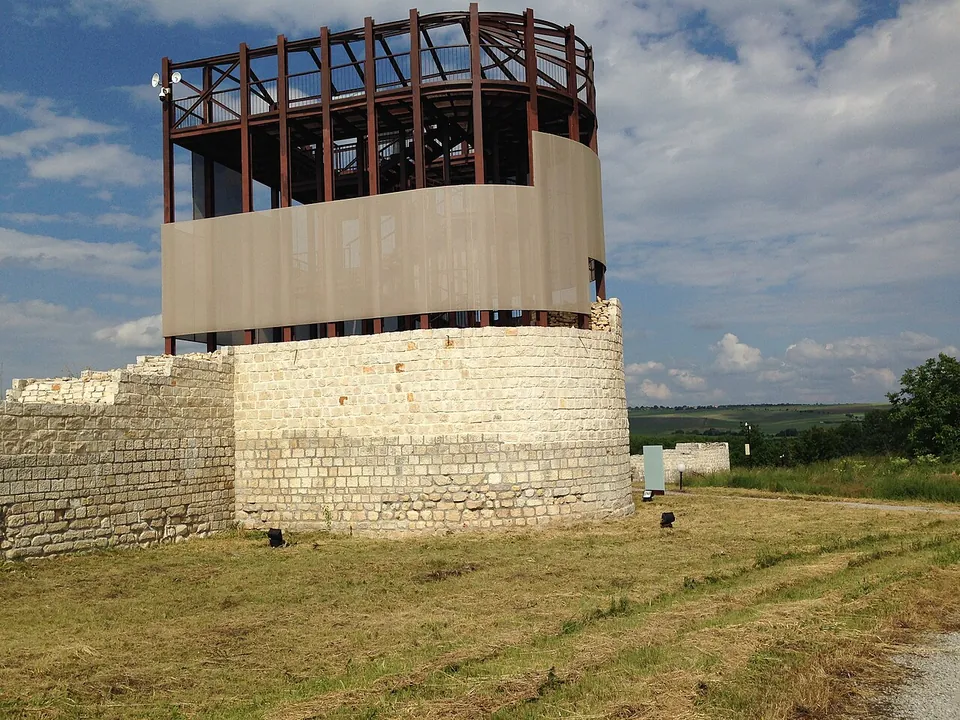
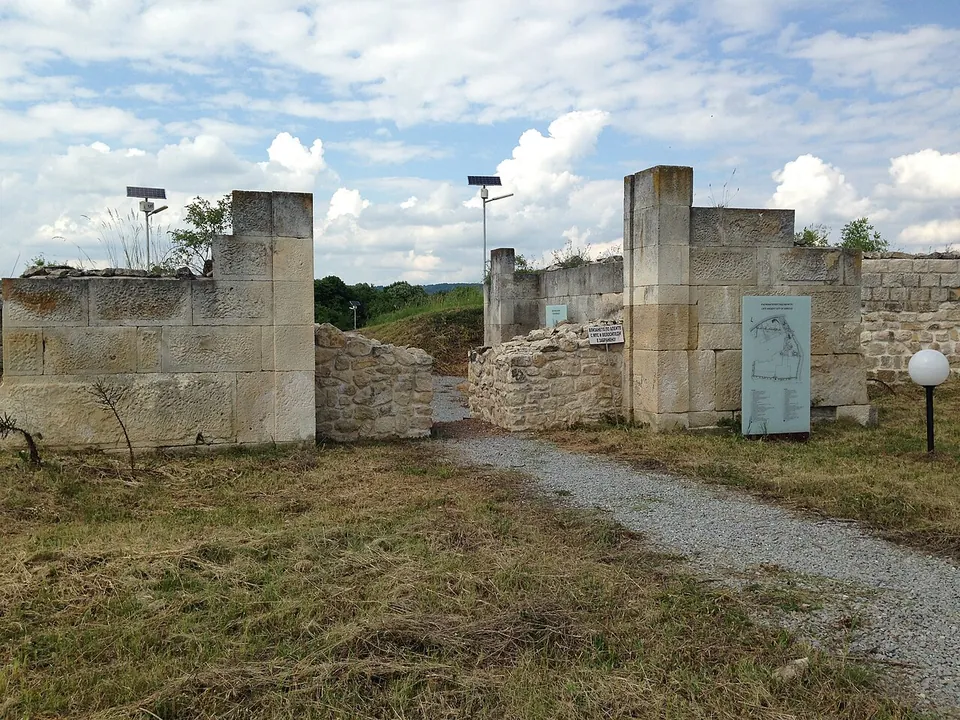
Under Constantine the Great, early in the 4th century, the town was enclosed by walls 1,400 m long and 2.10 to 3 m thick, with four gates and 35 towers, around 15 ha; with their battlements they rose to 12 m (the museum). A route leads round the walls, and modern metal structures built on some of the towers give a view over the whole fortress, the river that served as its moat and the hills around (the museum). The walls have been uncovered for most of their length, stand up to a few metres high, and have been restored and conserved (de.wikipedia).
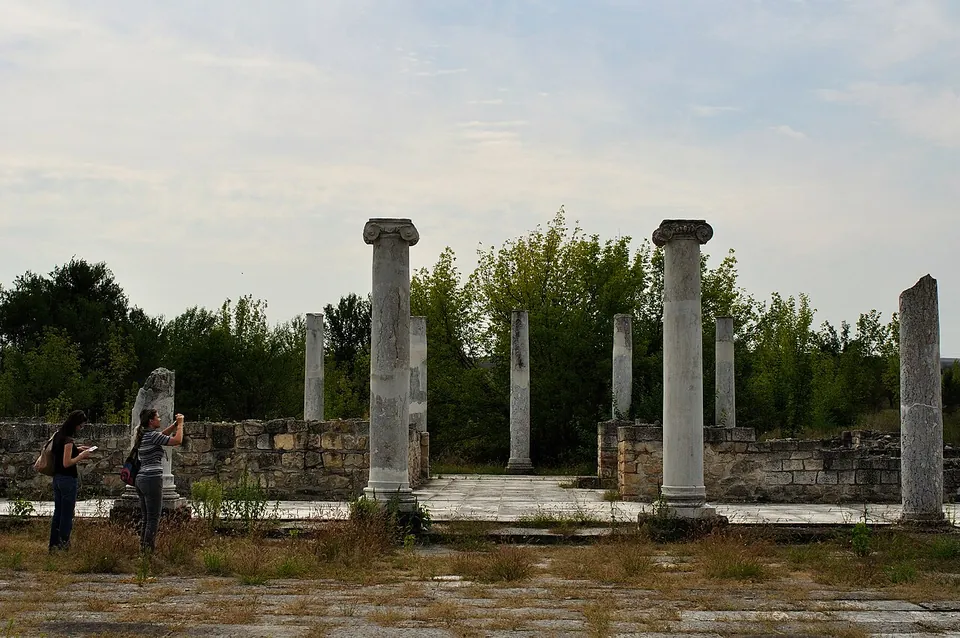
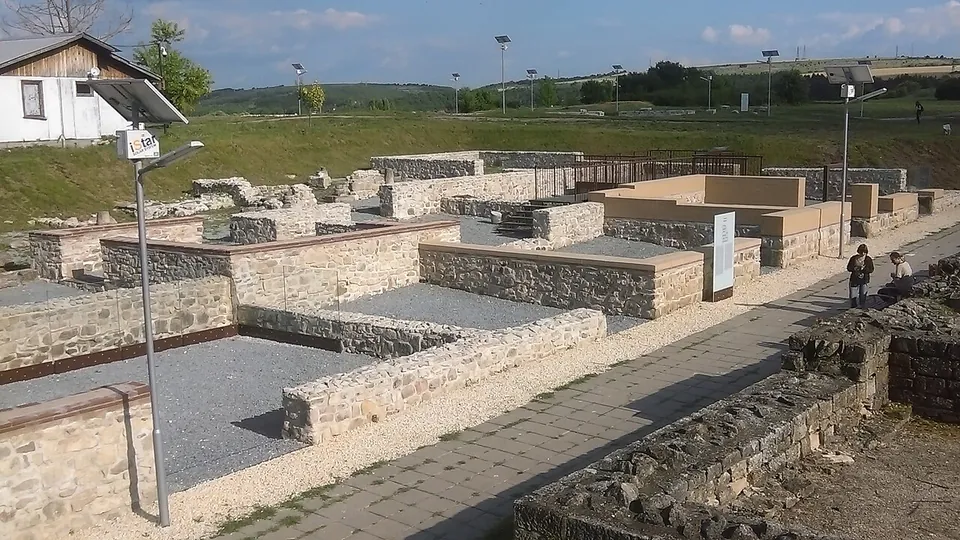
Inside, several houses and public buildings have been excavated. The largest, Building VII, is a 6th-century house of about 3,000 m² built round a colonnaded courtyard, with living rooms, shops and storerooms and columns in the Ionic style; next to it, a building with underfloor heating, probably first a bath, was later turned into a church with an apse. In the highest, eastern part of the town lies a large Christian complex, where a richly decorated basilica with three aisles was built in the 5th–6th century (the museum). Two open-air lapidaria show architectural pieces and votive and funerary monuments, and the museum on the site displays the finds, beside an interactive museum (the museum).
Is it worth the trip?
Yes, in north-eastern Bulgaria. It was the first Roman fortification in Bulgaria to be almost fully excavated and conserved (de.wikipedia), its circuit of walls and gates can be followed on the ground, and the museum is on the site. Part of the ancient town, in its central and western sections, lies under a pharmaceutical factory (de.wikipedia).
Getting there
The reserve is 2 km east of Razgrad, at 70 Aprilsko Vastanie Boulevard (the museum). A car park is mapped beside the museum, and a bus stop about 600 m from the excavations (OpenStreetMap).
From 1 April to 30 October the museum and the interactive museum are open daily, 09.30 to 18.00; from November to March, 09.00 to 17.00, with weekend visits for booked groups. A ticket for the archaeological museum is €3.07, or €1.02 for pupils, students and pensioners, and the interactive museum €5.11; a guided tour of the walls costs €10.23 per group in Bulgarian and €12.78 in another language (the museum, read 2 October 2026). The tariff gives no separate charge for walking the walls.
Visiting details
- Opening hours
- The museum and the interactive museum are open daily 09.30–18.00 from 1 April to 30 October, and 09.00–17.00 from 1 November to 31 March, with weekend visits in winter for groups of more than 10 booked in advance.
- Tickets
- Archaeological museum €3.07; €1.02 for pupils, students and pensioners; free under 7. Interactive museum €5.11; €2.56 for children over 7, pupils and pensioners. A guided tour of the walls is €10.23 per group in Bulgarian and €12.78 in another language. The tariff gives no separate charge for walking the walls.
- Parking
- A car park is mapped by the museum, about 330 m from the point (OSM way/266784019); a bus stop is mapped about 590 m away (OpenStreetMap).
- On foot
- About 4 min from the parking
Hours and prices checked 2 October 2026 on the operator's own site. Confirm before travelling.
History
Abritus grew up at the end of the 1st century AD over a Thracian settlement, on the roads from Odessos and Marcianopolis to Nicopolis ad Istrum and from there to Sexaginta Prista (the museum). A Roman military camp was built at the same time, and in the 2nd century the Cohors II Lucensium was stationed here (en.wikipedia). The town’s name is confirmed by three Latin inscriptions: an altar to Hercules found in 1954, a milestone found in 1980 and an altar of the reign of Elagabalus found in 2008 (the museum).
In the summer of 251, in a great battle not far from the town, the Goths defeated the Roman army, and the emperor Trajan Decius and his elder son and co-emperor Herennius Etruscus were killed (the museum); en.wikipedia places the battlefield about 15 km north-west of Abritus. After Constantine’s walls were built the town was an important military, administrative and religious centre, and in the 5th–6th centuries one of the largest towns of its province and the seat of a bishop (the museum). The Goths sacked it in 376–378 and the Huns in 447, and it was finally destroyed in the Avar invasion of 586 (the museum). A Bulgarian fortress was built on the ruins at the end of the 9th century and lasted until the 11th (the museum).
The largest late Roman hoard of gold coins found in Bulgaria, 835 coins weighing about 4 kg, was found inside the eastern wall (en.wikipedia; de.wikipedia).
More photographs

Sources
Every fact on this page comes from the records below, each used under the licence noted.
| Source | Licence |
|---|---|
| Pleiades 216688 | CC BY |
| Wikidata Q331488 | CC0 |
| OpenStreetMap node/2411178847 | ODbL |
| Regional Historical Museum Razgrad — Abritus Archaeological Reserve | licence not recorded |
| Regional Historical Museum Razgrad — routes in Abritus | licence not recorded |
| Regional Historical Museum Razgrad — ticket prices | licence not recorded |
| Regional Historical Museum Razgrad — contacts and opening hours | licence not recorded |
| Wikipedia (en) — Abritus | CC BY-SA 4.0 |
| Wikipedia (bg) — Абритус | CC BY-SA 4.0 |
| Wikipedia (de) — Binnenkastell Abrittus | CC BY-SA 4.0 |