

What is there today
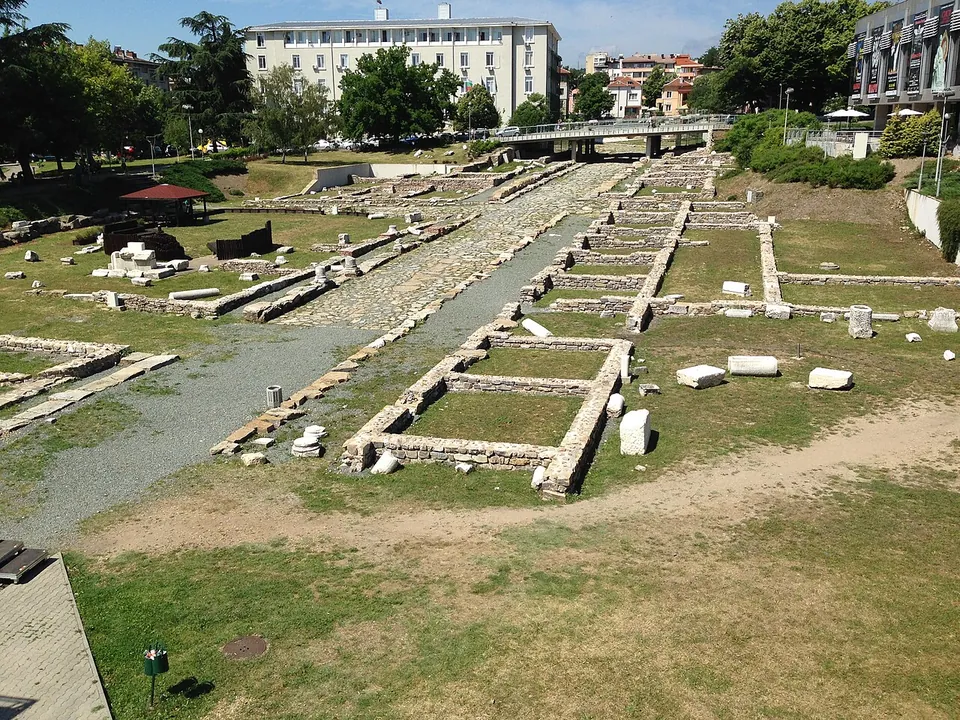
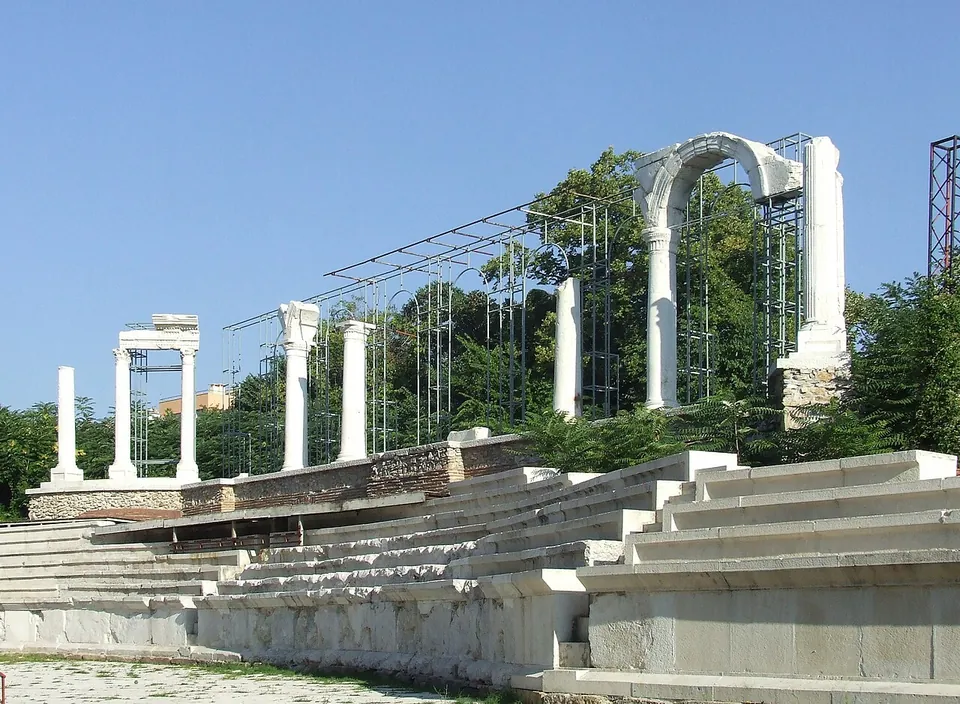
The forum complex covers about 0.7 ha. On its west side stands the western gate, 4.20 m wide, with three doors: two portcullises, whose grooves survive, and a double-leaf door. Beside it run parts of both city walls, the inner one built at the end of the 2nd century and the outer one at the end of the 5th or the start of the 6th (the museum; bg.wikipedia). The semicircular stone square keeps the base of an imperial equestrian statue, and north of it rises an auditorium of nine rows of stone seats, topped by a colonnade with arches. Behind it are the south front of the city baths, built in the middle of the 2nd century, with their original hypocaust heating, and the main street, the decumanus maximus, running east past the remains of 36 shops (the museum; bg.wikipedia).
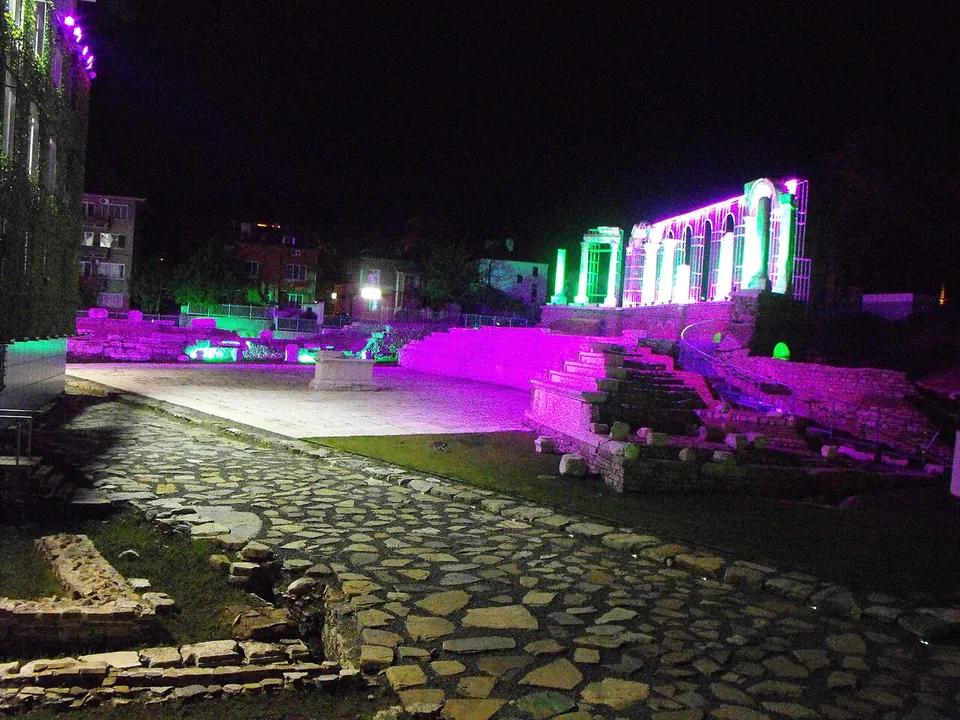
Restoration went on until 2014, and the complex is now a stage for the Stara Zagora opera and for concerts and festivals, with a stand for the audience (bg.wikipedia; the museum). The museum also shows a late Roman mosaic of the 4th century from a private house in the town (the museum).
Is it worth the trip?
Worth arranging if you are in Stara Zagora. The gate, the seating and the street lie in the open in the city centre, and the restored colonnade gives the square a shape you can read. But it is a complex of foundations and re-erected pieces rather than standing buildings, and visits have to be booked through the museum, so it is not a place to drop in on.
Getting there
The forum complex is at bul. Mitropolit Metodiy Kusev 33, next to the courthouse (the museum). A paid car park for 15 cars is mapped about 100 m away and the Maxim Gorki High School bus stops about 220 m away (OpenStreetMap).
Visits are by prior arrangement, made in person at the Regional Historical Museum or by telephone on 042/919-214 (the museum, read 1 October 2026). The museum’s price list gives no entry fee for the forum. Its own exhibition costs €3.50 for adults, and the 4th-century mosaic €2.00.
Visiting details
- Opening hours
- By prior arrangement only, made in person at the Regional Historical Museum or by telephone on 042/919-214.
- Tickets
- The museum's price list gives no entry fee for the forum complex.
- Parking
- A paid car park for 15 cars is mapped about 100 m away (OSM way/300840975, fee=yes); the nearest bus stops, Maxim Gorki High School, are about 220 m away (OpenStreetMap).
Before you go
- The forum complex is also an open-air stage for the Stara Zagora opera, concerts and festivals (the museum).
Hours and prices checked 1 October 2026 on the operator's own site. Confirm before travelling.
History
In 106 Trajan gave the town of Beroe self-government and renamed it Augusta Traiana. With Philippopolis it was one of the two great cities of Roman Thrace: Ammianus Marcellinus wrote that “the great cities of Philippopolis and Augusta Traiana, which in antiquity were called Eumolpias and Beroe, adorn the province of Thrace” (bg.wikipedia). Under Marcus Aurelius it was laid out with straight streets and dozens of houses and public buildings, inside walls enclosing about 50 ha and strengthened with some 40 towers, with water supply and sewers, a theatre, temples, markets, an odeon, baths and the forum. It struck its own coins from 161 until the reign of Gallienus (bg.wikipedia).
The Goths defeated a Roman army at Beroe in 250 (en.wikipedia). The city was last called Augusta Traiana in a law of the emperors Valens, Gratian and Valentinian II dated 25 September 378, kept in the Theodosian Code (bg.wikipedia). At the end of the 6th century it was destroyed, and it was rebuilt as Veroia (en.wikipedia).
Sources
Every fact on this page comes from the records below, each used under the licence noted.
| Source | Licence |
|---|---|
| Pleiades 216731 | CC BY |
| Wikidata Q11909204 | CC0 |
| Vici.org 17401 | CC BY-SA (text), CC0 (metadata) |
| OpenStreetMap way/954856693 | ODbL |
| Pleiades — Ancient forum of Beroe/Augusta Traiana | licence not recorded |
| Wikipedia (bg) — Августа Траяна | CC BY-SA 4.0 |
| Wikipedia (bg) — Форум на Августа Траяна | CC BY-SA 4.0 |
| Wikipedia (en) — Stara Zagora | CC BY-SA 4.0 |
| Regional Historical Museum, Stara Zagora — Antique forum complex | licence not recorded |
| Regional Historical Museum, Stara Zagora — price list | licence not recorded |