

What is there today
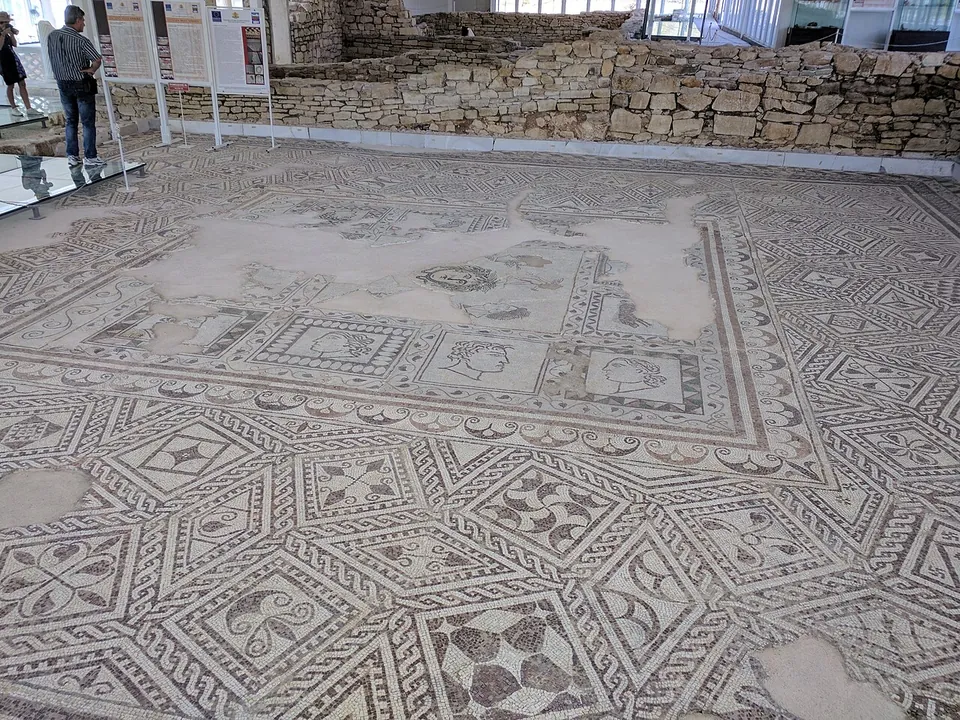
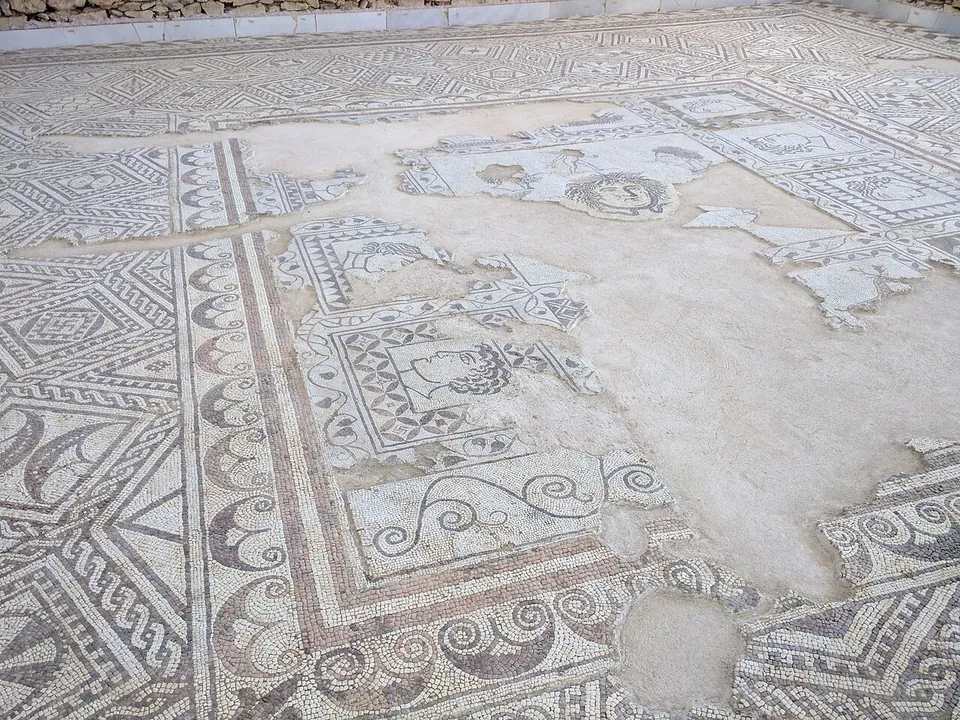
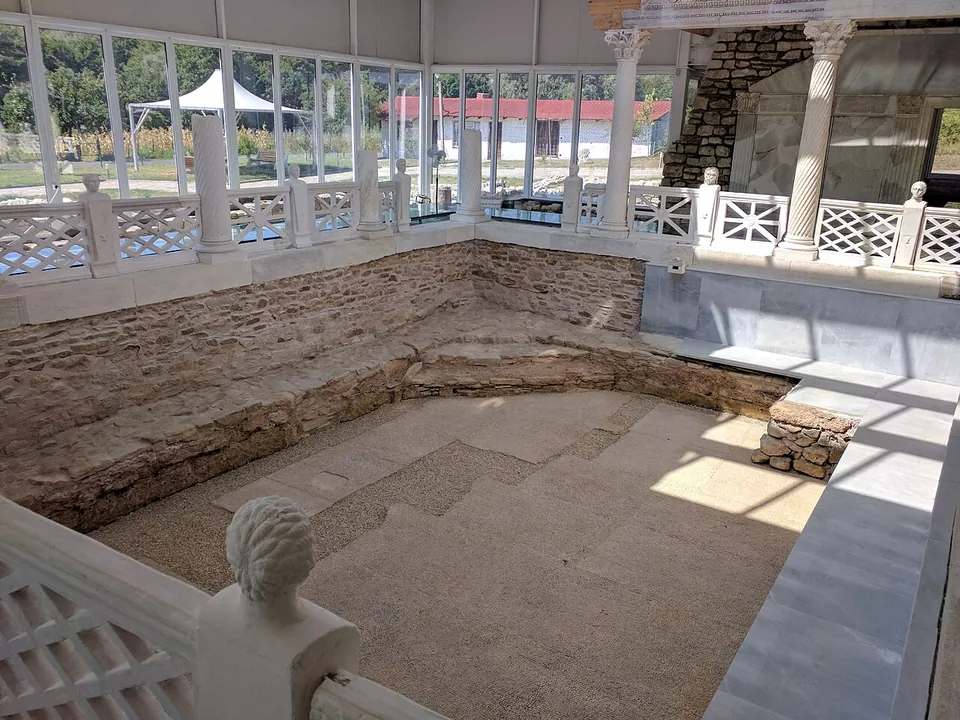
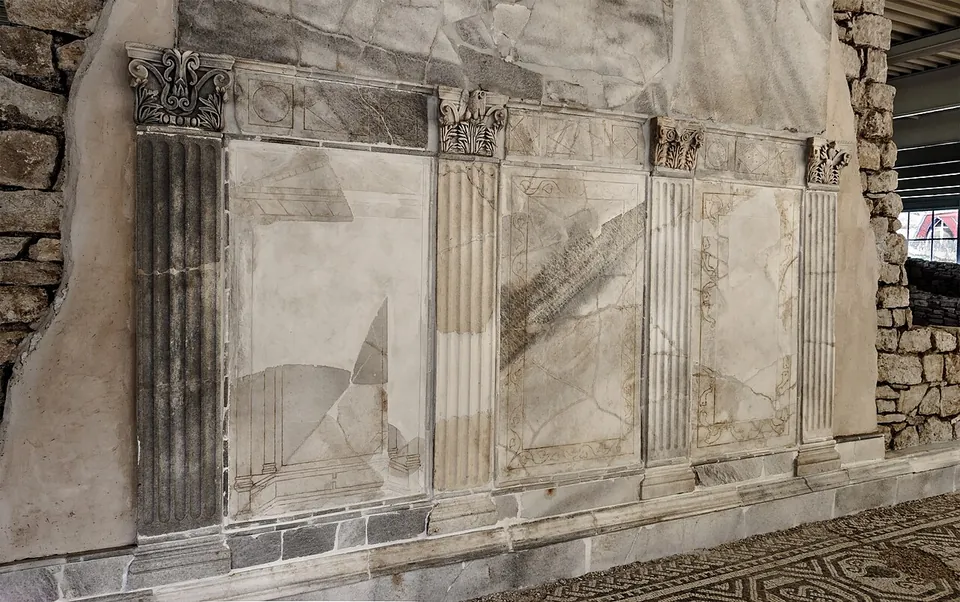
The villa is shown where it was found, with many of its floor mosaics still in place (en.wikipedia), under a modern roof (bg.wikipedia). It was a two-storey, U-shaped house; its living quarters, 978 m², are arranged round a large courtyard with a colonnade and, in the middle, a pool 11 m by 7 m and almost 2 m deep, once enclosed by openwork marble parapets; marble herms were found as well (de.wikipedia; bg.wikipedia). The ground floor alone had 22 rooms, and its walls were faced with elaborately decorated white marble (en.wikipedia).
The mosaics carry geometric, plant and animal designs, and the gorgon Medusa is a recurring theme. The portraits of the 2nd-century owner and his two children — the only Roman mosaic portraits found in Bulgaria — are not here but in the National Historical Museum in Sofia (en.wikipedia). Much of the marble was stolen around 1990 and smuggled abroad, one herm surfacing at Sotheby’s in London; almost all of it has since been returned to the site (bg.wikipedia).
Is it worth the trip?
Yes, if you can get here. Its mosaics are the largest find of their kind in Bulgaria (de.wikipedia), left in the house they decorated, and the marble gives a sense of how the rooms looked. The catch is the journey: it is near the Greek border, with no public transport mapped nearby, and the mosaic portraits are in Sofia, not here.
Getting there
The villa lies a few kilometres south-west of Ivaylovgrad, in Haskovo Province; published distances range from 1.5 km, measured from the town’s Ladzha quarter, to 4 km (en, de and bg.wikipedia). Car parks are mapped about 80 m and 120 m from it (OpenStreetMap). It reopened in the summer of 2024 after its roof and visitor facilities were renovated (bg.wikipedia).
It is open daily, 09.00 to 18.00 (the operator, the Municipal Historical Museum of Ivaylovgrad, read 1 October 2026). Neither the operator’s site nor the municipality’s ticketing page gives an admission price.
Visiting details
- Opening hours
- Daily 09.00–18.00.
- Tickets
- Not published. Neither the operator's site nor the municipality's page on its ticketing platform gives a price (searched 1 October 2026).
- Parking
- Car parks are mapped about 80 m and 120 m from the villa (OSM way/261064951 and way/261064932).
Before you go
- No bus stop is mapped near the villa; you will need a car.
Hours and prices checked 1 October 2026 on the operator's own site. Confirm before travelling.
History
The villa was built between AD 50 and 70, shortly after Thrace became a Roman province, for a Thracian noble in Roman service who was probably the governor of the surrounding area. At the start of the 2nd century a workshop for its marble was set up on the site, using white marble quarried nearby and stonemasons brought from Aphrodisias in Asia Minor, a city known for its school of sculpture. In the 3rd century the house was extended to the east with a dining hall of 11.70 m by 10.90 m and underfloor heating (de.wikipedia).
It was lived in until the late 4th century and burned in the devastation of the country around Adrianople, 40 km to the east, in 378, the year the Goths defeated the emperor Valens there. The wounded emperor is said to have been carried by his soldiers to a villa near the battlefield, which the Goths then took and burned, killing him; some writers suggest it was this one (en, de and bg.wikipedia).
Workers building a small dam found the villa in 1964, and the dam was abandoned in its favour. Excavations continued until 1980 (bg.wikipedia). It was partly re-erected by anastylosis with EU funds and opened to visitors in 2008 (en and de.wikipedia). A large burial mound at Svirachi, about 2.3 km to the south-east, is thought to have been the family tomb of its owners (de.wikipedia).
More photographs

Sources
Every fact on this page comes from the records below, each used under the licence noted.
| Source | Licence |
|---|---|
| Pleiades 501360 | CC BY |
| Wikidata Q1892609 | CC0 |
| OpenStreetMap way/1374973663 | ODbL |
| Wikipedia (en) — Villa Armira | CC BY-SA 4.0 |
| Wikipedia (de) — Villa Armira | CC BY-SA 4.0 |
| Wikipedia (bg) — Вила Армира | CC BY-SA 4.0 |
| Wikipedia (it) — Villa Armira | CC BY-SA 4.0 |
| Villa Armira, run by the Municipal Historical Museum of Ivaylovgrad — opening hours | licence not recorded |