

What is there today
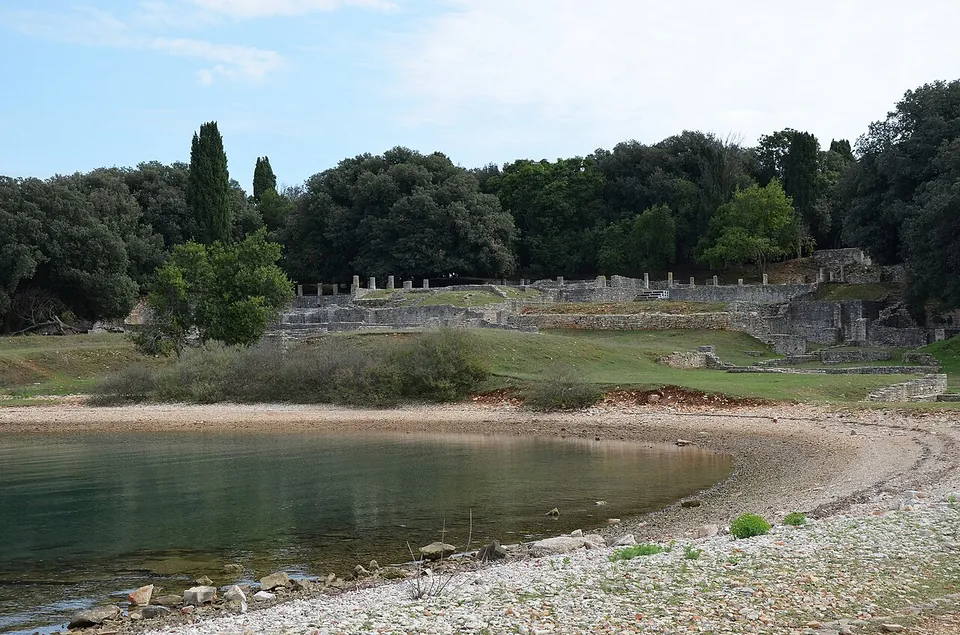
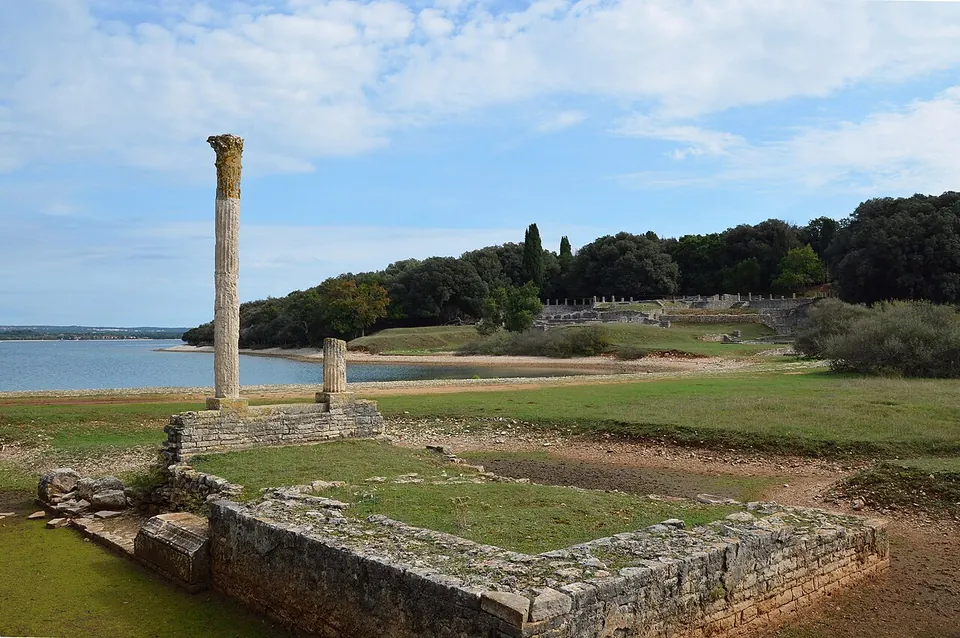
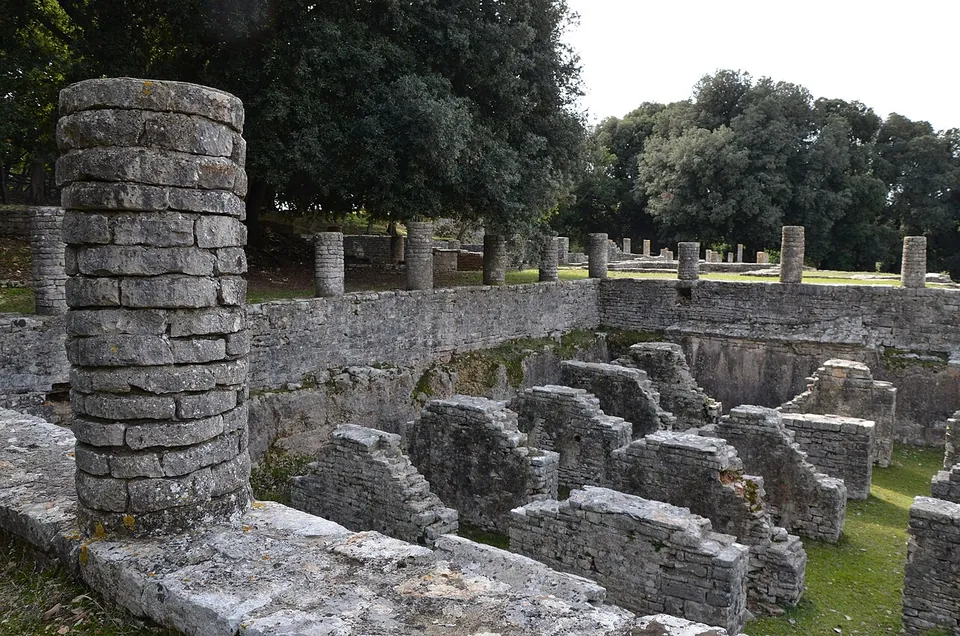
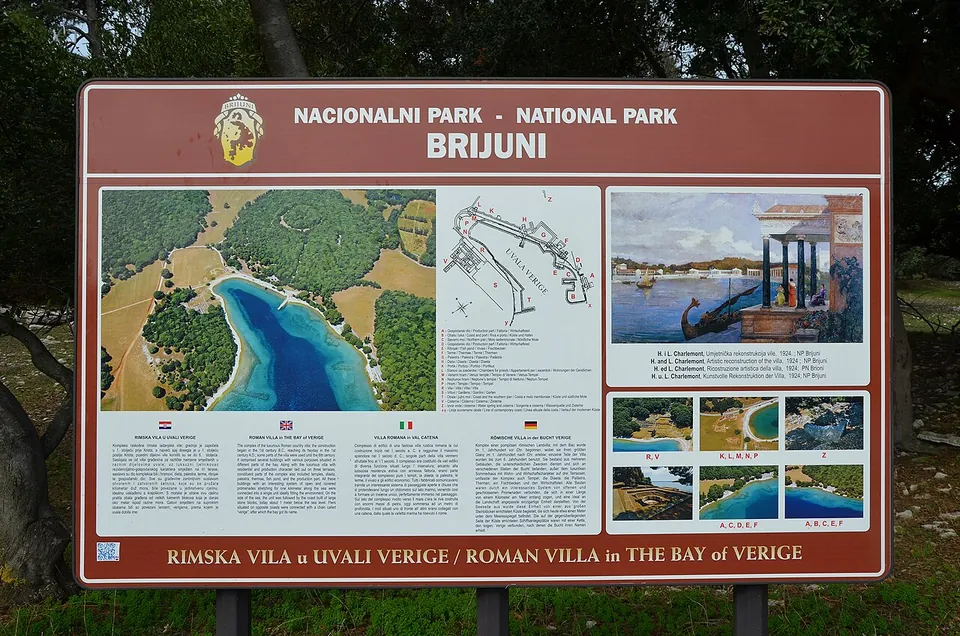
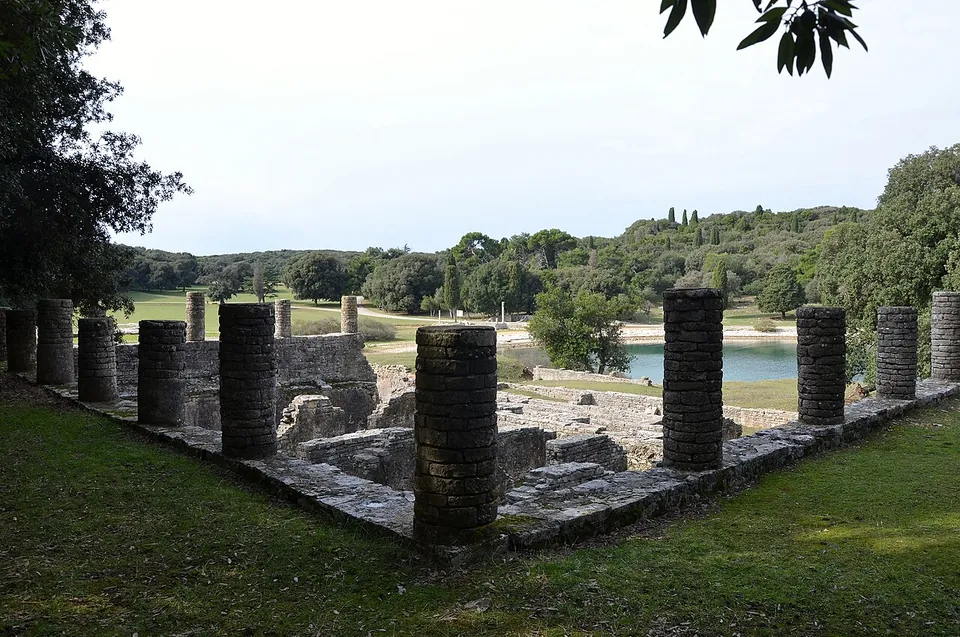
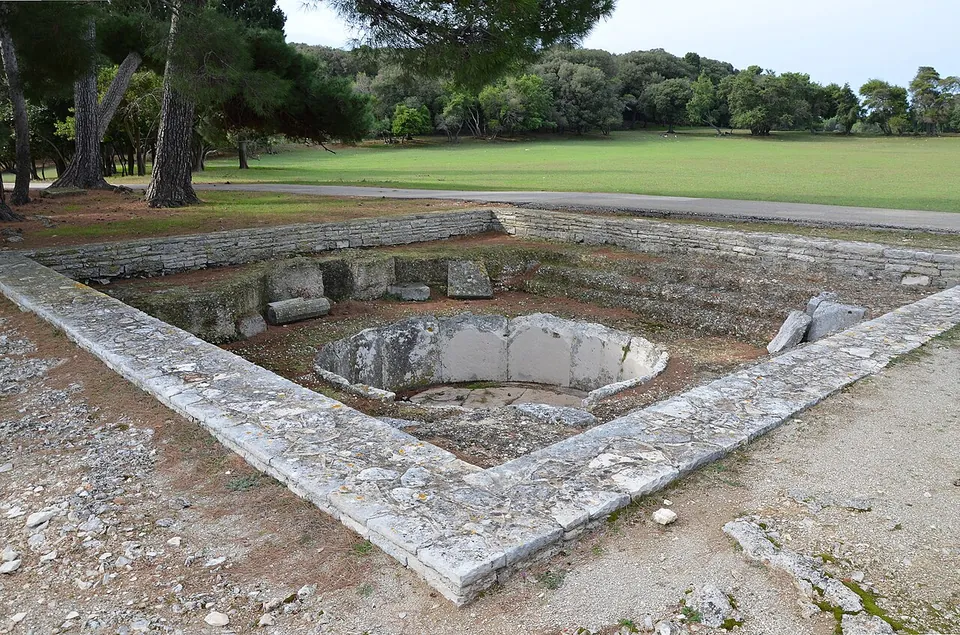
The villa was never one building but several, placed around the bay (the operator), and that is how it reads on the ground: walls standing several courses high on stepped terraces, rows of column shafts around open courts, a temple platform with one tall column standing at the end of the bay, and baths with a round basin sunk into the floor of one room (Commons photographs, 2013–2014). A board at the site carries a plan of the complex and an artist’s reconstruction of 1924.
Some of it is under water. On the seaward side the complex was edged by a shore built up of large stone blocks that now lies about 1 m below the surface, and in summer the park runs a guided 500 m snorkelling trail over the remains in the bay. Part of the villa’s original mosaic is kept in the 15th-century church of St German, which the park’s standard excursion visits (the operator).
Is it worth the trip?
You cannot visit the villa on its own: it lies inside a national park reached only on the park’s boat, so the real question is whether half a day on Brijuni is worth it. For anyone curious about Rome, the villa is a good reason to say yes — a seaside estate whose temples, baths and terraces you can walk between, with the bay still in front of them.
Choose the ticket carefully, though. The standard guided excursion is built around a one-hour tourist-train ride, and it passes the villa on the train: “another glimpse into the distant past” before the next stop (the operator). To walk among the ruins, buy the cheaper self-guided Brijuni Pocket Guide ticket and walk there: the villa is about 900 m south-east of the boat landing as the crow flies (OpenStreetMap). The park’s premium tour by electric car (€200–250 a person) and its archaeological tour (on request) both stop at Verige Bay.
Getting there
Boats to Veliki Brijun leave from the jetty in the centre of Fažana and take about 15 minutes (the operator). Buy tickets online at shop.np-brijuni.hr or at the park’s office at Brionska 10, next to the pier. A ticket is for one departure and cannot be changed or refunded, and the park advises buying in advance. Boats leave Fažana at 09.00 and 11.30 from November to March and roughly hourly from 09.00 into the evening from April to October; in winter the last boat back is at 16.00. Day visitors are admitted every day except in January and February, when only pre-booked groups go.
The guided excursion costs €35 for adults from October to May and €50 from June to September. The self-guided Pocket Guide ticket, which includes the return boat, the Safari Park and the museum exhibitions but not the train, is €30 and €40. Students and over-65s pay €30 / €40 guided and €25 / €30 self-guided, children aged 7 to 18 pay €15 / €20 and €13 / €15, and under-sevens go free (the operator’s 2026 price list, read 3 October 2026 — check before travelling). Bicycles and electric cars can be hired at the sports centre in the harbour, and there are no shops or ATMs on the island.
The snorkelling trail runs from June to September on Mondays, Wednesdays and Fridays: a 45-minute guided swim for €56, park admission and the boat included (€35 for children aged 7 to 14), booked at least 48 hours ahead.
Visiting details
- Opening hours
- Day visitors every day except in January and February, when only pre-booked groups go. Boats leave Fažana at 09.00 and 11.30 from November to March, and roughly hourly from 09.00 into the evening from April to October; in winter the last boat back is at 16.00. You board the departure printed on your ticket.
- Tickets
- Guided excursion (boat, guide, tourist train, Safari Park, exhibitions) €35 for adults from October to May, €50 from June to September; students and over-65s €30 / €40; children 7–18 €15 / €20. Self-guided Brijuni Pocket Guide ticket (boat, Safari Park and exhibitions, no train) €30 / €40; students and over-65s €25 / €30; children 7–18 €13 / €15. Under 7 free. The premium electric-car tour, which stops at Verige Bay, is €200 a person (€250 June to September).
Before you go
- The standard guided excursion shows the villa only from the tourist train. To walk round it, take the self-guided Pocket Guide ticket, or book the premium or archaeological tour.
- Tickets are for one departure and cannot be changed or refunded; the park advises buying in advance.
- There are no shops or ATMs on the island.
Hours and prices checked 3 October 2026 on the operator's own site. Confirm before travelling.
History
Building began in the 1st century BC, the villa was at its most splendid in the 1st century AD, and parts of it stayed in use until the 6th century (the operator; Pleiades). The Romans called the Brijuni islands Pullariae (Pleiades).
The park describes the complex as several buildings set around the bay. On the southern shore stood a luxurious summer residence that also served the estate’s production, with two peristyles and laid out on three terraces. At the end of the bay were temples to Neptune, the Capitoline Triad and Venus. On the northern shore were the baths, a palaestra, a diaeta, a fishpond and the working part of the estate. Open and covered promenades running for a kilometre along the sea joined it all together, and the rooms were finished with mosaics, frescoes, stucco and precious marble (the operator; the board at the site). Piers on opposite sides of the bay were linked by a chain that controlled entry to the harbour — verige in Croatian, which gave the bay its name.
Verige was not the only Roman villa on the islands. The park counts several more, most of them working estates, among them one on Kolci hill, and the Byzantine castrum in Dobrika Bay grew out of a villa first built there in the 1st century BC (the operator). The Verige villa is on the Roman Emperors’ Route, a cultural route certified by the Council of Europe (the operator).
More photographs



Nearby
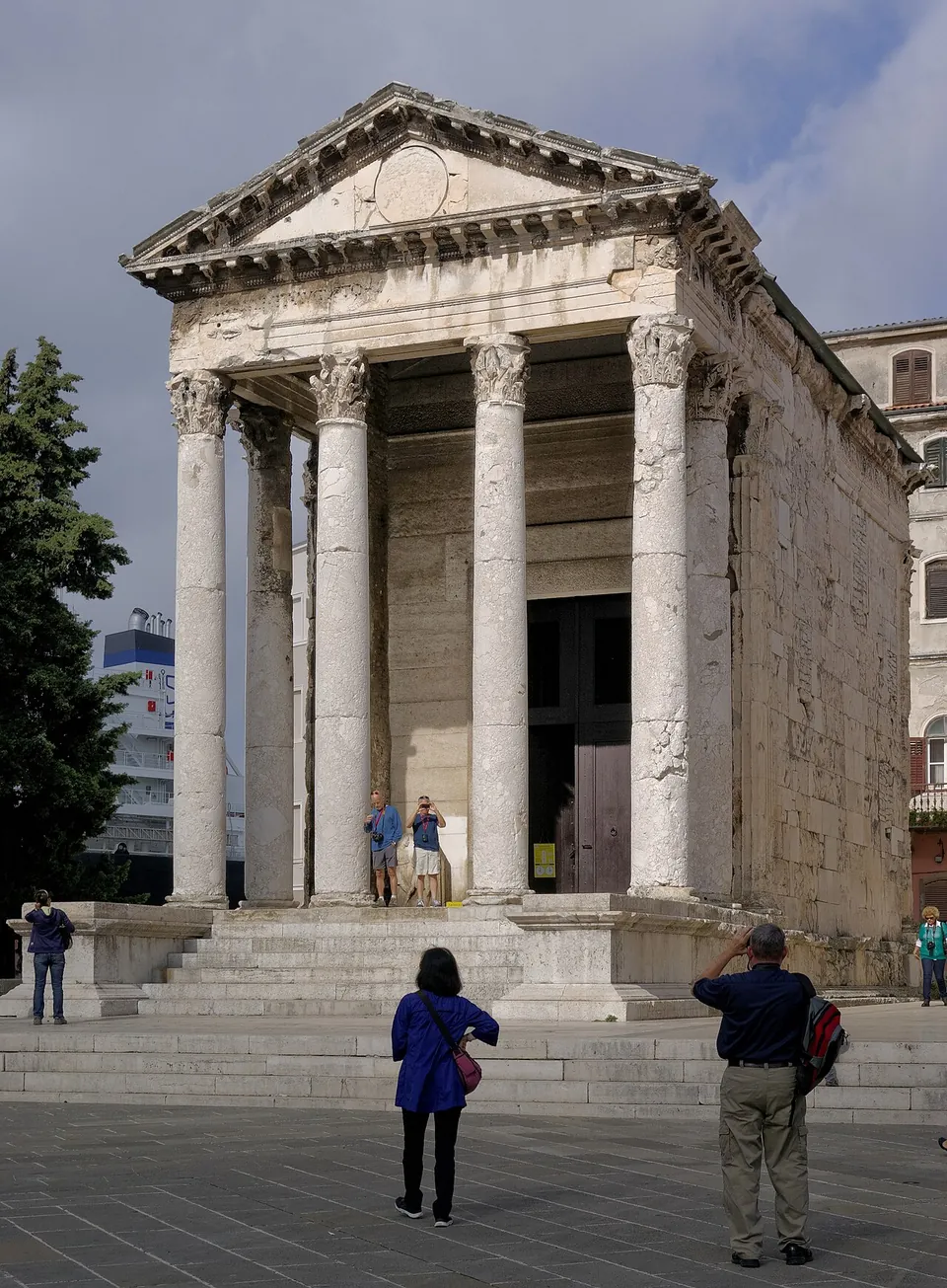
Photo: Berthold Werner · CC BY-SA 3.0 · Commons
7 km · temple · Istria County
Temple of Augustus
The temple is about 13 m high, 8.5 m wide and 17.65 m long: a closed shrine behind a porch of six Corinthian columns, four of them across the front.
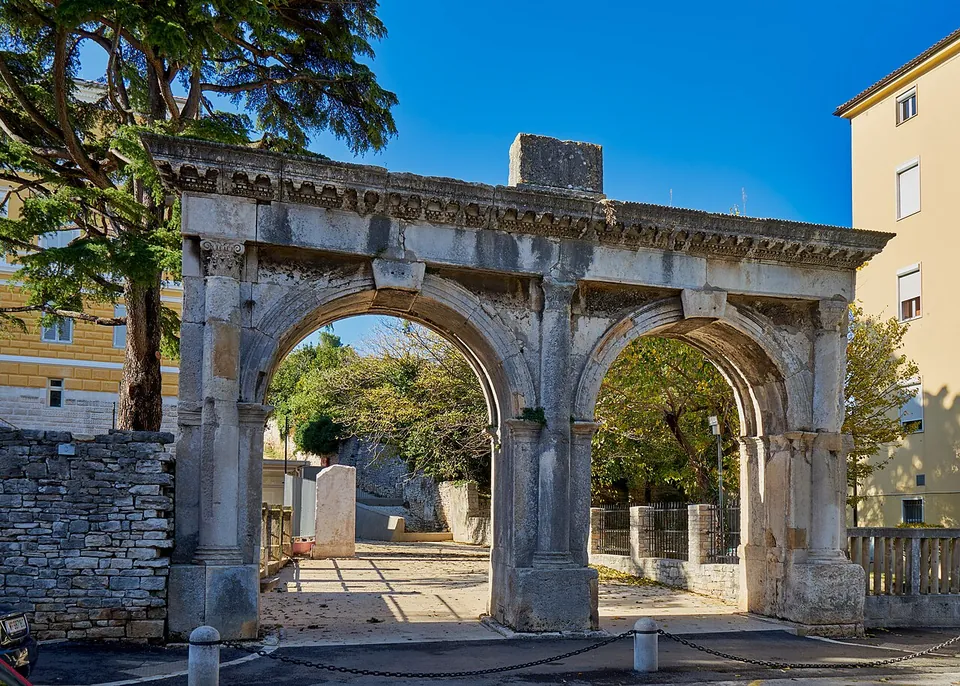
Photo: Georg Karl Ell · CC BY-SA 4.0 · Commons
7 km · city · Istria County
Pola – Pula
The stops each have their own page: the Pula Arena, the amphitheatre; the Temple of Augustus on the forum; the Arch of the Sergii at the end of the main street; and the Small Roman Theatre on the slope of the central hill.
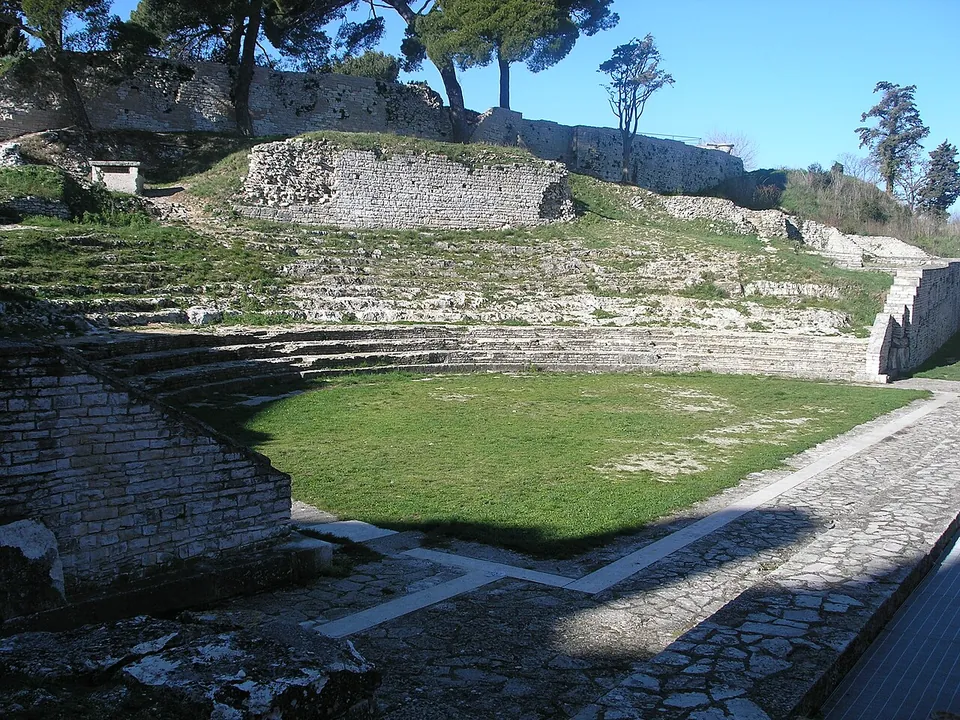
Photo: Orlovic · CC BY-SA 4.0 · Commons
7 km · theatre · Istria County
Small Roman Theatre, Pula
The foundations of the stage building and the semicircular auditorium, its seating partly cut into the living rock of the slope, with the stage and the actors' area on the flat side (the museum; hr.wikipedia).


Straight-line distances.
Sources
Every fact on this page comes from the records below, each used under the licence noted.