

What is there today
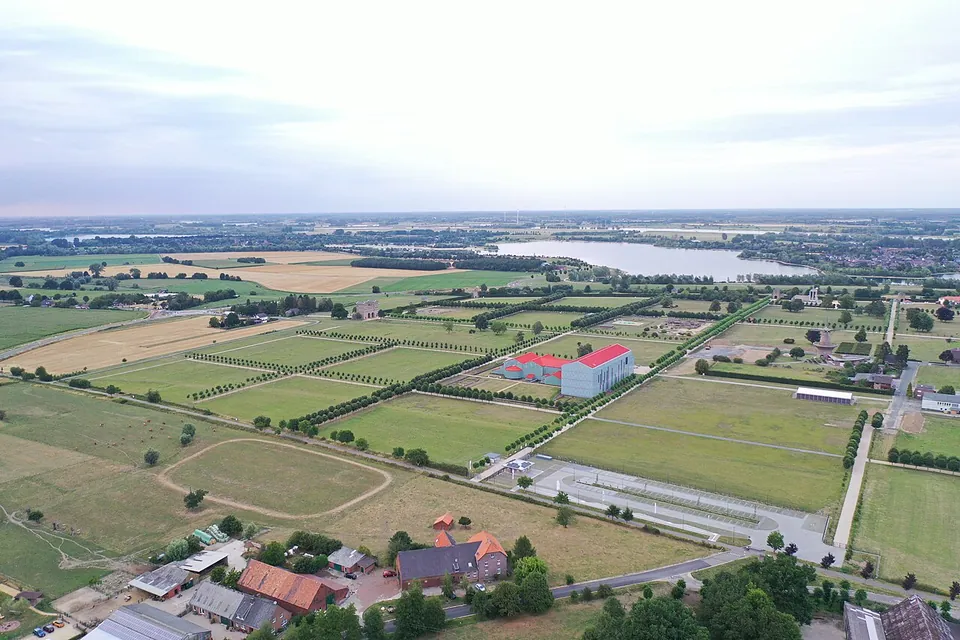
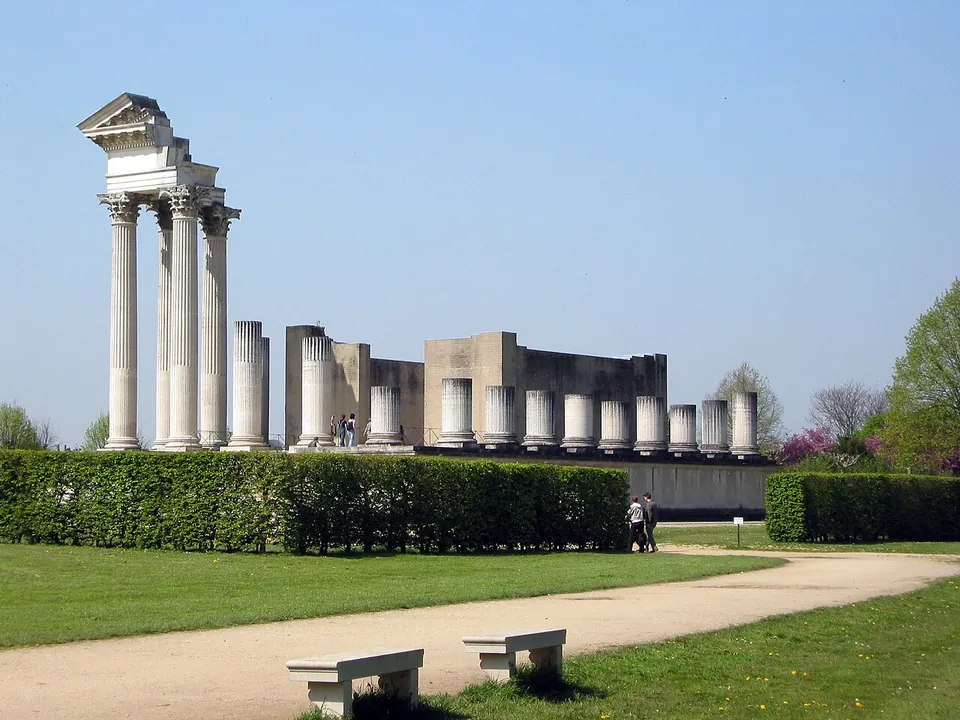
What stands to any height here is mostly modern reconstruction. The Roman city was quarried for building stone from the Middle Ages onwards and then ploughed (de.wikipedia), so the park’s approach is to reconstruct: the street grid is marked out by gravel paths and avenues of trees, the city blocks are lawns, and on that plan stand the rebuilt Harbour Temple, the inn (Herberge), parts of the city wall and the amphitheatre. House plans are traced in hornbeam hedges on one block, and seven pavilions deal with themes from building technique and shipbuilding to the Limes on the Lower Rhine (de.wikipedia). Six Roman ships have been rebuilt in the park’s own wood workshop and are shown in a ship tent (the operator).
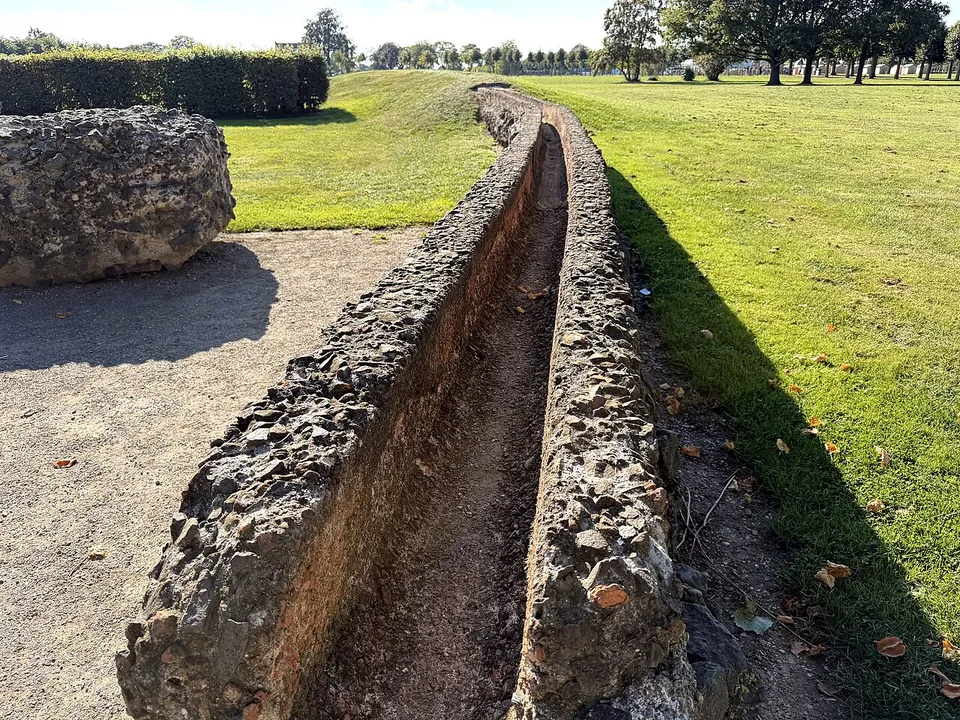
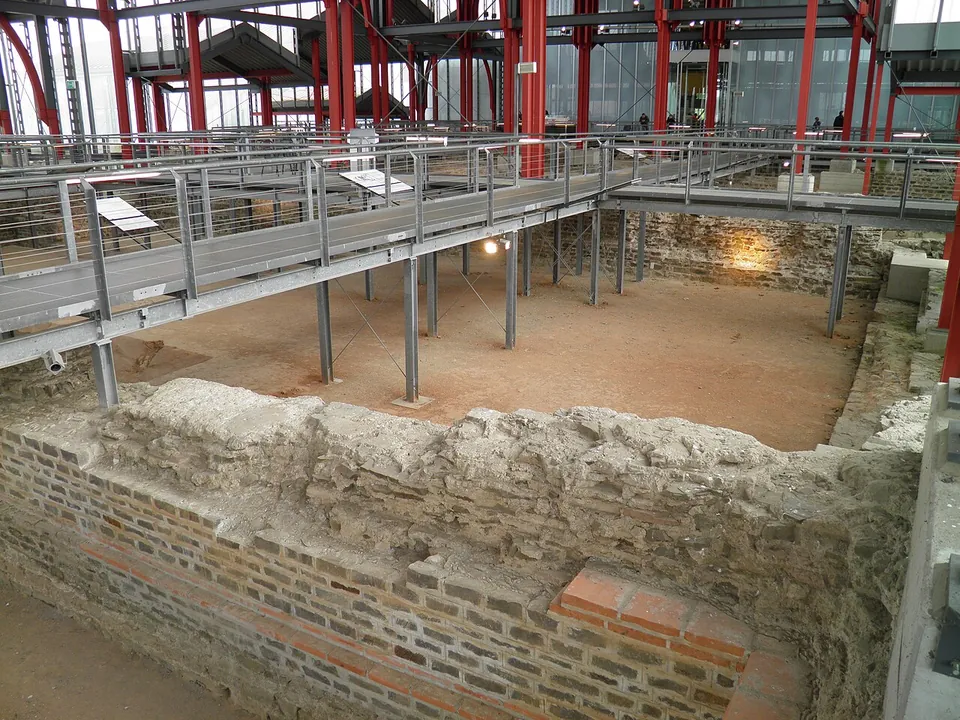
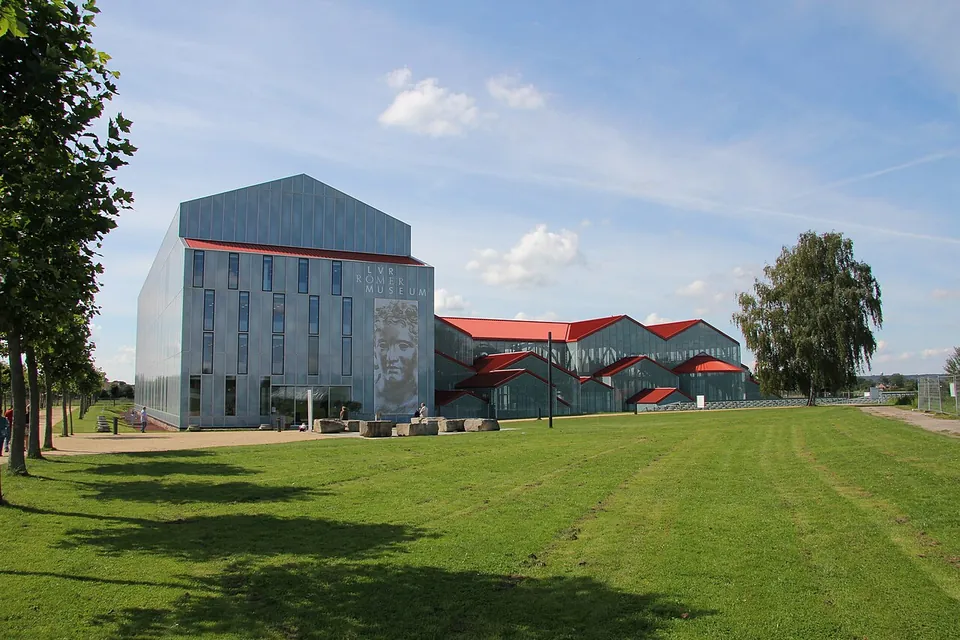
The original Roman fabric is mostly foundations. The main one is the Great Baths, excavated and covered since 1999 by a glass shelter that copies the size of the main building; next to it the RömerMuseum, opened in 2008 over the baths’ entrance hall, shows finds from the city and the region (de.wikipedia). Elsewhere in the park are the foundations of the Matronentempel and a section of the city’s water pipeline, moved here and preserved (en.wikipedia). Excavation in the park is permanent, and a summer training dig for students has run since 1989 (de.wikipedia).
The park covers 60 hectares and has a playground, a café and restaurant, and toilets (de.wikipedia; the operator; OpenStreetMap).
Is it worth the trip?
Yes, with the right expectations. This is a Roman town you can walk through at full scale, but what you will remember - the temple columns, the arena, the wall towers - was built after the park was founded in 1973. If what you want is Roman masonry still standing, this is not it. Where Xanten is strong is in showing a non-specialist how a Roman city fitted together, and with a playground and free entry under 18 it suits children.
It is also an easy visit. The park is a short walk from the centre of Xanten, the RömerMuseum entrance is about ten minutes from the station, it is open every day except three around Christmas, and under-18s go free (the operator).
Getting there
The park lies on the edge of Xanten, about 0.7 km from the town centre. There are three entrances, each with free parking: Stadtzentrum (Am Amphitheater), Hafentempel (Am Rheintor; closed December to February) and Römermuseum (Trajanstraße 10), about ten minutes’ walk from the railway station (the operator).
It opens daily, 09.00 to 18.00 from 1 March until the clocks go back at the end of October, and 10.00 to 16.00 from then until the end of February; park and museum are closed on 24, 25 and 31 December and open on New Year’s Day. A ticket is €11; students, apprentices and people with a severe disability pay €7, and under-18s go free. Entry to park and museum is free for everyone on the first Monday of the month. From late March to late October an electric train, the APXpress, takes visitors with limited mobility round the park for €2, but on 30 October 2026 it was out of service with a technical fault (lvr.de, read 30 October 2026 - check before travelling, since prices move).
Visiting details
- Opening hours
- Daily 09.00–18.00 from 1 March to the end of summer time (the last Sunday in October), and 10.00–16.00 from then until 28 February. Park and museum are closed on 24, 25 and 31 December and open on New Year's Day.
- Tickets
- €11; €7 for students, apprentices, people in the federal volunteer service or a voluntary social year, and people with a severe disability (with proof); free under 18 and for refugees with proof of status. Groups of 10 or more pay €10.50 per adult. Entry to park and museum is free for everyone on the first Monday of each month. One tariff is published for the park and the RömerMuseum.
- Parking
- Free car parks at all three entrances - Stadtzentrum (Am Amphitheater), Hafentempel (Am Rheintor) and Römermuseum (Trajanstraße 10), with coach parking at the last two. On weekdays one of the two car parks at the Stadtzentrum entrance needs a parking disc (four hours).
- On foot
- About 10 min from the parking
Before you go
- The Hafentempel entrance is closed from December to the end of February.
- The APXpress electric train, which runs from late March to late October for visitors with limited mobility (€2, children €1), was out of service with a technical fault on 30 October 2026.
- The RömerMuseum closes for annual maintenance from 23 to 27 November 2026.
Hours and prices checked 30 October 2026 on the operator's own site. Confirm before travelling.
The amphitheatre
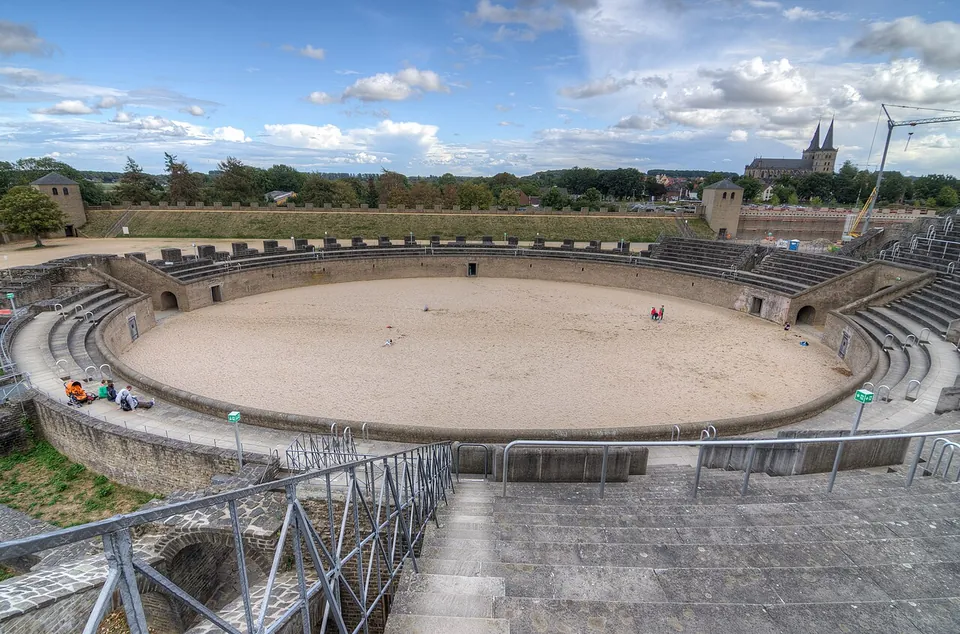
The amphitheatre stood in a corner of the city, on its easternmost block. A first arena of timber on an earth bank was built around the time the colonia was founded, about 100, and was replaced in stone towards the end of the 2nd century. It measured 99 m on its long axis and held up to 10,000 people. Stone robbing had left almost none of its walls when it was dug, but the greywacke foundations survived, and the partial reconstruction stands on them. It was largely uncovered in the 1930s, and from spring 2018 the timber cellar beneath the arena was dug again (de.wikipedia).
The arena is in use. The Xanten summer festival has staged opera and musicals here, usually from June to August, rock bands have played concerts, and the park’s occasional Roman festival has put on gladiator fights in it (de.wikipedia).
The Matronentempel
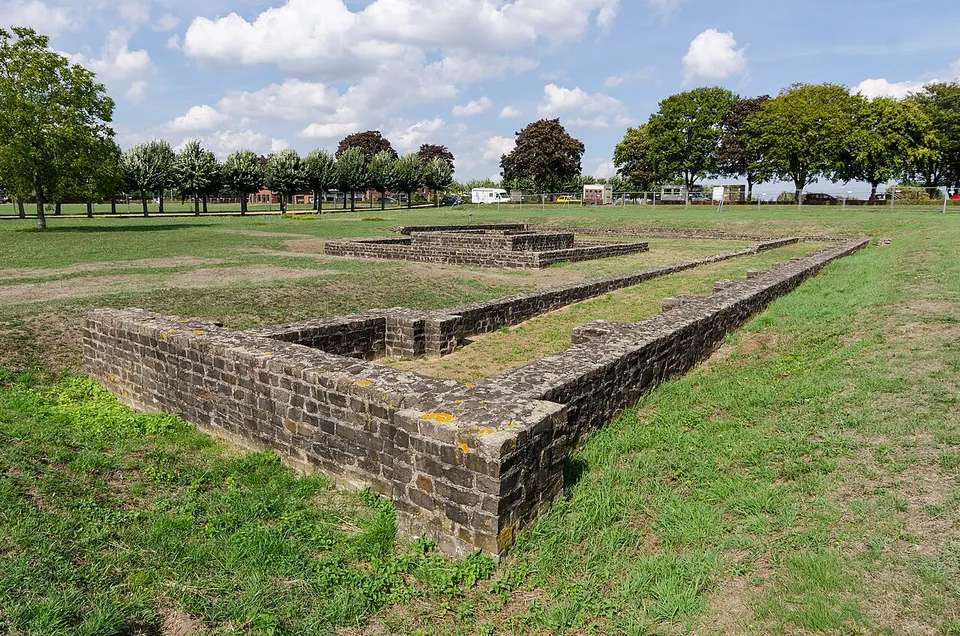
The third-largest temple of the city stood hidden among houses on block 20, reached from the main street by a passage 3 m wide. It was a Gallo-Roman temple of the ambulatory type: a walled precinct of 44 × 27 m with a small cella, 4.4 × 3.8 m, set slightly off-centre. Fragments of two altars, one of them restorable to the Aufanian Matronae, show whom it served. It was built around the beginning of the 2nd century and taken down in the late 3rd, when the town shrank to a fortress in its centre. Excavated in a rescue dig in the winter of 1973-74, its walls were exposed again in the early 1990s and built up slightly so the plan can be read (de.wikipedia).
History
Finds on the site go back to the 4th century BC. Before the colonia there was a town of the Cugerni, Germanic people resettled on the left bank of the Rhine by Drusus in 8 BC, near the legionary camp of Vetera. It was probably burnt in the Batavian revolt of 70 and rebuilt with the new camp in 71. Around 100 Trajan raised it to a colonia and gave it his name, Colonia Ulpia Traiana; the major public buildings are documented from Hadrian’s reign onward. Inside a wall 3.4 km long the city covered 73 hectares and housed about 10,000 people, the third-largest Roman city in what is now Germany after Cologne and Trier (en.wikipedia).
The city declined in the 3rd century. The Frankish raids of 275-276 have been taken as the cause of its destruction, but the only clear evidence is a burnt layer in the cellar of the inn. In the late 3rd century a strong fortress was built over nine blocks at its centre; whether this was the Tricensimae of late Roman sources is debated. The Franks took it in 352, it was rebuilt from 359, and it was abandoned in the first half of the 5th century (en.wikipedia).
Xanten grew up on the Roman cemetery rather than on the city, so the ruins were robbed for stone but, unlike Roman Cologne and Trier, not built over (en.wikipedia). The Landschaftsverband Rheinland decided to create the park in 1973 and opened its first 6 hectares in 1977; it reached 27 hectares in 1980 and, after the main road that cut through the Roman city was moved, 60 hectares in 2009 (de.wikipedia). Since 2021 Colonia Ulpia Traiana has been part of the UNESCO World Heritage Site of the Lower German Limes (the operator).
More photographs




Sources
Every fact on this page comes from the records below, each used under the licence noted.
| Source | Licence |
|---|---|
| Wikidata Q316385 | CC0 |
| OpenStreetMap way/475037411 | ODbL |
| Wikipedia (de) — LVR-Archäologischer Park Xanten | CC BY-SA 4.0 |
| Wikipedia (en) — Xanten Archeology Park | CC BY-SA 4.0 |
| Wikipedia (en) — Colonia Ulpia Traiana | CC BY-SA 4.0 |
| Wikipedia (de) — Colonia Ulpia Traiana | CC BY-SA 4.0 |
| Wikipedia (de) — Amphitheater der Colonia Ulpia Traiana | CC BY-SA 4.0 |
| Wikipedia (de) — Matronentempel (Xanten) | CC BY-SA 4.0 |
| Wikidata — Colonia Ulpia Traiana (Q464588) | licence not recorded |
| Wikidata — Amphitheatre of Xanten (Q2549489) | licence not recorded |
| Wikidata — Matronentempel Xanten (Q56526664) | licence not recorded |
| vici.org — Colonia Ulpia Traiana (103) | licence not recorded |
| vici.org — Amphitheatre of Xanten (82) | licence not recorded |
| LVR-Archäologischer Park Xanten — admission and opening hours (the operator) | licence not recorded |
| LVR-Archäologischer Park Xanten — home page and current notices (the operator) | licence not recorded |