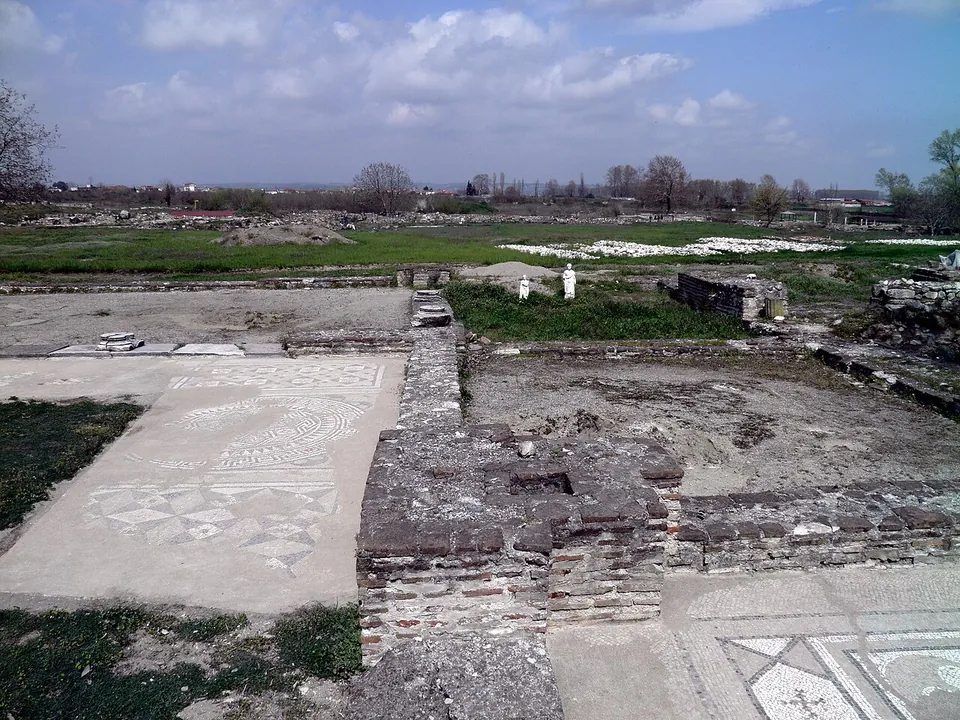
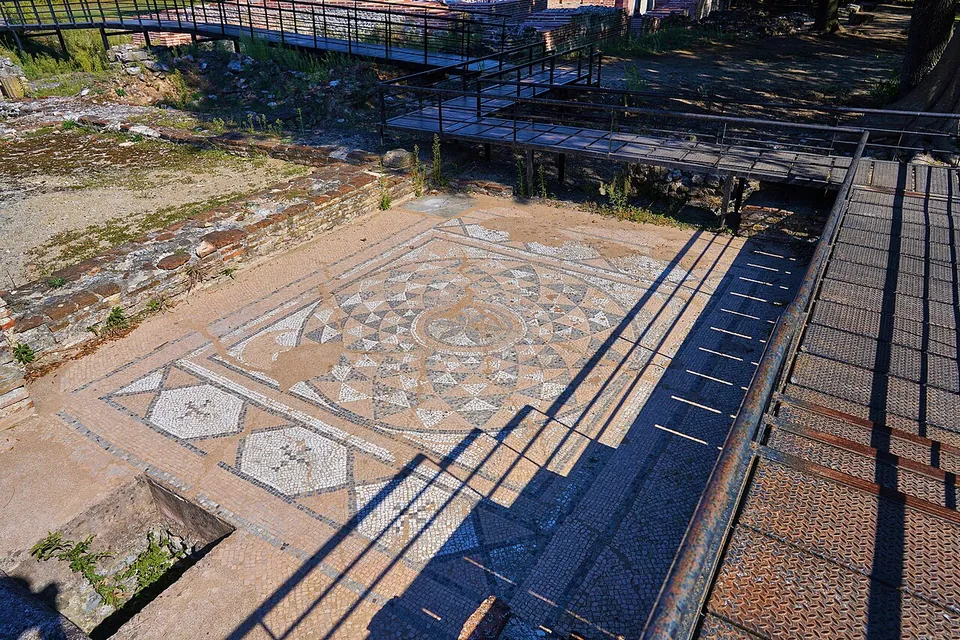


Dion was the sacred city of the ancient Macedonians, at the northern foot of Mount Olympus, where their kings sacrificed to Olympian Zeus (the Ministry; the operator). After the battle of Actium in 31 BC Augustus made it a Roman colony, settled with Italians, mostly army veterans, and most of what stands in the park today is from that Roman city: baths, an odeon and a theatre, a forum, houses with rich mosaic floors and, later, early Christian basilicas (the Ministry; the operator).
What is there today
The Great Baths, on the south edge of the city by the main street, date from about AD 200 and cover more than 4,000 m². Around an open courtyard were public toilets, shops and workshops; the main building had swimming pools, changing rooms, hot and cold rooms, rooms for rest, sweating and massage, with hypocausts carrying warm air to the rooms that needed it. Its rooms were decorated with mosaic floors, marble inlays and statues of gods and nymphs in niches, and its north wing, where statues of the circle of Asklepios were found, may have served for healing (the Ministry). The odeon stands beside them, on the way in from the main street (the Ministry).
The Villa of Dionysos, in the east of the city, was built about AD 200 and is still one of the most impressive buildings of Dion. Its banqueting hall, about 100 m², had a many-coloured mosaic floor showing the triumph of Dionysos, the god riding a chariot drawn by sea panthers (the Ministry).
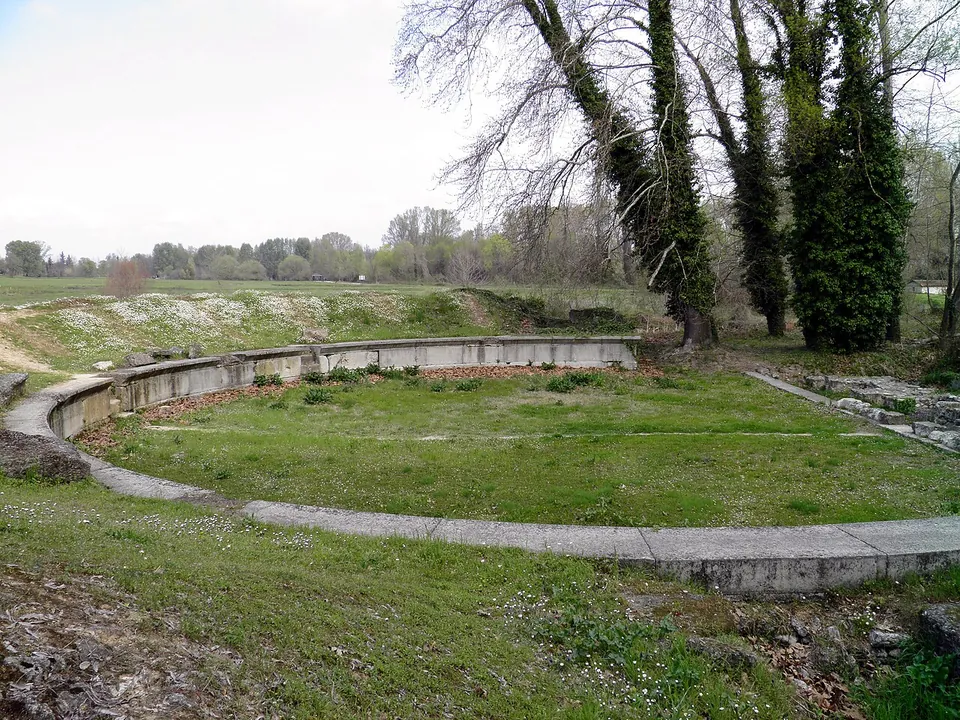
The Roman theatre, outside the walls south-east of the older Greek theatre, is smaller, with a seating area 16.45 m across; its seats rested on eleven vaulted chambers, and only a few of an estimated 24 rows survive. The Ministry’s site description dates it to the 2nd century AD, while its page on the theatre says the 2nd century BC (the Ministry).
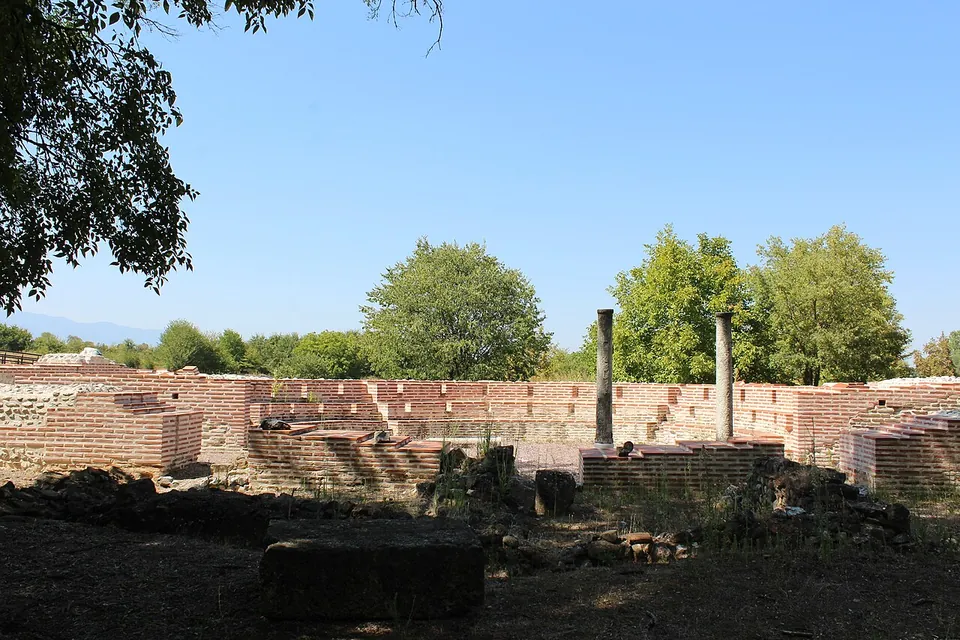
The walls and the churches. When the Goths swept into the Balkans in the mid-3rd century, the walls were hastily rebuilt with altars, statues and architectural pieces taken from older buildings (the Ministry); a statue of Hera found in them in 2006 had been used as filling (en.wikipedia). In early Christian times the city shrank, and an early Christian basilica of the late 4th century took over its centre; two basilicas stood within the old city and a third outside the walls (the Ministry).
The park also holds the sanctuaries of Zeus, Demeter and the Egyptian gods, and the Hellenistic theatre (the Ministry).
Is it worth the trip?
Yes. Dion is the largest archaeological site in Pieria, and the city a visitor walks through is mostly the Roman colony: the baths, the mosaics and the theatre, in a green park of springs and trees at the foot of Olympus (the operator). A ticket is €10, and it is 20 minutes by car from Katerini (the operator). Note the shorter Tuesday hours, and that in winter it is closed on Tuesdays and Wednesdays.
Getting there
The park is a 5-minute walk from the village of Dion and 20 minutes by car from Katerini; Katerini’s town bus line 3 stops at “Archaeological Museum”, 10 minutes’ walk away (the operator).
From 1 April to 31 October it opens daily, 08.00–20.00 to the end of August and closing earlier through September and October (18.00 by the second half of October), but only 08.30–15.30 on Tuesdays. From 1 November to 31 March it opens 08.30–15.30 and is closed on Tuesdays and Wednesdays. Last entry is 20 minutes before closing; it is shut on 1 January, 25 March, 1 May, Easter Sunday and 25–26 December. A ticket is €10, reduced €5, and entry is free on 6 March, 18 April, 18 May, the last weekend of September, 28 October, and on the first and third Sunday of each month from November to March (hh.gr, read 9 October 2026 — check before travelling). There is a café, a shop, toilets and parking (the operator).
Visiting details
- Opening hours
- From 1 April to 31 October daily, 08.00–20.00 to the end of August, then closing earlier through the autumn (19.30 in early September, 18.00 by late October), but 08.30–15.30 on Tuesdays; from 1 November to 31 March 08.30–15.30, closed on Tuesdays and Wednesdays. Last entry 20 minutes before closing. Closed 1 January, 25 March, 1 May, Easter Sunday and 25–26 December.
- Tickets
- €10; reduced €5. Free on 6 March, 18 April, 18 May, the last weekend of September and 28 October, and on the first and third Sunday of each month from November to March.
- Parking
- The park is a 5-minute walk from the village of Dion; the operator lists parking. Katerini's town bus line 3 stops at "Archaeological Museum", 10 minutes' walk away.
Hours and prices checked 9 October 2026 on the operator's own site. Confirm before travelling.
History
Archelaos I founded festivals here at the end of the 5th century BC; Philip II celebrated his victories at Dion, and Alexander the Great sacrificed to Zeus here before setting out for Asia (the Ministry; en.wikipedia). The Romans entered the city in 169 BC, before the battle of Pydna (the Ministry). Roman colonists may have come as early as 43 BC, but the colony itself was founded by Augustus straight after Actium; Latin was the official language, but most inscriptions are in Greek, a sign that the newcomers soon took on Greek ways (the Ministry). The city had a second heyday under the emperors of the 2nd and 3rd centuries, who admired Alexander (en.wikipedia), and its bishop attended the councils of Serdica in 343 and Ephesus in 431. Dion suffered from the Ostrogoths’ invasions, and earthquakes and the floods of the river Vaphyras led to its abandonment in the 5th century (the Ministry).
More photographs

Sources
Every fact on this page comes from the records below, each used under the licence noted.
| Source | Licence |
|---|---|
| Pleiades 491572 | CC BY |
| Wikidata Q9207638 | CC0 |
| Vici.org 2208 | CC BY-SA (text), CC0 (metadata) |
| OpenStreetMap way/249176654 | ODbL |
| Hellenic Heritage (H.O.C.R.E.D., for the Ministry of Culture) — Archaeological Park of Dion, hours and tickets | licence not recorded |
| Ministry of Culture and Sports (Odysseus) — Dion, history and site | licence not recorded |
| Ministry of Culture and Sports (Odysseus) — Great thermae of Dion | licence not recorded |
| Ministry of Culture and Sports (Odysseus) — Villa of Dionysos | licence not recorded |
| Ministry of Culture and Sports (Odysseus) — Roman Theatre of Dion | licence not recorded |
| Ministry of Culture and Sports (Odysseus) — Walls of Dion | licence not recorded |
| Wikipedia (en) — Dion, Pieria | CC BY-SA 4.0 |
| Wikipedia (en) — Macedonia (Roman province) | CC BY-SA 4.0 |