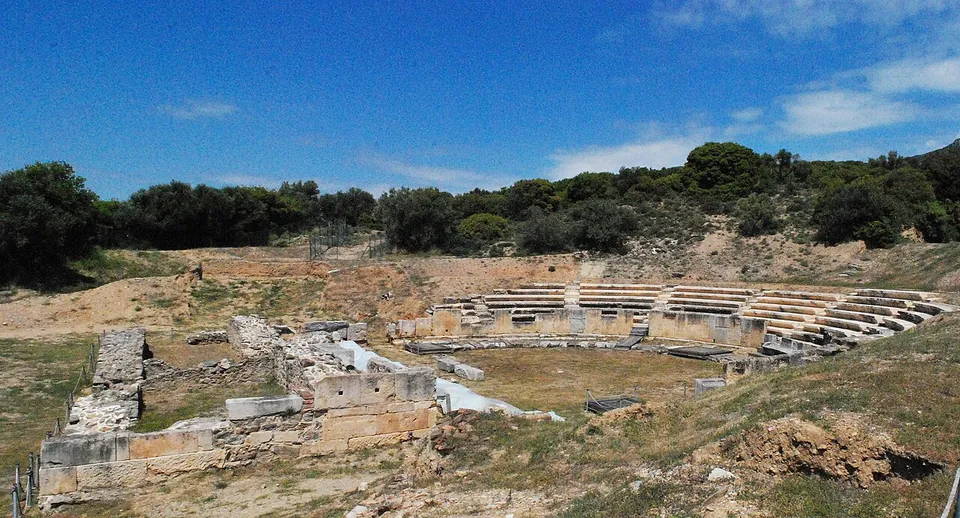
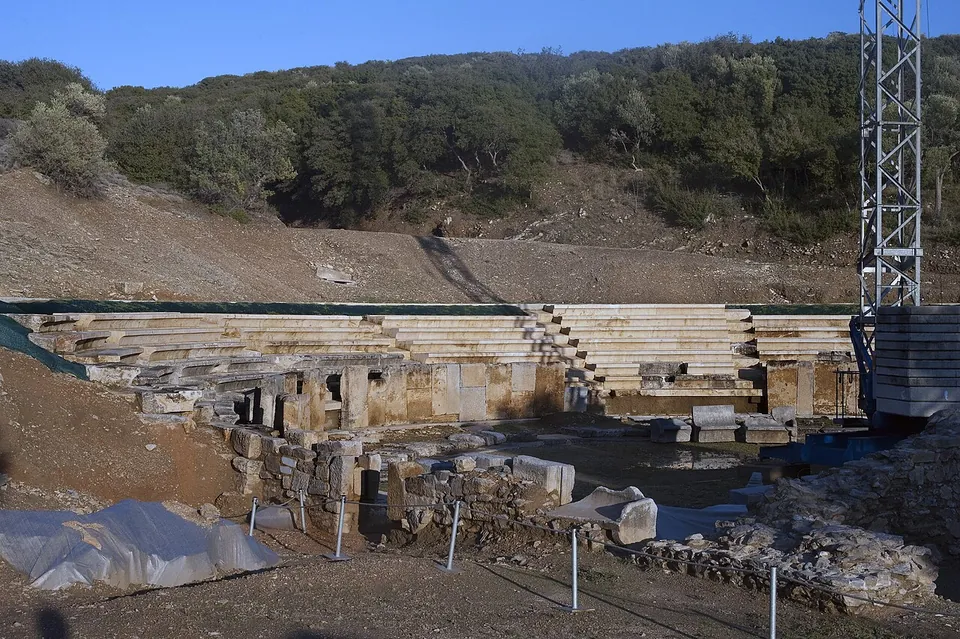


The theatre of Maroneia, a rich city of the Thracian coast, was built in the Hellenistic period and rebuilt under Rome, when its orchestra was turned into an arena for gladiator fights (the operator; Pleiades; el.wikipedia). Restored between 2004 and 2015, it sits in the ruins of the ancient city among olive groves and the slopes of Mount Ismaros, looking out to the Thracian Sea (the operator; el.wikipedia).
What is there today
The seating is divided by eight stairways into nine wedges, with no horizontal gangway; the seats found point to room for 2,500–3,000 spectators, resting on the bare rock or on marble supports fixed to it (el.wikipedia).
The Roman arena. In the first Roman phase the theatre was rebuilt with reused architectural pieces in the seating. To make an arena the orchestra was doubled in size: the seats of honour, the kerb and the paving slabs were taken up, and the drain round the orchestra was covered over with assorted blocks. In a second Roman phase the theatre was altered and repaired again and again for shows and for citizens’ assemblies; the doors into the seating were blocked, and the west entrance passage was walled up with architectural pieces, probably in the later 3rd century AD (el.wikipedia).
The site also has signposted remains of the sanctuary of Dionysus, a gateway and an early Christian basilica, and more ruins lie scattered in the olive groves (the operator).
Is it worth the trip?
Yes, if you are in Thrace: a theatre restored to its seats, looking out to the sea, where a Roman arena can be read in the older theatre, for €5 (the operator; el.wikipedia). No bus stop is mapped nearby, so it needs a car (OpenStreetMap).
Getting there
The archaeological site is 8 minutes by car from the village of Maroneia, 35 minutes from Komotini and 50 from Alexandroupoli (the operator), along a gravel road; no bus stop is mapped nearby (OpenStreetMap).
It opens daily except Tuesdays, 08.30–15.30, all year. Last entry is 20 minutes before closing; it is shut on 1 January, 25 March, 1 May, Easter Sunday and 25–26 December. A ticket is €5, reduced €3, and entry is free on 6 March, 18 April, 18 May, the last weekend of September, 28 October, and on the first and third Sunday of each month from November to March (hh.gr, read 10 October 2026 — check before travelling). There are toilets and parking (the operator).
Visiting details
- Opening hours
- Daily except Tuesdays, 08.30–15.30, all year. Last entry 20 minutes before closing. Closed 1 January, 25 March, 1 May, Easter Sunday and 25–26 December.
- Tickets
- €5; reduced €3. Free on 6 March, 18 April, 18 May, the last weekend of September and 28 October, and on the first and third Sunday of each month from November to March.
- Parking
- 8 minutes by car from the village of Maroneia, 35 from Komotini and 50 from Alexandroupoli (the operator), which lists parking. The theatre lies beside a gravel road (OSM way/1181506409); no bus stop is mapped nearby.
Hours and prices checked 10 October 2026 on the operator's own site. Confirm before travelling.
History
Maroneia was a rich city of the Cicones, walled over more than 10 km, which flourished above all in the Hellenistic and Roman periods; the emperor Hadrian visited it, and in Byzantine times it was the seat of a bishop (the operator). The theatre was built in the late 4th or early 3rd century BC (el.wikipedia). Evangelos Pentazos uncovered it in his excavations of 1981–1988 (el.wikipedia).
Sources
Every fact on this page comes from the records below, each used under the licence noted.
| Source | Licence |
|---|---|
| Pleiades 19771164 | CC BY |
| Wikidata Q41074339 | CC0 |
| OpenStreetMap way/353420694 | ODbL |
| Hellenic Heritage (H.O.C.R.E.D., for the Ministry of Culture) — Ancient Theatre of Maroneia, hours and tickets | licence not recorded |
| Wikipedia (el) — Αρχαίο θέατρο Μαρώνειας | CC BY-SA 4.0 |