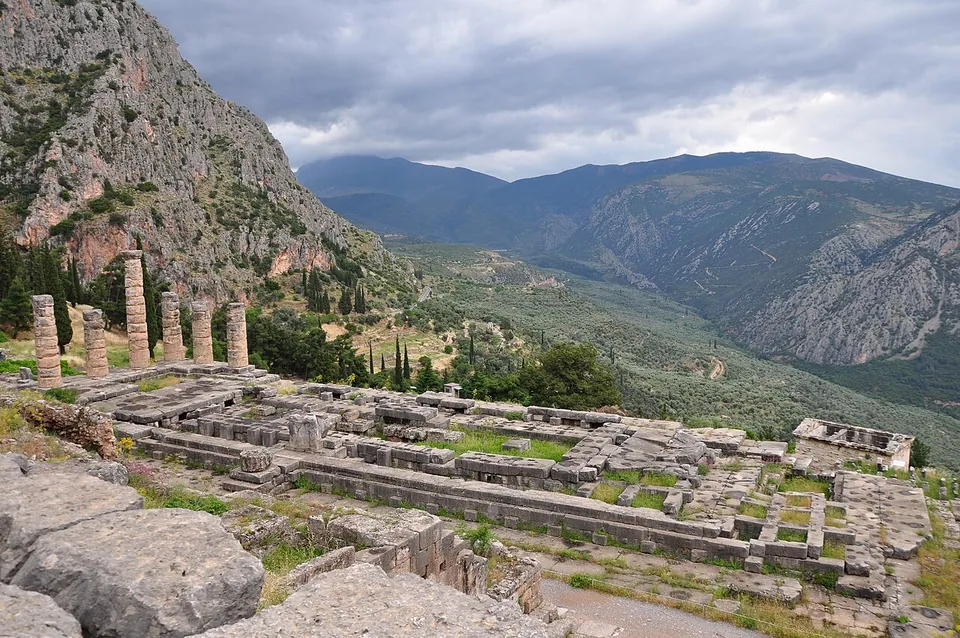
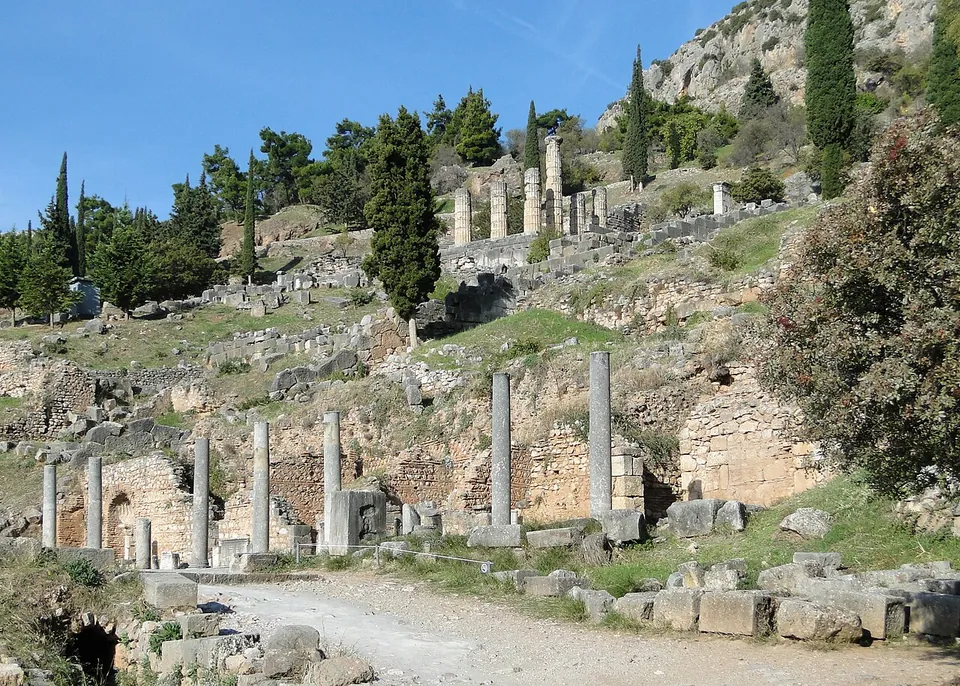
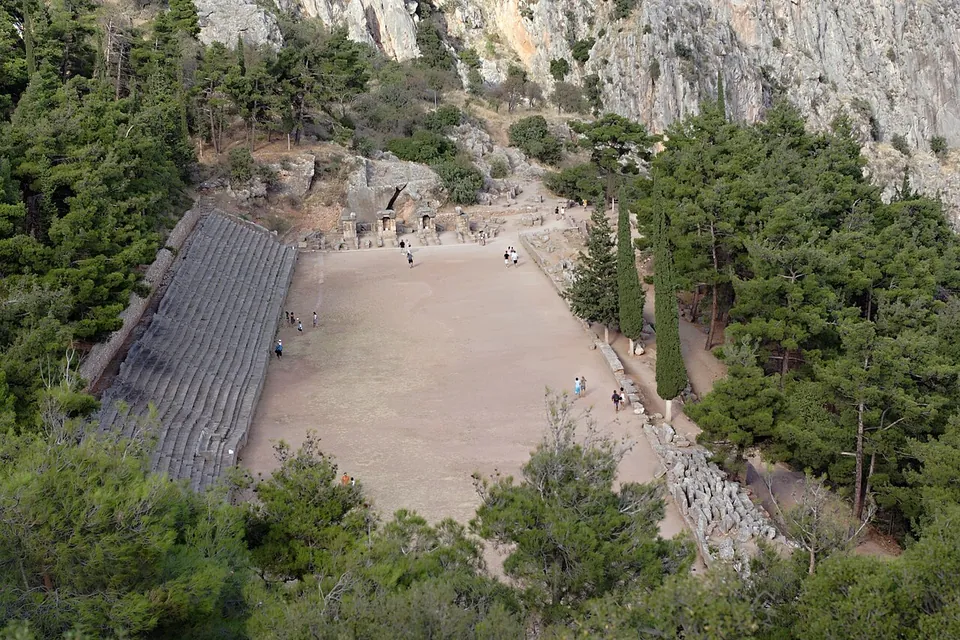


Delphi is the sanctuary of Apollo and seat of his oracle on the slopes of Mount Parnassus. It was already ancient when Rome took Greece, and most of what stands is Greek, but the Romans left their mark: the Roman Agora you walk through at the entrance, the stone seats of the stadium, a theatre reworked for Nero, and baths and houses of late antiquity.
What is there today
Most of the ruins date from the sanctuary’s busiest period, the 6th century BC (en.wikipedia). The Roman layer runs through them.
The Roman Agora is the first thing you see on entering the site. It was a large paved square just outside the sanctuary walls, with Ionic colonnades on three sides; the square was built in the Roman period, though what is visible along its north and north-west sides is late antique. Statues of emperors and benefactors stood here, and their pedestals remain; in late antiquity craftsmen set up workshops inside it (en.wikipedia).
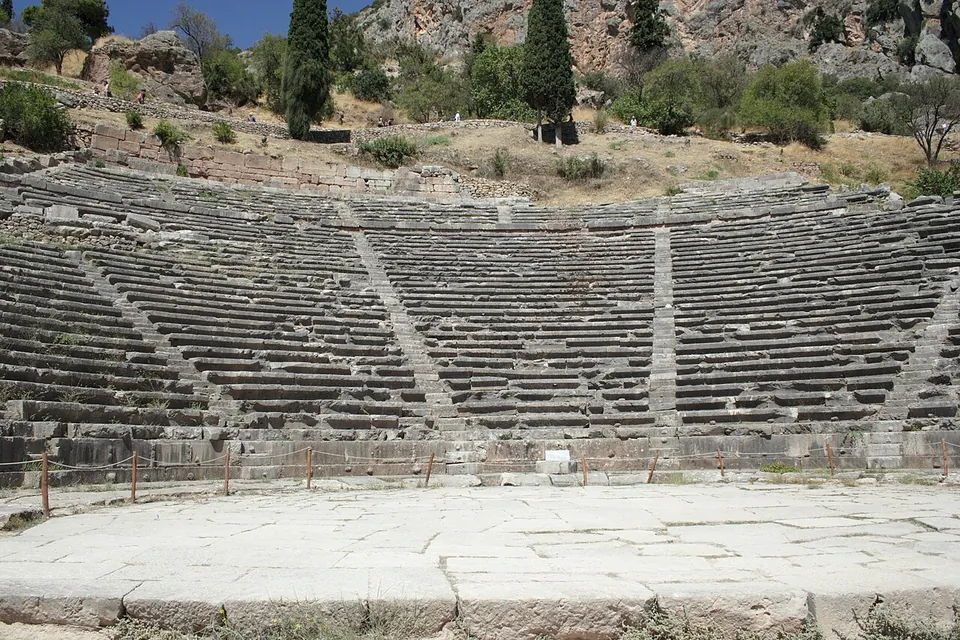
The theatre, above the Temple of Apollo, was built in the 4th century BC and remodelled for the emperor Nero’s visit to Greece in AD 67: the orchestra was paved and closed off with a stone parapet, and the stage front was rebuilt low and carved with stories of Hercules. Further repairs in the 2nd century were credited by Pausanias to Herodes Atticus (en.wikipedia).
The stadium, at the top of the site, took its final form under Rome: its tiers were faced with stone in the Roman period (en.wikipedia), work paid for by Herodes Atticus in Hadrian’s time in the 2nd century, with a fountain and a ceremonial gate, and never quite finished (de.wikipedia). The track is 177.55 m long, the stadium held about 6,500 people, and it is the best-preserved ancient stadium in Greece (en.wikipedia). It is closed at present (see below).
Late antiquity added the Eastern Baths, a house with a peristyle and a large cistern; late Roman cemeteries lay on the edge of the town (en.wikipedia). At the Castalian Spring, one of the two monumental fountains is Roman, cut into the rock (en.wikipedia). In the museum, by the exit, is the inscription that names the Roman proconsul Gallio (en.wikipedia).
Is it worth the trip?
Yes - for Delphi itself, one of the great sanctuaries of the ancient world and a UNESCO World Heritage Site (en.wikipedia). For Rome specifically, be honest with yourself: the Roman buildings are the agora at the entrance, a theatre reworked rather than built, and the stadium. And right now the stadium is closed for works against rockfalls, as are the Castalian Spring and the Sanctuary of Athena Pronaia (the Ministry). The €20 ticket includes the museum.
The site climbs a steep slope. In summer the Ministry asks visitors to bring their own water and to wear a hat and light clothing that covers the limbs.
Getting there
The site is a 15-minute walk from the modern village of Delphi; by car it is about three hours from Athens and two from Patras, and KTEL Phocis buses run there from Athens and Patras (the operator). Parking outside the Archaeological Museum is limited, with more spaces farther away (the Ministry).
It opens daily from 08.00. From 1 April to 31 August it closes at 20.00; through September and October closing comes earlier in steps, to 18.00 in the second half of October; from 1 November to 31 March it opens 08.30–15.30. Last entry is 20 minutes before closing. It is shut on 1 January, 25 March, 1 May, Easter Sunday and 25–26 December, with shorter hours on Good Friday and Holy Saturday. A ticket is €20, reduced €10, and covers the site and the museum; tickets are issued at the museum’s ticket office as well as online. Entry is free on 6 March, 18 April, 18 May, the last weekend of September, 28 October, and on the first and third Sunday of each month from November to March (the Ministry’s site guide and hh.gr, read 9 October 2026 — check before travelling).
Visiting details
- Opening hours
- Daily 08.00–20.00 from 1 April to 31 August, then closing earlier through the autumn (19.30 in early September, 18.00 by late October); 08.30–15.30 from 1 November to 31 March. Last entry 20 minutes before closing. Closed 1 January, 25 March, 1 May, Easter Sunday and 25–26 December; shorter hours on Good Friday and Holy Saturday.
- Tickets
- €20; reduced €10. The ticket covers the archaeological site and the Delphi Archaeological Museum. Free on 6 March, 18 April, 18 May, the last weekend of September and 28 October, and on the first and third Sunday of each month from November to March. Tickets are issued at the museum's ticket office and online at tickets.hh.gr.
- Parking
- Parking for cars is limited outside the Archaeological Museum, with further spaces farther away (the Ephorate of Antiquities of Phocis).
Before you go
- The stadium is closed during emergency works against rockfalls (the Ministry of Culture, read 9 October 2026).
- The Castalian Spring area and the Sanctuary of Athena Pronaia are also closed.
- The site climbs a steep slope. In summer bring your own water and wear a hat and light clothing that covers the limbs (the Ministry).
Hours and prices checked 9 October 2026 on the operator's own site. Confirm before travelling.
History
The Romans took control of the oracle from the Aetolians in 190 BC, and in 168 BC Delphi passed under Roman rule (el.wikipedia). Sulla sacked it in 86 BC, during the Mithridatic Wars, and Nero in AD 66; the Flavian emperors helped restore it, but it gradually lost importance (en.wikipedia). Nero is said to have carried off some 500 statues (de.wikipedia).
The oracle flourished again in the 2nd century under Hadrian, who is believed to have visited it twice and gave the city full autonomy, and by the 4th century Delphi had the status of a city. Constantine took monuments from it to adorn Constantinople, among them the bronze Serpent Column (en.wikipedia). The sanctuary survived until the emperor Theodosius I banned the pagan cults (de.wikipedia); el.wikipedia dates the closing of the oracle to 395, en.wikipedia the destruction of the place to 390. Architectural pieces of a 5th-century Christian basilica, found in the excavations, date from when Delphi was the seat of a bishop (en.wikipedia).
More photographs

Sources
Every fact on this page comes from the records below, each used under the licence noted.
| Source | Licence |
|---|---|
| Pleiades 540726 | CC BY |
| Wikidata Q75459 | CC0 |
| OpenStreetMap way/145690044 | ODbL |
| Pleiades — Stadium of Delphi | licence not recorded |
| Wikipedia (en) — Delphi | CC BY-SA 4.0 |
| Wikipedia (de) — Delphi | CC BY-SA 4.0 |
| Wikipedia (el) — Δελφοί | CC BY-SA 4.0 |
| Wikipedia (en) — Stadium of Delphi | CC BY-SA 4.0 |
| Wikipedia (de) — Stadion von Delphi | CC BY-SA 4.0 |
| Wikipedia (en) — Achaia (Roman province) | CC BY-SA 4.0 |
| Ministry of Culture and Sports (Odysseus) — Delphi, information | licence not recorded |
| Hellenic Heritage (H.O.C.R.E.D., for the Ministry of Culture) — Delphi, hours and tickets | licence not recorded |