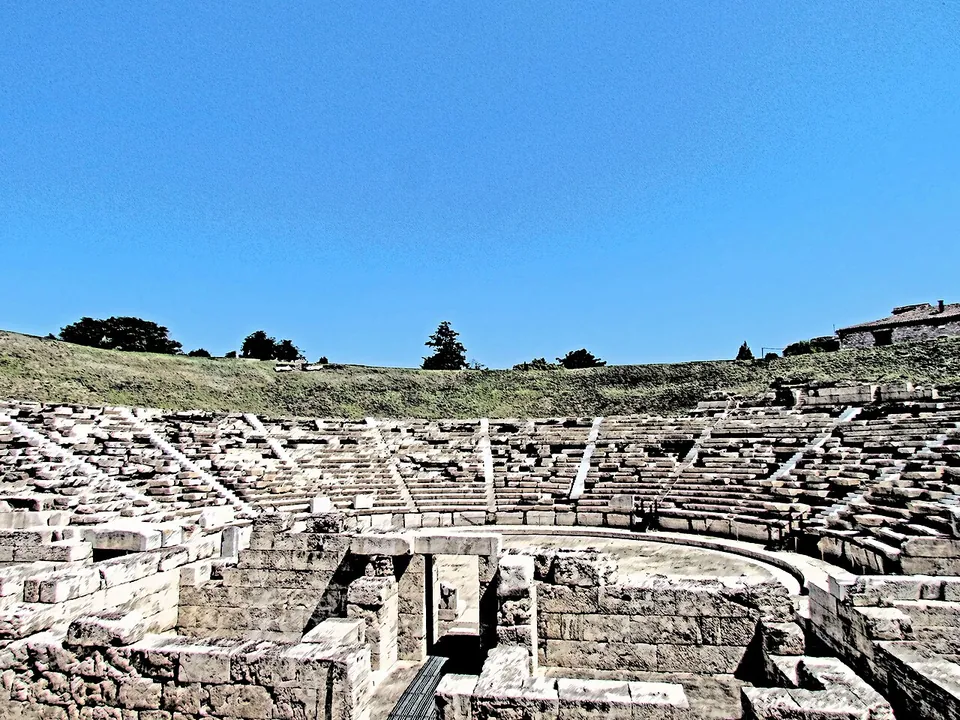
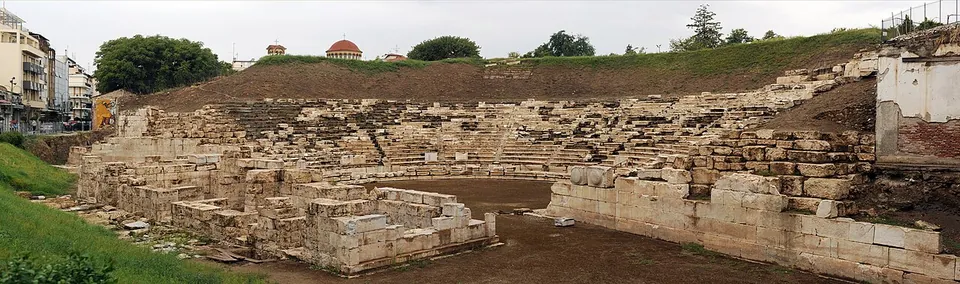
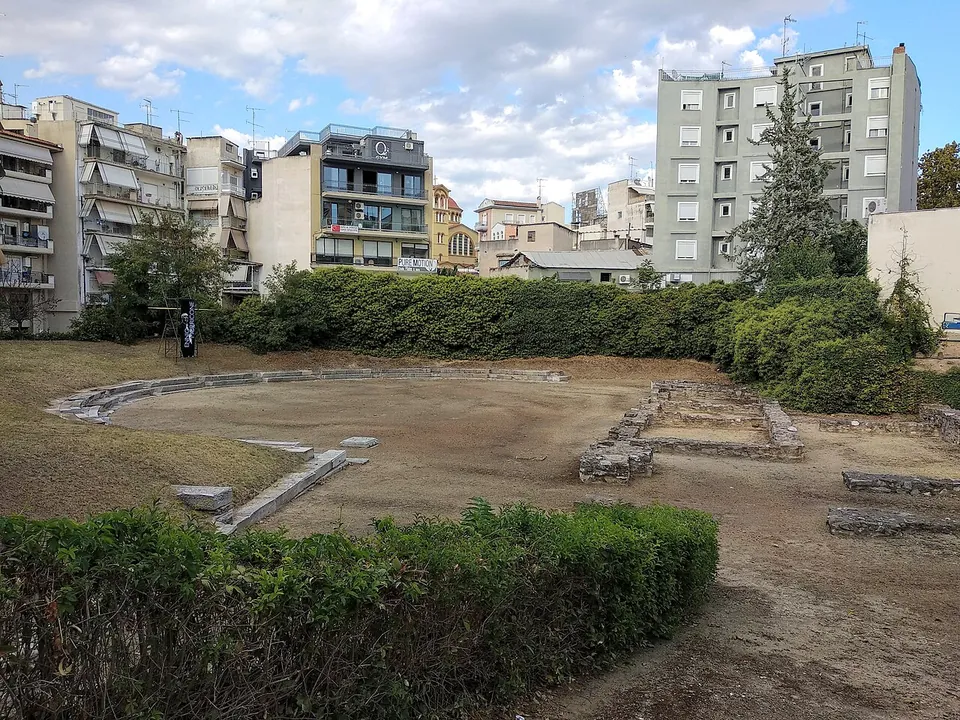


The First Ancient Theatre of Larissa is a large Greek theatre of the 3rd century BC in the centre of the city. In the 1st century BC, under Rome, it was rebuilt as an arena for gladiators and animal fights, and the seating you see today is the form it took then (Pleiades; en.wikipedia; the Municipality). The city then built a second theatre nearby, probably because the old one had become an arena (en.wikipedia; the theatre’s website).
What is there today
The first theatre, on the south slope of the Frourio hill, seated 10,000 people, the most of any theatre in Thessaly (the Ministry; en.wikipedia). The seating is divided by ten stairways into eleven wedges, and in its present form, as it was rebuilt in Roman times for the arena, it keeps twenty-one rows of marble seats. Many of the seats are inscribed with names, probably those of the representatives of the Thessalian cities (the Municipality). In front of the seating is the orchestra, and beyond it the stage building, where inscriptions honouring the emperors Augustus and Tiberius were found (en.wikipedia). The theatre has been restored after excavation, and the Ministry lists performances in it, as in July 2026 (the Ministry).
The second theatre, about 300 m west at the junction of Ergatikis Protomagias and Tagmatarchou Velissariou streets, was built in the second half of the 1st century BC. Only its stage and orchestra were ever finished. Its seating was left incomplete: thirteen wedges have two rows each of low grey-white marble seats, and wooden stands probably served for the rest. The orchestra, 29.7 m across, keeps a small marble altar (en.wikipedia; the Municipality). The site is fenced and can be visited by arrangement with the Ephorate (the Municipality).
Is it worth the trip?
Yes, if you are in Larissa: it is the city’s emblem, the largest theatre in Thessaly, and in the middle of town (en.wikipedia). The second theatre gives the Roman side of the story, but it can be seen inside only by arrangement. No operator publishes opening hours or a fee for the first theatre, so check locally before you go.
Getting there
The first theatre stands in the city centre on the south slope of the Frourio hill (the Ministry), beside Alexandrou Papanastasiou street, and town bus stops named “Archaio Theatro” are about 140 m away (OpenStreetMap).
Visiting details
- Tickets
- Unknown
- Parking
- In the city centre, on the south slope of the Frourio hill (the Ministry), beside Alexandrou Papanastasiou street (OSM way/133847846). Town bus stops named "Archaio Theatro" are about 140 m away (node/5694482201). No operator publishes hours or a fee.
History
The theatre was built in the 3rd century BC under the kings of Macedon; published sources date it to the first half of the century or to its end (the Ministry; the Municipality; en.wikipedia). It served for plays and for the meetings of the league of Thessalian cities (en.wikipedia). In the 1st century BC it was turned into a Roman arena for celebrations, duels and animal fights (Pleiades; the theatre’s website). The second theatre was built at about the same time, and its excavator linked it with the festival of the Eleutheria, which had theatre, music and poetry contests (en.wikipedia; the theatre’s website). An earthquake in the late 2nd or early 3rd century destroyed the upper floor of the stage building and part of the upper seating, and the theatre went out of use in the late 3rd or early 4th century. Houses were later built over it, and excavation from the 20th century led to its restoration (the Ministry). The second theatre, found in 1978 while foundations for apartment blocks were being dug, was excavated in 1985–86 (en.wikipedia).
Sources
Every fact on this page comes from the records below, each used under the licence noted.
| Source | Licence |
|---|---|
| Pleiades 942647940 | CC BY |
| Wikidata Q5452301 | CC0 |
| OpenStreetMap way/134388481 | ODbL |
| Hellenic Ministry of Culture (All of Greece One Culture) — First Ancient Theatre of Larissa | licence not recorded |
| Municipality of Larissa — A' Ancient Theatre | licence not recorded |
| Municipality of Larissa — B' Ancient Theatre | licence not recorded |
| Ancient Theatre of Larissa (official website) — The Theater | licence not recorded |
| Wikipedia (en) — First Ancient Theatre, Larissa | CC BY-SA 4.0 |
| Wikipedia (en) — Second Ancient Theatre, Larissa | CC BY-SA 4.0 |