

Olympia is the sanctuary of Zeus in Elis where the ancient Olympic Games were held. The Games went on under Rome for more than five centuries, and Rome built here: new baths, a monumental fountain paid for by Herodes Atticus, and a villa for the emperor Nero.
What is there today
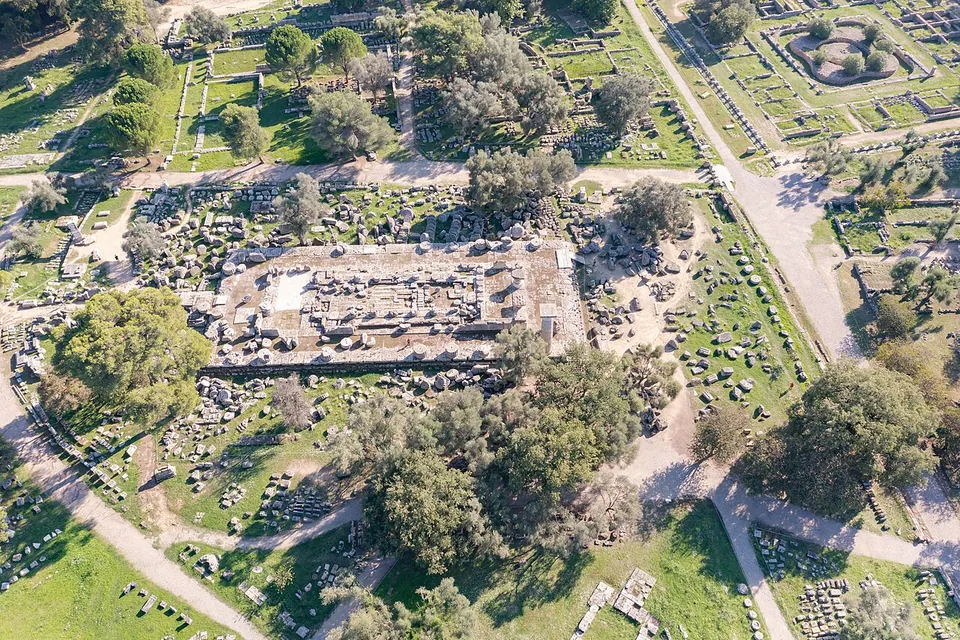
The sanctuary’s heart is Greek. The Temple of Zeus, built between 470 and 456 BC, still dominates the site; it once held Phidias’s gold-and-ivory statue of Zeus, one of the Seven Wonders of the Ancient World (the operator). Under Rome came new buildings and extensive repairs, including to the Temple of Zeus itself (en.wikipedia).
The Nymphaeum of Herodes Atticus was built in the middle of the 2nd century by Herodes Atticus and his wife Regilla, and it solved Olympia’s long-standing lack of water (the operator). It was an ornate fountain with statues at the end of an aqueduct: it took in the water and released it into channels running round the site, with troughs along the sides of the playing fields (en.wikipedia).
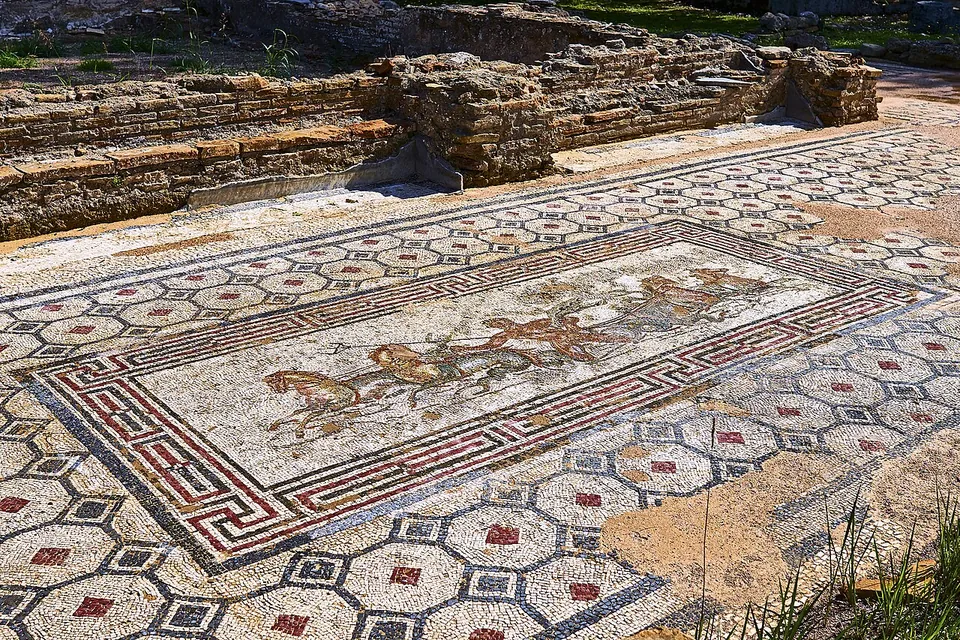
The baths. Around AD 100 new baths replaced the older Greek ones (en.wikipedia), and several were built in Roman times (de.wikipedia). Wikidata records four bath buildings at Olympia - the Kladeos, Kronion, East and South baths - and calls the South baths Roman. A floor mosaic of Triton among sea-horses survives in the Kronion baths (the photograph’s own description).
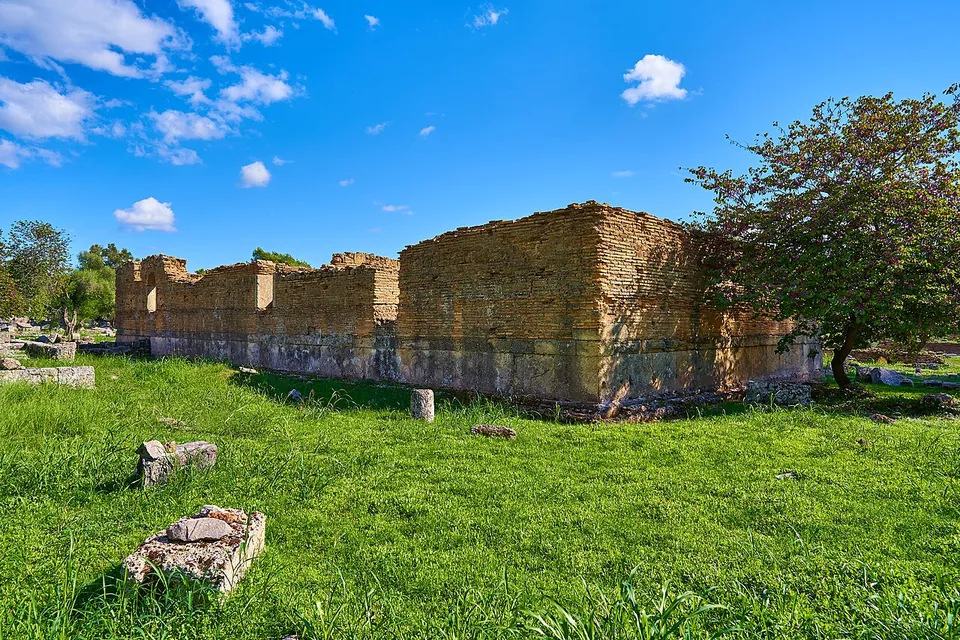
The Villa of Nero, south-east of the sanctuary, was built in 65–67 for the emperor’s stay when he drove in the chariot race of the Olympiad of AD 67. Nero walled it off from the sacred precinct and built a luxurious house with a large peristyle, gardens and baths; it was later an official guesthouse. What stands is a 3rd-century rebuilding as public baths, the Southeastern Baths, centred on a vaulted octagonal hot room. A lead water pipe found here bears the inscription “ner. aug.”, for Nero Augustus (en.wikipedia).
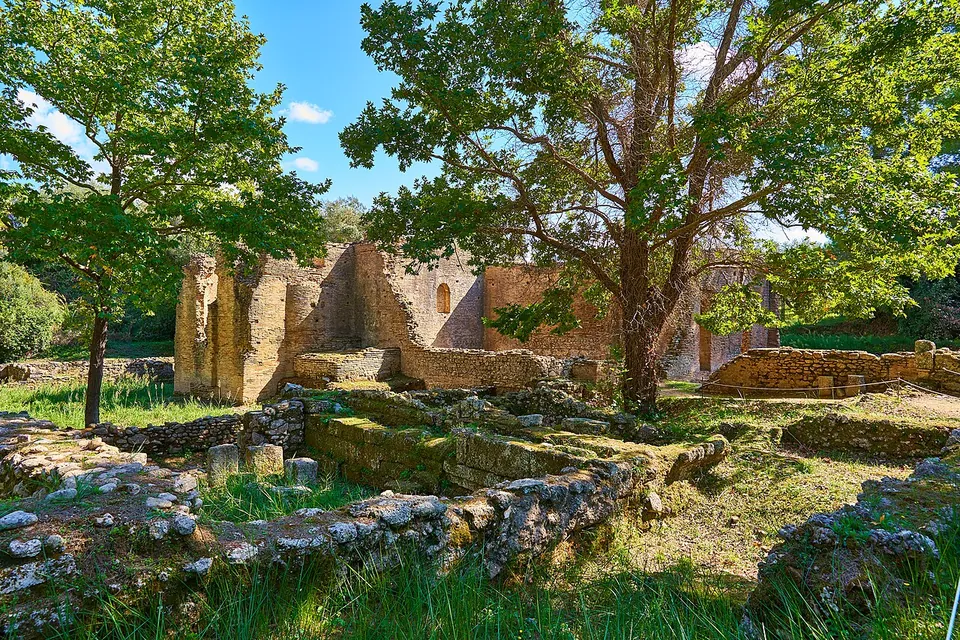
The workshop of Phidias, just outside the sanctuary, is where he made the statue of Zeus (the operator). After the end of the Games it was turned into a church (en.wikipedia).
Is it worth the trip?
Yes. This was the most important sanctuary of ancient Greece (the operator), and it is a large site: seeing all of it means a lot of walking (en.wikipedia). The Roman buildings are a real layer here - baths, the Nymphaeum and Nero’s villa - but they sit around a sanctuary that is Greek at its core. The €20 ticket covers the site and three museums for the day, and there is no cheaper ticket for the site alone (the Ministry).
Getting there
The site is next to the modern town of Archaia Olympia. It is about three and a half hours by car from Athens and an hour and twenty-five minutes from Patras (the operator). The river Kladeos forms the site’s western edge, and visitors cross a bridge to reach the main gate (en.wikipedia).
It opens daily from 08.00. From 1 April to 31 August it closes at 20.00; through September and October closing comes earlier in steps, to 18.00 in the second half of October; from 1 November to 31 March it opens 08.30–15.30. Last entry is 20 minutes before closing. It is shut on 1 January, 25 March, 1 May, Easter Sunday and 25–26 December, with shorter hours on Good Friday and Holy Saturday. A ticket is €20, reduced €10; entry is free on 6 March, 18 April, 18 May, the last weekend of September, 28 October, and on the first and third Sunday of each month from November to March (hh.gr and the Ministry’s site guide, read 9 October 2026 — check before travelling). Eating and drinking are not allowed on the site.
Visiting details
- Opening hours
- Daily 08.00–20.00 from 1 April to 31 August, then closing earlier through the autumn (19.30 in early September, 18.00 by late October); 08.30–15.30 from 1 November to 31 March. Last entry 20 minutes before closing. Closed 1 January, 25 March, 1 May, Easter Sunday and 25–26 December; shorter hours on Good Friday and Holy Saturday.
- Tickets
- €20; reduced €10. One ticket, valid for one day, covers the archaeological site and three museums (the Archaeological Museum, the Museum of the History of the Olympic Games in Antiquity and the Museum of the History of the Excavations); there is no ticket for the site alone. Free on 6 March, 18 April, 18 May, the last weekend of September and 28 October, and on the first and third Sunday of each month from November to March.
- Parking
- The operator lists parking among the site's amenities.
Before you go
- Eating and drinking are not allowed on the site (the Ministry's operating rules).
- Seeing the whole site means a lot of walking (en.wikipedia); the Ministry recommends footwear suitable for walking.
Hours and prices checked 9 October 2026 on the operator's own site. Confirm before travelling.
History
In the Roman period the Games were opened to all citizens of the Roman Empire. The Nymphaeum was built in 150 and an aqueduct in 160 (en.wikipedia). In the 3rd century a series of earthquakes did heavy damage, and after invaders struck in 267 the centre of the site was fortified with stone taken from its monuments (en.wikipedia).
The Games went on until the last Olympiad in 393, after which the emperor Theodosius I banned them (en.wikipedia; the operator). The Temple of Zeus was apparently destroyed around 426, under an edict of Theodosius II enforcing the ban on pagan festivals. A Christian community then lived on the site, until plague and two earthquakes devastated it in the middle of the 6th century; repeated floods drove out the last settlers in the early 7th century (en.wikipedia).
More photographs


Sources
Every fact on this page comes from the records below, each used under the licence noted.
| Source | Licence |
|---|---|
| Pleiades 570531 | CC BY |
| Wikidata Q38888 | CC0 |
| Vici.org 26001 | CC BY-SA (text), CC0 (metadata) |
| OpenStreetMap way/39984003 | ODbL |
| Wikipedia (en) — Olympia, Greece | CC BY-SA 4.0 |
| Wikipedia (de) — Olympia (Griechenland) | CC BY-SA 4.0 |
| Wikipedia (en) — Nymphaeum (Olympia) | CC BY-SA 4.0 |
| Wikipedia (en) — Villa of Nero | CC BY-SA 4.0 |
| Wikidata — Kronion baths (Q23869523) | licence not recorded |
| Wikidata — Olympia South baths (Q23869519) | licence not recorded |
| Wikidata — Kladeos baths (Q23869521) | licence not recorded |
| Wikidata — Olympia East Baths (Q23869520) | licence not recorded |
| Wikipedia (en) — Achaia (Roman province) | CC BY-SA 4.0 |
| Hellenic Heritage (H.O.C.R.E.D., for the Ministry of Culture) — Ancient Olympia, hours and tickets | licence not recorded |
| Ministry of Culture and Sports (Odysseus) — Olympia, information | licence not recorded |