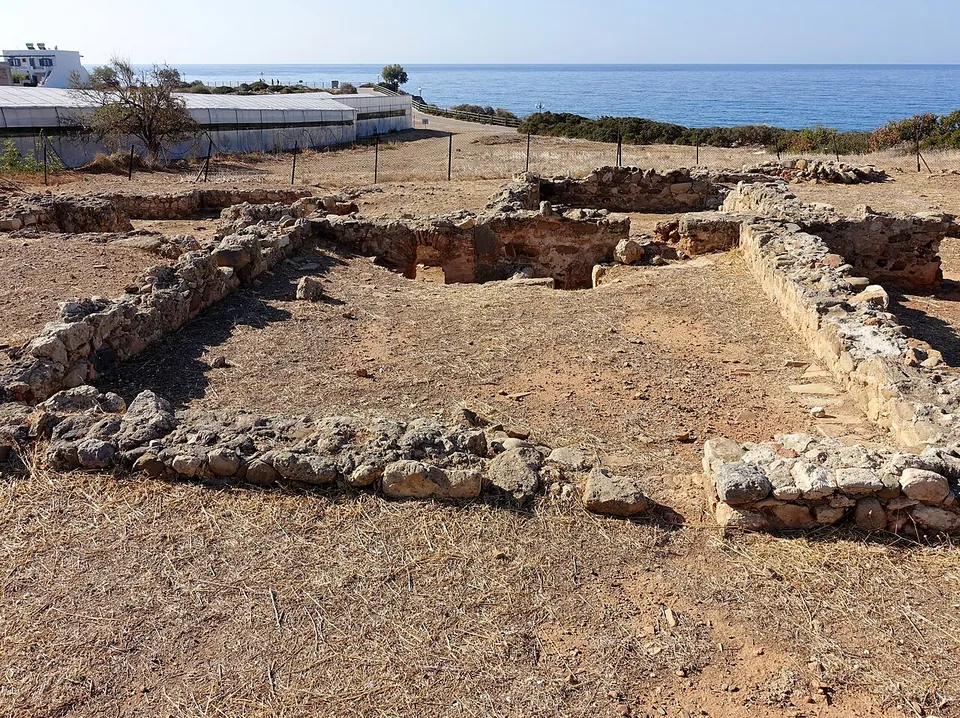
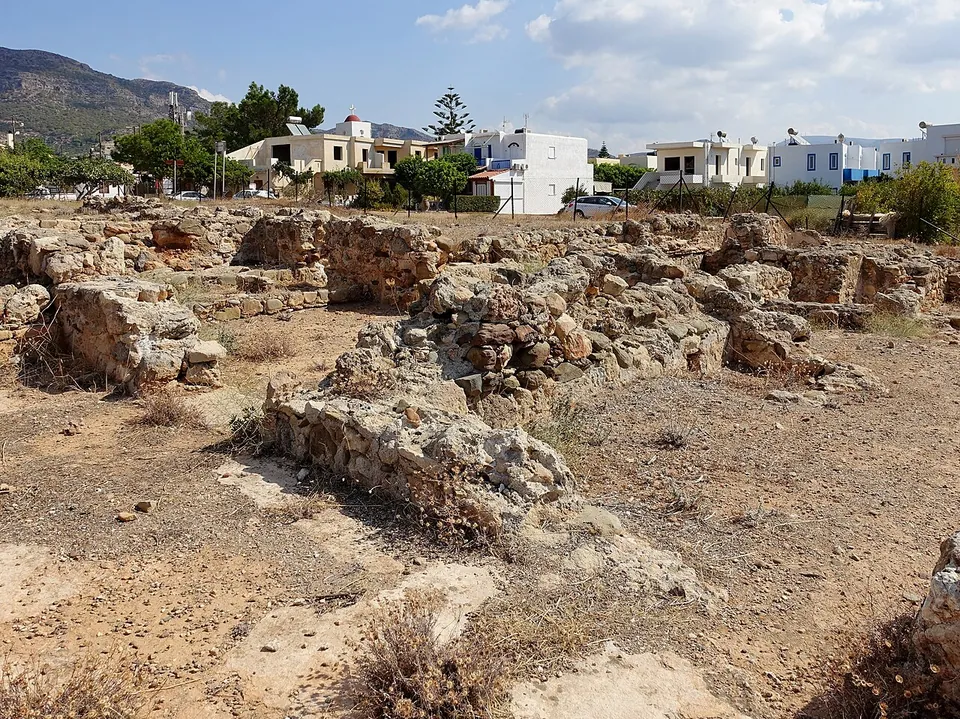
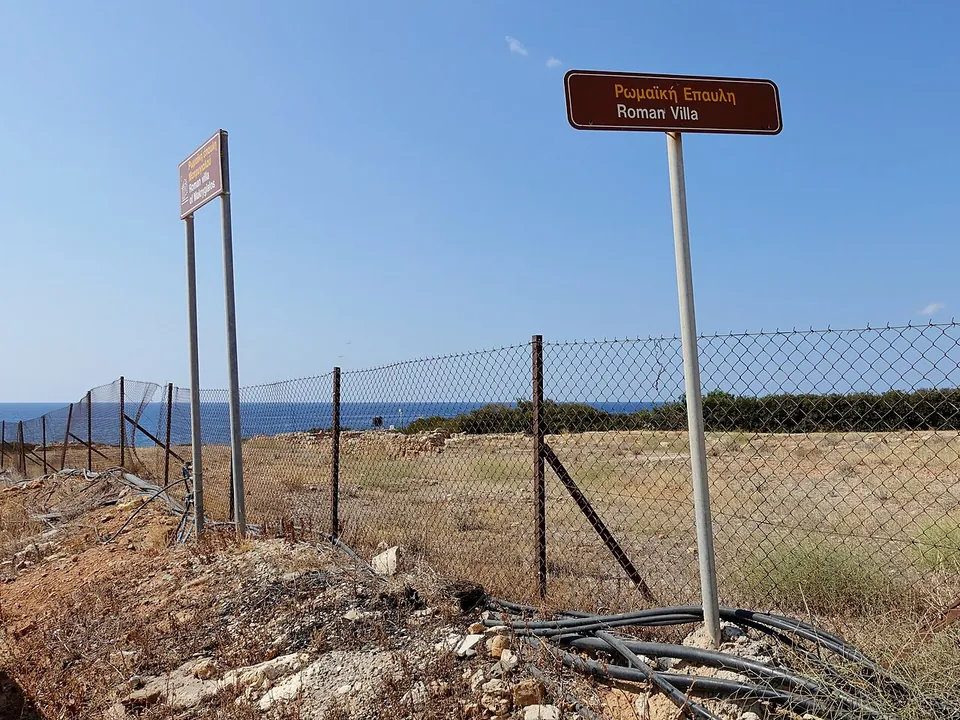


The Roman villa of Makrygialos is the excavated plan of a large Roman building of the 1st century BC to the 3rd century AD, on the Katovigli headland, about 15 m above the sea at the western edge of the village of Makrygialos, in the south-east of Crete (de.wikipedia). What a visitor sees is low walls in a fenced field above the sea.
What is there today
The excavation covers 1,500 m². In Roman times a building stood here with its rooms around an open courtyard; a large, richly fitted room served as a reception hall. A mosaic floor with geometric and floral motifs lay at the entrance, the main rooms had walls faced and floors paved with marble, and in the south-east corner a bath suite had a horseshoe-shaped pool, 3.90 by 3.15 m, with a marble floor and steps; outside it, to the west, lay a large geometric mosaic. Channels and pipes brought water from cisterns to the bath, and the house had a burial room with a tomb chamber (de.wikipedia). Today the low walls of the rooms remain; the photographs show no mosaics or marble on view.
Is it worth the trip?
Only as a short stop if you are staying in Makrygialos: the plan of a rich Roman house in a fine position above the bay, but little more than foundations, behind a fence whose opening hours no source publishes (de.wikipedia; the photographs).
Getting there
The site is on the Katovigli headland, 70 m north of Kalamokanias beach and 110 m west of the harbour; the entrance to the fenced excavation is 50 m south-east of the church of the Dormition (de.wikipedia). Car parks are mapped close by, and a bus stop about 300 m away (OpenStreetMap).
Visiting details
- Tickets
- Unknown
- Parking
- On the Katovigli headland at the western edge of Makrygialos, 110 m west of the harbour; the entrance to the fenced site is 50 m south-east of the church of the Dormition (de.wikipedia). Car parks are mapped within about 70–140 m (OSM way/1084057520) and a bus stop about 300 m away (node/14081639079). No operator publishes hours or a fee.
History
The British archaeologist John Pendlebury identified a Roman settlement here in the 1930s, and a 4th-century tombstone was found in 1937. Nikos Papadakis excavated the villa from 1976 to 1980. The near absence of finds in the ruins points to systematic looting, in modern times or already from the end of antiquity into the Middle Ages. An over-life-size marble head of the emperor Hadrian found here is in the Archaeological Museum of Sitia (de.wikipedia).
Sources
Every fact on this page comes from the records below, each used under the licence noted.
| Source | Licence |
|---|---|
| Wikidata Q27187818 | CC0 |
| OpenStreetMap node/271650554 | ODbL |
| Wikipedia (de) — Römische Villa von Makrygialos | CC BY-SA 4.0 |
| Wikipedia (en) — Crete and Cyrenaica | CC BY-SA 4.0 |