

What is there today
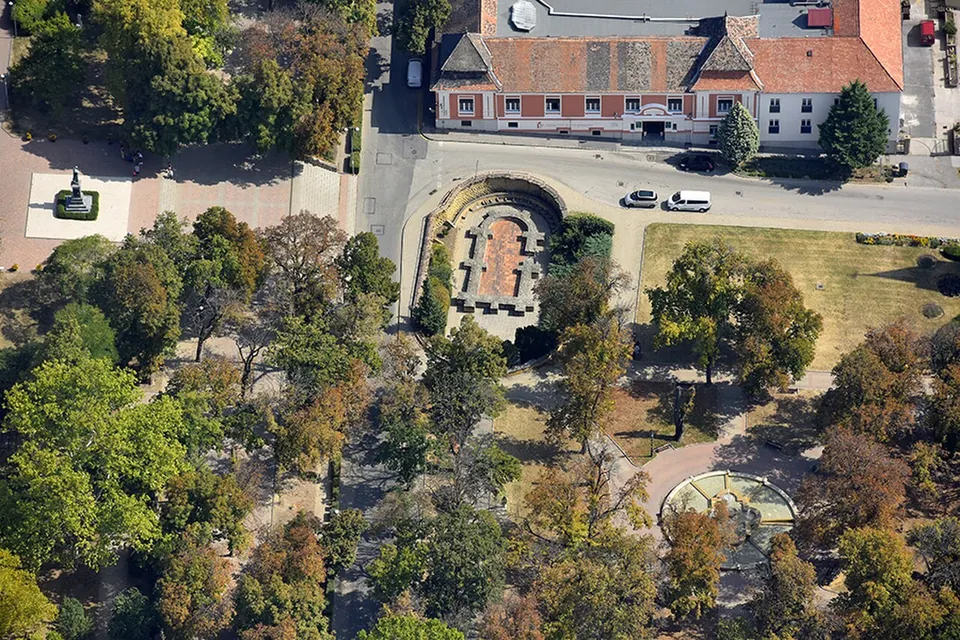
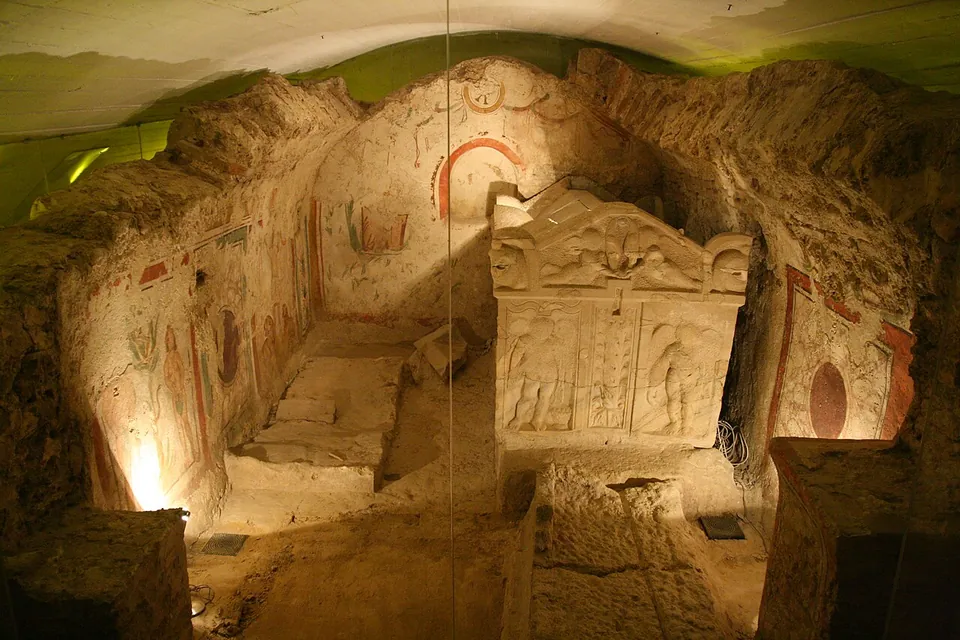
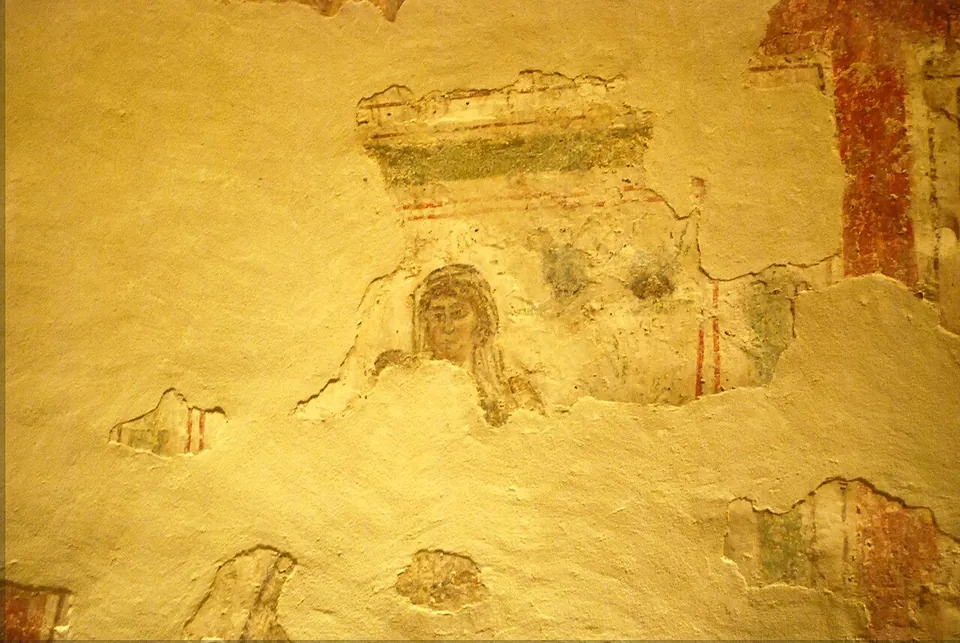
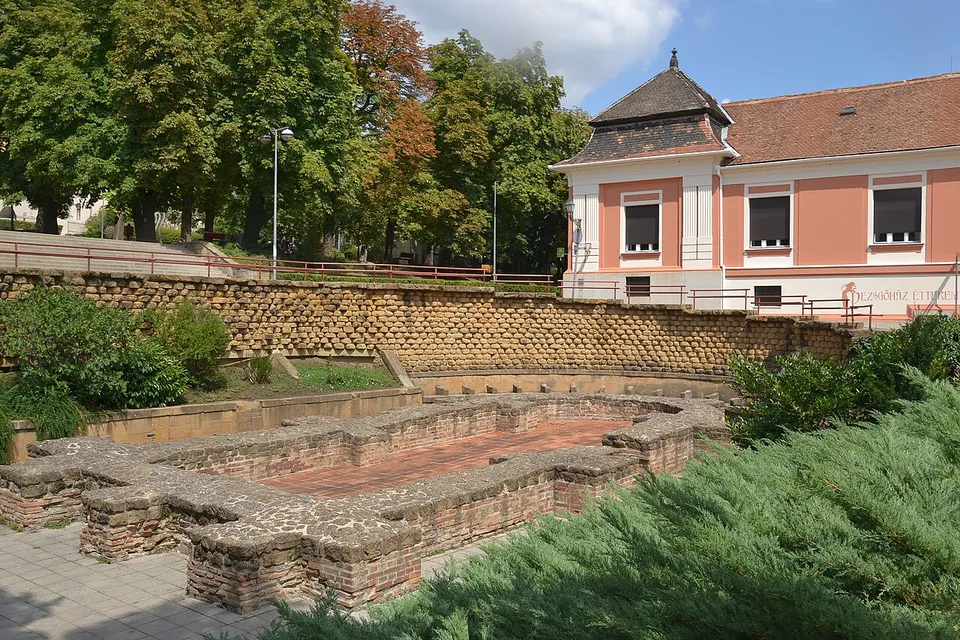
The late Roman tomb monuments under the cathedral square are brought together in the Cella Septichora Visitor Centre. Most of the chambers were the tombs of wealthy families, alongside larger communal vaults, and they were built in two storeys: an underground crypt where the dead were laid in brick graves or, more rarely, sarcophagi, and a memorial chapel above it, used for both burial and ceremony. Some are painted inside with biblical scenes and early Christian symbols. On view are six of these two-storey chambers (I, II, III, IV, XIX and XX) and two larger single-room buildings, the seven-lobed Cella Septichora and chamber V; the Peter and Paul chamber is reached from chamber IV, and the Jug chamber has its own wall paintings. The Early Christian Mausoleum and the tombs at Apáca utca 8 stand separately within the World Heritage site (the operator).
Archaeologists have uncovered 16 burial chambers, several hundred graves and thousands of late Roman objects here since the 18th century, and the figural and ornamental wall paintings of the chambers are comparable only with the painting of the catacombs of Rome (hu.wikipedia).
Is it worth the trip?
Yes. It counts among the most significant Roman cemeteries outside Italy (en.wikipedia), the painted tombs are the real thing, underground and lit, and one two-day ticket covers all of it. It sits in the middle of Pécs, so it combines easily with the rest of the old town.
Getting there
The visitor centre is on Sétatér, by the cathedral square (Dóm tér) in the centre of Pécs (the operator), with paid car parks about 80 to 130 m away (OpenStreetMap).
The visitor centre is open Tuesday to Sunday, from 10.00 to 18.00 between 1 April and 3 November (last ticket 17.30) and from 10.00 to 17.00 in winter (last ticket 16.30); the Early Christian Mausoleum keeps the same days, closing at 17.45 in summer. Both close on 1 November. The World Heritage ticket, valid for two days, covers the visitor centre, the mausoleum and the Apáca utca 8 tombs: 3,900 HUF, about €10.60; 2,500 HUF, about €6.80, for students, pensioners and teachers; and 10,000 HUF, about €27.10, for a family of two adults and two children. Under-sixes go free. The Apáca utca 8 tombs are seen on accompanied visits, which in 2026 leave at 13.00 and 16.00 from Tuesday to Sunday, and on a Sunday guided tour at 11.00 from the visitor centre (vilagoroksegpecs.hu, read 4 October 2026).
Visiting details
- Opening hours
- Cella Septichora Visitor Centre - 1 April to 3 November, Tuesday to Sunday 10.00–18.00 (last ticket 17.30); 4 November to 31 March, Tuesday to Sunday 10.00–17.00 (last ticket 16.30). Early Christian Mausoleum - Tuesday to Sunday 10.00–17.45 in summer, 10.00–17.00 in winter. Closed on Mondays and on 1 November.
- Tickets
- World Heritage ticket, covering the visitor centre, the Early Christian Mausoleum and the Apáca utca 8 tombs, 3,900 HUF (about €10.60); students, pensioners and teachers 2,500 HUF (about €6.80); family 10,000 HUF (about €27.10); valid for two days; free under 6.
- Parking
- Paid car parks about 80–130 m away (OpenStreetMap).
Before you go
- Closed on Mondays. The Apáca utca 8 tombs are seen only on accompanied visits, at set times.
Hours and prices checked 4 October 2026 on the operator's own site. Confirm before travelling.
History
The necropolis is part of a cemetery of the ancient town of Sopianae, modern Pécs (de.wikipedia), where the early Christian inhabitants of the town were buried in the 4th century (hu.wikipedia). Stone-built tombs were not usual in the late Roman cemeteries of the northern and western provinces, and what sets Sopianae’s apart is how many of them were built here (the operator).
The first burial chamber was found in the early 18th century in the courtyard of today’s Nagy Lajos Gimnázium, though only written records of it survive. In 1782 the Peter and Paul chamber came to light, the first early Christian monument to survive to the present. The chambers were partly restored in the first half of the 20th century, and in 2000 excavation began on an octagonal chamber with a unique plan (hu.wikipedia). UNESCO added the necropolis to the World Heritage List on 30 November 2000, for its size, its architecture, its art and its witness to the spread of Christianity in the late Roman Empire (en.wikipedia; hu.wikipedia).
More photographs

Sources
Every fact on this page comes from the records below, each used under the licence noted.
| Source | Licence |
|---|---|
| Pleiades 565807319 | CC BY |
| Wikidata Q927535 | CC0 |
| OpenStreetMap node/1118545754 | ODbL |
| Pleiades — Sopianae (the Roman town) | licence not recorded |
| Wikipedia (en) — Early Christian Necropolis of Pécs | CC BY-SA 4.0 |
| Wikipedia (hu) — Pécsi ókeresztény sírkamrák | CC BY-SA 4.0 |
| Wikipedia (de) — Frühchristlicher Friedhof von Pécs | CC BY-SA 4.0 |
| Világörökség Pécs — Cella Septichora Visitor Centre (the operator, Zsolnay Örökségkezelő) | licence not recorded |
| Világörökség Pécs — opening hours | licence not recorded |
| Világörökség Pécs — tickets | licence not recorded |