

What is there today
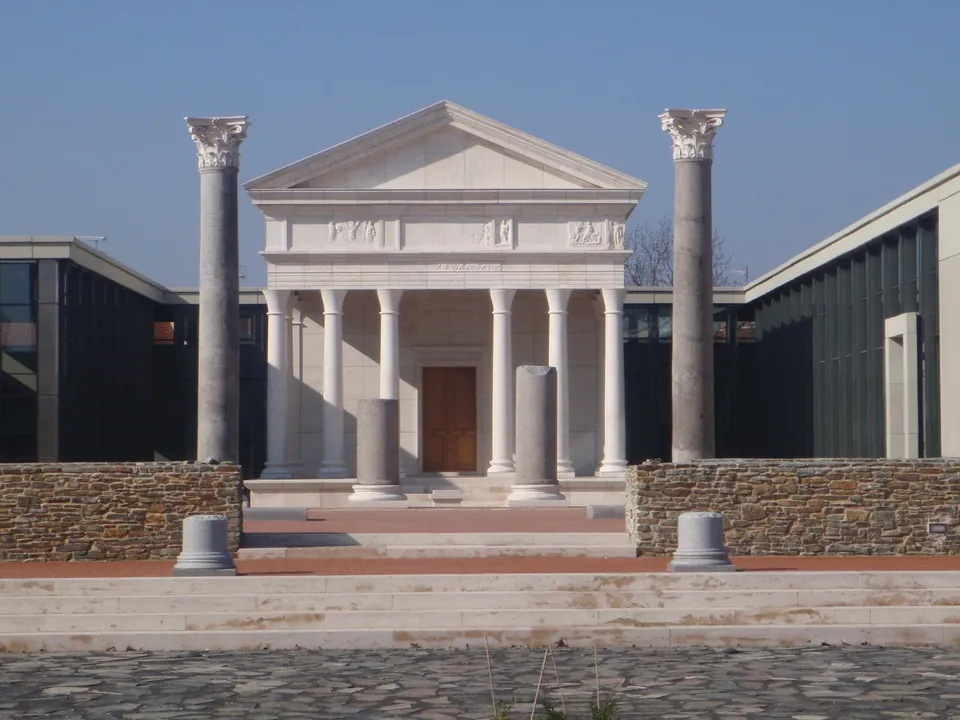
The Iseum Savariense, on Rákóczi Ferenc utca, is the sanctuary of the Egyptian goddess Isis. A partial reconstruction of it was completed in August 2010, and the Savaria Museum’s display of the most important finds from the town and its surroundings is attached to it (de.wikipedia). What you see is a rebuilt temple front between modern museum wings (the photograph).
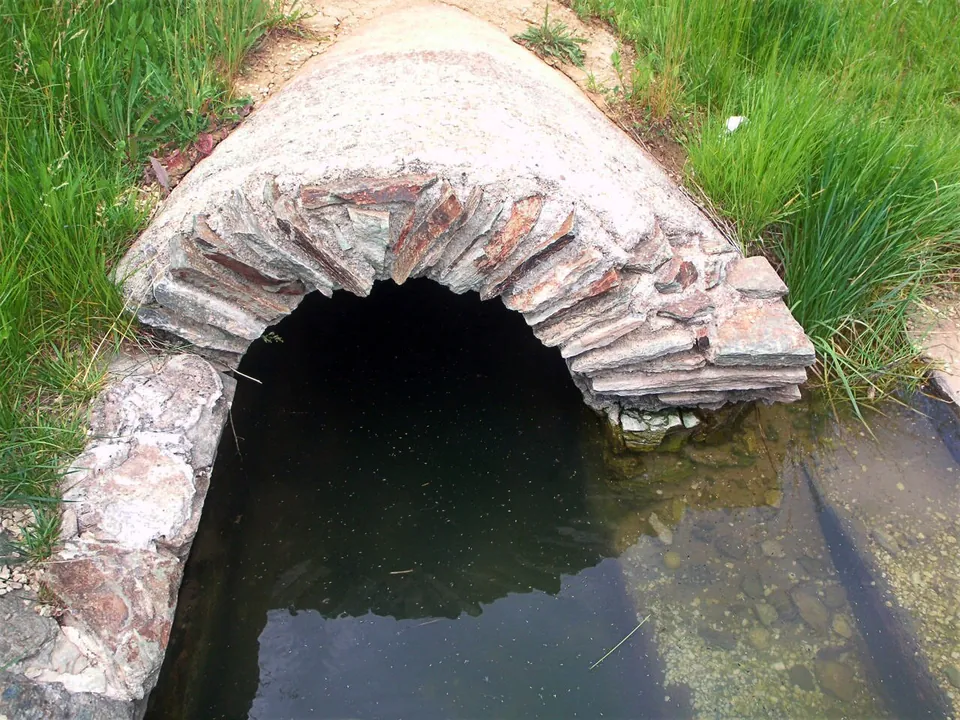
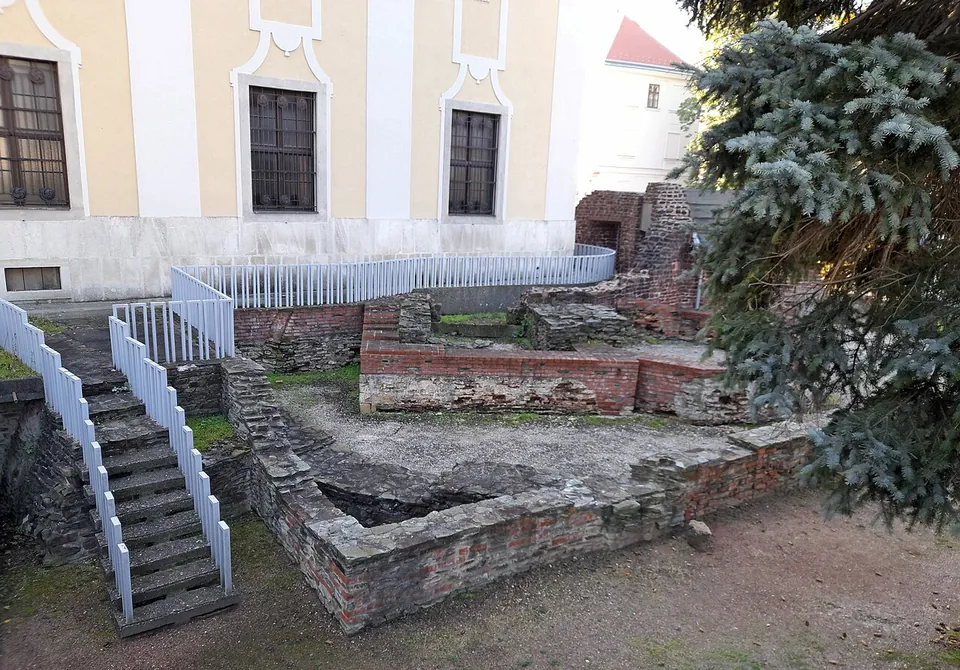
The Járdányi Paulovics István ruin garden, about 250 m from the town-wall remains at the centre, shows significant building remains of the Roman town, including stretches of ancient street paving from the Amber Road (de.wikipedia). Remains of the town wall are also mapped in the centre (OpenStreetMap), and outside the town a section of the aqueduct, about 26 km long, survives beside the road at Bucsu (Commons file description), with further remains near Bozsok (de.wikipedia).
The town also had a sanctuary of Mithras (Wikidata; hu.wikipedia); no source records remains of it on show.
Is it worth the trip?
For the Iseum, yes, if you are in western Hungary: it is a partly rebuilt Roman temple and a museum of the town’s finds under one roof, open most days of the year. The ruin garden, with the original remains, is much harder to see: it opens only from April to September, three days a week, on guided visits. Check its dates before you plan around it; its 2026 season ended on 30 September.
Getting there
Both sites are in central Szombathely, within a few minutes’ walk of each other and of the main square, Fő tér (OpenStreetMap). The Iseum Savariense museum is at Rákóczi Ferenc utca 2; there is paid parking in the centre.
The Iseum is open from 1 April to 31 October, Tuesday to Sunday, 10.00 to 18.00, and the rest of the year, from 7 January, Wednesday to Sunday, 09.00 to 17.00; it closes on public holidays. A ticket is 2,000 HUF, about €5.40; reduced 1,000 HUF, about €2.70; a family ticket 3,000 HUF, about €8.10. The ruin garden is open from 2 April to 30 September, Thursday to Saturday, only on guided visits at 10.30, 14.00 and 16.00; a ticket is 1,000 HUF, about €2.70, reduced 500 HUF (savariamuseum.hu, read 4 October 2026; check before travelling, since prices move).
Visiting details
- Opening hours
- Iseum Savariense - 1 April to 31 October, Tuesday to Sunday 10.00–18.00; 7 January to 31 March and 1 November to 31 December, Wednesday to Sunday 09.00–17.00; closed on public holidays. Ruin garden - 2 April to 30 September, Thursday to Saturday, guided visits only at 10.30, 14.00 and 16.00.
- Tickets
- Iseum Savariense 2,000 HUF (about €5.40), reduced 1,000 HUF (about €2.70), family 3,000 HUF (about €8.10). Ruin garden 1,000 HUF (about €2.70), reduced 500 HUF (about €1.40).
Before you go
- The ruin garden is open only from early April to the end of September, three days a week, and only on guided visits.
Hours and prices checked 4 October 2026 on the operator's own site. Confirm before travelling.
History
Savaria, in full Colonia Claudia Savaria, was founded under Claudius (41–54) as a colony of veterans (de.wikipedia), the earliest town of colonial rank on the territory of today’s Hungary and a station on the Amber Road (hu.wikipedia). Early in the 2nd century it became the civil administrative centre of Upper Pannonia and grew into an influential city, owing its wealth most probably in part to the Amber Road that ran through it (de.wikipedia). From the 2nd century it was the religious centre of Pannonia Superior, and later the seat of the province of Pannonia Prima (hu.wikipedia). The Iseum was built in the 1st century and substantially renovated under Septimius Severus (de.wikipedia).
Savaria is named as the birthplace of Saint Martin, bishop of Tours (hu.wikipedia; de.wikipedia gives it as probable, around 316–317). The town was devastated by an earthquake on 7 September 456 (de.wikipedia) and destroyed in the Migration Period (hu.wikipedia).
Sources
Every fact on this page comes from the records below, each used under the licence noted.
| Source | Licence |
|---|---|
| Pleiades 197498 | CC BY |
| Wikidata Q3944220 | CC0 |
| OpenStreetMap way/574879808 | ODbL |
| Wikipedia (de) — Savaria | CC BY-SA 4.0 |
| Wikipedia (hu) — Savaria | CC BY-SA 4.0 |
| Wikipedia (hu) — Mithrász-szentély (Fertőrákos) (lists Szombathely among Hungary's mithraea) | CC BY-SA 4.0 |
| Savaria Museum — ticket information (the operator) | licence not recorded |
| Iseum Savariense — opening hours (the operator) | licence not recorded |
| Járdányi Paulovics István Romkert — opening hours (the operator) | licence not recorded |