

Akragas is the ancient city below modern Agrigento, founded by Greek settlers in about 582 BC and renamed Agrigentum once Rome had won it in the Punic Wars. Its ridge of Doric temples, the Valle dei Templi, is the reason most people come; under Rome the town was resettled and some of its temples were repaired, and Roman houses, a small temple and a tomb monument from those centuries can still be seen.
What is there today
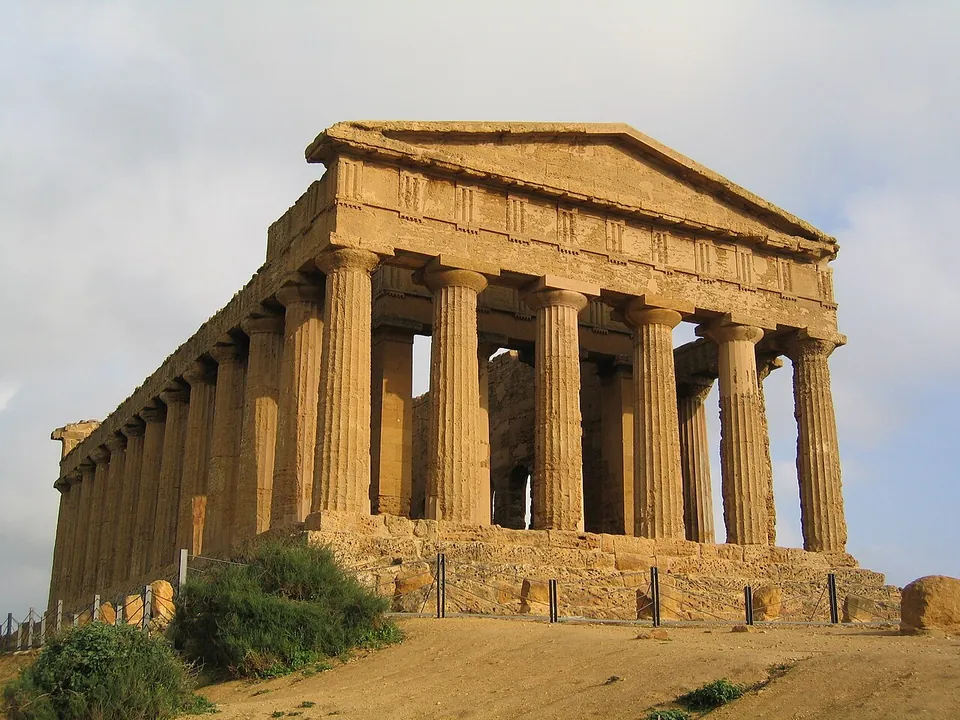
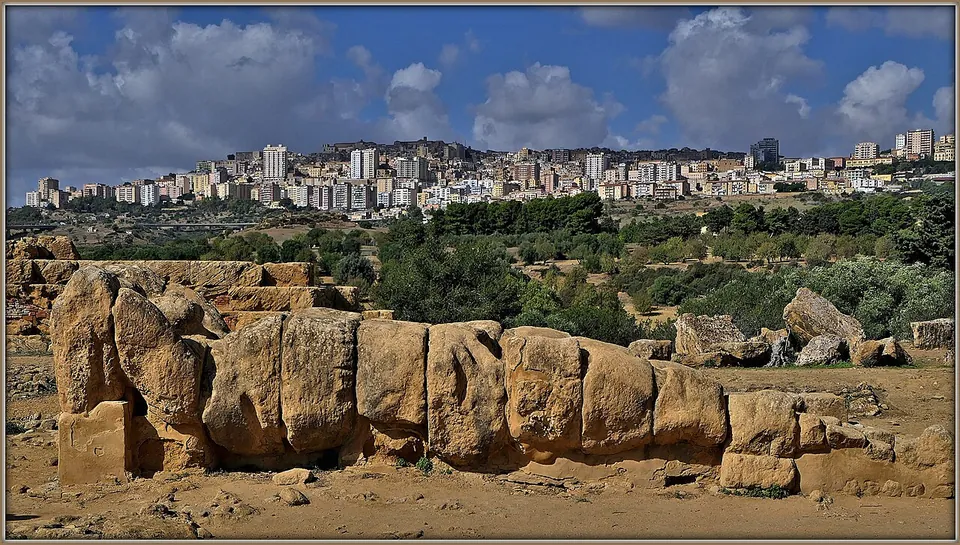
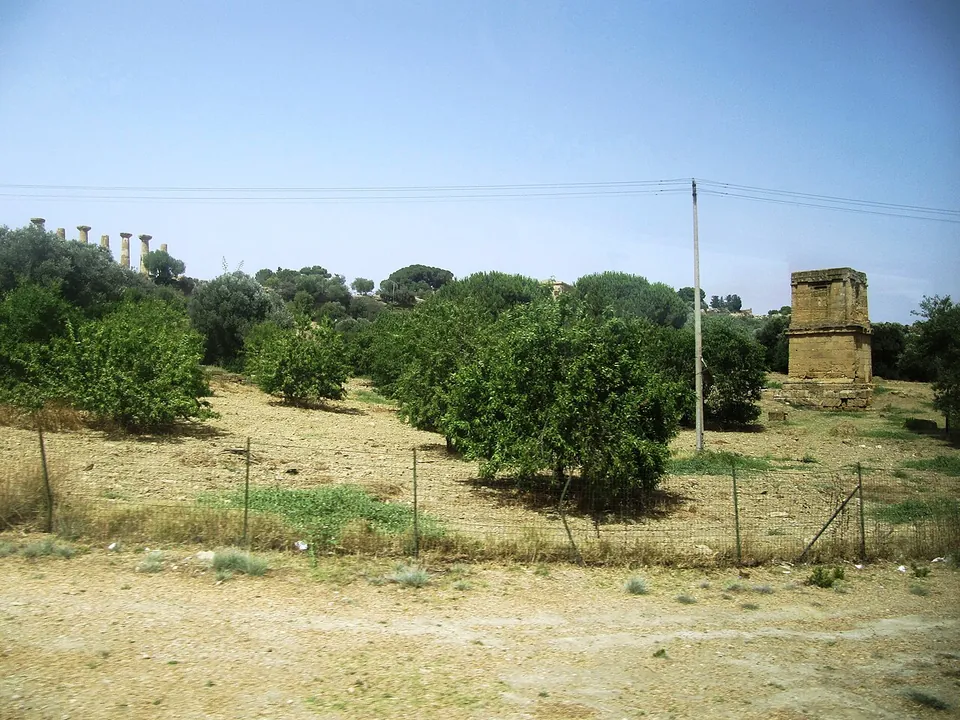
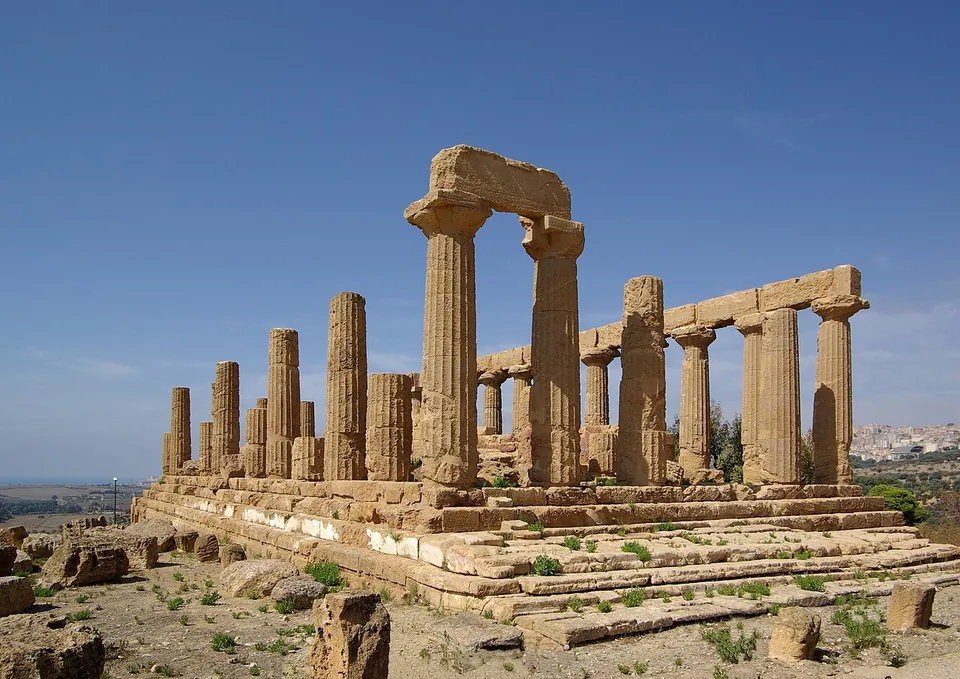
The temple ridge. The temples stand in a line along the southern edge of the ancient city, on a ridge that is called a valley only because the modern town looks down on it (de.wikipedia). The so-called Temple of Concordia, built about 440–430 BC, counts among the best-preserved Greek temples anywhere: it survived almost intact because it was used as a church from 597 until it was deconsecrated in 1748. Of the so-called Temple of Juno (Hera), 25 of its 34 columns stand, those on the north side still carrying their capitals and architrave. The Temple of Heracles has a row of columns re-erected in the 20th century (eight by de.wikipedia’s count, nine by en.wikipedia’s), and the Temple of Olympian Zeus, once the largest Doric temple ever built, is now a field of fallen blocks with a replica of one of its stone giants, nearly eight metres tall, laid on the ground (de.wikipedia). The road through the old Gate IV divides the park in two: the Temple of Olympian Zeus, the corner of the Temple of the Dioscuri and the sanctuary of the chthonic deities lie to the west, Heracles, Concordia and Juno to the east (de.wikipedia).
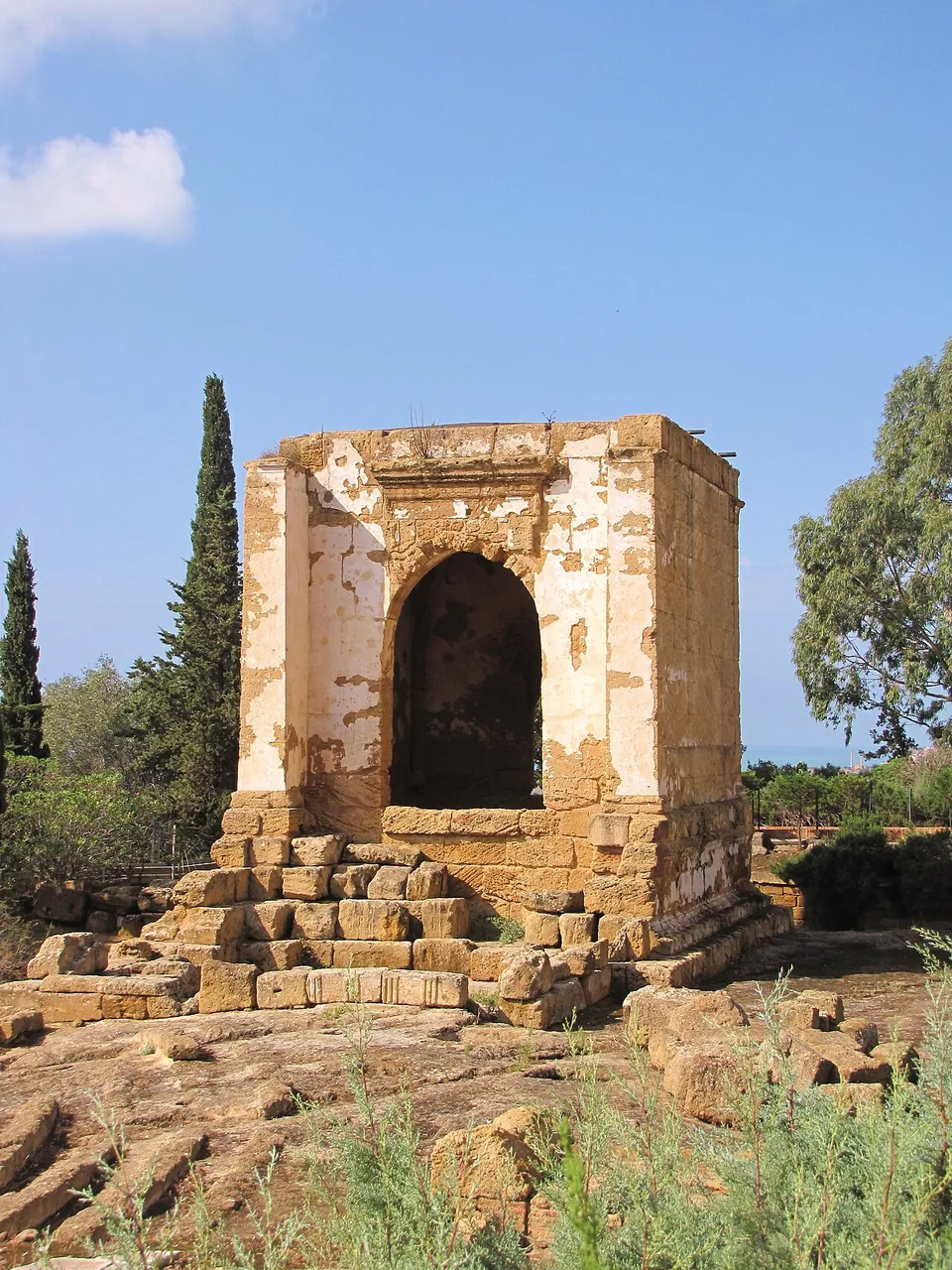
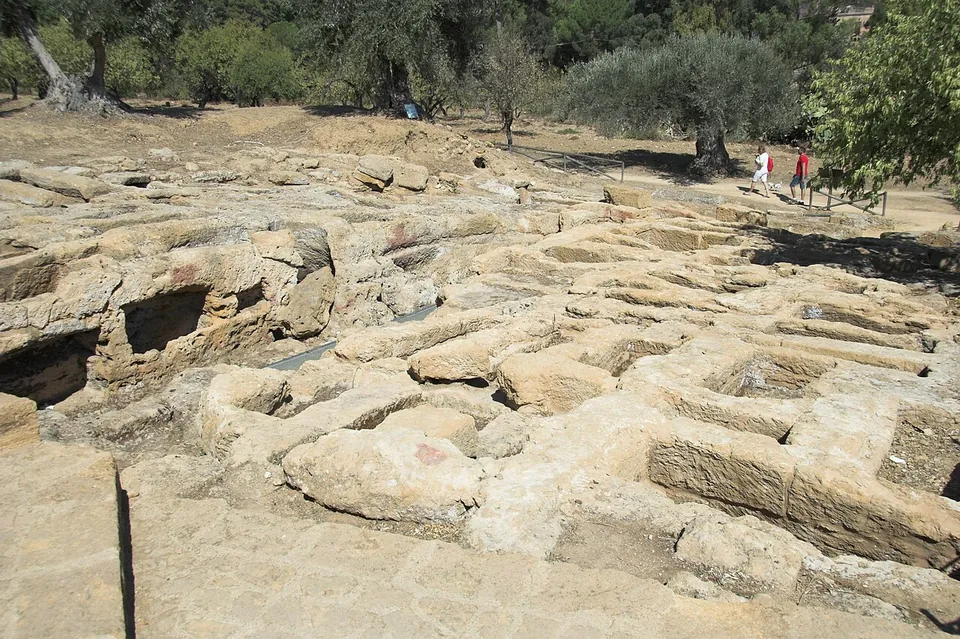
The Roman town. Rome built no great temples of its own here; it rebuilt some of the destroyed ones and rededicated them (de.wikipedia). The Temple of Juno, burned by the Carthaginians in about 406 BC, was repaired under Roman rule (de.wikipedia; en.wikipedia), and the cella of the Temple of Heracles was divided into three in a Roman restoration (en.wikipedia; it.wikipedia). Around the Temple of Concordia lies an early Christian cemetery whose oldest graves, cut into the rock, date from the 3rd to 5th centuries AD (de.wikipedia). Outside Gate IV stands the so-called Tomb of Theron, which has nothing to do with the tyrant: it was put up in about 75–70 BC, probably as a memorial to a leading citizen, a square base carrying a storey with false doors and Ionic corner columns (de.wikipedia).
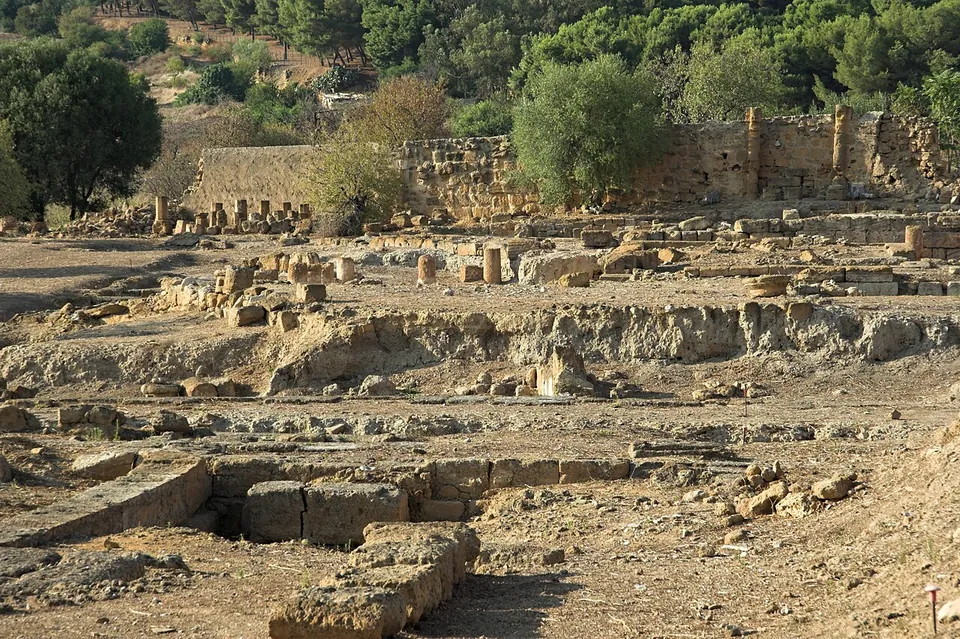
The other Roman sights are up by the archaeological museum, about a kilometre north of the temple ridge. East of the museum’s hill an excavated quarter of the Hellenistic and Roman town keeps its street grid, peristyle houses and Italic atrium houses, one of them with its own baths, and the simpler geometric floor mosaics are still in place; the finer ones went to the museum (de.wikipedia). Beside the old assembly place stands the so-called Oratory of Phalaris, a small temple of the 2nd century BC on a podium; de.wikipedia calls it the only cult building newly built in Roman times, though it.wikipedia records a temple of Isis of the 2nd century AD on the northern terrace of the upper agora, which would be the only one found in Sicily. The museum itself shows finds from the prehistoric to the Roman period, among them a Roman child’s sarcophagus carved with the grieving parents and scenes from the child’s life (de.wikipedia).
Is it worth the trip?
Yes, without reservation, but be clear what you are coming for. The temples are Greek, and they are why UNESCO listed the site in 1997, calling the row of Doric temples one of the most outstanding monuments of Greek art and culture (de.wikipedia). The Roman chapter is a quieter one: a residential quarter, a small temple, a tomb and Roman repairs to the Greek buildings. Next to the Greek temples it is modest, but anyone travelling in Sicily should not miss the site. The park is large: the walls enclosed about 450 hectares (de.wikipedia), so allow for walking, and for the museum and the Roman quarter, which lie about a kilometre from the temples.
Getting there
The park lies about 2.6 km below the centre of Agrigento. City buses 1, 2, 2/ and 3/ run to the Valle dei Templi from the Piazzale Rosselli bus station and from Agrigento Centrale railway station, about two hours by train from Palermo; drivers come by the SS640 or the SS115 to the Rotatoria Giunone, below the Temple of Juno, and park at Sant’Anna, where the Porta V ticket office is, or near the Temple of Juno (the operator’s ticket office). There are three ticket offices: at the Temple of Juno, at Porta V, and opposite the archaeological museum, the last closed from November to March. The operator suggests walking the whole via sacra from the Temple of Juno to Porta V, or, for a shorter visit, from the Temple of Juno to the Temple of Concordia and back.
The park is open every day from 08.30 to 20.00, with last entry at 19.00; in summer 2026 (20 June to 20 September) it stayed open in the evening, to 23.00 on weekdays and 24.00 on public holidays and the days before them. A ticket is €14, or €7 for EU citizens aged 18 to 25; under-18s go free, and everyone does on the first Sunday of the month. Until 31 October 2026 every paid ticket carries a €3 supplement for an exhibition. A combined ticket with the Pietro Griffo archaeological museum costs €19.20, and one with the Kolymbethra garden, in what was probably the city’s reservoir and is now planted with citrus, almond and olive trees, €20 (CoopCulture, the park’s ticket office, read 18 October 2026 — check before travelling). Entries are capped, so book online in advance; bicycles and scooters are not allowed.
Visiting details
- Opening hours
- Daily 08.30–20.00, last entry 19.00. From 20 June to 20 September 2026 the park also opened in the evening, to 23.00 Monday to Friday and to 24.00 on public holidays and the days before them (last entry an hour before closing).
- Tickets
- €14; €7 reduced (EU citizens aged 18–25, FAI members); free under 18 and on the first Sunday of each month. From 23 July to 31 October 2026 every paid ticket carries a €3 exhibition supplement. Combined tickets — with the Pietro Griffo archaeological museum €19.20 (reduced €9.60), with the Kolymbethra garden €20 (reduced €12).
- Parking
- Car parks at Sant'Anna, by the Porta V entrance, and near the Temple of Juno, both reached from the Rotatoria Giunone below that temple (the operator's ticket office).
Before you go
- Entries are capped and the operator's ticket office advises buying online in advance.
- Bicycles and scooters are not allowed in the park.
- The ticket office opposite the archaeological museum (Teatro Ellenistico) is closed from November to March; the Temple of Juno and Porta V offices remain.
Hours and prices checked 18 October 2026 on the operator's own site. Confirm before travelling.
History
Akragas was founded in about 582 BC (de.wikipedia; it.wikipedia gives about 581 BC) by settlers from Gela and Rhodes and, after the Greek victory at Himera in 480 BC, became the second city of Greek Sicily after Syracuse; most of the temples on the ridge went up in the second half of the 5th century BC. Carthage took and destroyed the city in 406 BC, and Timoleon resettled it after 340 BC (de.wikipedia).
Rome came to it in two steps. In the First Punic War the Romans besieged Akragas from 262 BC, took it in 261 BC and sold its people into slavery; Carthage recaptured it in 255 BC, and the peace that ended the war ceded it to Rome (en.wikipedia; de.wikipedia). Fought over again in the Second Punic War, it came finally under Roman rule in 210 BC and was renamed Agrigentum (de.wikipedia; en.wikipedia). It stayed largely Greek-speaking for centuries. Cicero counted it among the largest cities of Sicily, with a port and a sizeable community of Roman citizens living alongside the Greeks (en.wikipedia). Augustus made it a municipium (de.wikipedia), and an inscription records that Septimius Severus raised it to a colonia, “Colonia Septimia Augusta Agrigentorum” (en.wikipedia). In the imperial period the city prospered again; the Vandals brought new destruction from 439 (de.wikipedia).
The temple now called Concordia takes its name from a Roman inscription found nearby that speaks of concord among the people of Agrigentum; which god it served is unknown. In 597 Bishop Gregory turned it into a church of Saints Peter and Paul, cutting arches through the cella walls and walling up the spaces between the columns, and that is why it still stands (de.wikipedia; it.wikipedia). Under Byzantine rule the lower city emptied; faced with Arab raids, which began early in the 8th century, its people withdrew to the Girgenti hill, where the modern town stands (de.wikipedia; en.wikipedia).
More photographs




Sources
Every fact on this page comes from the records below, each used under the licence noted.
| Source | Licence |
|---|---|
| Pleiades 462086 | CC BY |
| Wikidata Q636774 | CC0 |
| OpenStreetMap way/39096127 | ODbL |
| Wikipedia (de) — Archäologische Stätten von Agrigent | CC BY-SA 4.0 |
| Wikipedia (en) — Agrigento | CC BY-SA 4.0 |
| Wikipedia (it) — Agrigento | CC BY-SA 4.0 |
| Wikipedia (it) — Tempio della Concordia (Agrigento) | CC BY-SA 4.0 |
| Wikipedia (en) — Temple of Hera, Agrigento | CC BY-SA 4.0 |
| Wikipedia (en) — Temple of Heracles, Agrigento | CC BY-SA 4.0 |
| Wikipedia (it) — Tempio di Iside (Agrigento) | CC BY-SA 4.0 |
| Parco Valle dei Templi — opening hours (the park's own site) | licence not recorded |
| CoopCulture — Valle dei Templi ticket, prices and hours (the ticket office the park's site links to) | licence not recorded |