

What is there today
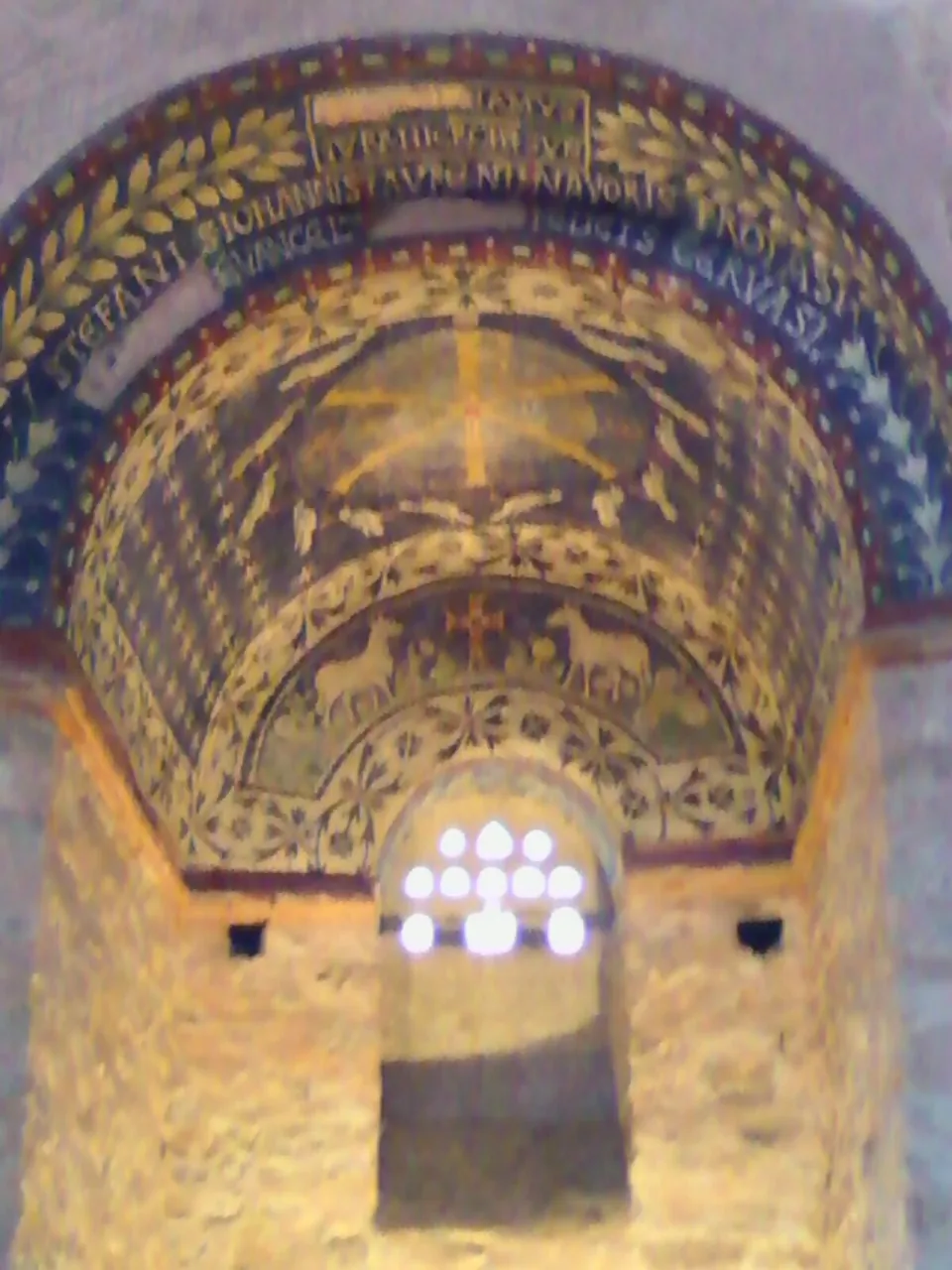
In the old town. The street grid still follows the Roman one: Via Medaglie d’Oro was the cardo and the line of Via Enrico d’Aste and Via Bernardo Ricci the decumanus (fr.wikipedia, it.wikipedia). The Roman ground level lies about 6 m below today’s, under the silt of the river Centa (it.wikipedia), so little of the town itself shows. The exception is the baptistery beside the cathedral, whose octagonal interior you reach by a stair that goes down to the level of the 5th-century town. Its date is published as either the 5th century or the late 5th to early 6th; the mosaic in the niche facing the entrance, with the monogram of Christ, twelve doves and two lambs at a jewelled cross, is dated to the 5th or 6th century and is well preserved (it.wikipedia, en.wikipedia).
Two museums hold what the excavations found. The Civic Museum in the old town hall shows Roman and Byzantine inscriptions, a 1st-century mosaic floor in its loggia and a plan of the Roman finds (it.wikipedia; the municipality). The Roman Naval Museum in Palazzo Peloso Cepolla was founded in 1950 for the cargo of a Roman ship of the 1st century BC that sank off Albenga: more than a thousand amphorae were raised that year under Nino Lamboglia, and the museum shows them with helmets, pottery and parts of the hull (it.wikipedia; the municipality). Published estimates of the full cargo run from about 10,000 to 13,000 amphorae.
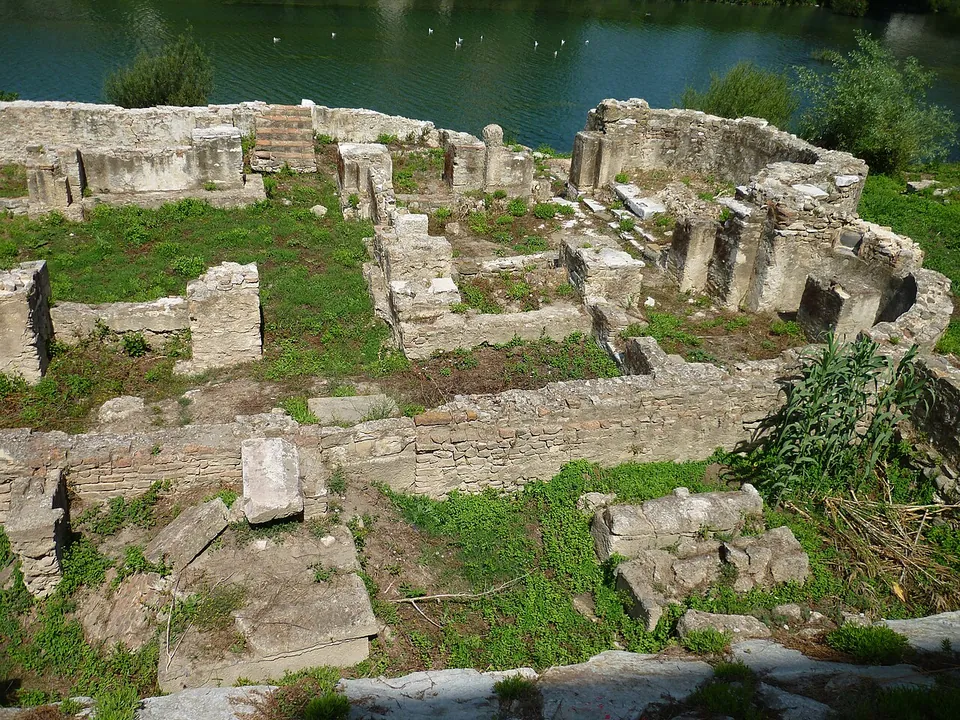
In the river bed. South of the old town, the Centa runs over a Roman bath complex covering about 0.2 hectares, built between the late 1st and the early 3rd century. Its first walls came to light in 1910 and the complex was uncovered in 2000–2001, when the river’s banks were widened; an early Christian complex of the 4th or 5th century with an octagonal font, and later the 13th-century church of San Clemente, were built on top of it (it.wikipedia, fr.wikipedia, the municipality). The municipality says that most of what is visible belongs to the medieval church, and that floods are destroying the area.
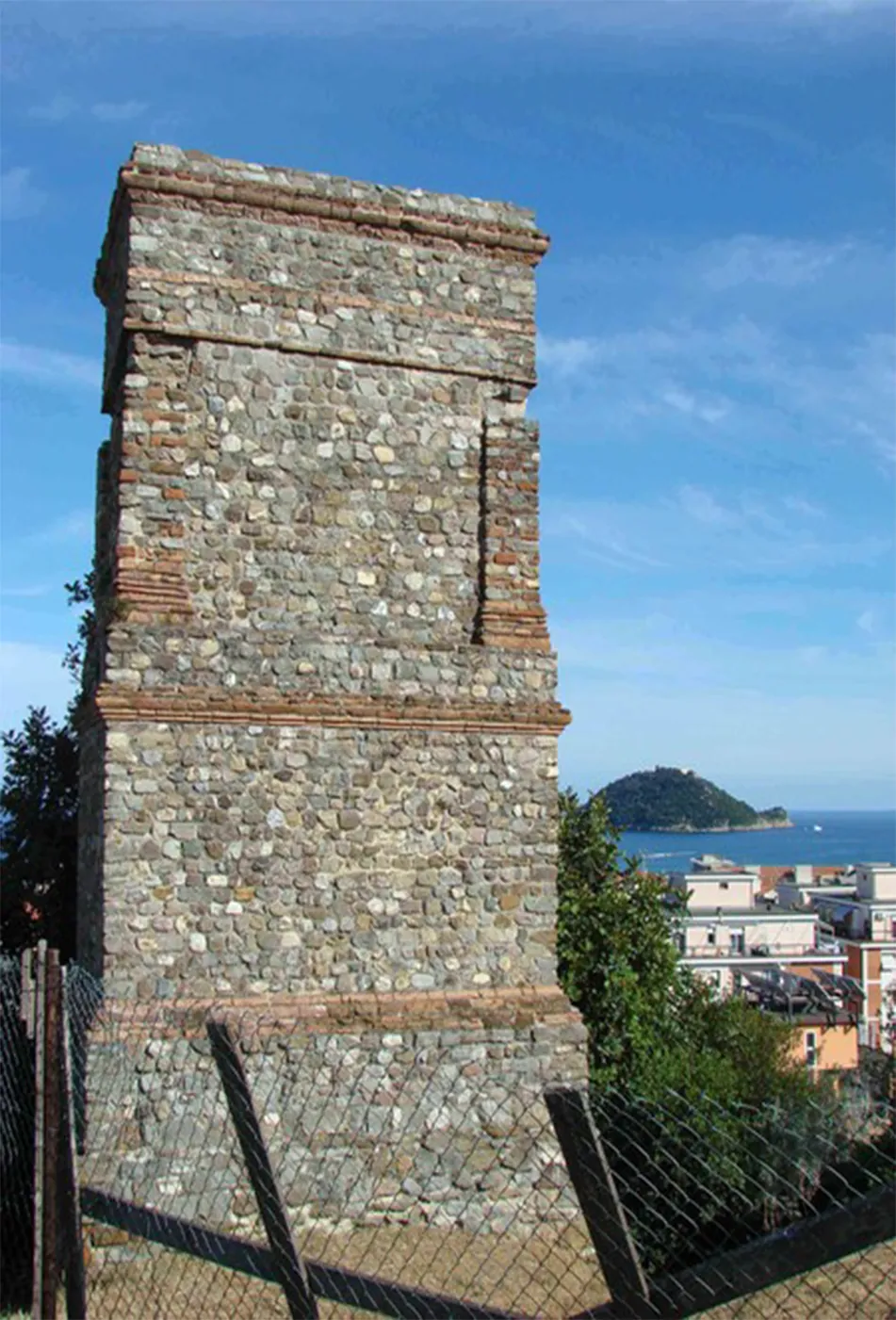
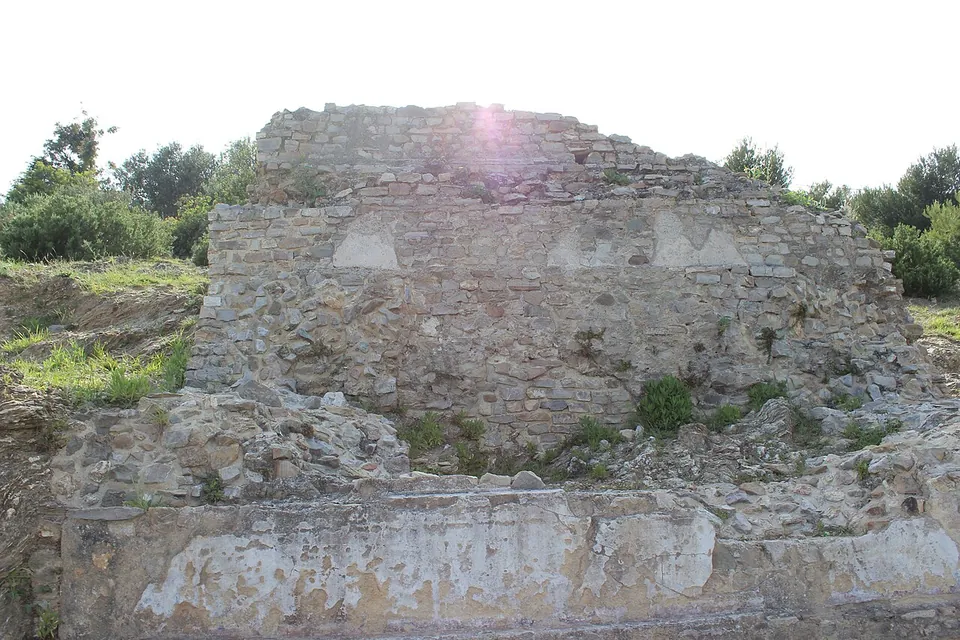
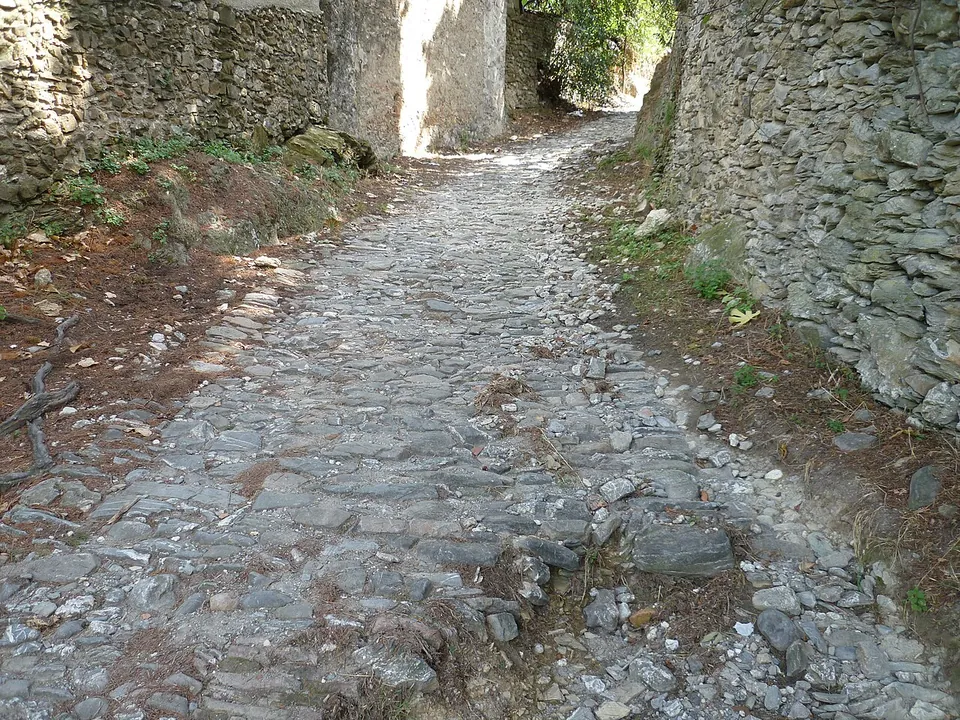
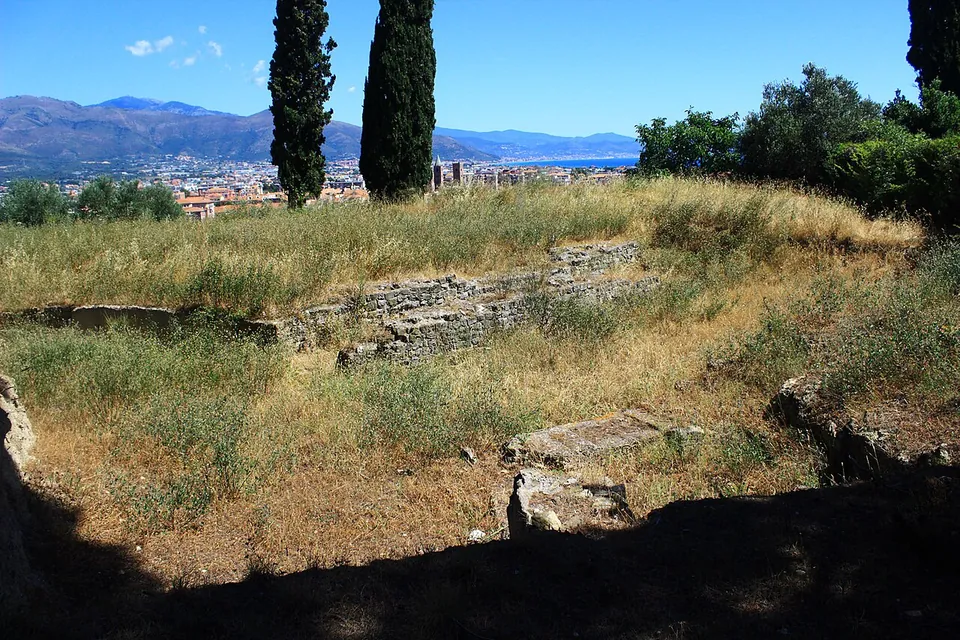
On the hill. The Via Julia Augusta left the Roman town for the hill of San Martino, and the municipality’s walking route follows it. First comes the Pilone, a three-storey Roman tower tomb 7.5 m high, dated to the late 1st or early 2nd century, which the municipality calls the symbol of Albenga’s Roman past. Higher up, behind a wire fence, lie the remains of the amphitheatre, built around the 2nd century AD and the only one known on the western Riviera: an ellipse of about 73 by 52 m of which only ground-level walls remain. Past the former abbey of San Martino the path reaches a row of Roman funerary monuments, lettered G to A, each with an explanatory board and a drawing of how it looked; beyond the last of them is the one stretch of Roman road that survives intact, 3.5 m wide and paved, with a footway along each side and a low wall on the uphill side (the municipality).
Is it worth the trip?
If you are on the Riviera between Genoa and Nice, yes, as a half-day: the baptistery and its mosaic, the Naval Museum’s amphorae, then the walk up the Via Julia Augusta for the Pilone, the tombs and the views over the sea to the island of Gallinara. Know what you are getting: none of it is a large standing ruin. The baths are foundations in a river bed, and the amphitheatre is a fenced field of low walls on private ground, entered only by appointment or on the guided visits the FAI organises (it.wikipedia). As a long detour for Roman remains alone, Albenga does not compete with the great Roman cities of Italy.
Getting there
Albenga is on the Genoa–Ventimiglia railway, and the station is a few minutes’ walk from the old town; by car, leave the A10 at the Albenga exit, ten minutes from the centre. The municipality says the town has several free car parks, and a paid one is mapped about 165 m from Piazza San Michele (OpenStreetMap). The walk along the Via Julia Augusta starts from Piazza del Popolo, where local buses also stop, and crosses the river: allow at least two hours there and back to the last Roman tomb, or three to four to continue to the church of Santa Croce above Alassio (the municipality).
The municipality mentions no ticket for the walk, and the Civic Museum is free. The baptistery is €7 (reduced €6), or €10 (reduced €8) together with the Diocesan Museum, open Tuesday to Sunday 09.30–13.00 and 14.30–18.30 (the diocesan museum, read 19 October 2026). The Ministry of Culture lists the Naval Museum at €6 (reduced €4), open Tuesday to Sunday 10.00–18.00, but that listing was last updated in 2020, so check at the IAT office in the old town, which sells the museum’s tickets. The excavated late antique church of San Calocero on the hill can be visited by booking only, for €8 (the municipality).
Visiting details
- Opening hours
- Baptistery and Diocesan Museum: Tuesday to Sunday 09.30–13.00 and 14.30–18.30; Mondays for booked groups only; closed at Easter, on 15 August and at Christmas. The Roman Naval Museum is listed by the Ministry of Culture as open Tuesday to Sunday 10.00–18.00, a listing last updated in 2020. The IAT tourist office, which sells the town's museum tickets, is open Monday to Friday 09.00–13.00, weekends 10.00–13.00, and every day 15.00–18.00.
- Tickets
- The Via Julia Augusta walk, the Pilone and the roadside tombs are an open path, with no ticket mentioned by the municipality. Civic Museum (Museo Civico Ingauno): free. Baptistery €7 (reduced €6); baptistery and Diocesan Museum together €10 (reduced €8). Roman Naval Museum €6 (reduced €4) on the Ministry's 2020 listing. The San Calocero excavations on the hill: €8 (reduced €6), by booking only.
- Parking
- A paid surface car park is mapped about 165 m from Piazza San Michele (OSM way/278362046), and the municipality says the town has several free car parks.
Before you go
- The amphitheatre stands on private ground; from the path its low walls are seen behind a wire fence, and visits inside are by appointment.
- The baths and the church of San Clemente lie in the bed of the river Centa, where floods are steadily damaging them.
Hours and prices checked 19 October 2026 on the operator's own site. Confirm before travelling.
History
Albenga was the chief town of the Ingauni, a Ligurian people. It sided with Carthage in the Second Punic War and was reduced in 181 BC by the proconsul Lucius Aemilius Paullus; a treaty with Rome followed, Latin rights came in 89 BC and Roman citizenship in 45 BC (Pleiades, en.wikipedia). The town became a municipium (it.wikipedia), and the Via Julia Augusta, built under Augustus in 13 BC, ran through it towards Gaul (en.wikipedia, it.wikipedia). A citizen of Albingaunum, Proculus, armed 2,000 of his slaves on the plain and had the legions at Lyon proclaim him emperor in 280; the reigning emperor, Probus, quickly disposed of him (it.wikipedia).
The Visigoths sacked the town in the 5th century; it.wikipedia dates the sack to 402 and the rebuilding by Constantius, Honorius’s general, to 414 or 417. A bishop of Albenga attended the synod of Milan in 451 (en.wikipedia, it.wikipedia). Under Byzantine rule the town was governed by a count and tribune, and the epitaph of Honorata, wife of the count Tzittanus, records one in 568; it is now in the Civic Museum (it.wikipedia). Fredegar records Albenga among the coastal towns that the Lombard king Rothari reduced to villages (en.wikipedia).
Excavation began in the early 20th century and gained pace under Nino Lamboglia and the Istituto Internazionale di Studi Liguri, whose Albenga section is based in Palazzo Peloso Cepolla (it.wikipedia).
More photographs



Sources
Every fact on this page comes from the records below, each used under the licence noted.