

What is there today
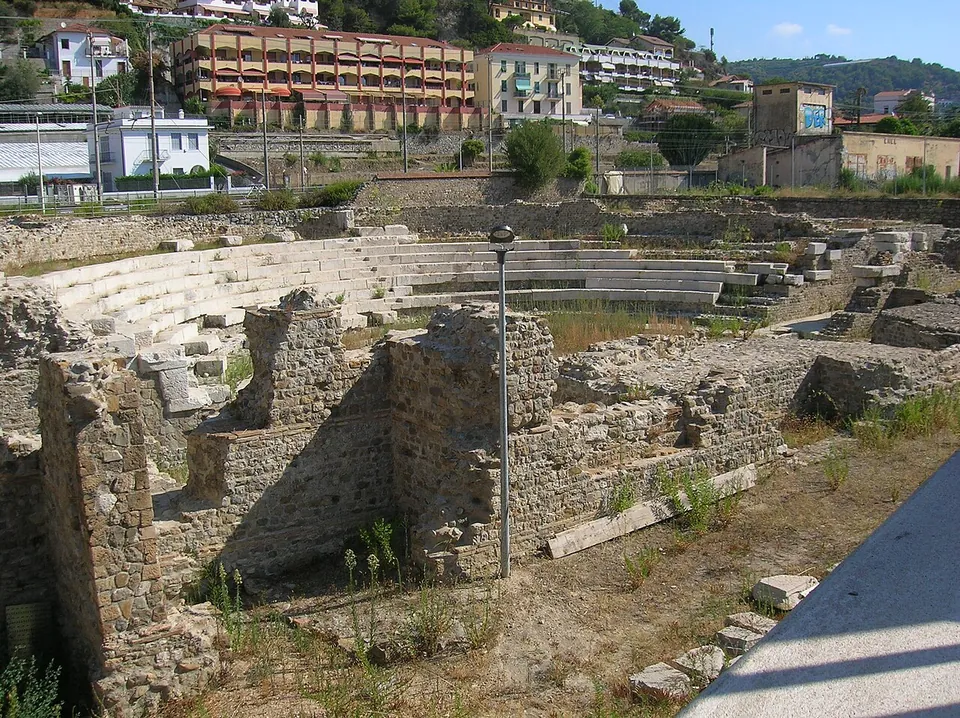
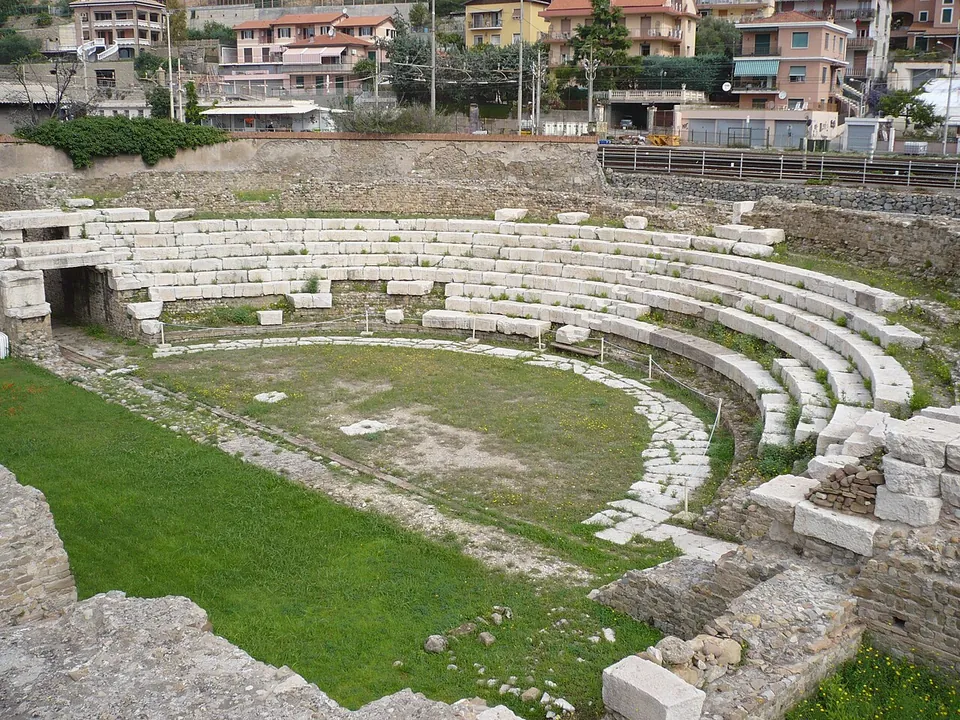
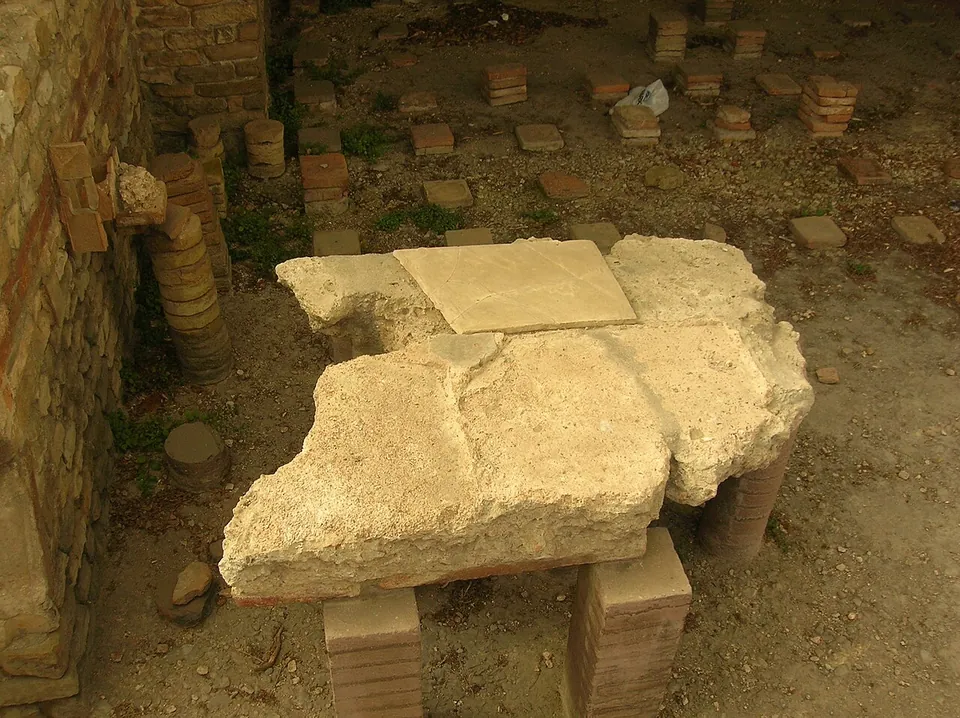
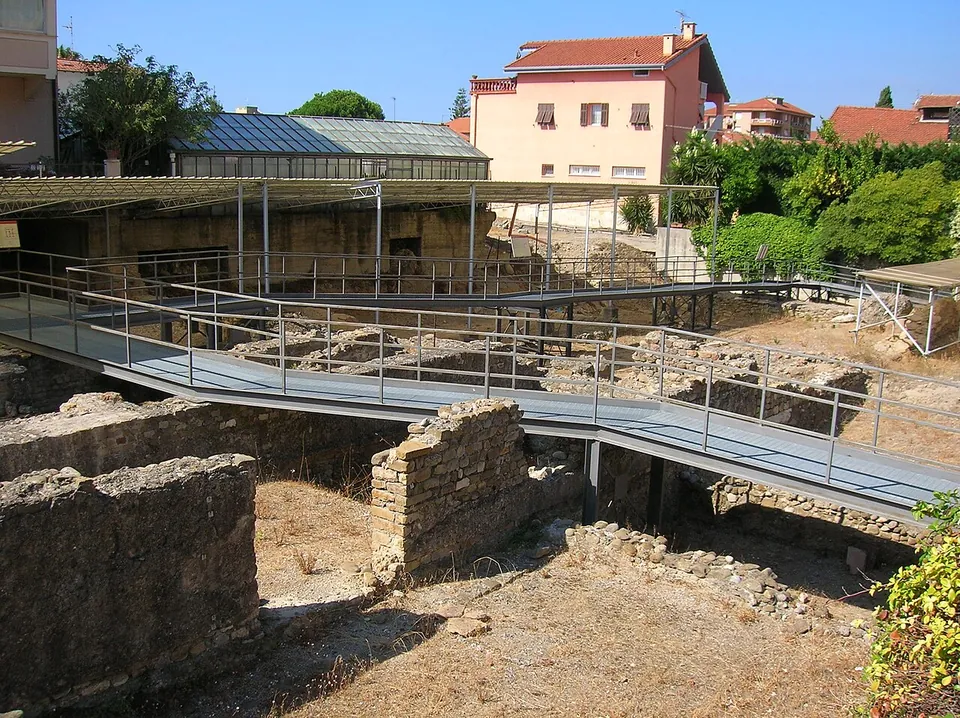
The ticketed area holds the theatre, the public baths and the Antiquarium, a museum room in the middle of the site (the operator). The theatre, built of pale local Turbie stone that looks almost like marble, is described by the operator as one of the best-preserved theatres in northern Italy: the lower rows of seats curve round the orchestra, the left-hand side passage into the orchestra is still intact, and the stage building survives along its whole base (it.wikipedia). The baths are walls and underfloor heating seen from a raised walkway. Outside the Antiquarium the town wall is visible with two of its gates; a rich house that faced the main street, the Domus del Cavalcavia, has been excavated, and on the south side of Corso Genova a quarter of two-storey houses can be seen (the operator). The great cemetery that supplied much of the museum’s collection lies under the railway and cannot be seen (the operator).
Is it worth the trip?
Yes, if you are on the western Riviera: this is a real Roman townscape with a theatre you can stand in, and the Antiquarium adds the finds that bring it to life. Two honest caveats. It is small – the theatre is one of the smallest Roman theatres known (it.wikipedia) – and it sits in an ordinary built-up street with the railway beside it, so this is not a ruin in a landscape. And it keeps short hours: mornings only, to 14.30, closed on Mondays, and open on only two Sundays a month, so check the day before you go.
Getting there
The site is in Nervia, a district of Ventimiglia (it.wikipedia); the entrance is at Corso Genova 134 (the operator). There are bus stops about 75 m from the site and two free car parks within about 170 m (OpenStreetMap).
It is open Tuesday to Saturday from 09.30 to 14.30, and on the first and third Sunday of each month at the same hours, with last entry at 14.00. A ticket is €5, €2 for visitors aged 18 to 25, and free under 18; an €8 combined ticket adds the prehistoric museum of the Balzi Rossi, also in Ventimiglia, and Forte Santa Tecla in Sanremo (nervia.cultura.gov.it, read 21 October 2026 – the operator posts extraordinary closings on the same page).
Visiting details
- Opening hours
- Tuesday to Saturday 09.30–14.30, and on the first and third Sunday of the month at the same hours; last entry 14.00. Closed on Mondays and on the other Sundays.
- Tickets
- €5; €2 for visitors aged 18 to 25; free under 18 and for other categories. An €8 combined ticket adds the prehistoric museum of the Balzi Rossi (Ventimiglia) and Forte Santa Tecla (Sanremo).
- Parking
- Free car park about 110 m from the point (OSM way/234436704, fee=no), and another about 170 m away (way/681099262).
Before you go
- Open mornings only, until 14.30, and on Sundays only twice a month. The ministry's own listing shows every Sunday open; the site's own page, which says the first and third Sunday, is the one to plan by, and it posts extraordinary closings and openings on its information page.
Hours and prices checked 21 October 2026 on the operator's own site. Confirm before travelling.
The theatre
The theatre dates from the end of the 2nd or the start of the 3rd century AD and stands at the north-western edge of the town; part of the western wall and of a tower of the north gate, the Porta di Provenza, were demolished to make room for it. It measures 21 m across inside and could seat at most 4,000 to 5,000 people, more than twice what the surviving seating suggests. Unusually it was not set against a hillside: its tiers rest on curved retaining walls filled with earth. The walls are of small split blocks with double courses of brick, a technique it shares with the Roman theatres of Provence, and the steps and decoration are of Turbie stone. The stage building’s base is a wall 4 m thick that once carried columns and windows round three doors; behind it are four rooms, probably for storage. Of the upper seating only the outer and radial walls survive. The theatre was abandoned from the 4th century, about a century after it was built, stripped for lime, and later used for burials (it.wikipedia).
The baths
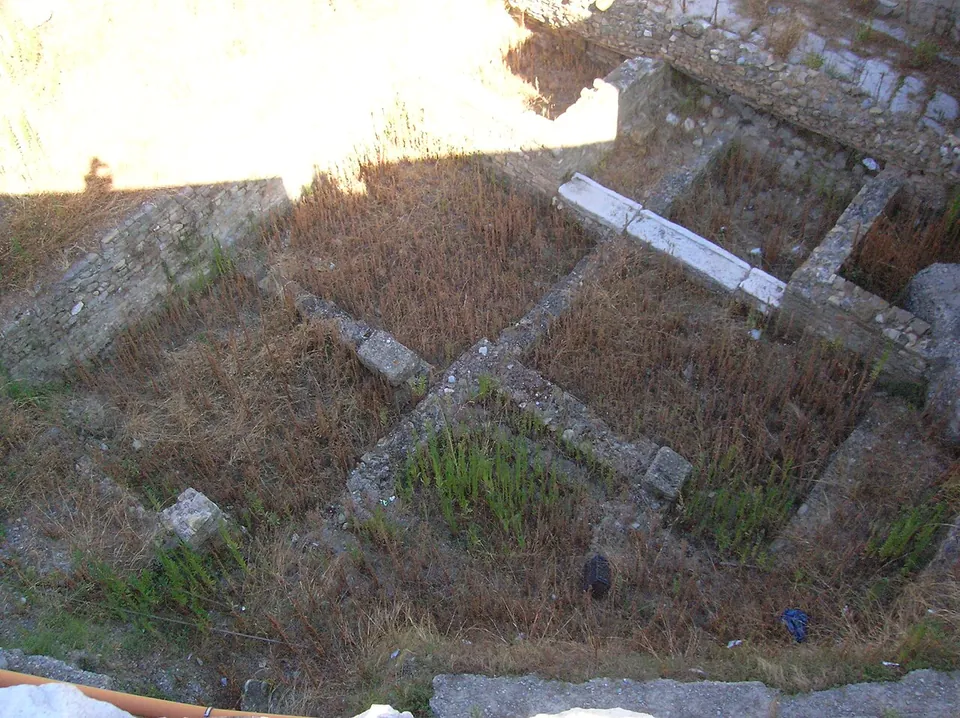
The baths were built in the second half of the 1st century AD in the west of the town and reached their height in the 2nd and 3rd centuries (the operator); it.wikipedia adds that they rose over an Augustan-period block of houses and were last rebuilt under Diocletian. Water came by aqueduct from the Seborrino stream, a tributary of the Nervia, and the west wing held two hot pools heated from below (the operator). Excavation has found the furnace rooms, the underfloor heating, a room thought to be a sweat room, and two cold pools; the floor of one cold pool carries a mosaic of a figure riding a dolphin, named Arion by Girolamo Rossi, badly cut by the building of the former Santo Spirito hospital (it.wikipedia).
The Antiquarium
The museum room shows finds from the excavations, many of them from the cemetery west of the town. The operator singles out a silver travelling set of the 2nd or 3rd century AD with six tools, among them a spoon, a small fork and a strainer, of which only two other examples are known; a small glass vessel found intact in a grave; a bust thought to show a member of the Apronii, a rich local family, in Hadrian’s time and the only sculpture found on the site; and a gold earring set with an emerald, found in the baths. Scale models show the gate, theatre, baths, cemetery and houses (it.wikipedia).
History
Albintimilium was the main centre of the Ligurian people of the Intemelii and came under Roman control in the 2nd century BC (Pleiades); the ministry’s page says the Roman town grew on a camp founded at the mouth of the Nervia after the Second Punic War. It became a municipium in 89 BC (Pleiades, it.wikipedia), and its walls, of pebbles bound with lime, date from the 1st century BC, probably between 80 and 60 BC (it.wikipedia). The Via Julia Augusta, opened in 13 BC, ran through the town and linked the Po plain with southern Gaul; Otho’s troops devastated it in AD 68, and Vespasian rebuilt it. In the 2nd and 3rd centuries the baths were enlarged, the aqueduct doubled, the theatre built and the main streets paved in Turbie stone (ministry).
In the 6th and early 7th century the town was a Byzantine stronghold (Pleiades), and it was finally abandoned in the 6th–7th century for the site of today’s upper town of Ventimiglia (ministry). A cemetery of those last centuries, still being excavated, has produced ten stone sarcophagi of the 6th–7th century (the operator). In the Middle Ages a dune of wind-blown sand from the beach covered the ruins (it.wikipedia).
The digging of that sand after 1860, for the international railway station and the new town, brought the ruins back to light, and with it clandestine digging that scattered the cemetery’s grave goods. Girolamo Rossi uncovered part of the theatre in 1877 and the baths in 1900; Pietro Barocelli excavated much of the theatre, the walls and 145 graves between 1915 and 1918; and Nino Lamboglia led campaigns from 1938 to 1976, refining the technique of stratigraphic excavation in the building that is now the Antiquarium. The site opened to the public in 1980 (it.wikipedia).
More photographs



Sources
Every fact on this page comes from the records below, each used under the licence noted.
| Source | Licence |
|---|---|
| Pleiades 157802 | CC BY |
| Wikidata Q3608794 | CC0 |
| Vici.org 2757 | CC BY-SA (text), CC0 (metadata) |
| OpenStreetMap way/237950970 | ODbL |
| Area archeologica di Nervia — information (the site's own operator, Ministero della Cultura) | licence not recorded |
| Area archeologica di Nervia — Scopri Albintimilium (the operator) | licence not recorded |
| Area archeologica di Nervia — Entra nel Teatro (the operator) | licence not recorded |
| Area archeologica di Nervia — Entra nelle Terme (the operator) | licence not recorded |
| Area archeologica di Nervia — Antiquarium (the operator) | licence not recorded |
| Ministero della Cultura — Area archeologica di Nervia | licence not recorded |
| Pleiades — Ventimiglia Roman Theater | licence not recorded |
| Wikipedia (it) — Albintimilium | CC BY-SA 4.0 |
| Wikipedia (it) — Teatro romano di Ventimiglia | CC BY-SA 4.0 |
| Wikipedia (fr) — Albintimilium | CC BY-SA 4.0 |