

What is there today
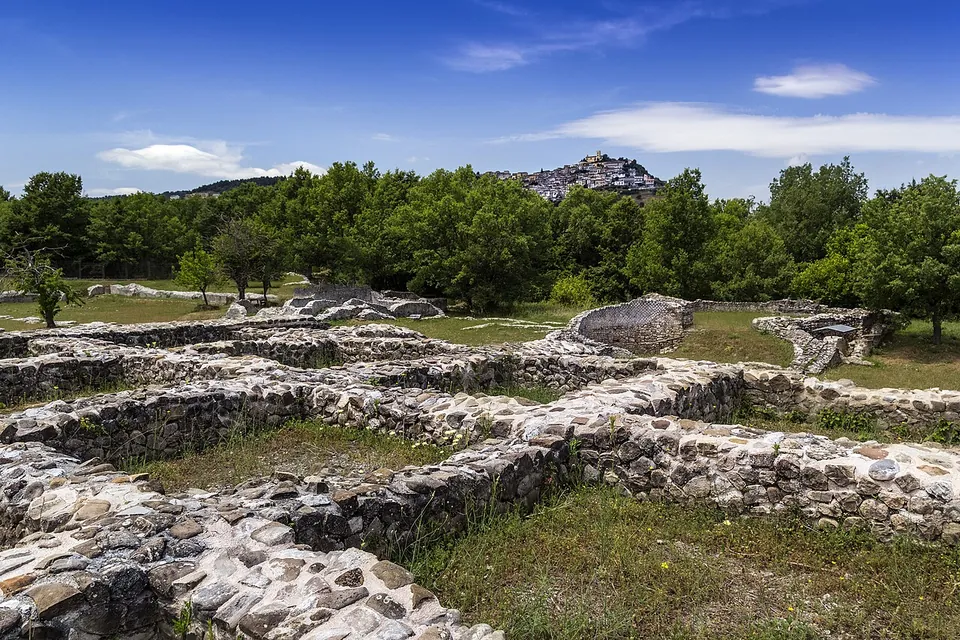
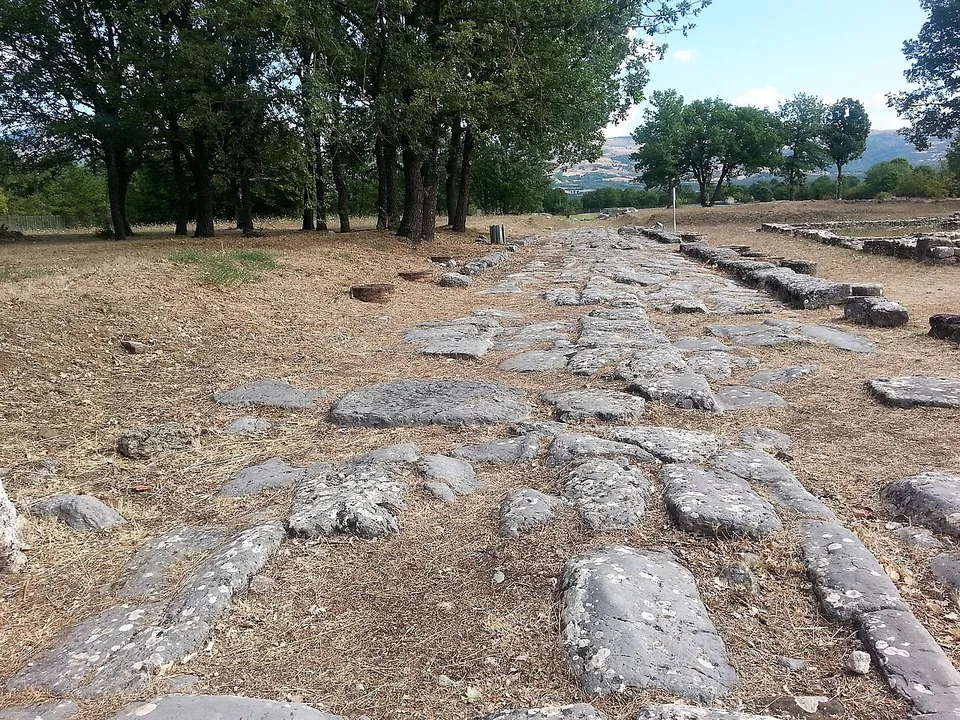
The excavated buildings lie mostly along the town’s main street, the plateia (the operator). Only about a tenth of a town of some 25 hectares, once enclosed by about 3 km of walls with six gates, has been uncovered (it.wikipedia), but that tenth is its public heart.
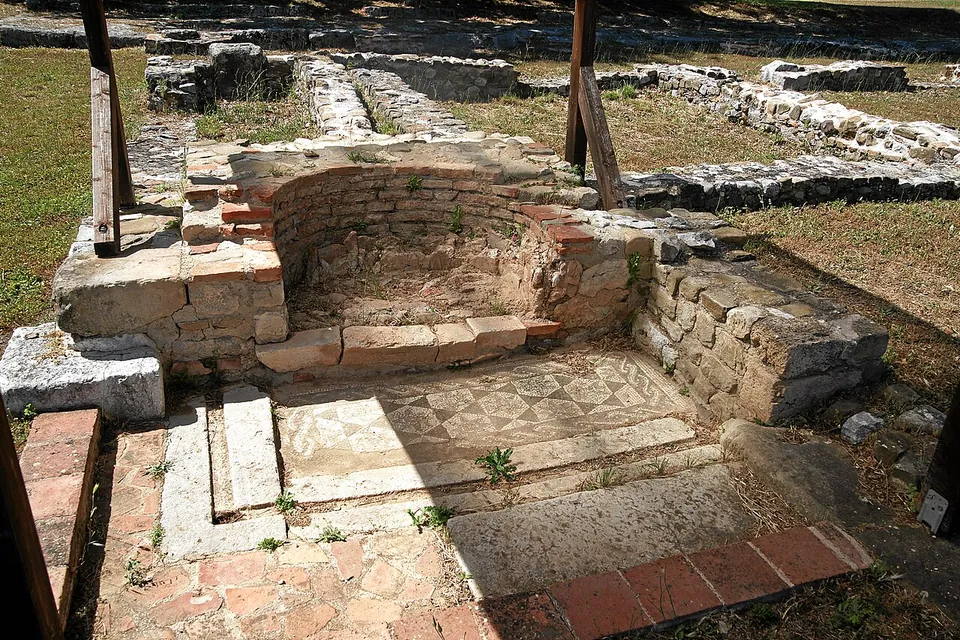
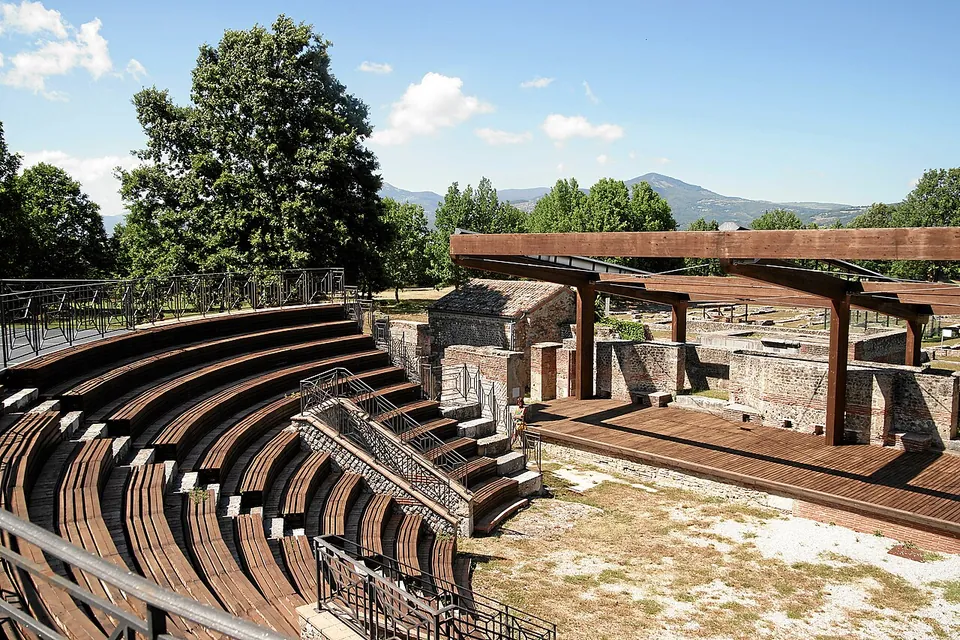
Just inside the entrance stands the theatre, built in the 1st century AD and largely remodelled in the 2nd and 3rd (the operator; Pleiades dates it to the Julio-Claudian period). Excavated from 1951 and restored in 1964–68 (it.wikipedia), it can again be used as a theatre (the operator). Behind its stage is a small temple on a high podium, traditionally assigned to an Egyptian cult because a statue thought to be of Harpocrates was found nearby. Facing the main street is the house with mosaics, a wealthy residence that fills a whole block of about 30 × 60 m, with shops on the street front, an atrium with its rainwater basin and a household shrine in a small apse, and dining and reception rooms floored with mosaic and inlaid marble (the operator). The operator puts the main phase of the house in the 2nd century AD; some of its mosaic floors are dated to the 4th (it.wikipedia).
The forum was paved with stone and closed on three sides by a colonnade. On its south side are the remains of its oldest building, a temple identified as the Capitolium; facing it is a second temple, probably for the imperial cult, with a small round temple beside it; the basilica, where courts sat and meetings were held, lines the west side (the operator). Next to the forum lie the forum baths, partly enclosed in later farm buildings, with mosaic floors (the operator).
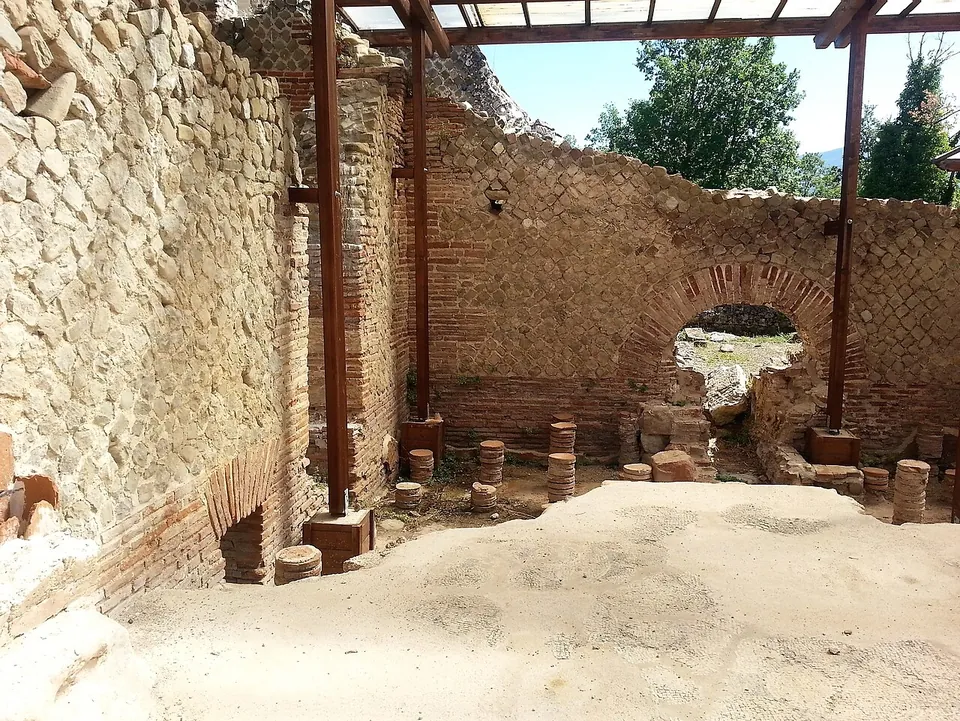
A short way north-east are the main baths, the Terme maggiori: sixteen rooms that the operator calls exceptionally well preserved. The cold room has a sea-scene mosaic with the monster Scylla, Giants and sea creatures, and the heated rooms still show the brick stacks that held their floors above the hot air from three furnaces. The operator tentatively dates the building to the second half of the 2nd century AD. Beyond it, the church of Santa Maria Assunta probably served as the cathedral once Grumentum had a bishop (the operator).
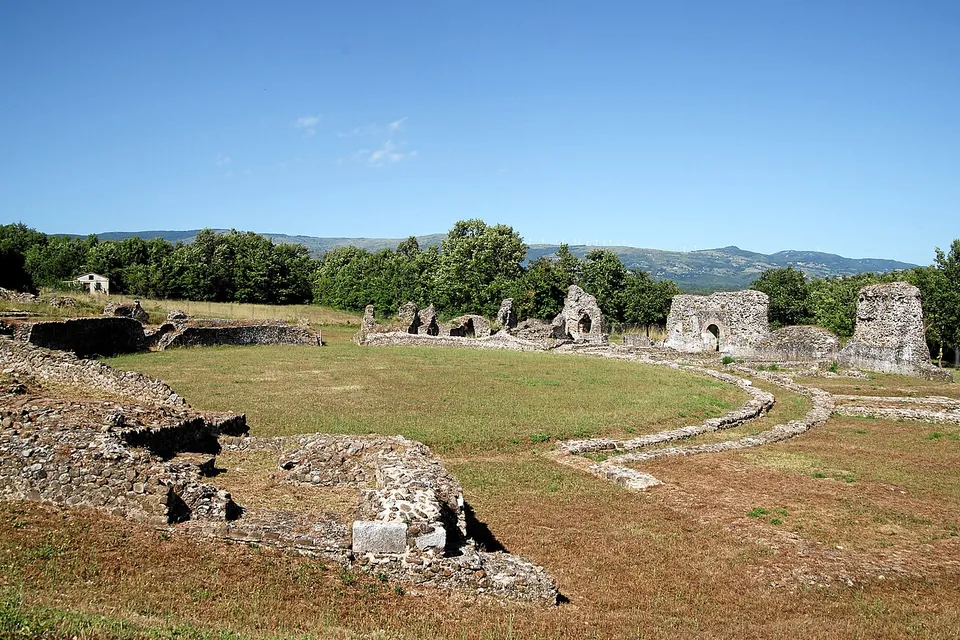
The walk ends at the amphitheatre on the eastern edge of the town, about 0.7 km from the theatre (OpenStreetMap). It dates from around the middle of the 1st century BC and the operator counts it among the oldest masonry amphitheatres known. Its western half rests against the cut-back hillside and its eastern half on built substructures; the arena has no underground rooms, and the building stands above the Pertusillo reservoir (the operator; it.wikipedia).
The finds, among them a marble head of Livia, Augustus’s widow, from the forum, and marble statues from the baths, are in the Museo Archeologico Nazionale dell’Alta Val d’Agri, built over the town’s southern cemetery a short walk away, with a stretch of the Roman aqueduct crossing its garden (the operator).
Is it worth the trip?
Yes, if you are anywhere in Basilicata. The Ministry of Culture calls Grumentum the only Roman town plan in Basilicata that can be read as a whole, and walking from a restored theatre down a paved street to an amphitheatre above a lake is the experience of a small Roman town rather than of a single monument. Most of what you walk past is low walls and floors; the theatre, the baths and the amphitheatre are where the masonry stands highest.
The catch is getting there. The site sits in the upper Agri valley with no public transport mapped near it, and the park shuts from 12.30 until mid-afternoon, so plan to arrive by mid-morning or for the afternoon session. The combined ticket with the museum costs €6 and is good for three days.
Getting there
The park lies in the valley below the hill town of Grumento Nova, in the locality of Spineta, near the Pertusillo reservoir (it.wikipedia). Villa d’Agri is the nearest larger town, about 10 km away in a straight line. OpenStreetMap maps a car park about 100 m south-west of the theatre; the museum, where the single ticket office is, stands about 300 m south of the park entrance.
The park is open Tuesday to Sunday, 09.00–12.30 and 15.00–18.30 from April to September, and 09.00–12.30 and 14.30–16.00 from October to March; it is closed on Mondays and on 1 January, 1 May and 25 December. A park ticket is €3, and €6 buys a combined ticket for the park and the museum, valid for three days; EU citizens aged 18–25 pay €2, under-18s go free, and entry is free for everyone on the first Sunday of the month. Tickets can also be bought online through Musei Italiani (museoaltavaldagri.beniculturali.it, read 24 October 2026). The Ministry of Culture’s own listing gives €4 for the park and keeps the summer hours until the end of October, so in October check by phone before travelling.
Visiting details
- Opening hours
- Tuesday to Sunday, 09.00–12.30 and 15.00–18.30 from 1 April to 30 September, and 09.00–12.30 and 14.30–16.00 from 1 October to 31 March. Closed on Mondays, 1 January, 1 May and 25 December. The Ministry of Culture's listing keeps the summer hours until 31 October, so in October ring ahead (+39 0975 65074).
- Tickets
- €3 for the park; €6 for a combined ticket with the Museo Archeologico Nazionale dell'Alta Val d'Agri, valid for three days. EU citizens aged 18–25 pay €2; under-18s go free, and so does everyone on the first Sunday of the month. Tickets are sold at the museum, 300 m south of the park entrance, and online through Musei Italiani. The Ministry's listing prints €4 for the park.
- Parking
- OpenStreetMap maps a car park about 100 m south-west of the theatre (way/194381292), at the end of the park nearest the museum, which is roughly where the operator places the entrance.
Before you go
- No bus stop is mapped within 2 km; the site needs a car.
- The park closes at midday, from 12.30 until the afternoon session.
Hours and prices checked 24 October 2026 on the operator's own site. Confirm before travelling.
History
The first settlement here dates from the 6th century BC (it.wikipedia). The town itself dates from the early 3rd century BC, and its beginnings are told two ways: as a Roman fortified outpost founded during the Samnite Wars, at about the same time as Venusia and Paestum (it.wikipedia), or as a small Lucanian town allied with Rome (the operator). Its position, on the road between Venusia and Heraclea that later became the Via Herculia, made it a junction (it.wikipedia; en.wikipedia).
In the Second Punic War the Carthaginian general Hanno was defeated there in 215 BC, and in 207 BC Hannibal made it his base before the Romans drove him off (Pleiades; it.wikipedia). In the Social War the town sided with Rome and was sacked by the Italic rebels (it.wikipedia; the operator). It was refounded as a Roman colony in the 1st century BC (the operator), perhaps under Sulla and at the latest under Augustus (en.wikipedia), and inscriptions record work on its walls and the building of baths in 57–51 BC and of a portico in 43 BC (en.wikipedia). The operator puts its most prosperous period in the 2nd and 3rd centuries AD.
The Christian martyr Laverius was executed outside the walls in 312, and Grumentum became the seat of a bishop in 370 (it.wikipedia). Popes still mentioned the see in the 5th and 6th centuries, and a cemetery by the church of San Marco outside the walls was in use in the 7th (it.wikipedia). The town then emptied slowly; the operator puts the final abandonment around the 9th century, and in 954 the people founded Saponara on the hill above, the town renamed Grumento Nova after the Roman city (it.wikipedia). Systematic excavation began with the theatre in 1951; the amphitheatre was investigated from 1981, after the 1980 earthquake had made its collapse more likely (it.wikipedia).
More photographs



Sources
Every fact on this page comes from the records below, each used under the licence noted.
| Source | Licence |
|---|---|
| Pleiades 442603 | CC BY |
| Wikidata Q1550380 | CC0 |
| Vici.org 1814 | CC BY-SA (text), CC0 (metadata) |
| OpenStreetMap way/69532398 | ODbL |
| Museo Archeologico Nazionale dell'Alta Val d'Agri — tickets and opening hours (the operator) | licence not recorded |
| Museo Archeologico Nazionale dell'Alta Val d'Agri — the archaeological park (the operator) | licence not recorded |
| Museo Archeologico Nazionale dell'Alta Val d'Agri — home page, park hours and prices (the operator) | licence not recorded |
| Ministero della Cultura — Parco archeologico di Grumentum | licence not recorded |
| Pleiades — Grumentum amphitheatre | licence not recorded |
| Pleiades — Roman theatre at Grumentum | licence not recorded |
| Wikipedia (it) — Grumentum | CC BY-SA 4.0 |
| Wikipedia (en) — Grumentum | CC BY-SA 4.0 |
| Wikipedia (de) — Grumentum | CC BY-SA 4.0 |
| Wikipedia (fr) — Grumentum | CC BY-SA 4.0 |