

What is there today
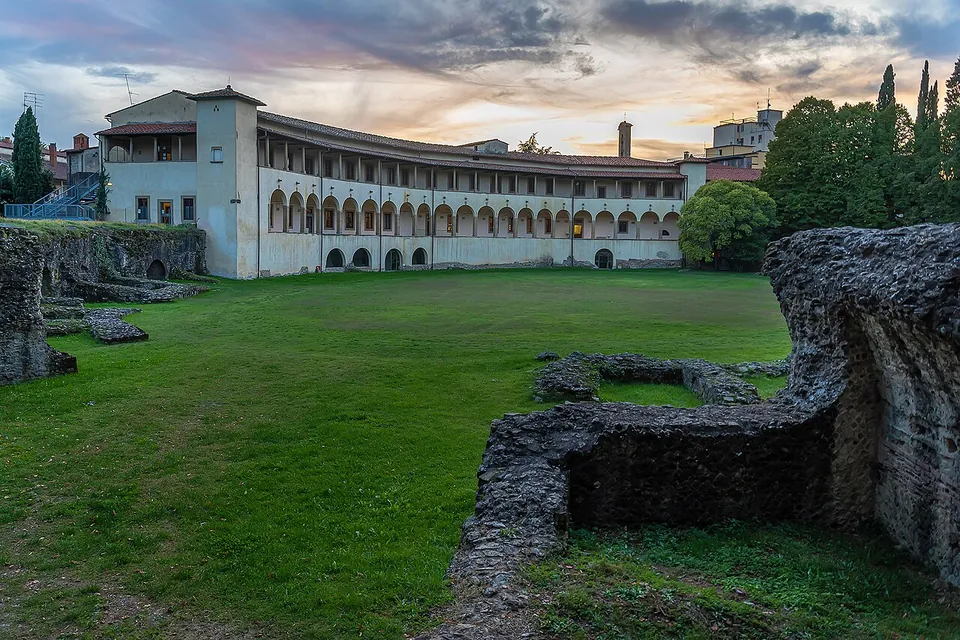
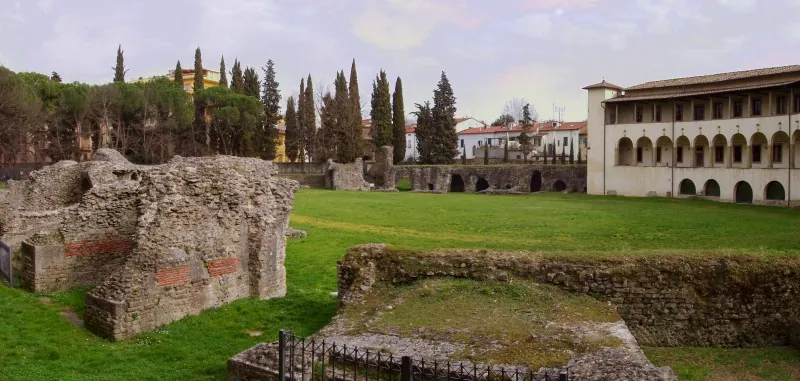
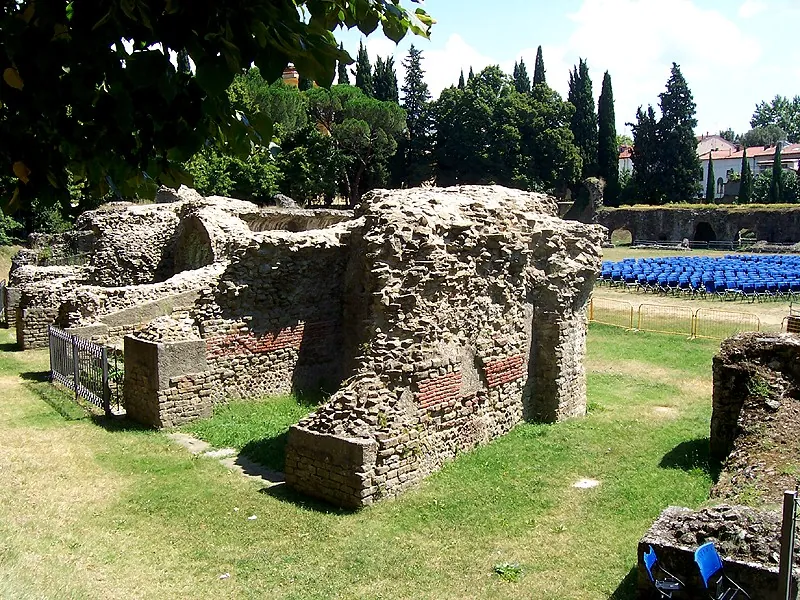
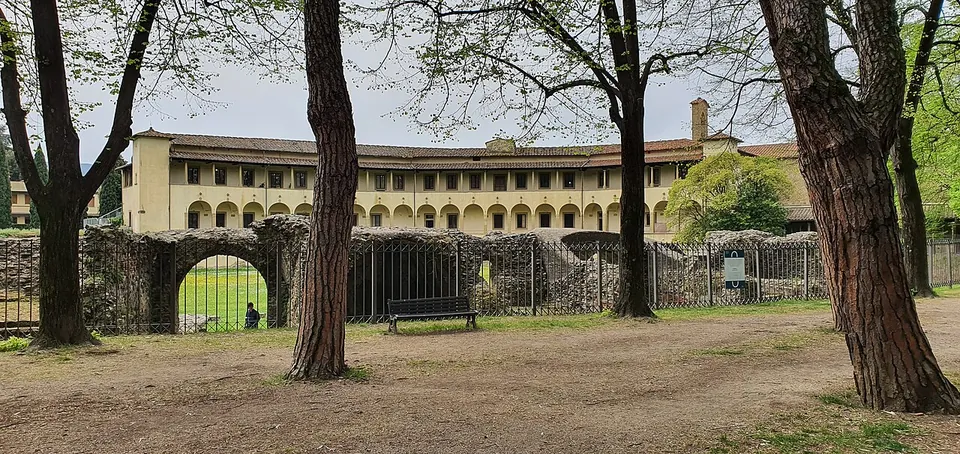
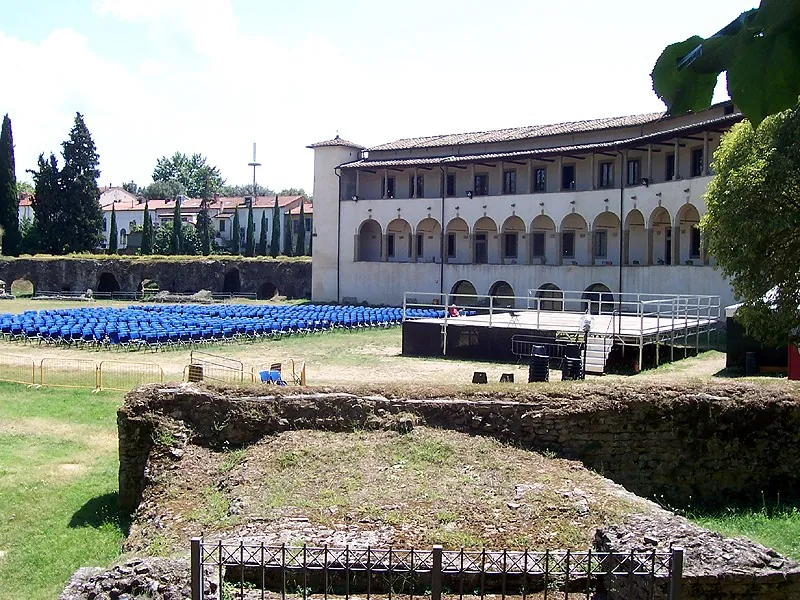
Do not expect a standing arena. The seating terraces have gone. What is left is the grassed arena floor and, around it, remains of the corridors, passage vaults and stairways that once carried the seats, surviving to different heights at different points of the ring (it.wikipedia). The scale is still easy to read: the building measures 121 by 68 m, and the arena alone, 71.9 by 42.7 m, is only a little smaller than the Colosseum’s 77 by 46.5 m (it.wikipedia). The museum’s building follows the curve of the southern half, and the Ministry of Culture, which runs it, says the whole circuit is visible: on the museum’s ground floor, in its basement and in the outdoor archaeological area. The arena is used today as an open-air theatre (it.wikipedia).
Is it worth the trip?
If you are in Arezzo, yes. It is in the town, and the national archaeological museum stands on its southern half. The museum holds the richest collection in the world of Arretine red-gloss pottery, the ware that made the ancient town famous (the operator). On its own the amphitheatre is a walk among low ruins rather than a spectacle, so it is a reason to stop in Arezzo, not a reason to come here for Rome alone.
Getting there
The amphitheatre lies in the south of the old town, with entrances from Via Margaritone and Via Francesco Crispi (it.wikipedia). The museum is at Via Margaritone 10 (the operator). Two paid car parks are mapped about 100 m and 130 m away, and the nearest mapped bus stop is about 300 m away (OpenStreetMap).
The museum is open Monday and Wednesday 09.00–14.00, Tuesday 14.00–19.30, Thursday to Saturday 09.00–19.30 and Sunday 09.00–14.00, with last entry an hour before closing. The outdoor archaeological area of the amphitheatre can be visited until sunset. A museum ticket is €6, reduced €2, and the museum is free on the first Sunday of the month from March to September 2026. Online tickets carry a €3 booking fee. A combined ticket for €17 (reduced €8) adds the Basilica of San Francesco, Casa Vasari and the National Museum of Medieval and Modern Art. The operator’s page does not say whether the outdoor area needs the museum ticket. Step-free access to the amphitheatre area is from the Via Crispi side, on request, and pets are not allowed (cultura.gov.it, read 21 October 2026; check before travelling).
Visiting details
- Opening hours
- Museum: Monday and Wednesday 09.00–14.00; Tuesday 14.00–19.30; Thursday to Saturday 09.00–19.30; Sunday 09.00–14.00 (last entry an hour before closing). On the first Sunday of the month from March to September 2026 it opens 09.00–19.30, last entry 18.00. The outdoor archaeological area of the amphitheatre can be visited until sunset.
- Tickets
- Museum €6, reduced €2; free on the first Sunday of the month from March to September 2026. Bought online, €9 and €5 (each with a €3 booking fee). A combined ticket for the Arezzo museum circuit (Basilica of San Francesco, Casa Vasari, this museum and the National Museum of Medieval and Modern Art) is €17, reduced €8, plus €3 online. The operator's page does not say whether the outdoor area is charged separately from the museum.
- Parking
- Two paid surface car parks about 100 m and 130 m from the arena (OSM way/239969507 and way/239967816); the nearest mapped bus stop, Arezzo Guido Monaco, is about 300 m away.
Before you go
- Groups of more than ten must book in advance; the museum's ticket office takes no bookings.
- No pets, in the museum or in the archaeological area of the amphitheatre.
- Step-free access to the amphitheatre area is from the Via Crispi side, on request (assistance booked on +39 0575 20882).
Hours and prices checked 21 October 2026 on the operator's own site. Confirm before travelling.
History
The amphitheatre was built between the last years of the 1st century AD and the first years of the 2nd. it.wikipedia dates the building to the reign of Hadrian (117–138), and the Ministry of Culture to the first half of the 2nd century. It was the largest public building of the ancient town (the operator). Its seating rose in two tiers, carried on two concentric covered corridors, with a third ring that probably marked the edge of the arena. The outer portico and corridor have gone, but the two main entrances at the ends of the long axis and two lesser ones on the short axis can still be made out. The builders used sandstone blocks, brick and marble: the corridor vaults are in Roman concrete, the walls are faced with alternating net-pattern and coursed stonework and brick, the inner stairs are travertine, and the outside was probably clad in local sandstone. Estimates of its capacity run to about 8,000–10,000 spectators (it.wikipedia).
Over the centuries the building was plundered for stone, some of which went into religious buildings. One of them is the monastery built against the southern half of the ring, which it.wikipedia names as San Bernardo and dates to the 16th century. The museum, founded in 1936, is housed there; the Ministry of Culture calls the building the medieval monastery of Monte Oliveto, so published names and dates for it differ. The amphitheatre was first excavated in 1914–1915. Work stopped because of the war and resumed in 1926. Restorations carried out at intervals since 1950 have brought it fully to light (it.wikipedia).
More photographs


Sources
Every fact on this page comes from the records below, each used under the licence noted.
| Source | Licence |
|---|---|
| Pleiades 442563575 | CC BY |
| Wikidata Q3616681 | CC0 |
| Vici.org 4206 | CC BY-SA (text), CC0 (metadata) |
| OpenStreetMap way/22718564 | ODbL |
| Wikipedia (it) — Anfiteatro romano di Arezzo | CC BY-SA 4.0 |
| Wikipedia (fr) — Amphithéâtre romain d'Arezzo | CC BY-SA 4.0 |
| Ministero della cultura — Museo archeologico nazionale "Gaio Cilnio Mecenate" (hours, tickets, description; the operator) | licence not recorded |
| Ministero della cultura — new signage at the museum and the Amphitheatre Park (2020) | licence not recorded |