

What is there today
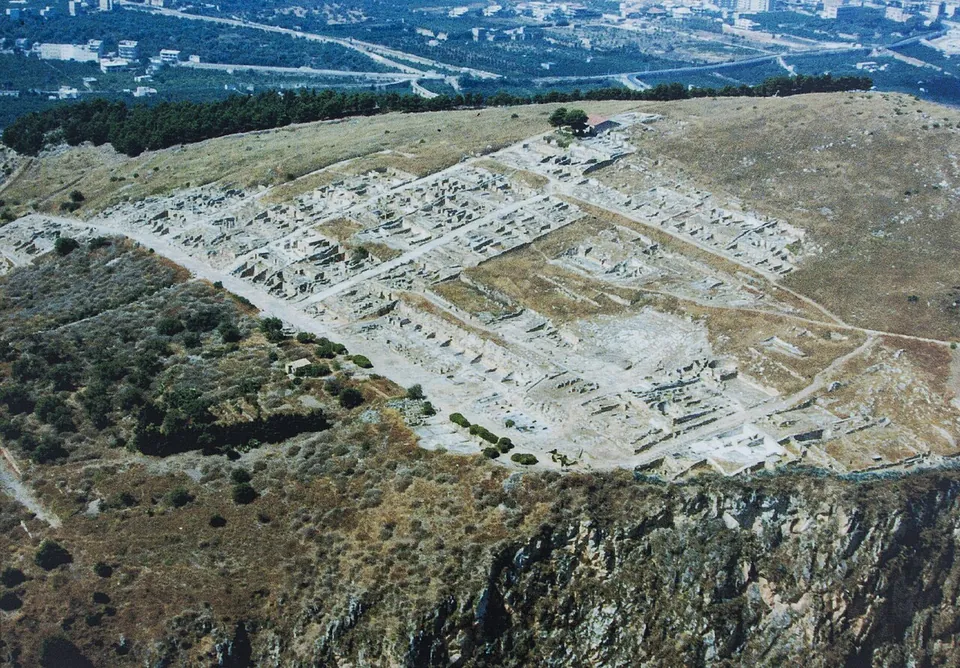
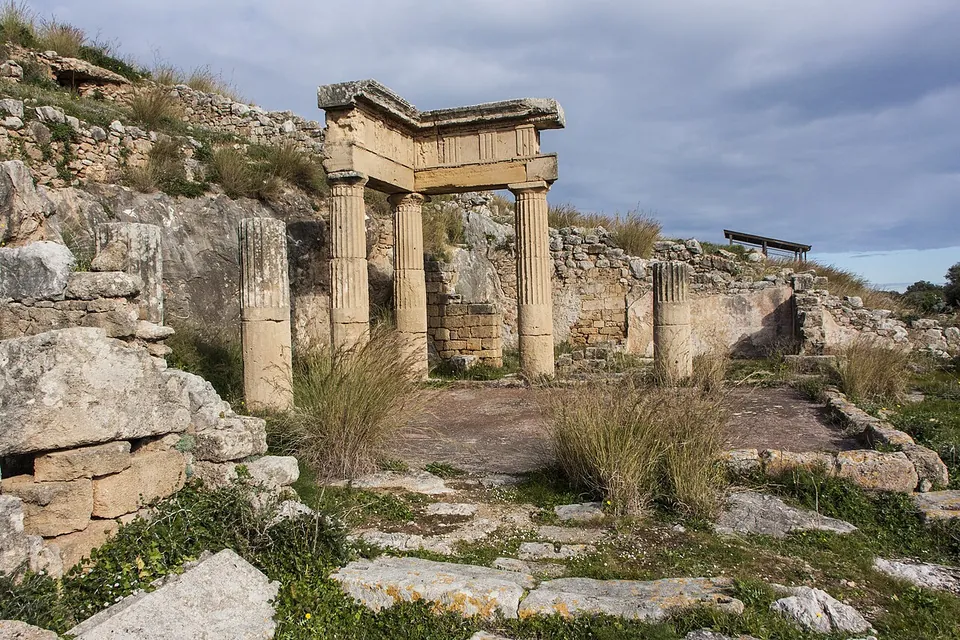
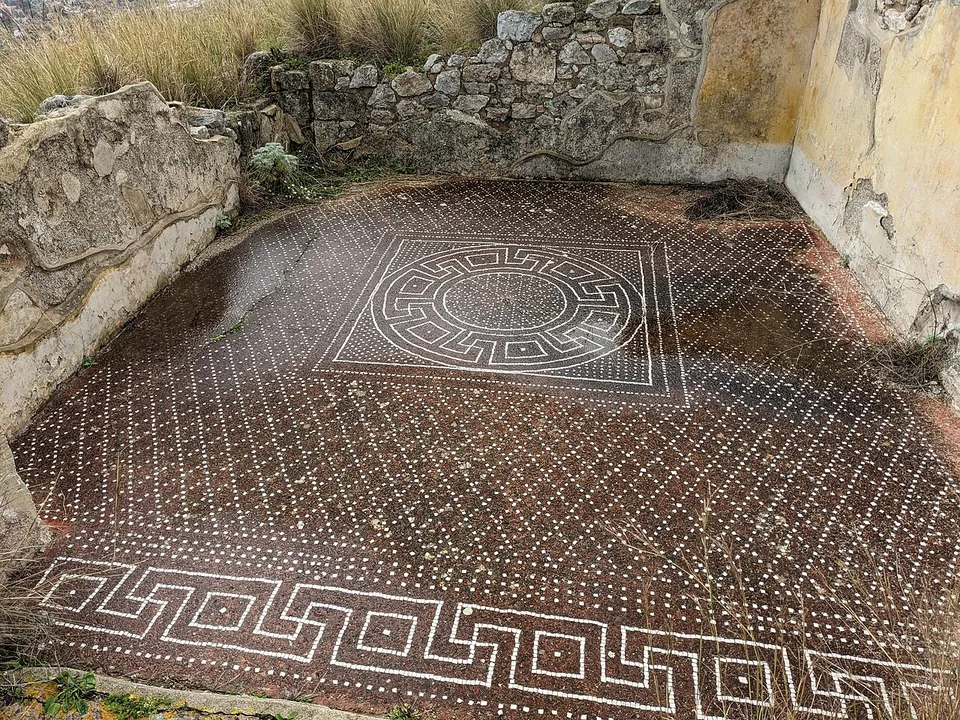
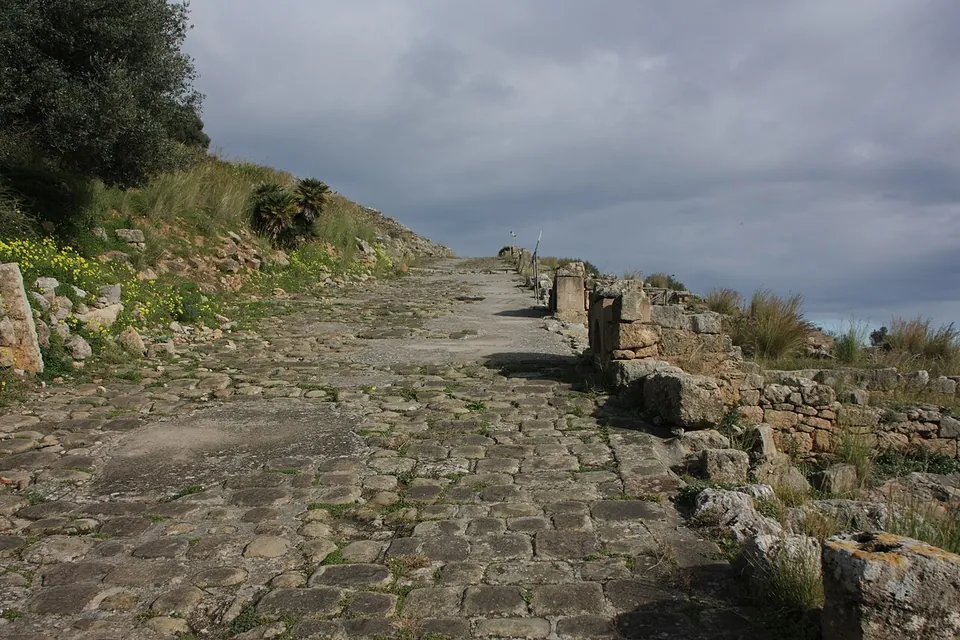
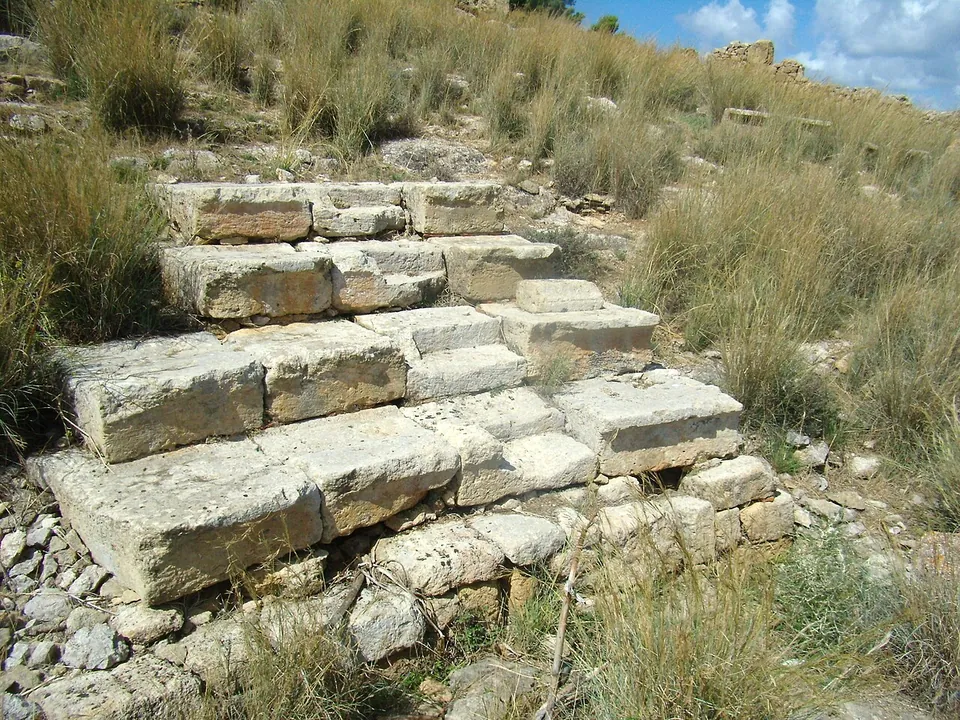
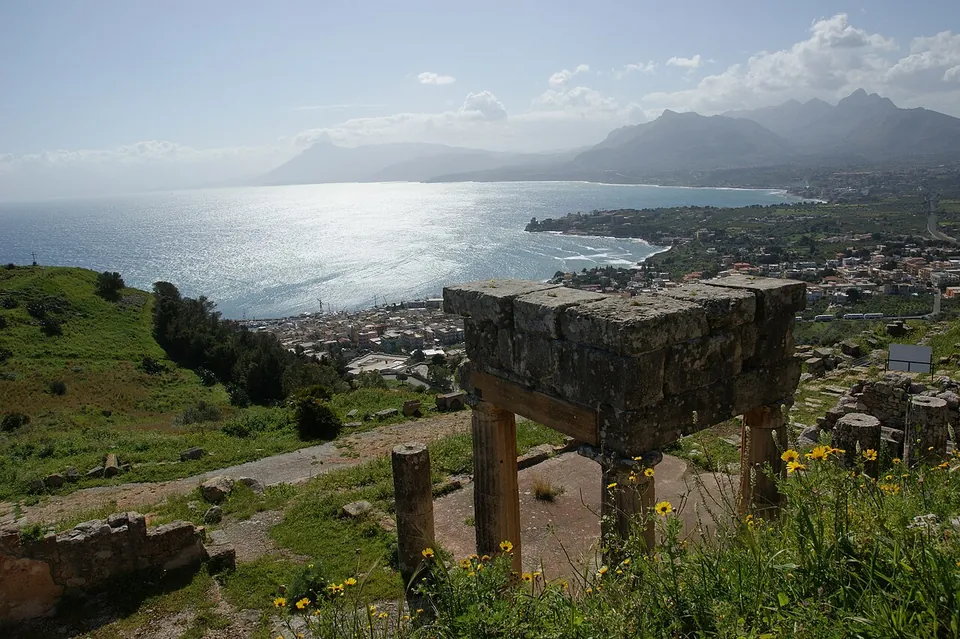
A town plan you can walk. About half of the town has been excavated, and it is relatively well preserved (de.wikipedia): straight paved streets run along the slope, with stepped side streets climbing between the house blocks, and on the steep ground houses often survive up to three storeys high. The landmark is the so-called Gymnasium, really the courtyard of a large house, whose columns were set up again in the 19th century (de.wikipedia; it.wikipedia adds that the restorer’s additions were arbitrary). Mosaic floors remain in place in several houses.
At the north end is the public quarter: the square of the agora, closed on three sides by a portico, with a large covered cistern, a bath building, and above it the theatre, the small council chamber and an area of sanctuaries (the operator; de.wikipedia). Little of the theatre survives. At the entrance a small museum, the Antiquarium, shows finds from the site (it.wikipedia); the large statues found here and the wall paintings of the House of the Masks are in Palermo’s archaeological museum (de.wikipedia).
Is it worth the trip?
Yes, if you are in Palermo and want to walk through an ancient town rather than look at a single monument. It is close to the city, it costs €6, and the setting is half the point: the town sits on terraces high above the sea.
Know what kind of Roman site it is. Soluntum looks Greek, not Roman: its streets follow a Greek grid plan, its houses are Hellenistic courtyard houses, and its shrines follow Punic models rather than Greek or Roman ones (de.wikipedia). What is Roman about it is the date: the theatre, the portico on the agora, the baths and the best of the paintings were made after the town came under Rome (de.wikipedia), and its houses were rebuilt again and again between the 2nd century BC and the 1st century AD (it.wikipedia). Much of it is fragmentary, the local stone crumbles, and many of the paintings found in the mid-20th century have faded on the walls (de.wikipedia).
Getting there
The site is on the slope of Monte Catalfano above Santa Flavia, with a free car park about 200 m away (OpenStreetMap). No bus stop is mapped near it; the railway station of Santa Flavia-Solunto-Porticello is about 2 km away (de.wikipedia), and the town lies 183 m above sea level (en.wikipedia).
Under the summer timetable it is open Monday to Saturday 09.00 to 18.30, under the winter one 09.00 to 17.30, and on Sundays and public holidays 09.00 to 14.00, with last entry an hour before closing. A ticket is €6, or €3 for EU citizens aged 18 to 25; under-18s go free, and entry is free for everyone on the first Sunday of the month. Tickets are sold at the ticket office on the site. The operator lists the Antiquarium on its own tariff page, also at €6, without saying whether one ticket covers both (Parco archeologico di Himera, Solunto e Iato, read 16 October 2026; the dates on which the summer and winter timetables change are not given, so check before travelling).
Visiting details
- Opening hours
- Summer timetable Monday to Saturday 09.00–18.30 (last entry 17.30); winter timetable 09.00–17.30 (last entry 16.30); Sundays and public holidays 09.00–14.00 (last entry 13.00). The operator does not give the dates on which the timetables change.
- Tickets
- €6; €3 for EU citizens aged 18 to 25; free under 18, for visitors with disabilities and one companion, and for several professional groups. Entry is free on the first Sunday of every month. Tickets are sold at the ticket office on site. The Antiquarium is listed separately on the same tariff page, also at €6, and the page does not say whether one ticket covers both.
- Parking
- A free surface car park is mapped about 200 m from the site (OSM way/53455425).
Before you go
- No bus stop is mapped near the site; the nearest railway station, Santa Flavia-Solunto-Porticello, is about 2 km away, below the hill.
Hours and prices checked 16 October 2026 on the operator's own site. Confirm before travelling.
The theatre
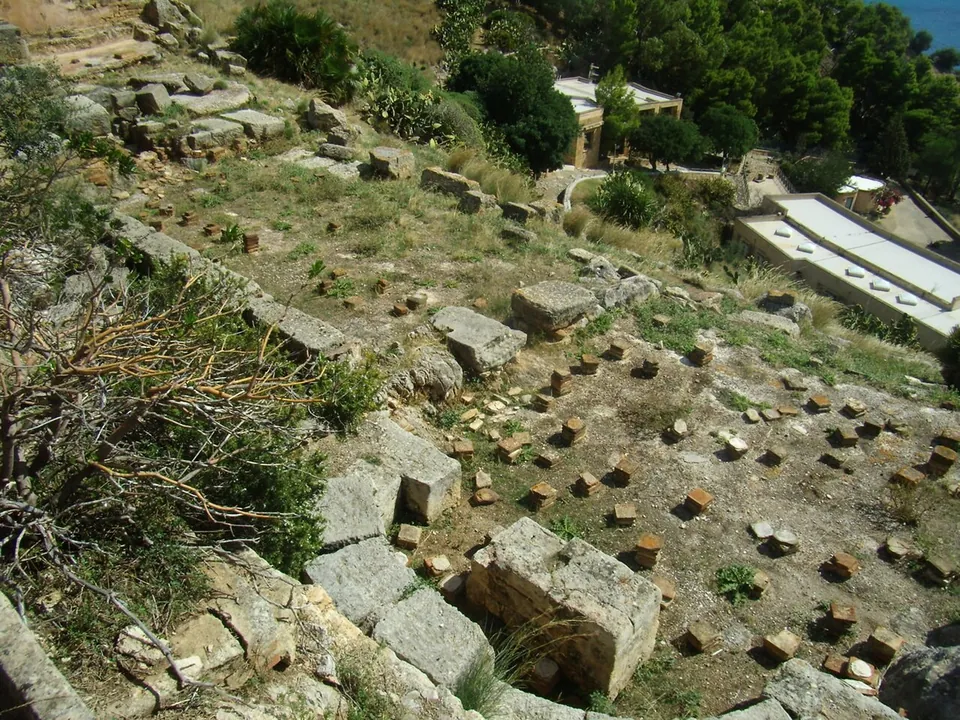
The theatre was built into the slope above the agora. de.wikipedia (and en.wikipedia, which translates it) dates it probably to the 2nd century BC, when Sicily prospered under Roman rule, and finds no older theatre on the spot; it.wikipedia instead reads the orchestra’s lower floor as a first phase of the 4th century BC and the upper one as Hellenistic. It had about twenty rows of seats (de.wikipedia; it.wikipedia gives twenty-one and room for about 1,200 people), but little of the seating survives, and some stones in its middle part have been put back as a modern reconstruction (de.wikipedia). Of the two-storey stage building only parts of the foundations are still in place. The theatre was probably in use until the town was abandoned.
History
According to Thucydides the first Solus was one of the three Phoenician towns of Sicily, with Panormus and Motya (it.wikipedia, which notes that excavation has not confirmed a Phoenician origin). It probably stood on the nearby Solanto promontory, where Punic tombs have been found (de.wikipedia; the operator), and it was destroyed by Dionysius I of Syracuse in 397/396 BC. The town was rebuilt in the middle of the 4th century BC on its present site on Monte Catalfano, on a regular grid plan, and in 307 BC Carthage settled Greek veterans of Agathocles there (de.wikipedia; it.wikipedia).
During the First Punic War the town became Roman in 254 BC (de.wikipedia; it.wikipedia). It then had its best years: the theatre and a new stoa on the agora were built in the 2nd century BC, baths in the 1st century BC, and one of its houses was decorated with wall paintings of high quality in the same century (de.wikipedia). Many hilltop towns in Sicily were abandoned in the peace of Roman rule, as people moved down to easier ground, but Soluntum stayed the home of wealthy citizens; Cicero names it as a civitas in the years when Verres governed Sicily, 73–71 BC (de.wikipedia).
The town declined in the 1st century AD, when little was built beyond a renovation of the baths, and perhaps new baths by the agora (de.wikipedia). The last record is a Latin dedication by the citizens to Fulvia Plautilla, wife of the emperor Caracalla, dated 202–205, and the town was probably abandoned gradually after it (the operator).
Tommaso Fazello identified the site in 1558, and excavation began in 1825 (de.wikipedia). Digging went on mainly in the 19th century and from the 1950s, and the excavated area has been open to visitors since 2009 (de.wikipedia).
More photographs




Sources
Every fact on this page comes from the records below, each used under the licence noted.
| Source | Licence |
|---|---|
| Pleiades 462498 | CC BY |
| Wikidata Q631432 | CC0 |
| Vici.org 1892 | CC BY-SA (text), CC0 (metadata) |
| OpenStreetMap way/53454891 | ODbL |
| Wikidata — theatre of Soluntum (Q15695908) | licence not recorded |
| Wikipedia (en) — Soluntum | CC BY-SA 4.0 |
| Wikipedia (de) — Solunt | CC BY-SA 4.0 |
| Wikipedia (it) — Solunto | CC BY-SA 4.0 |
| Wikipedia (it) — Teatro di Solunto | CC BY-SA 4.0 |
| Parco archeologico di Himera, Solunto e Iato — Area archeologica di Solunto (the operator, Regione Siciliana) | licence not recorded |
| Parco archeologico di Himera, Solunto e Iato — opening hours (the operator) | licence not recorded |
| Parco archeologico di Himera, Solunto e Iato — tickets for the Area archeologica di Solunto (the operator) | licence not recorded |
| Parco archeologico di Himera, Solunto e Iato — free and reduced entry (the operator) | licence not recorded |