

What is there today
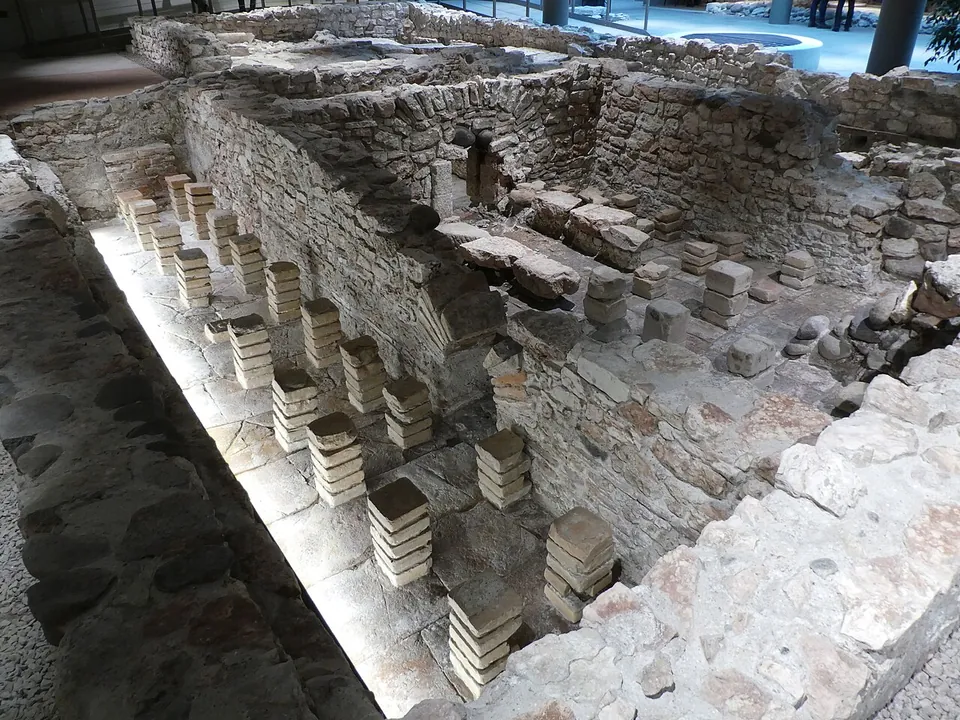
The Spazio Archeologico Sotterraneo del Sas (S.A.S.S.) is the core of the visit: about 1,700 m² of the Roman town uncovered when the Teatro Sociale was restored and enlarged in 1990–2000. It takes in a long stretch of the eastern town wall, with a tower that was turned into a town gate in the imperial period, and a street paved with large slabs of local red stone, with the drains beneath it. Around them are parts of houses with mosaic floors, rooms heated from below, courtyards, a well and a glassmaker’s workshop (the operator). A video reconstruction plays on site, and a free audio guide in Italian, English and German downloads to your phone from a QR code (the operator).
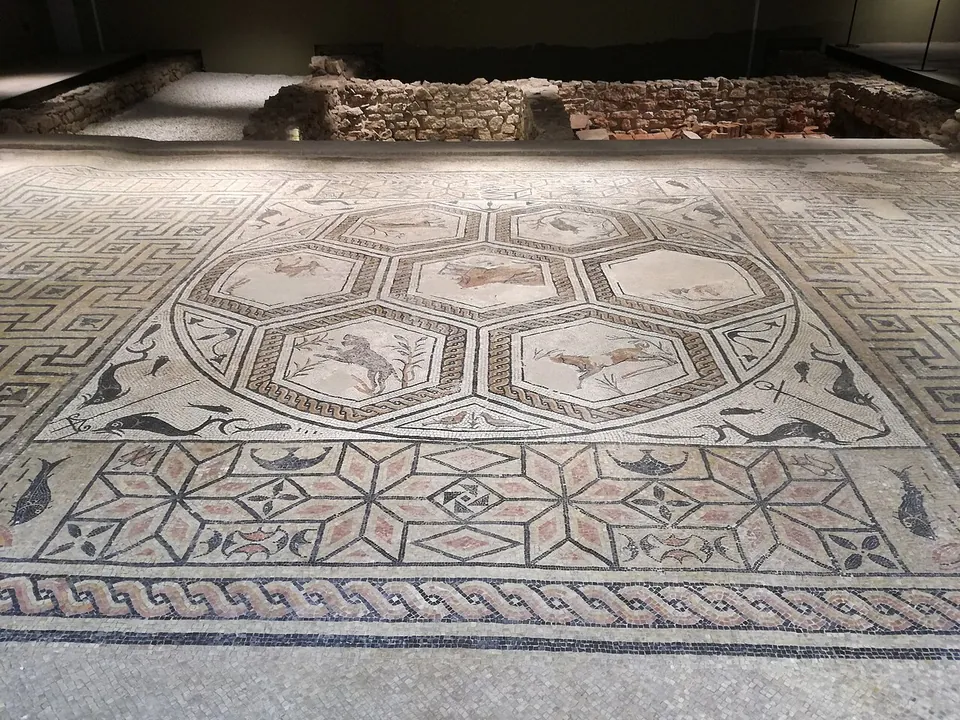
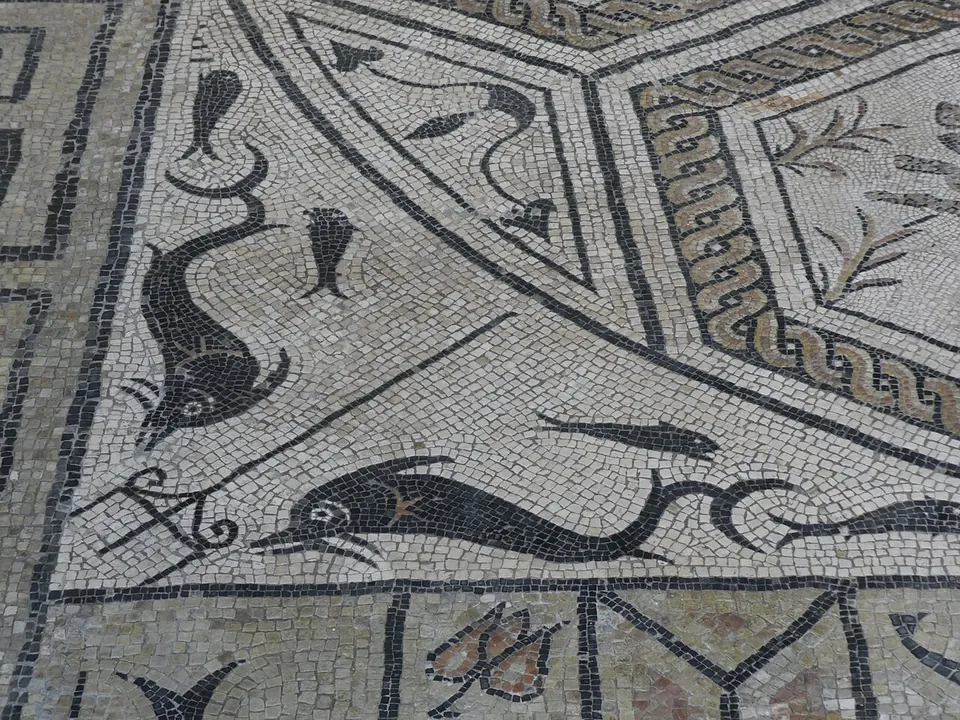
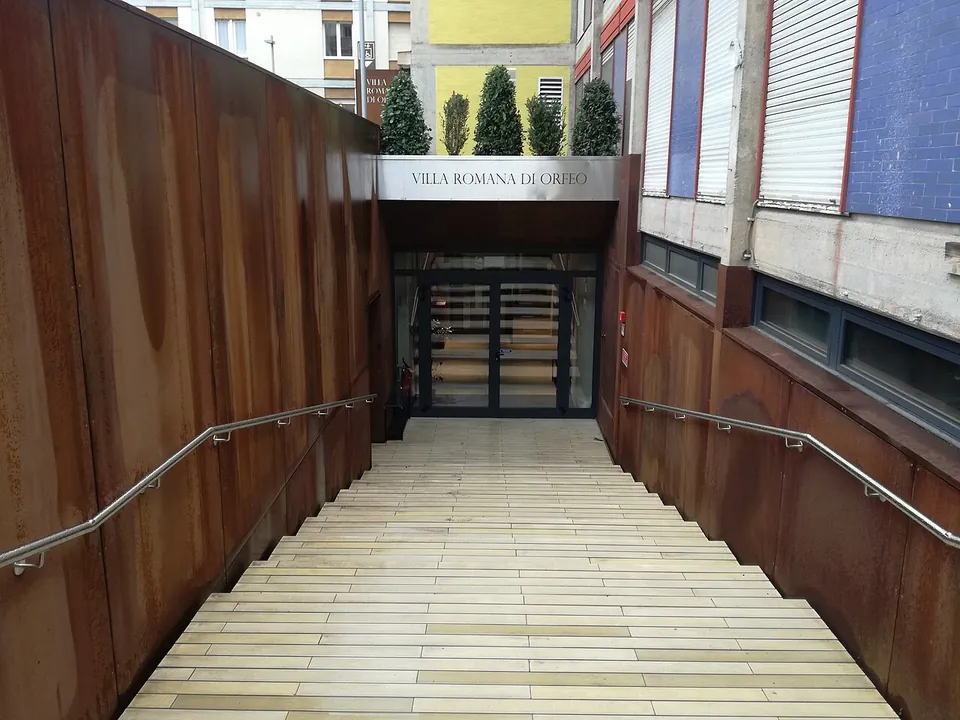
The Villa of Orpheus in Via Rosmini was a rich house outside the town walls, built in the 1st century AD and lived in until the 3rd. Its showpiece is a reception room paved entirely in a polychrome mosaic of Orpheus charming the animals with his music; the house also had baths, with a dressing room and a hot room, and a second room with mosaic floors (the operator). Since 2022 the remains have sat under a single modern building, and the villa reopened on 21 June 2023 (the operator).
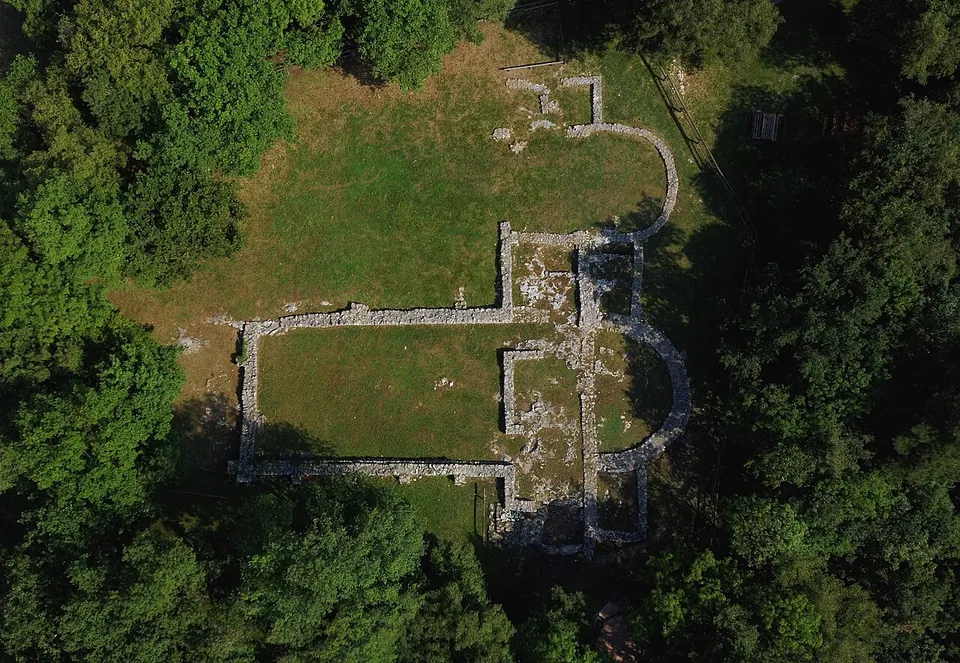
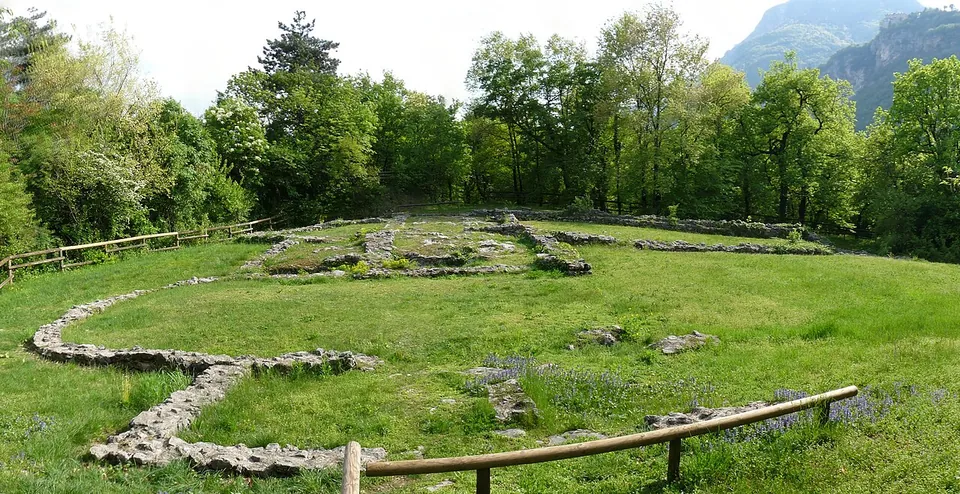
On Doss Trento, a wooded hill 307 m above sea level on the right bank of the Adige that rises more than 100 m above the valley floor (it.wikipedia), the footings of an early Christian church lie in the summit park, about halfway between the Alpini museum and the Cesare Battisti mausoleum. Only part of the base of the walls remains. They outline two parallel halls, each ending in an apse; the southern one was about 30 m long and 10 m wide (it.wikipedia). A surviving fragment of its 6th-century floor mosaic, dedicated to Saints Cosmas and Damian, is now in the Castello del Buonconsiglio (it.wikipedia).
More of Tridentum survives in town. Under the cathedral is the early Christian basilica of San Vigilio, which began as a cemetery church outside the walls (it.wikipedia) and can be visited (the Museo Diocesano). Under Palazzo Lodron is a further area with a street, a house with a latrine, a wine shop and a well-preserved stretch of the Roman and medieval walls, and the houses of Piazzetta Anfiteatro follow the curve of the amphitheatre they were built on (it.wikipedia).
Is it worth the trip?
If you are in Trento, or travelling the Brenner route between Verona and Innsbruck, yes. The S.A.S.S. and the villa together make a good half-day of Roman Trento for one €5 ticket, both within half a kilometre of the centre point, and the villa adds a large mosaic floor. The walk up Doss Trento adds a wooded hill and a church plan in the grass.
It is not a reason to cross the Alps on its own. What survives of Tridentum is foundations, floors and street paving under the modern city, not standing monuments, so the visit is about reading a Roman town from below rather than seeing one rise around you.
Getting there
Trento is on the Brenner railway between Verona and Innsbruck, and the Valsugana line runs from the city towards Bassano del Grappa, with connections for Venice; the A22 motorway links it with Verona and Bolzano (en/it.wikipedia). City buses are run by Trentino Trasporti (it.wikipedia), and the stops Verdi/Inama and Rosmini/Santa Maria Maggiore lie within about 150 m of the centre point (OpenStreetMap).
The S.A.S.S. is in Piazza Cesare Battisti and the villa at Via Rosmini 4. Both open Tuesday to Sunday: 09.30 to 13.00 and 14.00 to 18.00 from 1 June to 30 September, 09.00 to 13.00 and 14.00 to 17.30 from October to May. They close on Mondays (except public holidays), 1 January, 1 November and 25 December. One ticket covers both: €5, €4 for ages 15 to 26, over-65s and groups of fifteen or more, free up to 14; a guided tour is €3. Buy it at the ticket office, no booking needed; the Trentino Guest Card and Museum Pass are accepted (cultura.trentino.it, read 19 October 2026). The Roman paving inside the S.A.S.S. is uneven, so wear flat shoes.
Doss Trento is reached from the Piazzale delle Divisioni Alpine in Via Brescia, up the Strada degli Alpini or the footpath known as the sentiero dell’amore; the old road round the north side has been open only to walkers and cyclists since the hill became a protected biotope (it.wikipedia). The Comune di Trento publishes no opening hours for the summit park.
The basilica under the cathedral opens daily 10.00 to 12.00 and 14.30 to 17.30, Sundays afternoons only, and is closed on Tuesdays; a ticket is €3 (reduced €2), or €7 with the Museo Diocesano Tridentino. Services can change the hours, and the site cannot be reached by visitors with reduced mobility (museodiocesanotridentino.it, read 19 October 2026). The Porta Veronensis, Tridentum’s monumental southern gate beneath the Torre Civica, is currently closed to visitors (the Museo Diocesano).
Visiting details
- Opening hours
- S.A.S.S. (Piazza Cesare Battisti) and Villa of Orpheus (Via Rosmini 4): Tuesday to Sunday, 09.30–13.00 and 14.00–18.00 from 1 June to 30 September, 09.00–13.00 and 14.00–17.30 from 1 October to 31 May; closed Mondays (except public holidays), 1 January, 1 November and 25 December. Early Christian basilica under the cathedral: daily 10.00–12.00 and 14.30–17.30, Sundays 14.30–17.30 only; closed Tuesdays, 1 and 6 January, Holy Week and Easter, 26 June, 1 November and 25 December, and hours may change for services. The basilica remains on Doss Trento lie in the hilltop park; the Comune di Trento publishes no hours for it.
- Tickets
- One ticket covers both the S.A.S.S. and the Villa of Orpheus: €5; €4 for ages 15–26, over-65s and groups of 15 or more paying visitors; free up to 14. Guided tours €3. Bought at the ticket office, no booking needed; Trentino Guest Card and Museum Pass accepted. Basilica under the cathedral: €3, reduced €2, or €7 (reduced €5) with the Museo Diocesano Tridentino.
Before you go
- The Porta Veronensis, Tridentum's southern gate beneath the Torre Civica, is currently closed to visitors.
- The original Roman paving inside the S.A.S.S. is uneven; the operator asks for comfortable flat shoes.
- The early Christian basilica under the cathedral cannot be reached by visitors with reduced mobility.
Hours and prices checked 19 October 2026 on the operator's own site. Confirm before travelling.
History
Trento may have grown from an earlier Rhaetian settlement on the valley floor, and Doss Trento probably carried a Rhaetian hillfort (it.wikipedia). Rome conquered the area in the 1st century BC, and the town became a municipium between 50 and 40 BC (it.wikipedia); Julius Caesar is credited with re-founding it as a Roman municipality (en.wikipedia). The name Tridentum is traditionally explained by the three hills around the city, Doss Trento, Dosso Sant’Agata and Dosso di San Rocco, but historians treat that as a folk etymology and more likely derive it from a Rhaetian word trent, a ford (it.wikipedia).
Under Augustus, with Rome campaigning across the Alps, the town’s strategic role grew within the Regio X Venetia et Histria. It was laid out on a quadrangular plan, bounded on one side by the Adige and on the other three by walls and ditches with quadrangular towers; its main gate, the Porta Veronensis, had two passages, one for walkers and one for carts, flanked by sixteen-sided towers (it.wikipedia; the Museo Diocesano). Tridentum had a forum, an amphitheatre, baths, a river port and an aqueduct from the eastern hills, with cemeteries and villas outside the walls, and it stood on the Via Claudia Augusta, the military road north over the Reschen Pass (it.wikipedia). The Porta Veronensis itself dates from the middle of the 1st century AD (the Museo Diocesano). In the 4th and 5th centuries it remained the economic, commercial and military centre of the Adige valley (it.wikipedia).
The church on Doss Trento is dated by its mosaic, which names a cantor Laurentius as donor and Eugippius, bishop of Trento around 530–540. What it was for is uncertain: published readings include a memorial building later enlarged for worship, separate halls for Catholic and Arian Christians (Arians are documented in the city in the 6th and 7th centuries), and Trento’s first cathedral (it.wikipedia). Its ruins were still standing to some height in the 19th century, were rediscovered in 1900 and fully uncovered after the First World War (it.wikipedia).
Much of Roman Trento was damaged in the 1930s, when finds under the old streets were repeatedly cut through to lay the sewers (it.wikipedia) and the Sas quarter was partly demolished to make the square now named after Cesare Battisti (the operator). The villa was found in 1954, opened to the public in 1966 and closed days later by the flood of 4 November 1966, reopening only in 1982 (the operator).
More photographs



Sources
Every fact on this page comes from the records below, each used under the licence noted.
| Source | Licence |
|---|---|
| Pleiades 383804 | CC BY |
| Vici.org 1584 | CC BY-SA (text), CC0 (metadata) |
| Wikipedia (it) — Tridentum | CC BY-SA 4.0 |
| Wikipedia (it) — Trento | CC BY-SA 4.0 |
| Wikipedia (en) — Trento | CC BY-SA 4.0 |
| Wikipedia (it) — Spazio Archeologico Sotterraneo del Sas | CC BY-SA 4.0 |
| Wikipedia (it) — Villa romana di Orfeo | CC BY-SA 4.0 |
| Wikipedia (it) — Basilica paleocristiana del Doss Trento | CC BY-SA 4.0 |
| Wikipedia (it) — Doss Trento | CC BY-SA 4.0 |
| Trentino Cultura (Provincia autonoma di Trento) — Spazio Archeologico Sotterraneo del Sas, hours and admission | licence not recorded |
| Trentino Cultura — Villa romana di Orfeo | licence not recorded |
| Trentino Cultura — Roman Villa of Orpheus (English) | licence not recorded |
| Museo Diocesano Tridentino — visiting the early Christian basilica of San Vigilio | licence not recorded |
| Museo Diocesano Tridentino — Porta Veronensis | licence not recorded |