

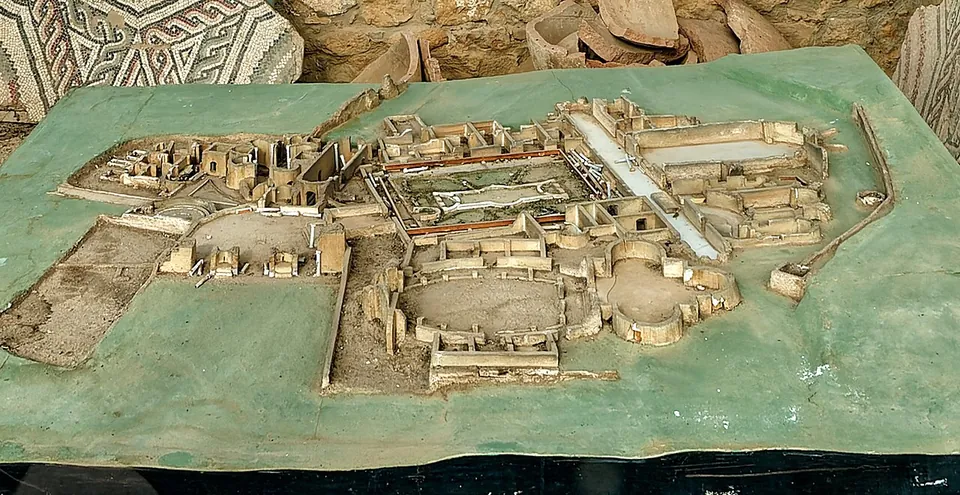
The Villa Romana del Casale is a large late Roman villa in inland Sicily, outside Piazza Armerina, famous for its floor mosaics: some 3,500 m² of mosaic and inlaid-marble floors survive here, in a state of preservation credited to the landslide and floods that buried the villa (en.wikipedia). UNESCO added it to the World Heritage list in 1997.
What is there today
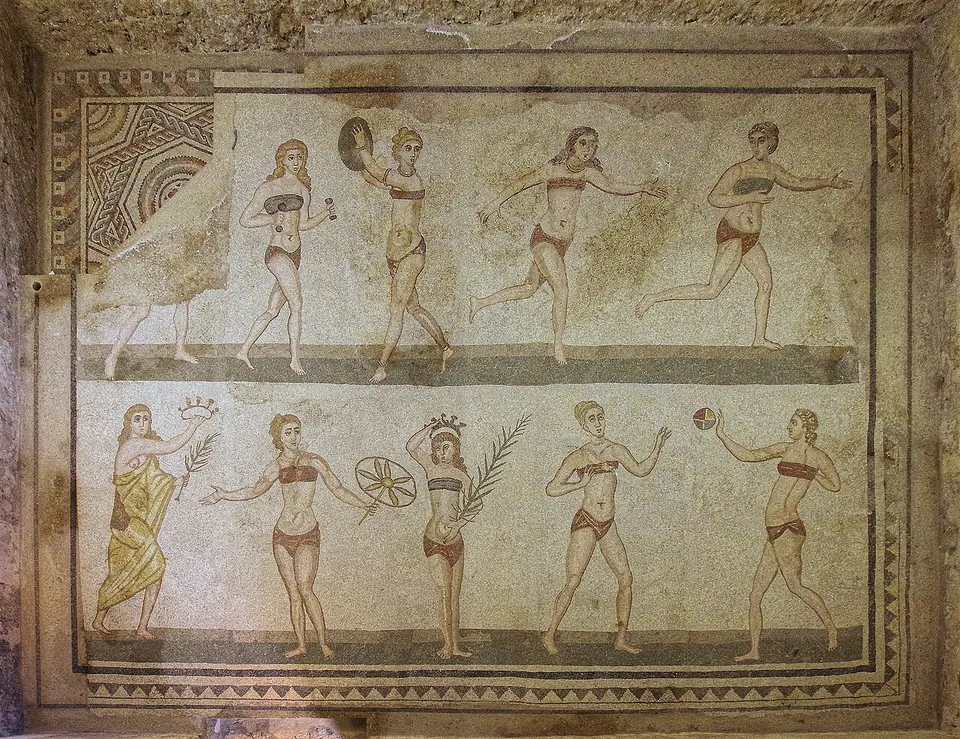
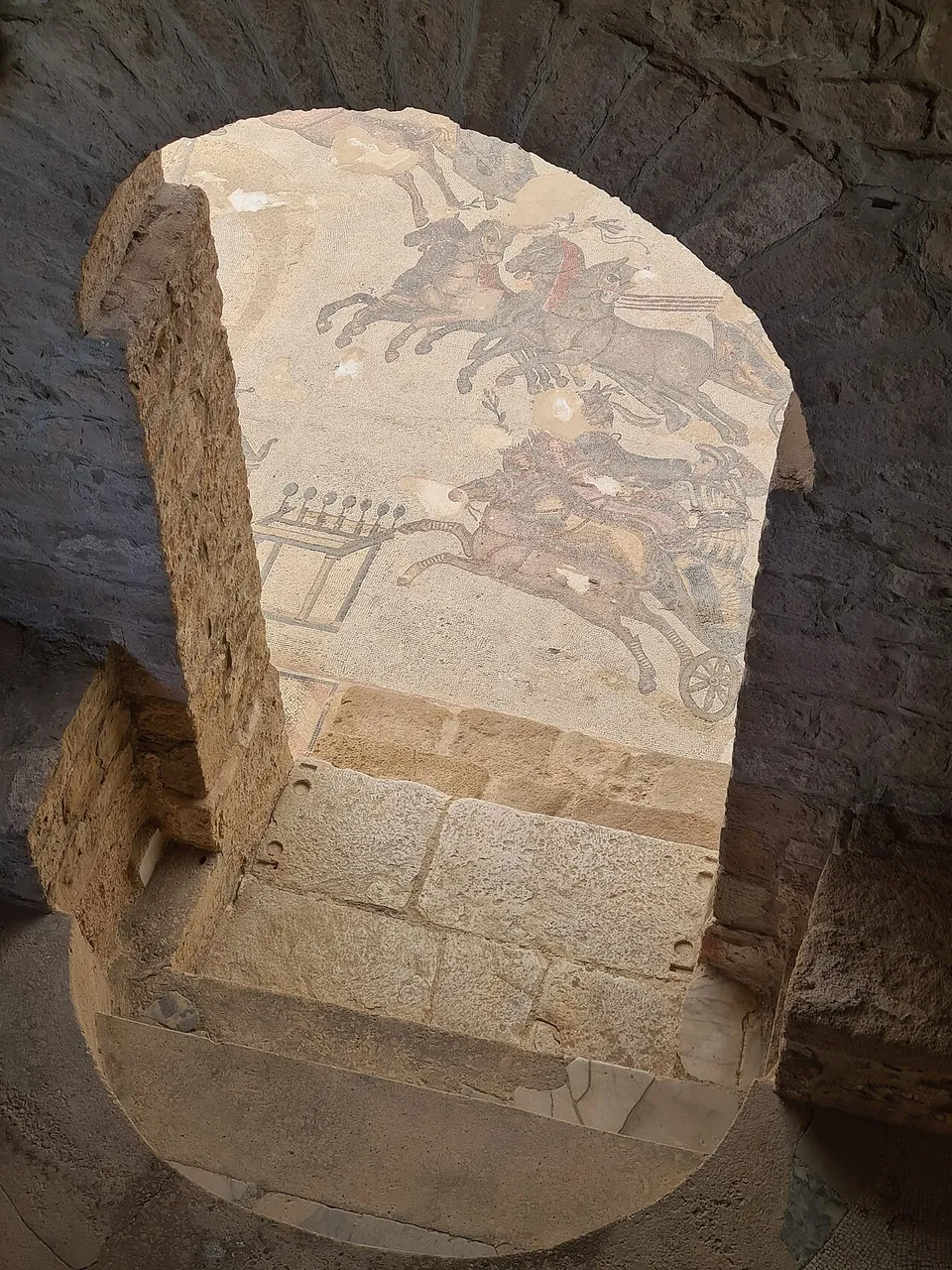
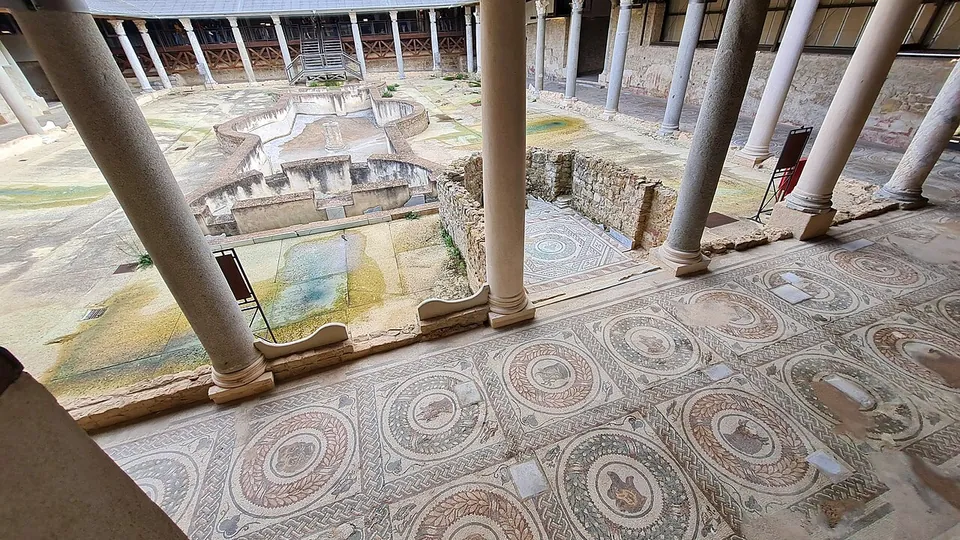
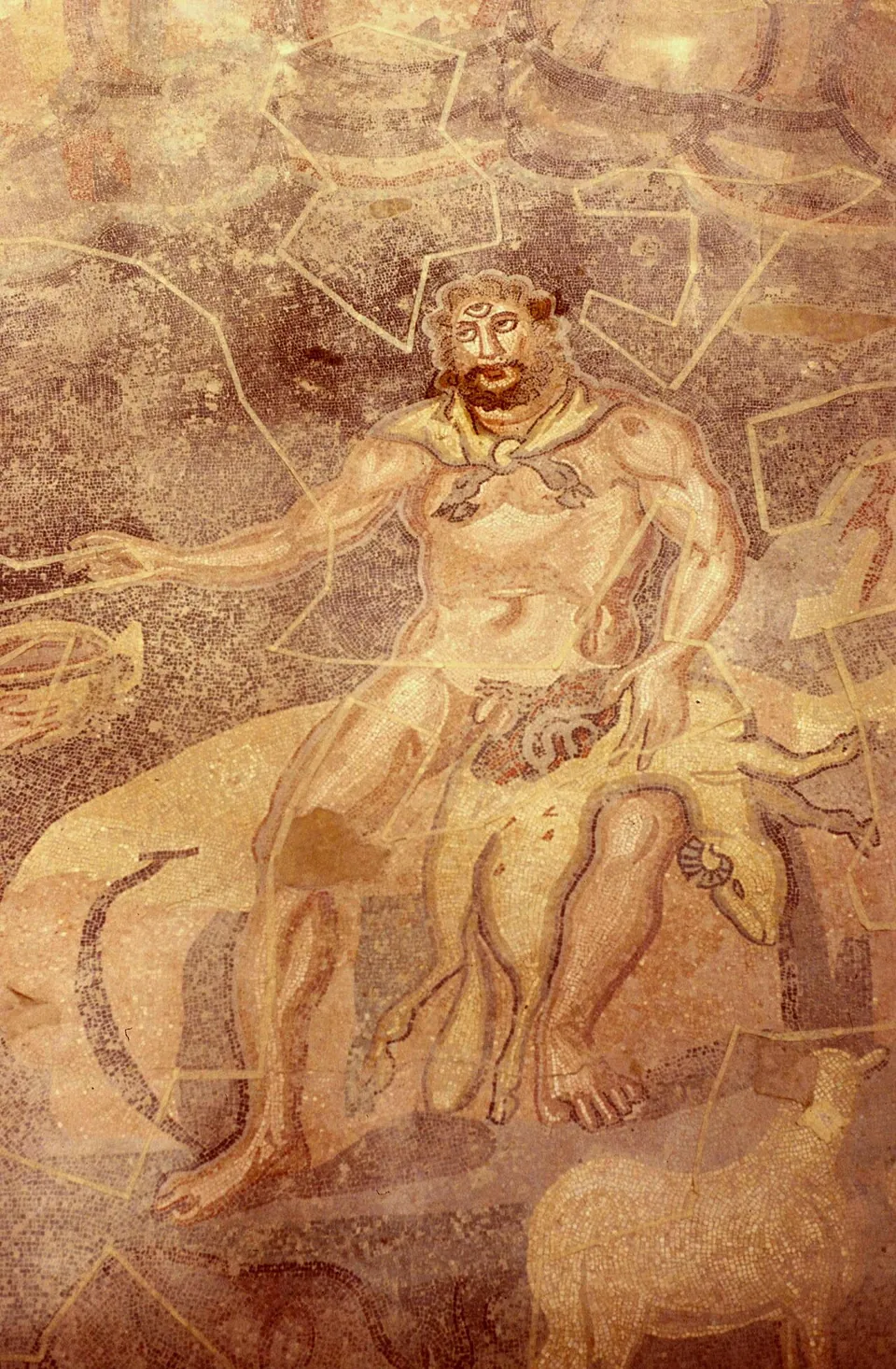
The floors are the site. Room after room of the villa’s ground plan has its mosaic in place, under a protective cover (en.wikipedia), so the visit is a walk through the house looking down. The best known is the room of the “girls in bikinis”: ten young women at their exercises, lifting weights, throwing the discus, running and playing ball, with a winner receiving a crown and a palm branch (it.wikipedia). Along the east side of the great colonnaded courtyard runs the corridor of the “Great Hunt”, 65.93 m long and 5 m wide, whose floor shows wild animals being captured and shipped for the games in Rome rather than hunted (it.wikipedia). Elsewhere there is a smaller hunting scene with men and dogs, a three-eyed Polyphemus offered a cup of wine by Ulysses, a chariot race in the Circus Maximus in a hall of the baths, and the labours of Hercules in the three-apsed dining hall (it.wikipedia). The great audience hall had a floor of coloured marbles from around the Mediterranean (en.wikipedia). The villa also had its own baths, with cold, warm and hot rooms, and their floors are mosaics too (it.wikipedia).
Is it worth the trip?
Yes, and it is worth planning a trip through inland Sicily around it. Citing the Grove Dictionary of Art, en.wikipedia calls the mosaics “the richest, largest, and most varied collection”; this is not a site where you have to imagine what was there. Expect company: the operator counts 350,000 visitors a year.
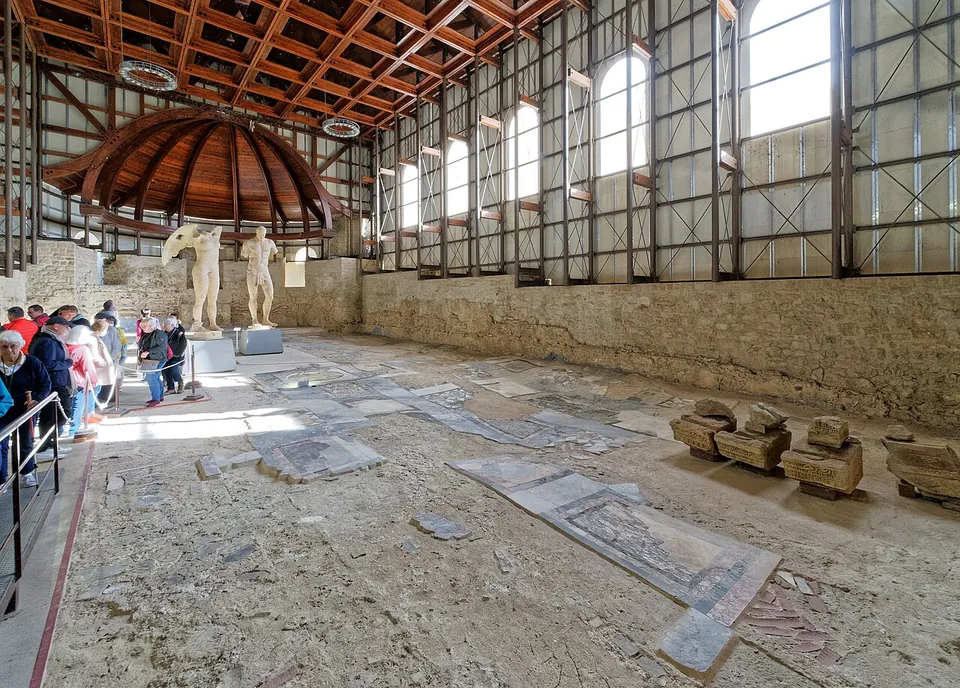
The honest caveat is that the villa was a single-storey building (en.wikipedia), and what survives is floors, and walls standing a few metres high, seen from walkways under modern roofs, not standing buildings. It also lies in the countryside outside the town, and without a car getting there takes a shuttle bus that has to be booked and runs only from April to October.
Getting there
The villa lies 3 to 5 km south-west of Piazza Armerina (published distances differ; the operator says about 5 km), with its entrance in Contrada Casale on the SP 90 road. From Catania airport the operator’s directions take the A19 motorway to the Dittaino exit and then the road towards Valguarnera and Piazza Armerina; from Palermo, the A19 to the Enna exit and on towards Pergusa. From the town, the SP 15 towards Barrafranca leads to the SP 90. There is a large car park at the site, charged by the hour (the operator).
Without a car, the operator links to a shuttle bus from Piazza Armerina, running 1 April to 30 October from Piazza Senatore Marescalchi by way of the info point in Piazza Generale Cascino, six times a day from 09.35, with the last bus back from the villa at 19.00. Each ride has to be booked 15 minutes before it leaves, with the bus company, SA.DA. Tours, whose number is on the timetable. A ride is €1.50 and a day return €2.50. The timetable does not say which year it is for, so check it before relying on it.
The villa is open every day from 09.00 to 19.00, with last entry at 18.00 (the operator, read 16 October 2026). A ticket is €14 for anyone over 25, over-65s included, and €7 for 18- to 24-year-olds; under-18s, teachers and disabled visitors go free, and so does everyone on the first Sunday of the month and on a handful of national days. There is no need to book: you pay at the ticket office, in cash or by card. An audio guide can be hired there, and the operator publishes a list of accredited guides (it.wikipedia; the operator). In summer 2026 the villa also opened in the evening, at €7, until 14 September; the operator’s site announces such openings. A café and free public toilets are mapped within about 200 m of the villa (OpenStreetMap).
Visiting details
- Opening hours
- Daily 09.00–19.00, last entry 18.00. In summer 2026 the villa also opened in the evening until 14 September (20.00 to 22.30 last entry).
- Tickets
- €14 for everyone over 25, over-65s included; €7 for ages 18–24; free for under-18s, teachers and disabled visitors. Free for all on the first Sunday of each month, 25 April, 2 June and 4 November, and on 10 March; free for women on 8 March. Evening entry €7. No booking needed; pay at the ticket office in cash or by card (no American Express).
- Parking
- A large car park at the site with hourly charges (the operator); the rate is not published.
Before you go
- The villa is in the countryside outside Piazza Armerina. Without a car the way in is a shuttle bus from the town, which runs 1 April to 30 October and must be booked 15 minutes before each ride, or a taxi.
Hours and prices checked 16 October 2026 on the operator's own site. Confirm before travelling.
History
The villa visible today was built in the 4th century on the remains of an older farm villa; en.wikipedia places the building in the first quarter of the century, while it.wikipedia reports a dating of walls and mosaics to roughly 320–370. It was the residence at the heart of a great agricultural estate, and grew in three phases, ending with a monumental entrance, the oval courtyard and the three-apsed dining hall (en.wikipedia). Some scholars have proposed an imperial owner such as Maximian; others a senatorial aristocrat (en.wikipedia), and it.wikipedia reports that the identification now most favoured is Lucius Aradius Valerius Proculus Populonius, governor of Sicily in 327–331.
In the 5th and 6th centuries the villa was fortified, and it was damaged, perhaps destroyed, during the brief Vandal rule of 469–478. Its outbuildings stayed in use through the Byzantine and Arab periods, and a village grew up around it; that settlement was destroyed in 1160–1 under the Norman king William I, and in the 12th century a landslide covered the villa and the survivors moved to where Piazza Armerina stands today (en.wikipedia). Pleiades’ note puts the end down to an earthquake in the early Middle Ages instead. Paolo Orsi made the first professional excavation in 1929, and the large campaigns of 1950–60 under Gino Vinicio Gentili were followed by a protective cover over the mosaics (en.wikipedia). A medieval settlement of the 10th to 12th centuries was found on the site in 2004 (en.wikipedia).
More photographs



Sources
Every fact on this page comes from the records below, each used under the licence noted.
| Source | Licence |
|---|---|
| Pleiades 462435 | CC BY |
| Wikidata Q505617 | CC0 |
| OpenStreetMap way/304804695 | ODbL |
| Villa Romana del Casale — tickets and services (Parco archeologico di Morgantina e della Villa romana del Casale, the operator) | licence not recorded |
| Villa Romana del Casale — opening hours of all the park's sites (the operator) | licence not recorded |
| Shuttle bus timetable, Piazza Armerina – Villa Romana del Casale (linked from the operator's site) | licence not recorded |
| Come arrivare — directions (the operator, 2021) | licence not recorded |
| Wikipedia (en) — Villa Romana del Casale | CC BY-SA 4.0 |
| Wikipedia (it) — Villa romana del Casale | CC BY-SA 4.0 |
| Wikipedia (de) — Villa Romana del Casale | CC BY-SA 4.0 |
| Wikipedia (fr) — Villa romaine du Casale | CC BY-SA 4.0 |
| Wikipedia (hr) — Villa del Casale | CC BY-SA 4.0 |
| UNESCO World Heritage List — 832, Villa Romana del Casale | licence not recorded |