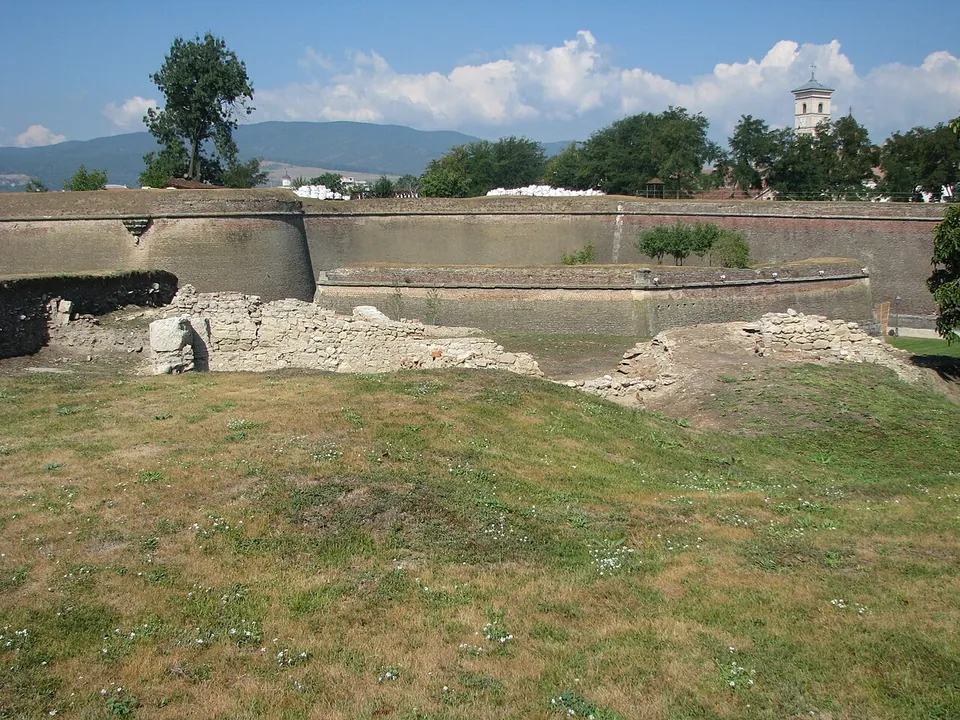
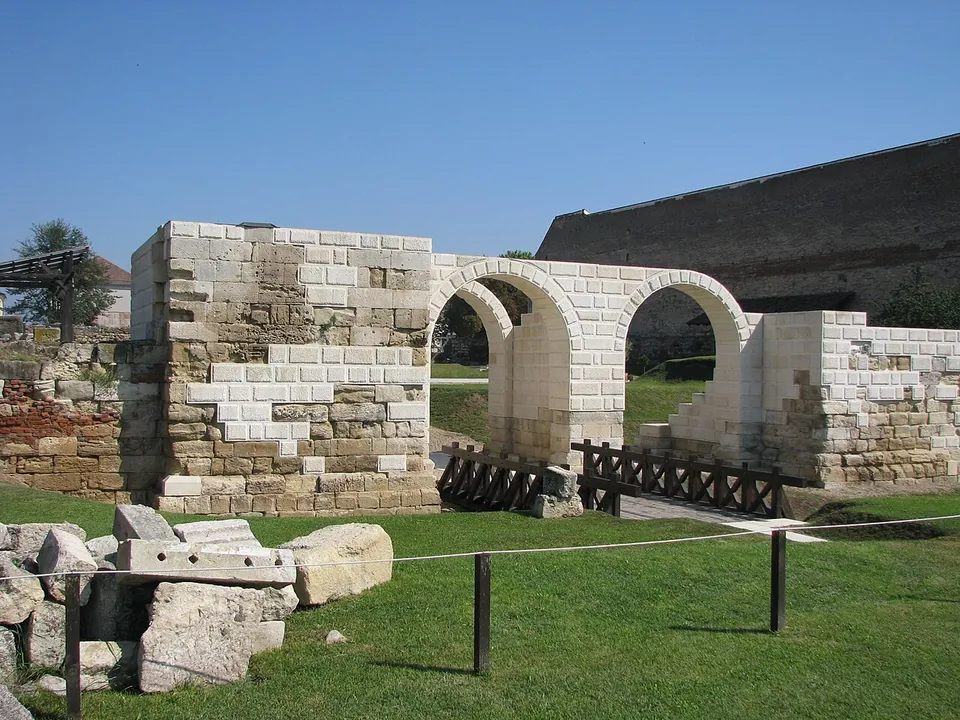
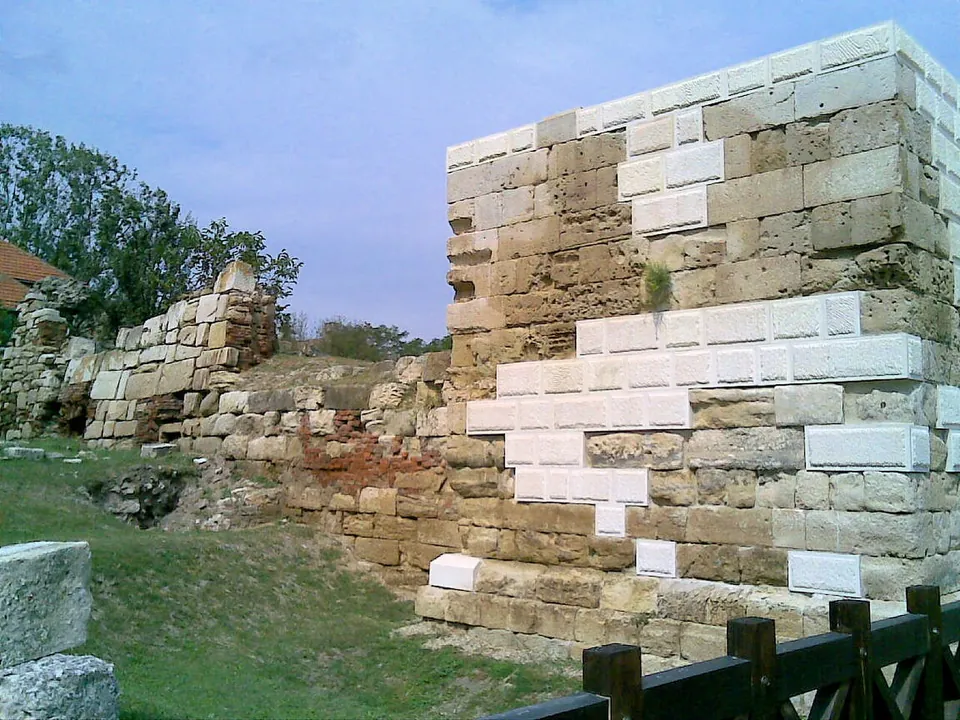


Apulum was the main military base of Roman Dacia and grew into its largest town: the fortress of the Thirteenth Legion stood where the Habsburg citadel of Alba Carolina stands today. Its rebuilt south gate, stretches of wall built into later buildings and the headquarters building, shown in a museum under a protective roof, can be seen inside the citadel.
What is there today
The legionary fortress lies under the star-shaped citadel of Alba Carolina, built in the early 18th century, which damaged much of what was left of it (de and en.wikipedia). Several parts are on show (de.wikipedia):
- The south gate (porta principalis dextra), a double gate with a central pier and rectangular side towers built of local limestone, has been conserved and partly reconstructed and is one of the town’s sights.
- The walls: a stretch of about 20 m survives in part in the west wall of the Museikon icon museum, and about 80 m, also in part, in the south wall of the Princely Palace of Transylvania.
- The via principalis: about 40 m of the fortress’s main cross street are shown in the paving, with the restored walls of shops on either side.
- The headquarters (principia): about 2,000 m² of its central part are covered by the Principia Museum, opened in 2015, around the conserved walls of the shrine of the standards and a room with underfloor heating, with finds and bronze statues of five emperors important to Apulum.
Published figures for the fortress’s size differ: about 18.5 ha (420 by 440 m) or 37.5 ha, which would make it the largest castrum in Romania (de and en.wikipedia).
Is it worth the trip?
Yes, as part of a visit to Alba Iulia: the Roman gate, walls and headquarters are all inside the citadel, together with the cathedrals and museums that bring most people here. On their own they are fragments of a fortress under a later one, so the citadel is the destination and Apulum one layer of it.
Getting there
Alba Iulia is a county town on the Mureș, where the Ampoi joins it (de.wikipedia). The remains are in the upper town, inside the Alba Carolina citadel; street parking is mapped beside the point this page uses (OpenStreetMap).
No operator page publishes opening hours or admission for the Principia Museum (searched 3 October 2026). The gate and the wall sections stand in the open grounds of the citadel.
Visiting details
- Tickets
- Unknown
Before you go
- No operator page publishes opening hours or admission for the Principia Museum (searched 2026-10-03); the gate and the wall sections stand in the open grounds of the Alba Carolina citadel.
History
Trajan moved the Thirteenth Legion (Legio XIII Gemina) here at the end of the Dacian war in 106, and the fortress was rebuilt in stone under Hadrian and Antoninus Pius (en and de.wikipedia). The governor’s seat moved here from Ulpia Traiana Sarmizegetusa: around 118, with Hadrian’s reforms of the province, according to de.wikipedia, or around 158 under Antoninus Pius, according to en.wikipedia (Ulpia Traiana Sarmizegetusa). His palace (praetorium consularis) has been excavated in the town (de.wikipedia). Two towns grew up: the Municipium Septimium Apulense around the fortress, of 25–30 ha, and between it and the Mureș the Municipium Aurelium Apulense, later the Colonia Aurelia Apulensis, of 75 ha at its height (de.wikipedia). The legion left in 271, when Rome evacuated the province (en.wikipedia).
Sources
Every fact on this page comes from the records below, each used under the licence noted.
| Source | Licence |
|---|---|
| Pleiades 206927 | CC BY |
| Wikidata Q774266 | CC0 |
| Vici.org 12896 | CC BY-SA (text), CC0 (metadata) |
| OpenStreetMap way/241917530 | ODbL |
| Wikipedia (de) — Apulum | CC BY-SA 4.0 |
| Wikipedia (en) — Apulum (castra) | CC BY-SA 4.0 |
| Wikipedia (en) — Alba Iulia | CC BY-SA 4.0 |