

Castra Drobeta is the fort Trajan built at Drobeta-Turnu Severin to guard the northern end of his bridge over the Danube, the first stone fort the Romans raised in Dacia. Its walls, gates and interior lie in the museum park on the river bank, about 140 m from the surviving pier of Trajan’s Bridge, the Roman baths and an amphitheatre.
What is there today
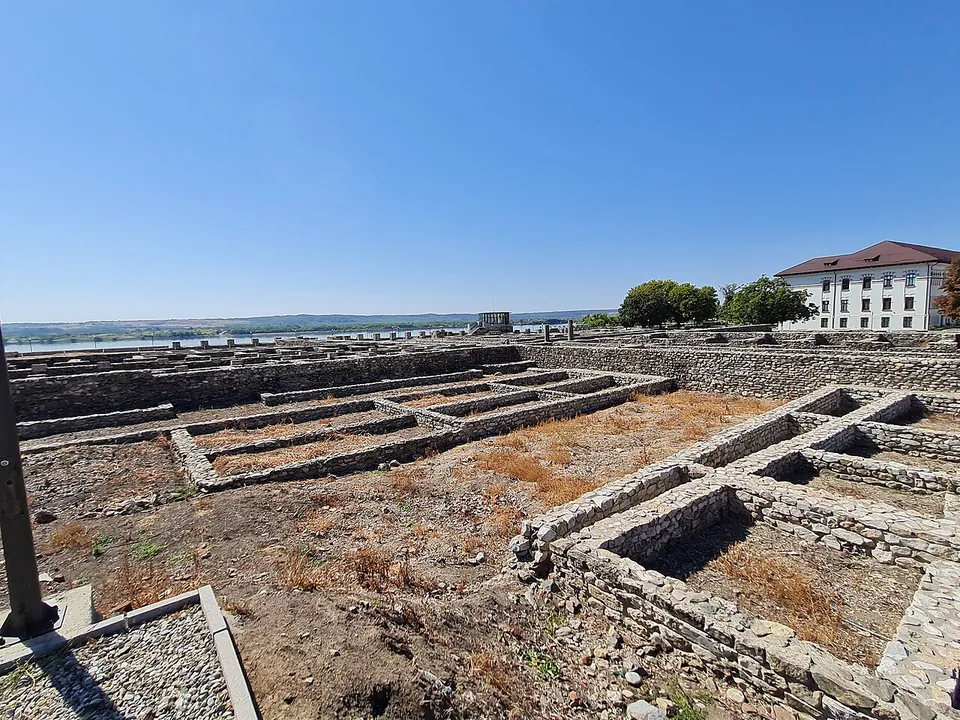
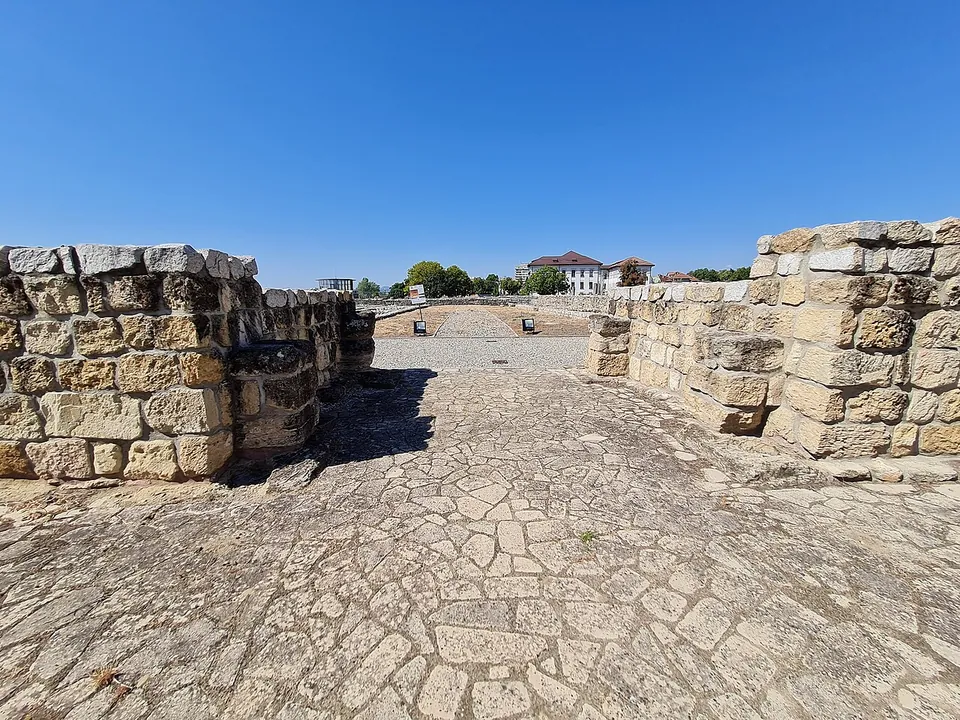
The fort’s foundations, as rebuilt under Constantine, are visible over about two hectares, with its four gates, dwellings, barracks, arms stores and streets, and in the centre the commander’s building, where Trajan himself is said to have stayed in the winter of 105 (ro.wikipedia). It is unusual in facing south, with its main gate towards the river, possibly because it defended the bridge (en.wikipedia). The photographs of 2021 show the walls consolidated in squared stone and a paved passage through them, in line with the reconstruction of the fort, baths and bridge foundation announced in 2010 (Adevărul).
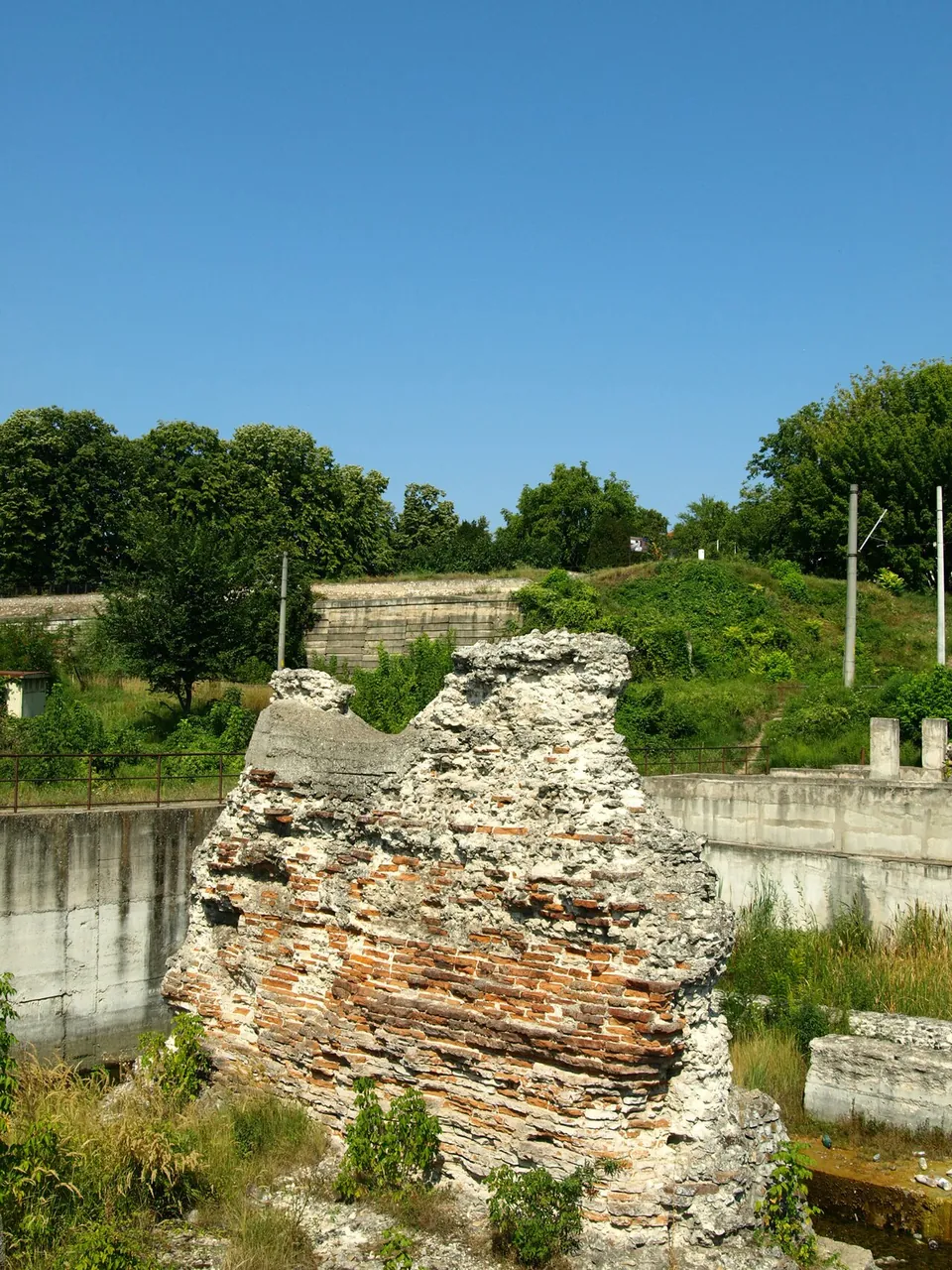
Trajan’s Bridge. About 140 m from the fort, on the Romanian bank, stands one of the two entrance piers of the bridge, the only parts still visible; the other is on the Serbian bank (en.wikipedia). It is a block of masonry and brick inside a square concrete enclosure, built to protect it when the Iron Gate I dam raised the river (Commons). The bridge was 1,135 m long, 15 m wide and 19 m high, with wooden arches on twenty masonry piers. It was designed by Trajan’s architect Apollodorus of Damascus and built between 103 and 105, and Hadrian had its wooden superstructure dismantled (en.wikipedia).
The baths. West of the fort, on the river bank, are the ruins of the Roman baths; bricks stamped by the Fifth Macedonian Legion date them to the time of the fort and the bridge (ro.wikipedia).
The amphitheatre. Pleiades records a Roman amphitheatre at Drobeta, mapped about 200 m from the fort.
Is it worth the trip?
Yes, for the bridge as much as for the fort. Standing at the pier of the first bridge over the lower Danube, with the fort it was built to protect behind you, is a good way to understand how Trajan took Dacia. The fort itself is a set of consolidated walls and foundations rather than standing buildings, and its walls have been consolidated and partly rebuilt, so come with the bridge in mind. Check first that the museum is open (see below).
Getting there
The fort lies in Drobeta-Turnu Severin, about 1.2 km from the centre, beside the Iron Gates Region Museum (Muzeul Regiunii Porților de Fier) at Strada Independenței 2. A bus stop, Generala Nr. 9, is mapped about 270 m away (OpenStreetMap).
The museum opens Tuesday to Sunday, 09.00 to 17.00, with last entry at 16.30, and is closed on Mondays. Its full ticket is 40 RON, about €7.50, and 10 RON for children; the planetarium is 20 RON (the museum’s own site, read 3 October 2026). It does not say whether the ruins in the park need a ticket of their own. The national museum guide, cIMeC, listed the museum as closed in an entry of 15 September 2026, so telephone +40 252 317 377 before you go.
Visiting details
- Opening hours
- Tuesday to Sunday, 09.00–17.00 (last entry 16.30); closed on Mondays. These are the Iron Gates Region Museum's hours; the ruins lie in its archaeological park.
- Tickets
- The museum's full ticket is 40 RON (about €7.50), 10 RON for children; the planetarium is 20 RON. The operator does not say whether the ruins in the park need a ticket of their own.
Before you go
- The national museum guide (cIMeC) listed the museum as "Closed" in an entry updated on 15 September 2026, while the museum's own site gives normal opening hours. Telephone the museum (+40 252 317 377) before travelling.
Hours and prices checked 3 October 2026 on the operator's own site. Confirm before travelling.
History
The fort went up with Trajan’s Bridge, as the guard of its northern end, at the point where the imperial road into Dacia began (en.wikipedia). It was built for a garrison of 500 men who guarded the bridge (ro.wikipedia), and it was the only Roman fort in Dacia in use from the 2nd century to the beginning of the 7th (en.wikipedia). A Roman town, Drobeta, grew around it; under Hadrian it became a municipium and under Septimius Severus a colonia (hu.wikipedia).
The fort went through at least five phases of building. Under Gallienus, after the Carpi destroyed it in 245–247, three of its gates were walled up and the main gate given semicircular towers; under Constantine it was repaired after Rome had withdrawn from Dacia. It was destroyed in the first half of the 5th century, probably by the Huns, rebuilt at the end of that century, possibly under Anastasius I, and partly restored by Justinian I, when it was briefly called “Theodora” after his wife. The Avars probably destroyed it at the beginning of the 7th century, and a settlement was built over the ruins in the 10th (en.wikipedia).
Sources
Every fact on this page comes from the records below, each used under the licence noted.
| Source | Licence |
|---|---|
| Pleiades 573484325 | CC BY |
| Wikidata Q5308156 | CC0 |
| Vici.org 12908 | CC BY-SA (text), CC0 (metadata) |
| OpenStreetMap way/242110934 | ODbL |
| Pleiades — Drobeta (the Roman town) | licence not recorded |
| Wikipedia (en) — Drobeta (castra) | CC BY-SA 4.0 |
| Wikipedia (ro) — Castrul roman Drobeta | CC BY-SA 4.0 |
| Wikipedia (en) — Trajan's Bridge | CC BY-SA 4.0 |
| Wikipedia (hu) — Drobeta | CC BY-SA 4.0 |
| Muzeul Regiunii Porților de Fier — hours and tickets (the operator) | licence not recorded |
| cIMeC museum guide — Iron Gates Region Museum (updated 2026-09-15) | licence not recorded |
| Adevărul — the castrum and baths to be rebuilt with €12 million (2010, updated 2022) | licence not recorded |