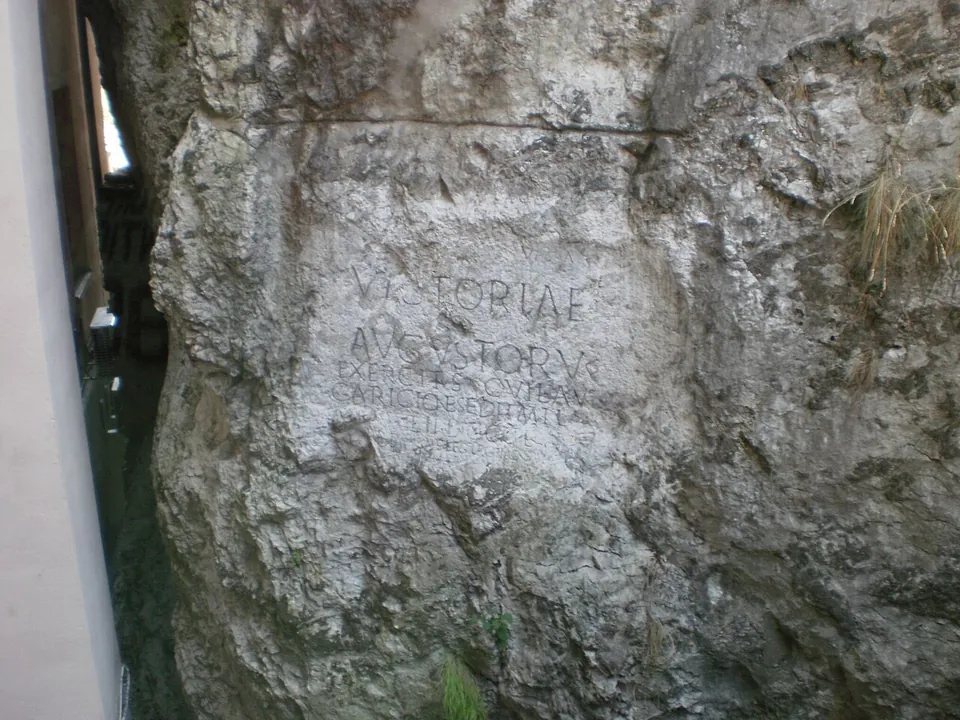
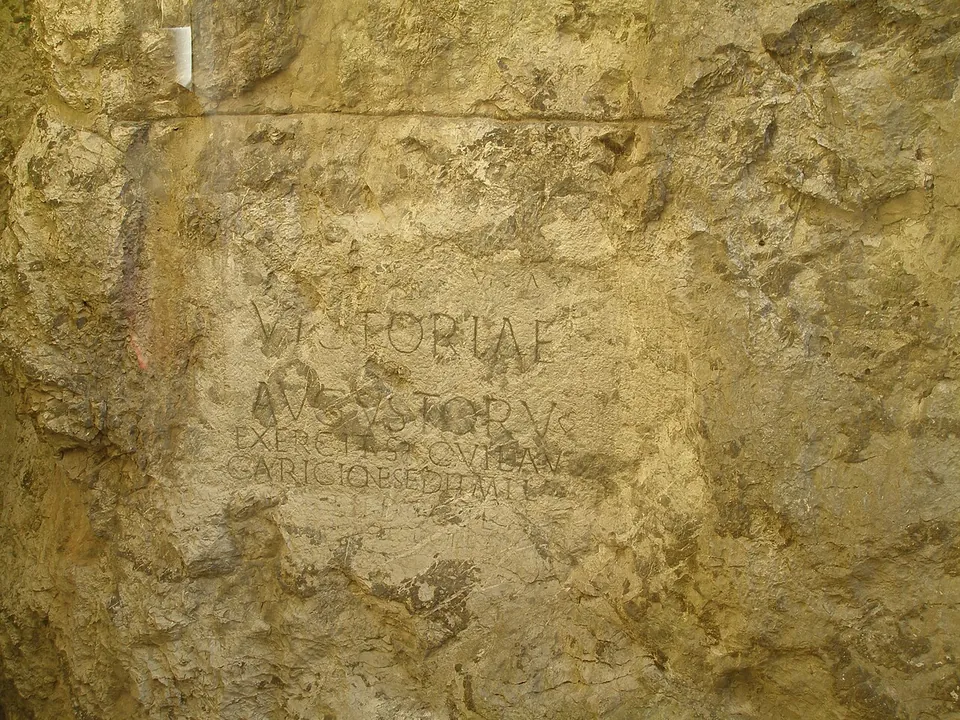
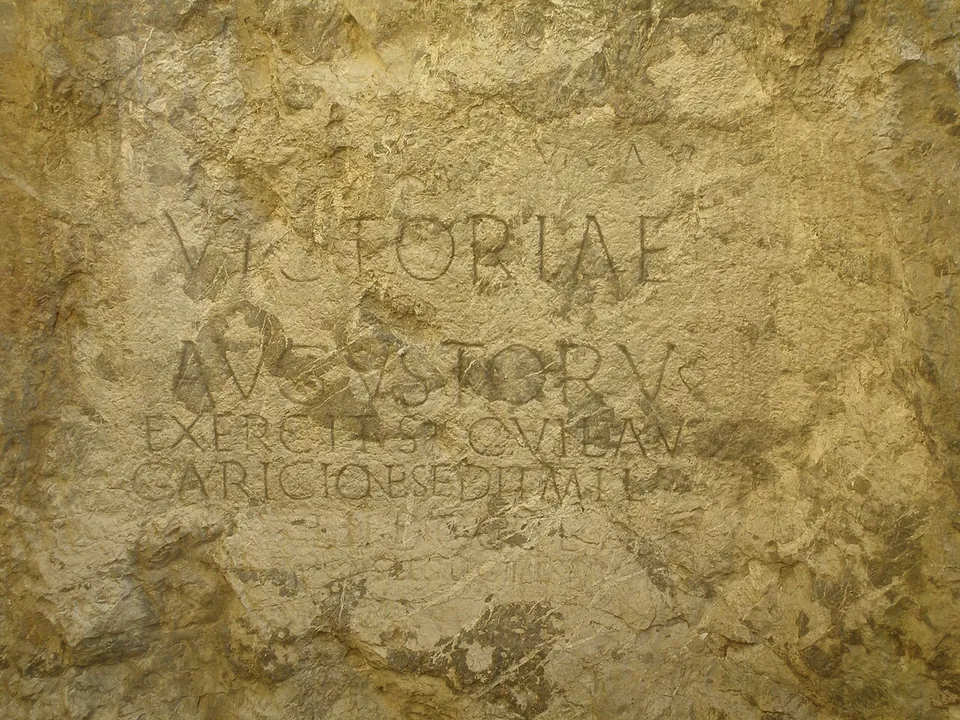


What is there today
What you see is a panel of lettering cut into the castle rock, still where it was carved, and described as the most important Roman inscription in central Europe north of the Danube (sk.wikipedia). Some of the text has weathered away or is missing (sk.wikipedia); the first lines, VICTORIAE AVGVSTORV(m), “to the victory of the emperors”, are still clear in photographs, the lower ones worn. The rock with the inscription is right beside Hotel Elizabeth, and you see it from inside the hotel, through a glass wall (the city of Trenčín).
Is it worth the trip?
On its own, probably not: it is a single inscription, seen through glass, and a look takes minutes. But it is free, it is at the beginning of Mierové námestie in Trenčín (the city of Trenčín), and Trenčín Castle stands on the rock above it, so anyone visiting the town or the castle should step inside. It is also rare: Laugaricio was one of the northernmost places Roman troops reached in their raids against the Germanic tribes (sk.wikipedia), and the inscription is among the few written records that confirm the Romans’ presence in central Europe (the city of Trenčín).
Getting there
Go into Hotel Elizabeth, the historic hotel at the beginning of Mierové námestie (Ul. gen. M. R. Štefánika 2), once known as the Hotel Tatra. Walk through the lobby and go upstairs, where you read the inscription through a glass wall. Entry is free, and the reception is open around the clock (the city of Trenčín, read 10 October 2026).
The nearest bus stop, Hasičská, is about 200 m away, and a small public car park about 90 m away is charged on weekdays 08.00–18.00 and Saturday mornings (OpenStreetMap).
Visiting details
- Opening hours
- Whenever Hotel Elizabeth is open; its reception is staffed around the clock.
- Tickets
- Free.
- Parking
- A small public car park about 90 m away, charged Monday to Friday 08.00–18.00 and Saturday 08.00–12.00 (OpenStreetMap way/541675927).
Hours and prices checked 10 October 2026 on the operator's own site. Confirm before travelling.
History
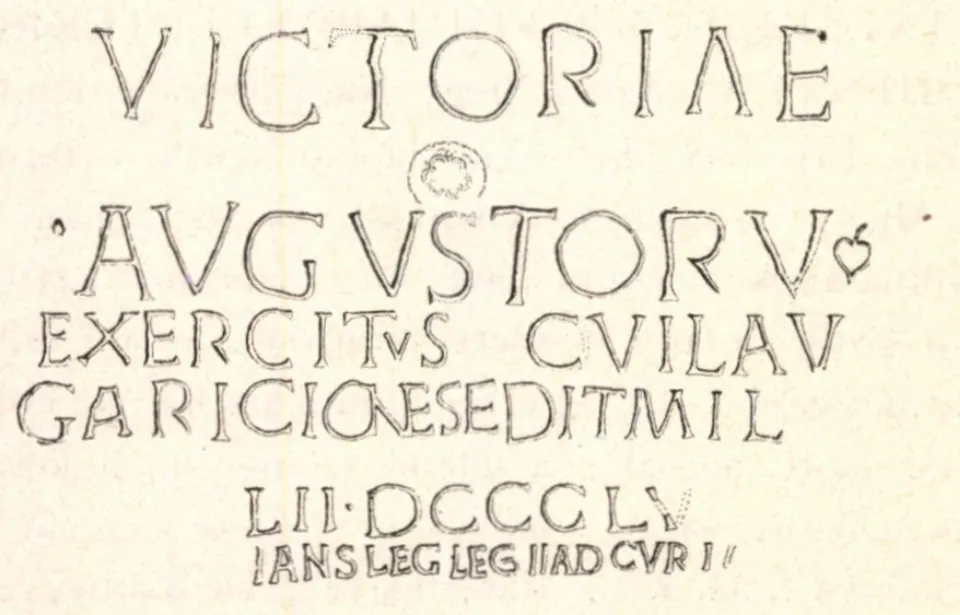
Around 170 the Marcomanni and Quadi, Germanic peoples living in what is now Slovakia, attacked the Roman frontier. Marcus Aurelius led a punitive campaign against them in 172, which his son Commodus continued and ended with a truce (sk.wikipedia). In the last year of the war, detachments of the Legio II Adiutrix, from its garrison at Aquincum (today’s Budapest), pushed up the valley of the Váh as far as Laugaricio, and they carved the inscription into the rock, which then rose above the bed of the river. It is dedicated to the Roman army’s victory over the Quadi (sk.wikipedia). It reads, with worn or missing letters in brackets (sk.wikipedia):
VICTORIAE AVGVSTORV(m) / EXERCITVS QVI LAV/GARICIONE SEDIT MIL(ites) / L(egionis) II DCCCLV / (Marcus Valerius) MAXIMIANVS LEG(atus) LEG(ionis) II AD(iutricis) CVR(avit) F(aciendum)
“To the victory of the emperors and of the army that was stationed at Laugaricio, 855 soldiers of the Second Legion; Marcus Valerius Maximianus, legate of the Legio II Adiutrix, had it made” (after the translations given by sk.wikipedia and the city of Trenčín). The emperors were probably Marcus Aurelius and Commodus (sk.wikipedia).
The inscription was found in 1854 (hu.wikipedia). Its authenticity was once doubted. It was settled in the mid-20th century, when a statue base of the same Marcus Valerius Maximianus was found at Zana in Algeria, Roman Diana Veteranorum in the province of Numidia. Its inscription describes his career and mentions his command of the troops who wintered at Laugaricio in the barbaricum beyond the Danube, which identified the legate and, with the Trenčín text itself, allowed the inscription to be dated precisely (sk.wikipedia).
Laugaricio was probably a settlement on the ground of today’s Trenčín or close to it; the Zana inscription spells it Leugaricio, and both may be the trading settlement Leukaristos on Ptolemy’s map (sk.wikipedia).
More photographs

Sources
Every fact on this page comes from the records below, each used under the licence noted.
| Source | Licence |
|---|---|
| Pleiades 128442 | CC BY |
| Wikidata Q639644 | CC0 |
| OpenStreetMap node/5418972883 | ODbL |
| Rímsky nápis na hradnej skale (Visit Trenčín, the city of Trenčín's tourism site) | licence not recorded |
| Roman inscription on the rock (Visit Trenčín, English version) | licence not recorded |
| Wikipedia (sk) — Rímsky nápis v Trenčíne | CC BY-SA 4.0 |
| Wikipedia (sk) — Laugaricio | CC BY-SA 4.0 |
| Wikipedia (hu) — Trencséni felirat | CC BY-SA 4.0 |