
What is there today
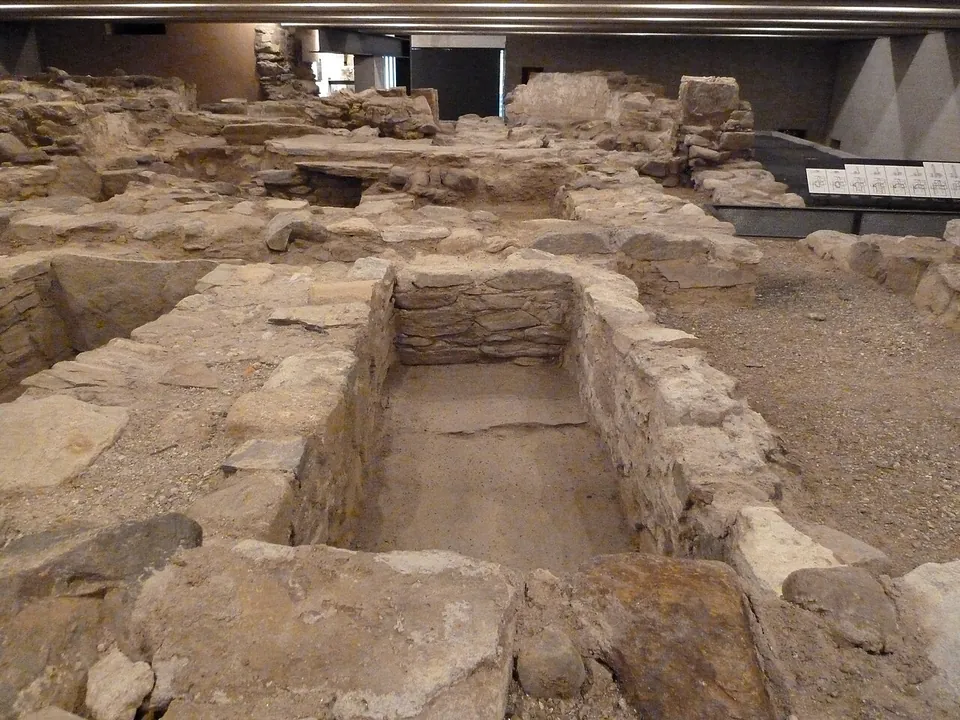
The municipality’s trail has three stops. On the surface, the outline of a building with a heated bath room, read as a mansio or road station, has been reconstructed. In the municipal underground car park, part of a boundary wall has been left on view. And beneath the churchyard of San Maurizio the remains are kept in view, with the front of the Roman place of worship, two columns with Corinthian capitals, partly reconstructed; the walls there belong to the successive building phases of the site (Municipality of Bioggio, 2016). The photograph shows the excavations under a concrete roof, with a grave in the foreground.
Is it worth the trip?
If you are in Lugano and like archaeology, yes: it is close, it is the main site of its region, and it covers a long story in one place, from a North Etruscan inscription to a Roman temple and an early church. For a casual visitor it is a set of excavated walls, partly in a basement, and the opening times are not published, so it is a detour to check before making.
Getting there
Bioggio has a station on the FLP railway, which the municipality treats as the arrival point for visitors (Municipality of Bioggio, 2016). The bus stop Bioggio, Scuole is mapped about 60 m from the site, and paid car parks about 75–95 m away (OpenStreetMap). No source in hand gives opening times or a charge.
Visiting details
- Opening hours
- No source in hand publishes opening times for the covered archaeological area.
- Tickets
- No charge is published or mapped.
- Parking
- Paid car parks about 75–95 m away (OpenStreetMap).
Before you go
- Part of the visit is underground, beneath the churchyard of San Maurizio and in the municipal underground car park (Municipality of Bioggio).
History
Bioggio’s history goes back before Rome: the finds begin in the 5th century BC (de.wikipedia), and a stele with an inscription in the North Etruscan alphabet was found in the old church of San Maurizio in 1998 (HLS). In the Roman period there was a small temple of the second half of the 2nd century AD, known from an altar dedicated to Jupiter found in 1996 with other parts of the building; a rural villa of the 3rd century, found in 1962; and a workshop building with a bath, probably of the same date, found in 1992 (HLS). The excavations of 1997-98 suggest that the church of San Maurizio began in the 5th or 6th century; it is first mentioned in 1261 (HLS). Other finds from between Agno and Bioggio are in the Museo Plebano in Agno (de.wikipedia).
Sources
Every fact on this page comes from the records below, each used under the licence noted.
| Source | Licence |
|---|---|
| Wikidata Q3621978 | CC0 |
| OpenStreetMap way/390327380 | ODbL |
| Wikipedia (de) — San Maurizio di Bioggio (archäologischer Fundplatz) | CC BY-SA 4.0 |
| Wikipedia (it) — Area archeologica di San Maurizio di Bioggio | CC BY-SA 4.0 |
| Historisches Lexikon der Schweiz — Bioggio (Bernardino Croci Maspoli) | licence not recorded |
| KGS inventory 10518 — Bioggio, area di culto romana-cristiana e sito musealizzato (BABS) | licence not recorded |
| Municipality of Bioggio — Messaggio Municipale 2016-03 on the archaeological trail | licence not recorded |