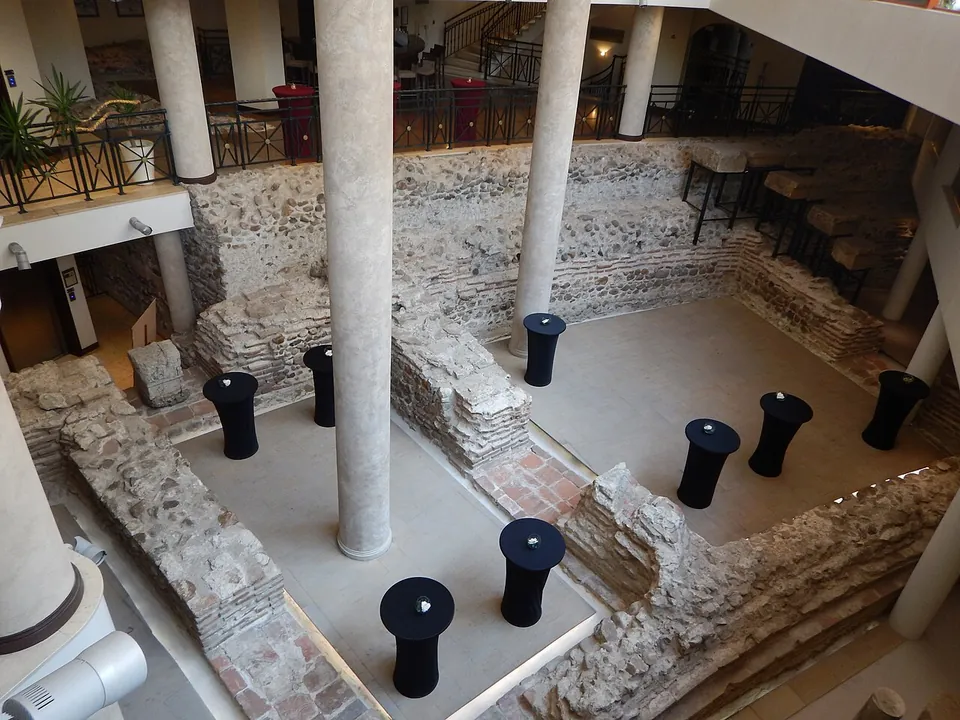
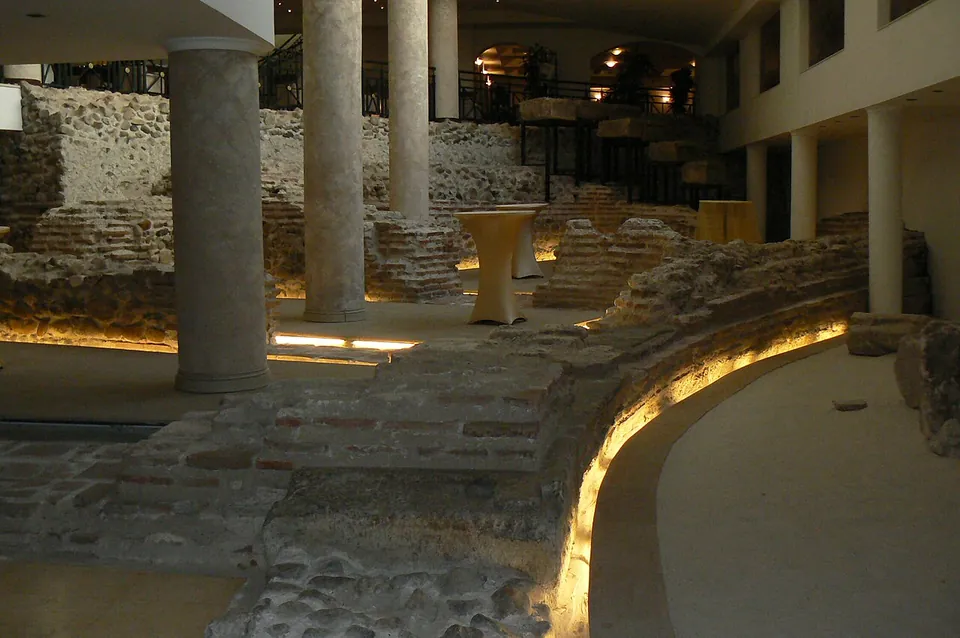
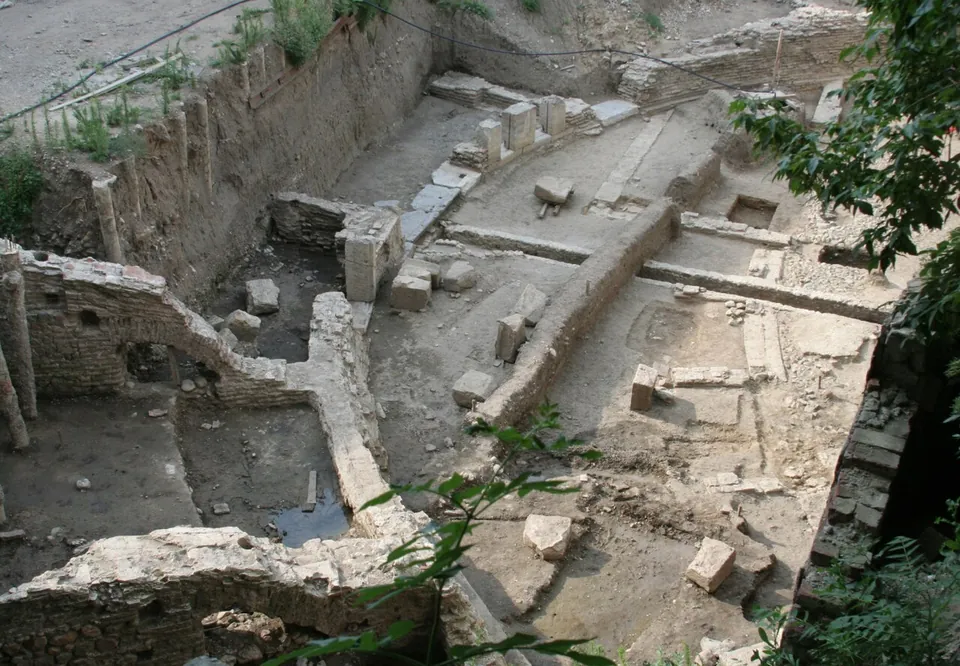


The Amphitheatre of Serdica was the arena of Roman Sofia, among the largest in the eastern Roman Empire and the largest in what is now Bulgaria. What you can see of it today is about a sixth of the building, its eastern arc, kept on the ground floor of a hotel (en.wikipedia; the hotel).
What is there today
The amphitheatre was found by accident in 2004, when work began on the Arena di Serdica hotel. Its eastern entrance and the part of the building on the hotel’s plot were preserved and built into the hotel’s ground floor, with a small display of the coins and pottery found on the site (en.wikipedia). The hotel says seven stone spectator seats have been set back in their original places. The remains you see are the lower walls of stone and brick, laid out among the hotel’s columns.
The western entrance and the part next to it were excavated in 2007 on the neighbouring plot (en.wikipedia), which is mapped as closed to the public (OpenStreetMap). Five metres below the amphitheatre lie the remains of an earlier Roman theatre, 55 m wide (en.wikipedia).
Is it worth the trip?
If you are in the centre of Sofia, yes, as a short stop: it is free to walk in, according to the published descriptions, and it was the largest amphitheatre in what is now Bulgaria. Set your expectations, though. This is a fragment inside a hotel, not an arena you can stand in, and its size comes across in the figures rather than the view.
Getting there
The amphitheatre lies south of Knyaz Aleksandar Dondukov Boulevard, between the Goethe-Institut and the British embassy (en.wikipedia), on Budapeshta Street, about 500 m east of the excavated centre of Serdica. A paid car park is mapped about 140 m away and public transport stops on Aleksandar Nevski Square about 170 m away (OpenStreetMap).
The hotel publishes no visiting hours. en.wikipedia says the remains are open to visitors during the day except on Mondays, and OpenStreetMap gives Tuesday to Sunday, 10.00 to 16.00, with no fee; check on the spot.
Visiting details
- Tickets
- Free
- Parking
- A paid car park is mapped about 140 m away (OSM way/26641429, fee=yes); public transport stops on Aleksandar Nevski Square are about 170 m away (OpenStreetMap).
- On foot
- About 2 min from the parking
Before you go
- The hotel that holds the eastern part publishes no visiting hours. en.wikipedia says it is freely accessible during the day except on Mondays, and OpenStreetMap tags it Tuesday to Sunday, 10.00–16.00, free; neither is the operator, so check on the spot.
- The western part, on the neighbouring plot, is mapped as closed to the public (OpenStreetMap).
History
The arena was 60.5 m long and 43 m wide, oriented east to west, with main gates at either end linked by an underground water channel; it was built for crowds of more than 20,000 and stood outside the city walls (en.wikipedia). It hosted fights between gladiators and wild beasts.
It was built over a theatre that bg.wikipedia dates, from its coins, to the end of the 2nd or the start of the 3rd century; a Gothic raid burned that theatre in 268 (en.wikipedia). The amphitheatre went up over its ruins in two stages, in the late 3rd and early 4th centuries, under Diocletian and Constantine the Great, dated by coins and pottery that include a rare bronze medallion of Antinous (en.wikipedia). It was in use for less than a century: abandoned by the 5th century, perhaps because of Theodosius I’s measures against pagan games. Later invaders made their homes in the arena, and in the Ottoman period it was quarried for building stone (en.wikipedia).
Its existence had been guessed since 1919, when a stone plate was found showing an amphitheatre’s façade and fights with crocodiles, bears, bulls and wild cats; it is now in the National Archaeological Institute with Museum in Sofia (en.wikipedia).
Sources
Every fact on this page comes from the records below, each used under the licence noted.
| Source | Licence |
|---|---|
| Pleiades 867812307 | CC BY |
| Wikidata Q980970 | CC0 |
| Vici.org 4141 | CC BY-SA (text), CC0 (metadata) |
| OpenStreetMap node/3514109025 | ODbL |
| Wikipedia (en) — Amphitheatre of Serdica | CC BY-SA 4.0 |
| Wikipedia (bg) — Софийски римски амфитеатър | CC BY-SA 4.0 |
| Arena di Serdica hotel — The amphitheatre of ancient Serdica | licence not recorded |