

What is there today
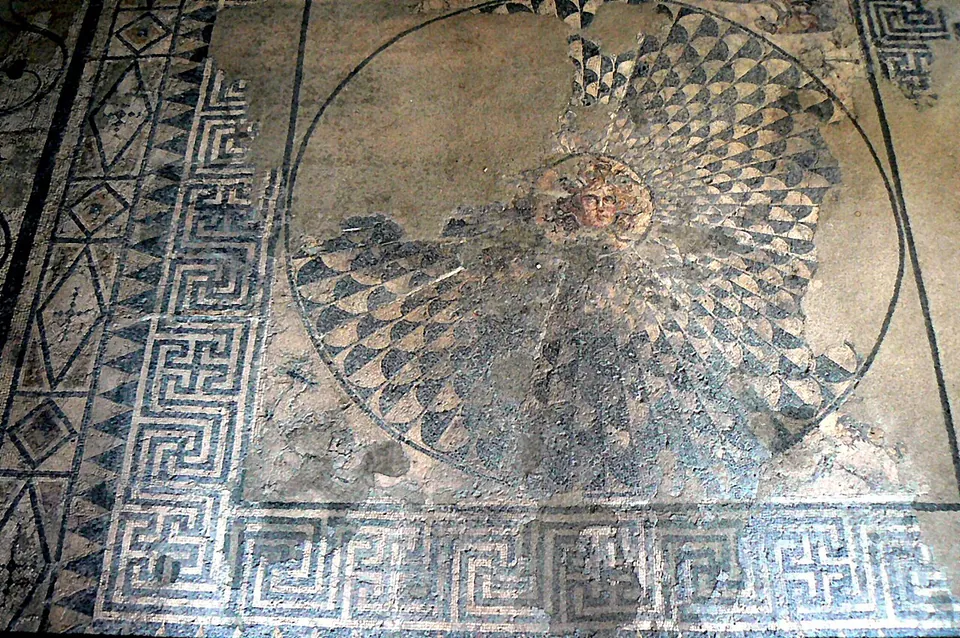
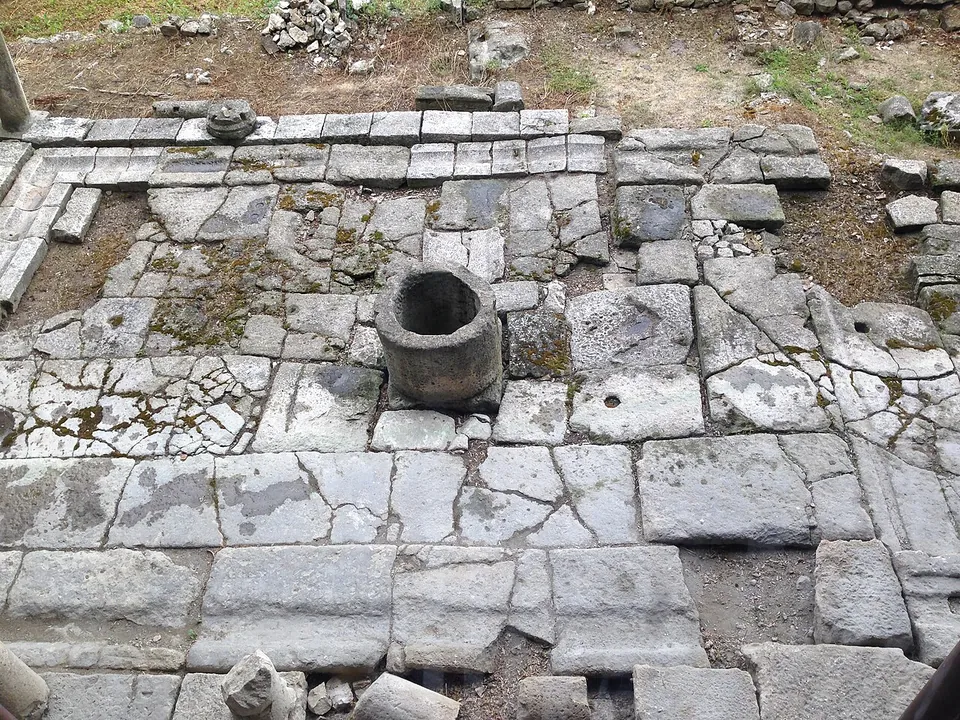
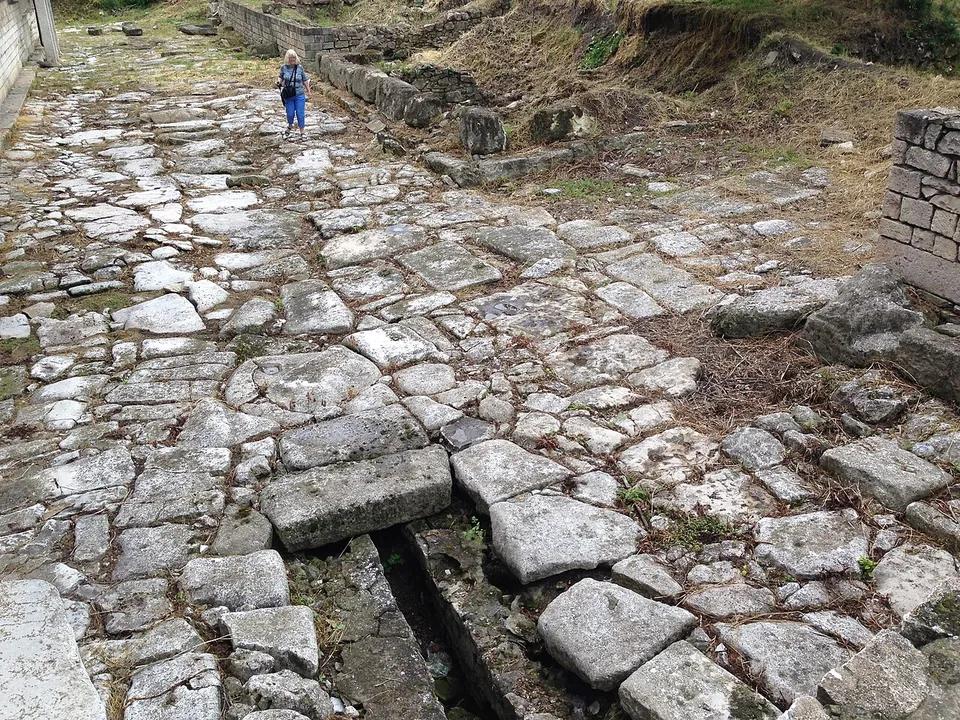
The museum stands over the House of Antiope, a house of the late 3rd or early 4th century that filled a whole city block, with 21 rooms around a paved courtyard with a well (en.wikipedia; the municipality). Five of its rooms and the portico had floor mosaics; three are shown in place and the others, conserved and partly restored, on new supports (the municipality). The best known shows the head of Medusa on the shield of Athena; others show Zeus as a satyr carrying off Antiope, Ganymede taken up by the eagle, and the Seasons, of which Autumn survives (en.wikipedia). The museum building covers the western part of the house; its eastern wing and courtyard are open, a Roman street passes under the building, and several ancient walls stand around it (en.wikipedia).
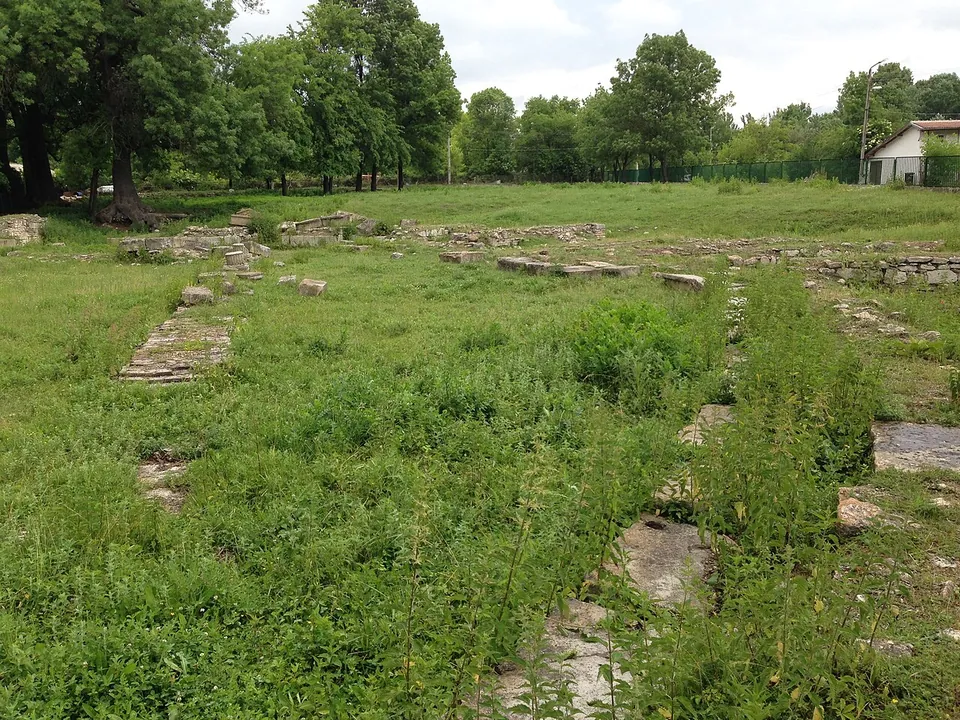
The museum also shows a hoard of 20 gold coins of Theodosius II, found in 2019–2023 in a building burned during the Hun invasion of 447, and the bronze fittings of a folding chair from a tomb of the late 2nd or early 3rd century (the municipality). The amphitheatre, a few hundred metres north, has been excavated, and the remains of a church were found in its eastern part (the municipality; bg.wikipedia); today its outline shows as low stone footings in a grassy field (the photograph).
Is it worth the trip?
Yes, for the mosaics: they are among the finest Roman floors found in Bulgaria, three of them still in the rooms they were laid for (the municipality), and Devnya is a short drive from Varna. The house and a few walls around the museum are most of what survives of the ancient city (en.wikipedia), so there is little else to see.
Getting there
The Museum of Mosaics is at 73 Saedinenie Boulevard in Devnya (the municipality), about 25 km from Varna (de.wikipedia). A car park is mapped beside it; no bus stop is mapped nearby (OpenStreetMap).
From May to September the museum is open daily, 10.00 to 16.00; from October to April 10.00 to 16.00, closed on Saturdays and Sundays. A ticket is €4.09, or €2.05 for pensioners, children and students, and a family ticket €8.18 (the municipality, published July 2025). A full renovation of the building was announced for 2024 (BTA, January 2024), so telephone before a long trip.
Visiting details
- Opening hours
- Museum of Mosaics: May to September daily 10.00–16.00; October to April 10.00–16.00, closed Saturday and Sunday.
- Tickets
- Museum of Mosaics €4.09; €2.05 for pensioners, children, students and visitors with disabilities; family ticket (up to three children under 18) €8.18.
- Parking
- A car park is mapped beside the museum, about 60 m from the point (OSM way/1238930829).
- On foot
- About 1 min from the parking
Before you go
- A full renovation of the museum building was announced for 2024 (BTA, 16 January 2024); the municipality's page, published July 2025, gives regular opening hours. Telephone the museum before a long trip (0519 34440).
- No bus stop is mapped near the museum.
Hours and prices checked 3 October 2026 on the operator's own site. Confirm before travelling.
History
Trajan named the town after his sister Ulpia Marciana after the Second Dacian War, which ended in 106 (en.wikipedia; de.wikipedia); en and bg.wikipedia say it was earlier called Parthenopolis, which de.wikipedia calls a mistaken identification. It stood where roads from the Danube to Adrianople and Constantinople crossed the road from the west to Odessos (de.wikipedia). The Goths attacked it in 248 and again in the late 260s, and both times were driven off (de.wikipedia; en.wikipedia). Under Diocletian it became the capital of Moesia Secunda, and in 366–369 the emperor Valens made it his base in his war with the Goths (en.wikipedia; de.wikipedia).
Attila’s Huns destroyed the city in 447, and Justinian I restored and fortified it. The Avars took it in 587, but it was retaken at once, and the army gathered there in 596 before crossing the Danube; an Avar raid finally destroyed it in 614–615 (en.wikipedia).
More photographs

Nearby
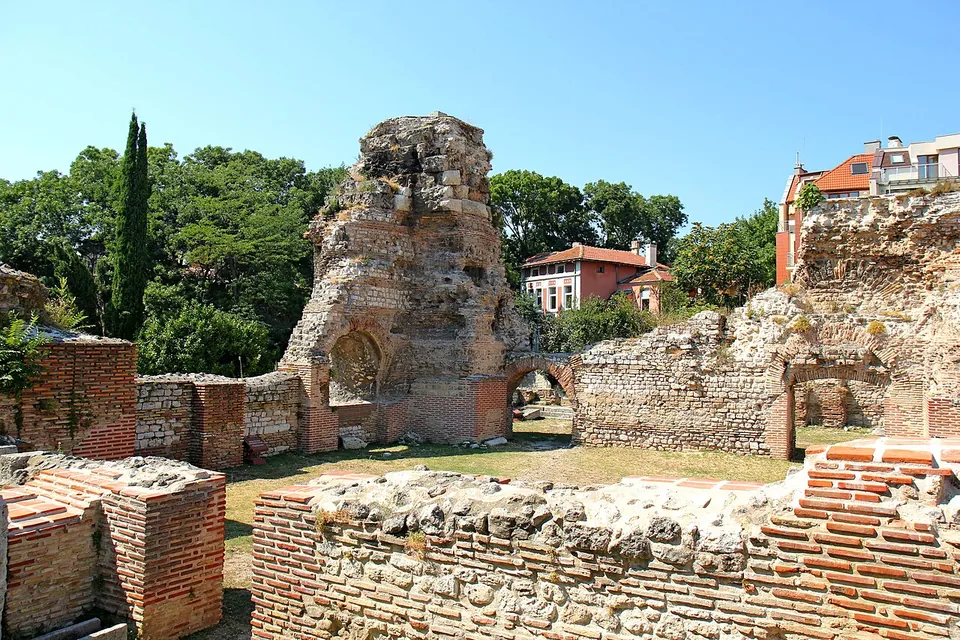
Photo: Dina Rogatnykh · CC BY-SA 4.0 · Commons
27 km · bath · Varna Province
Odessos
The large Roman baths lie in the south-east of the modern city, near the port.

Straight-line distances.
Sources
Every fact on this page comes from the records below, each used under the licence noted.
| Source | Licence |
|---|---|
| Pleiades 216878 | CC BY |
| Wikidata Q431280 | CC0 |
| Devnya municipality — Museum of Mosaics (hours, prices, collection) | licence not recorded |
| Wikipedia (en) — Marcianopolis | CC BY-SA 4.0 |
| Wikipedia (bg) — Марцианопол | CC BY-SA 4.0 |
| Wikipedia (de) — Marcianopolis | CC BY-SA 4.0 |
| Wikipedia (en) — Museum of Mosaics, Devnya | CC BY-SA 4.0 |
| Wikipedia (bg) — Музей на мозайките, Девня | CC BY-SA 4.0 |
| BTA (Bulgarian News Agency) — Devnya, Museum of Mosaics (photographs and captions, 16 January 2024) | licence not recorded |