What is there today
Be clear about what is Roman: most of what Nesebar is famous for, its churches of the 11th to 14th centuries, is medieval, and the town’s earliest remains are Thracian and Greek (en.wikipedia; the museum). The Roman-era remains are these:
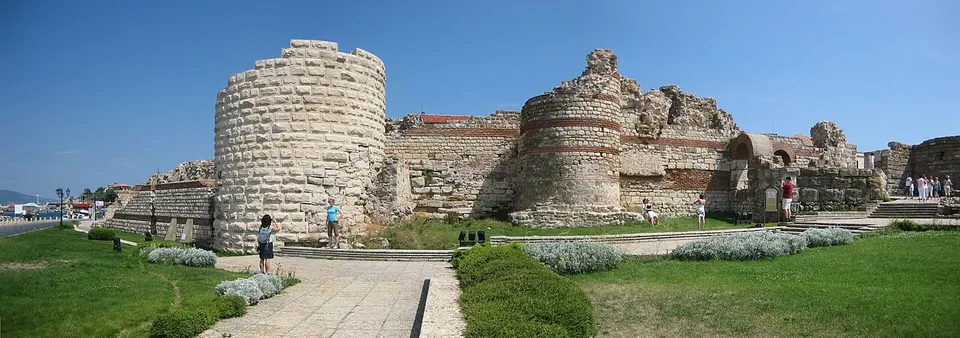
- The walls and gate. In the middle of the 5th century new walls were built in opus mixtum, courses of stone alternating with brick. The best-preserved stretch stands by the town gate, facing the causeway: the gate was flanked by two square towers, with round and semicircular towers set symmetrically beside them (the museum).
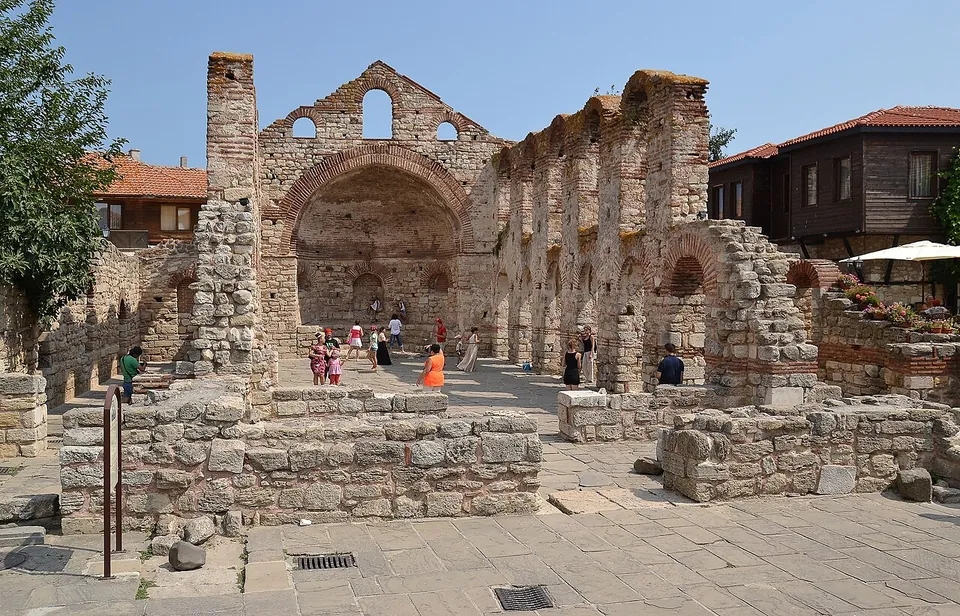
- The Basilica of St Sophia, the Old Bishopric, built at the end of the 5th or the start of the 6th century on what is thought to be the old centre of the town: a basilica 25.5 m long with three aisles divided by stone piers and brick arches, a second arcade above, and the bench for the clergy still in its apse (the museum).
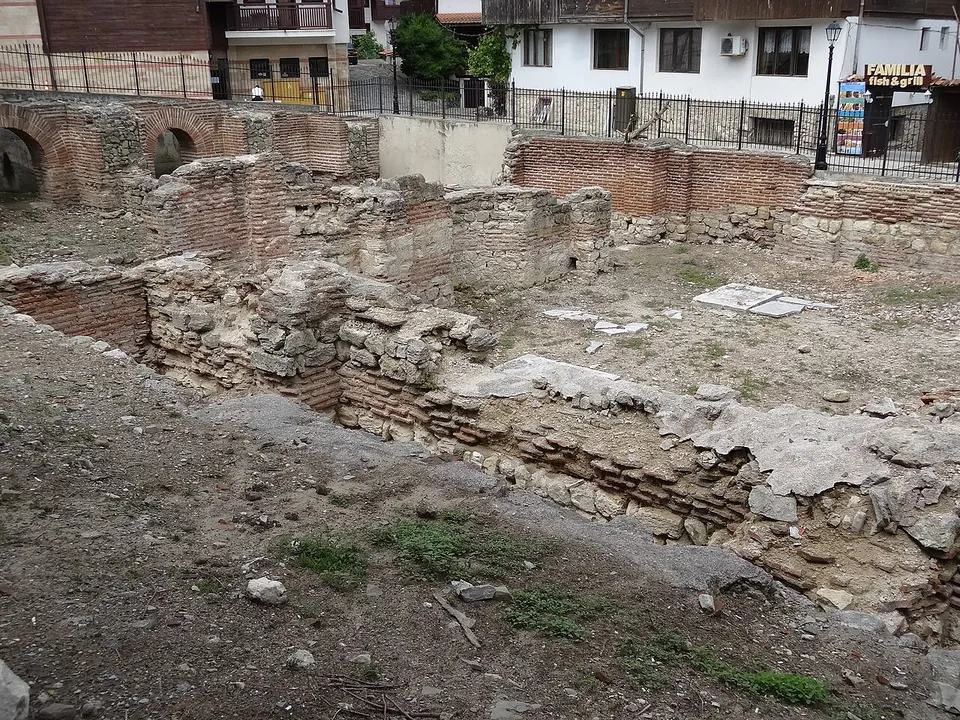
- The baths, built in the 6th century under Justinian I. About two-thirds have been excavated: five heated rooms, two with semicircular pools, a central hall and a corridor, with walls of stone and brick up to 3 m high in places (the museum).
The archaeological museum presents the history of ancient Mesembria and medieval Nesebar (the museum).
Is it worth the trip?
Yes, if you are on this coast. The walls at the gate, which you walk through on the way in, and the shell of St Sophia are substantial buildings of the 5th–6th century; come knowing that the Roman layer is one of several in a town known above all for its medieval churches.
Getting there
The town gate is at the landward end of the peninsula, opposite the causeway (the museum). A paid car park is mapped about 115 m away and the Star Grad bus stop about 45 m away (OpenStreetMap).
The walls, St Sophia and the baths carry no charge in the museum’s tariff. The archaeological museum costs €4.60, or €2.30 for children, and €6.14 with one church (2026 tariff). Its last published hours, for 2025, were daily from 09.00 to 17.00 in winter and to 19.00 in high summer (the museum).
Visiting details
- Opening hours
- Archaeological museum, as last published (for 2025): daily 09.00–17.00 from mid-October to April, 09.00–18.00 in May and from mid-September to mid-October, 09.00–19.00 from June to mid-September.
- Tickets
- The walls, the Basilica of St Sophia and the baths carry no charge in the museum's tariff. Archaeological museum (2026) €4.60, children €2.30; with one church €6.14.
- Parking
- A paid car park is mapped about 115 m from the gate (OSM way/176520474); the Star Grad bus stop is about 45 m away (OpenStreetMap).
- On foot
- About 2 min from the parking
Before you go
- The museum has posted its prices for 2026 but its opening hours only for 2025.
Hours and prices checked 3 October 2026 on the operator's own site. Confirm before travelling.
History
Mesembria was a Thracian settlement that became a Greek colony, of Dorians from Megara according to Strabo (en.wikipedia; bg.wikipedia). In 72–71 BC the legions of Marcus Lucullus took it, and it belonged first to Macedonia, then to Moesia, and from Septimius Severus to Thrace (bg.wikipedia). The Romans kept the Greek walls, built from the late 5th to the 3rd century BC, in use (the museum; bg.wikipedia), and the town kept the right to mint its own coins (en.wikipedia).
The new walls of the mid-5th century were repaired after Avar attacks at the end of the 6th or the start of the 7th century (the museum). The baths stayed in use until the end of the 8th century; Byzantine chroniclers record that the emperor Constantine IV treated his legs here in 680 (the museum). Khan Krum took the town in 812, and it was contested between Bulgaria and Byzantium through the Middle Ages (bg.wikipedia; en.wikipedia).
Nearby
28 km · bath · Burgas Province
Aquae Calidae
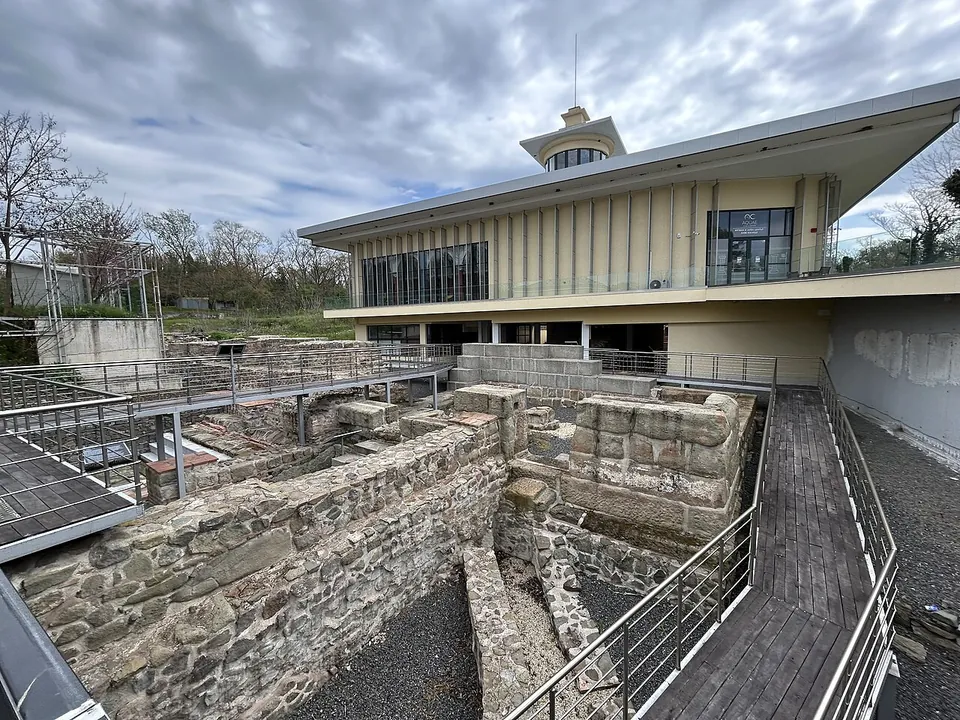
The ruins of the town walls, the Roman baths with their warm and cold pools, and medieval rooms are shown from raised walkways, and a museum displays the finds: gold coins and jewellery, lead seals, bathing tools, pottery, carved marble and inscriptions (the museum).
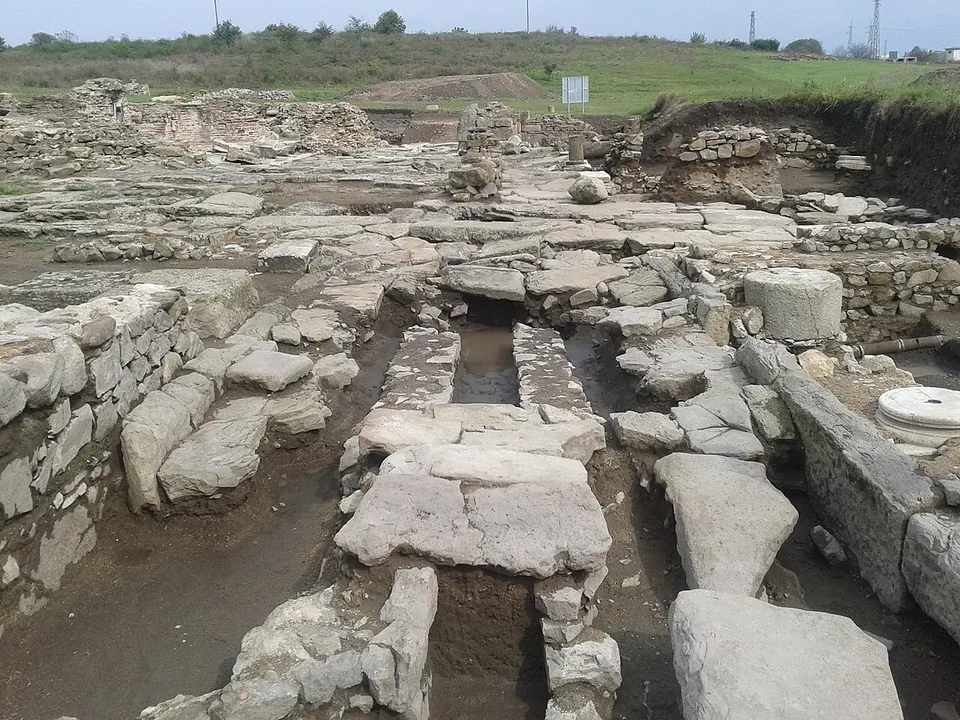
Photo: Камен Ханджиев · CC BY-SA 4.0 · Commons
48 km · city · Burgas Province
Deultum
Excavations since the 1980s have fully uncovered the town's east gate and part of its main street, with niches on the inner side of the gate for statues of the town's guardian gods (bg.wikipedia).


Straight-line distances.
Sources
Every fact on this page comes from the records below, each used under the licence noted.
| Source | Licence |
|---|---|
| Pleiades 216882 | CC BY |
| Wikidata Q1317936 | CC0 |
| OpenStreetMap way/398125727 | ODbL |
| Museum "Ancient Nessebar" — fortification walls | licence not recorded |
| Museum "Ancient Nessebar" — early Byzantine baths | licence not recorded |
| Museum "Ancient Nessebar" — the church of St Sofia | licence not recorded |
| Museum "Ancient Nessebar" — prices 2026 | licence not recorded |
| Museum "Ancient Nessebar" — working hours | licence not recorded |
| Wikipedia (bg) — Месамбрия Понтика | CC BY-SA 4.0 |
| Wikipedia (en) — Mesembria | CC BY-SA 4.0 |
| Wikipedia (en) — Nesebar | CC BY-SA 4.0 |