

What is there today
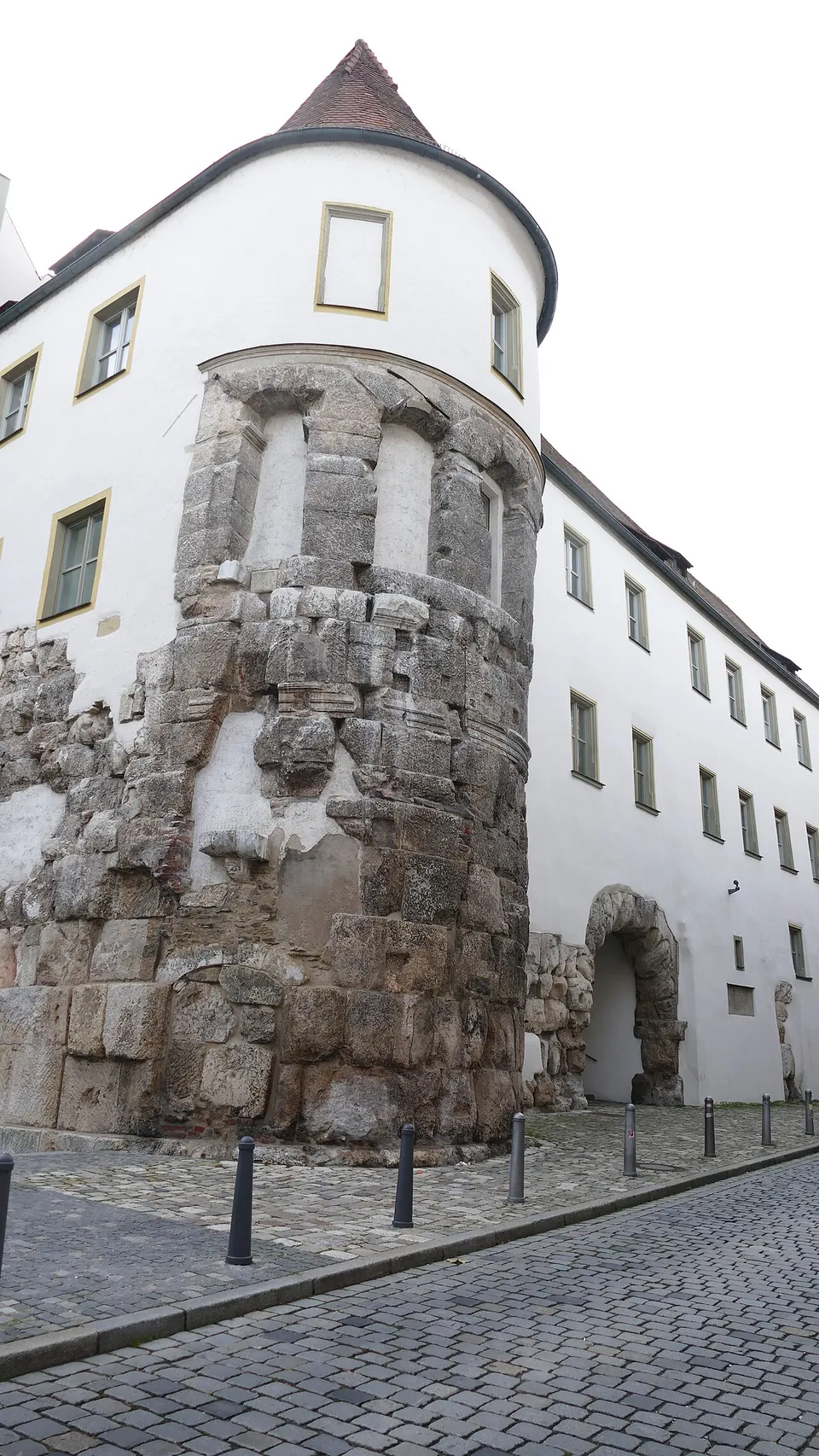
The gate is the thing to see. Of the Roman north gate, the eastern flanking tower and one of its two arches survive, set into the north front of the Bischofshof in the street Unter den Schwibbögen, beside the cathedral; the opening, 4 m wide and 5 m high, is built of 13 limestone blocks, and the place where the lost western tower stood is marked in the paving (de.wikipedia). It is one of the few Roman gates still standing north of the Alps, with the larger Porta Nigra in Trier and two gates at Autun (de.wikipedia).
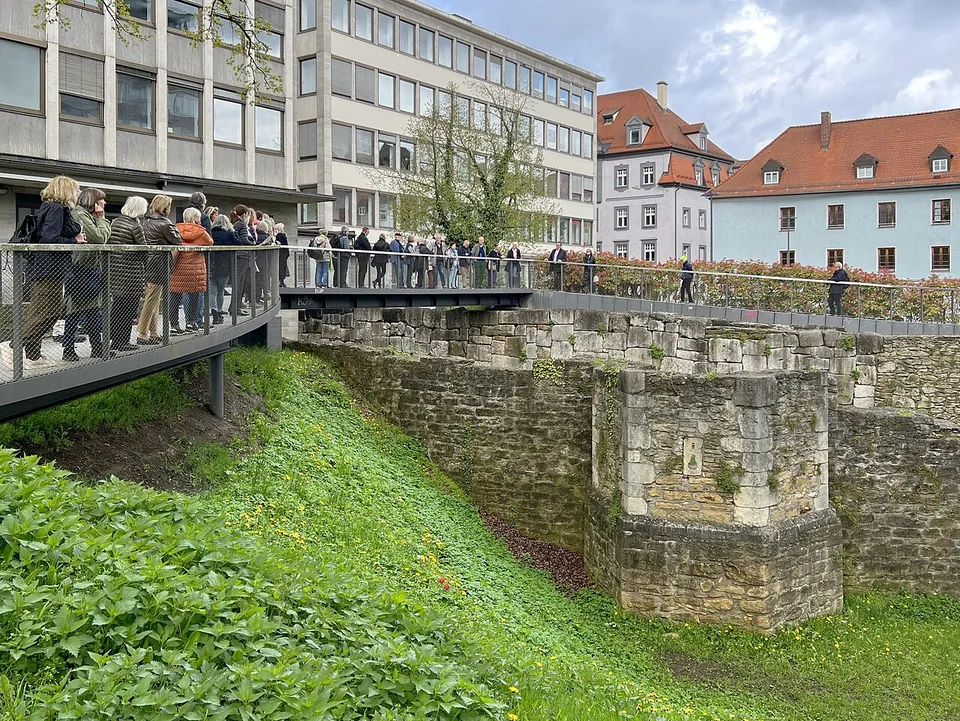
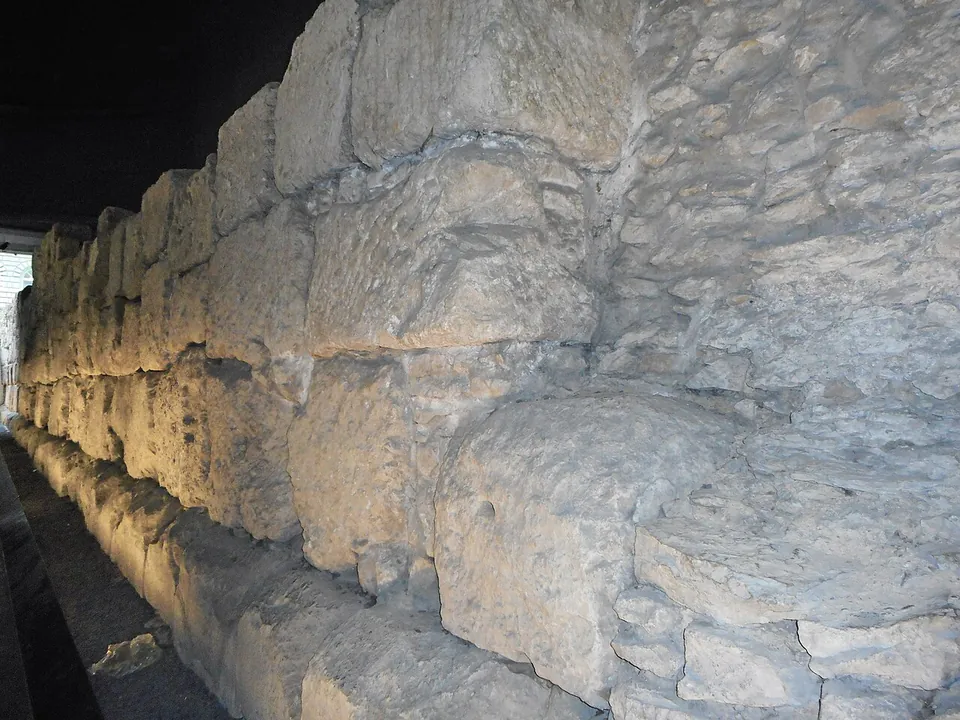
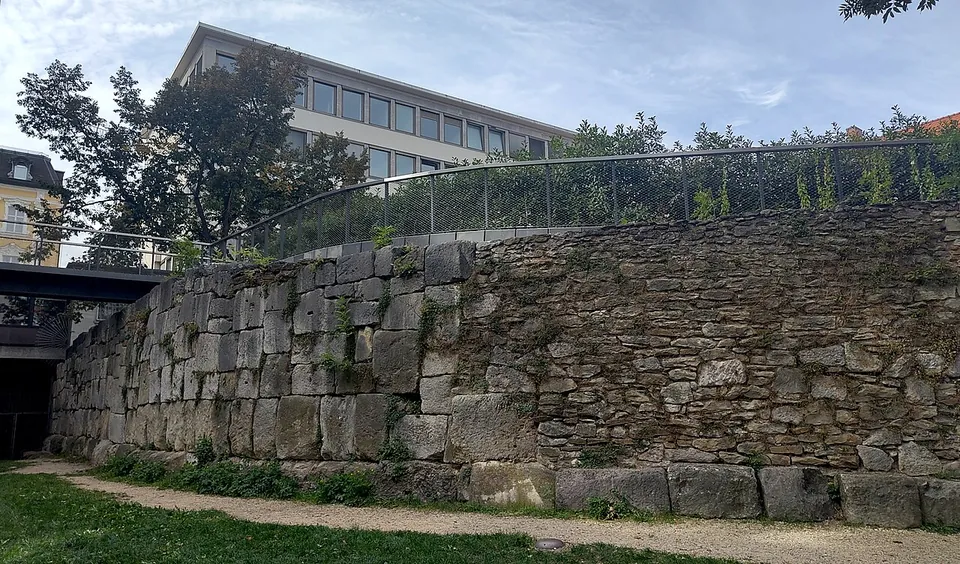
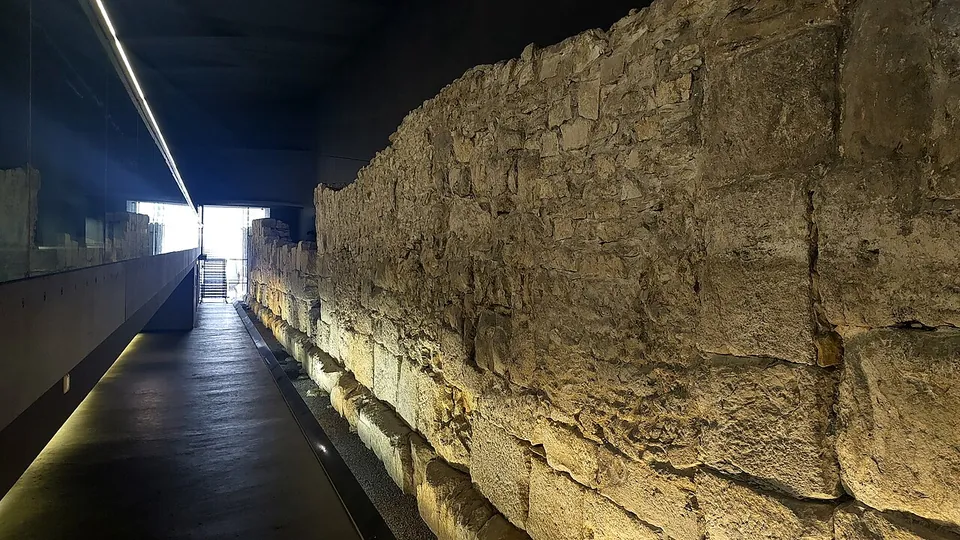
The camp wall survives in three places, which the city presents together as the “document Legionslagermauer” (Stadt Regensburg). At Ernst-Reuter-Platz, by the main railway station, about 80 m of the wall’s big limestone blocks stand in an open-air area at the south-east corner, seen from a footbridge (Stadt Regensburg). Inside the car park on Dachauplatz, a 60 m stretch of the east wall is preserved complete below street level, with the information room for all three sections (de.wikipedia; Stadt Regensburg). The rounded north-east corner stands as part of a later property wall at St.-Georgen-Platz, from where the street Unter den Schwibbögen leads straight to the gate (de.wikipedia; Stadt Regensburg). The stretches lie along a signposted route (de.wikipedia).
Inside the camp almost nothing is visible: medieval and later buildings cover it, and the rubble of the medieval ones alone forms a layer 3–5 m deep (de.wikipedia). Two places show what lies beneath, both on guided tours only. Under the Niedermünster church, the document Niedermünster shows the walls of the legionaries’ barracks and the remains of a late Roman heating system beneath the early medieval chapel and church (DOMPLATZ 5). Under Neupfarrplatz, the document Neupfarrplatz is mainly about the medieval Jewish quarter, but it also shows a few Roman walls that may have belonged to the officers’ quarters (de.wikipedia; Stadt Regensburg).
Opposite the car park, the Historisches Museum holds the finds: the fragment of the camp’s building inscription, 3 m long and weighing 3 tonnes, most of the grave goods from the great cemetery, and what the city calls one of the most important Roman collections in any German museum (de.wikipedia; Stadt Regensburg).
Is it worth the trip?
If you are in Regensburg, yes, and it costs nothing: the gate and the three wall sections on the camp’s east side are all free and open, and they lie along one walk through the old town. The gate is genuinely impressive. The wall sections are fragments in a modern city, between office blocks and inside a car park, so they reward someone who wants to trace the camp’s outline rather than someone looking for a ruin field.
Add the Historisches Museum, €5, which is where the legion’s story is told, and on a Sunday or Monday the document Niedermünster tour, the only way to see the barracks under the church and the inside of the gate tower. Regensburg’s medieval old town is a World Heritage Site in its own right (en.wikipedia), so the Roman remains are rarely the only reason to come; on their own they make a half-day, not a detour across Bavaria.
Getting there
The south-east corner at Ernst-Reuter-Platz lies just north of Regensburg’s main railway station (de.wikipedia), so the walk can start off the train. The nearest public-transport stop to the gate, Domplatz, is about 70 m away (OpenStreetMap). By car, the Parkhaus am Dachauplatz is the obvious choice, since the wall is inside it; the spaces mapped beside the gate are private or permit-only (OpenStreetMap).
The gate and the wall can be seen at any time and free of charge; the information room in the car park closes at night (Stadt Regensburg). The Historisches Museum, Dachauplatz 2–4, opens Tuesday to Sunday and on public holidays from 10.00 to 16.00 and costs €5, €2.50 reduced, €10 for a family; under-18s go free, and everyone does on the first Sunday of the month. A public tour on Roman Regensburg runs on Saturdays at 13.00, €8 including entry (Stadt Regensburg). The document Niedermünster tour, which since November 2021 also opens the inside of the Porta Praetoria, starts at the Infozentrum DOMPLATZ 5 on Sundays, Mondays and public holidays at 14.30, lasts about 75 minutes and costs €8, €5 reduced; it takes no more than 15 people, so book by telephone (DOMPLATZ 5). The document Neupfarrplatz is visited on tours from the Tourist Info at the Altes Rathaus, Monday and Thursday to Saturday at 14.30 (Sundays too in July and August), €8 (Stadt Regensburg). All of this was read on 30 October 2026; check before travelling.
Visiting details
- Opening hours
- The gate and the wall sections stand in public streets and can be seen at any time; the information room in the Dachauplatz car park closes at night. Historisches Museum, Tuesday to Sunday and public holidays 10.00–16.00, closed 1 January, Shrove Tuesday, Good Friday, 1 May, 1 November and 24, 25 and 31 December. The inside of the Porta Praetoria opens only on the document Niedermünster tour, Sunday, Monday and public holidays at 14.30 (about 75 minutes), none in the Christmas holidays.
- Tickets
- Free for the gate and all three wall sections. Historisches Museum €5, reduced €2.50, families €10; free under 18, and free for everyone on the first Sunday of the month. document Niedermünster tour €8, reduced €5, free up to 16; it takes at most 15 people, so a telephone booking with the Infozentrum DOMPLATZ 5 is advised.
- Parking
- Parkhaus am Dachauplatz, which itself holds a stretch of the camp's east wall. The parking mapped beside the gate is private or permit-only (OpenStreetMap ways 403898099 and 111409604).
Before you go
- The interior of the gate tower can be seen only on the guided document Niedermünster tour.
Hours and prices checked 30 October 2026 on the operator's own site. Confirm before travelling.
History
Before the legion came, the Romans held the area with an auxiliary fort on the hill at Kumpfmühl, about 2 km south of the Danube, built towards the end of the 1st century, and a second camp by the river, each with a civilian settlement. Both were destroyed around 170 in the Marcomannic Wars. Marcus Aurelius then decided to guard the northern frontier of Raetia with a full legion, the Legio III Italica, and had the new camp built in stone from about 175, where the upper Danube reaches its northernmost point (de.wikipedia). The building inscription records that Marcus Aurelius and his son Commodus had the wall with its gates and towers built for the legion, under the legionary commander and governor Marcus Helvius Clemens Dextrianus; the imperial titles date it to 179 (de.wikipedia).
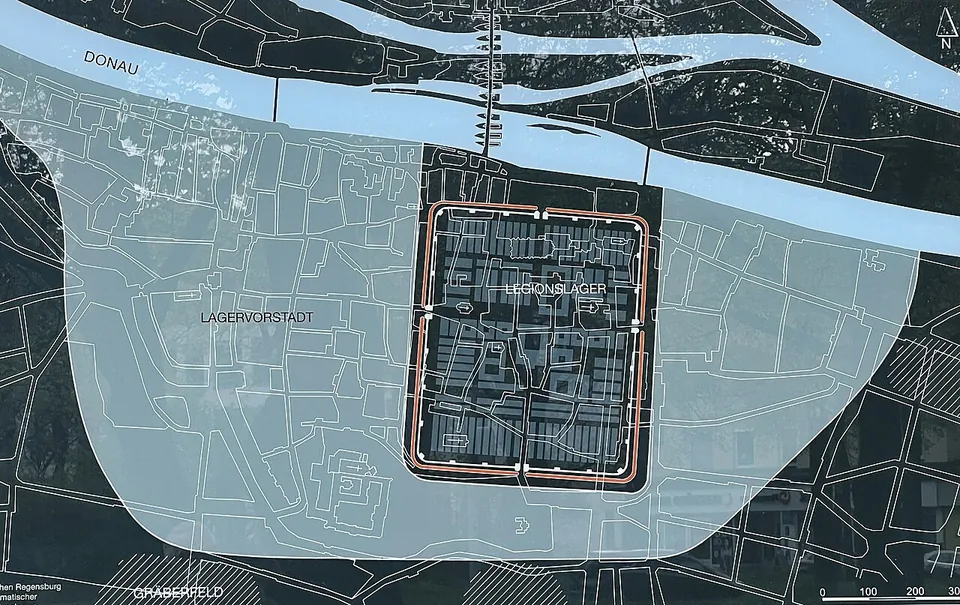
The camp measured about 540 by 450 m, some 24.5 ha, enclosed by a wall about 6.2 m high with a ditch in front. It had four gates and 30 towers, and was laid out for a legion nominally about 6,000 strong (de.wikipedia). West of it grew a civilian town almost as large as the camp; its great cemetery to the south-west held an estimated 30,000–40,000 burials (de.wikipedia). The name comes from the river Regen, which joins the Danube about 1 km north-east of the camp (de.wikipedia).
Burnt layers point to destruction in the 270s or early 280s; the gate may have lost its western tower and one passage then, and the walls were repaired hastily, even with broken tombstones (de.wikipedia). The legion shrank, perhaps to about 1,000 men, and the civilians moved inside the walls. Around 430 the Notitia Dignitatum lists the legion’s unit at Castra Regina as “now at Vallatum”, so its own soldiers seem to have left. Settlement inside the walls went on through the 5th century, when Roman control probably ended, and into the Middle Ages (de.wikipedia). Around 770 Arbeo of Freising described the town as a strongly fortified metropolis, most likely behind the Roman walls, and the Agilolfing dukes of Bavaria ruled from it (de.wikipedia).
The north gate stayed in use as the “water gate” to the river into the 17th century, then disappeared around 1650 inside the bishop’s new brewery. It was rediscovered in 1885 when part of that building was pulled down and laid open in 1887, and only in 1971 did a re-examination of the foundations prove it had had two passages between two towers (de.wikipedia). Since 2021 the camp’s visible remains have been part of the Danube Limes World Heritage Site (de.wikipedia; Stadt Regensburg).
More photographs



Nearby
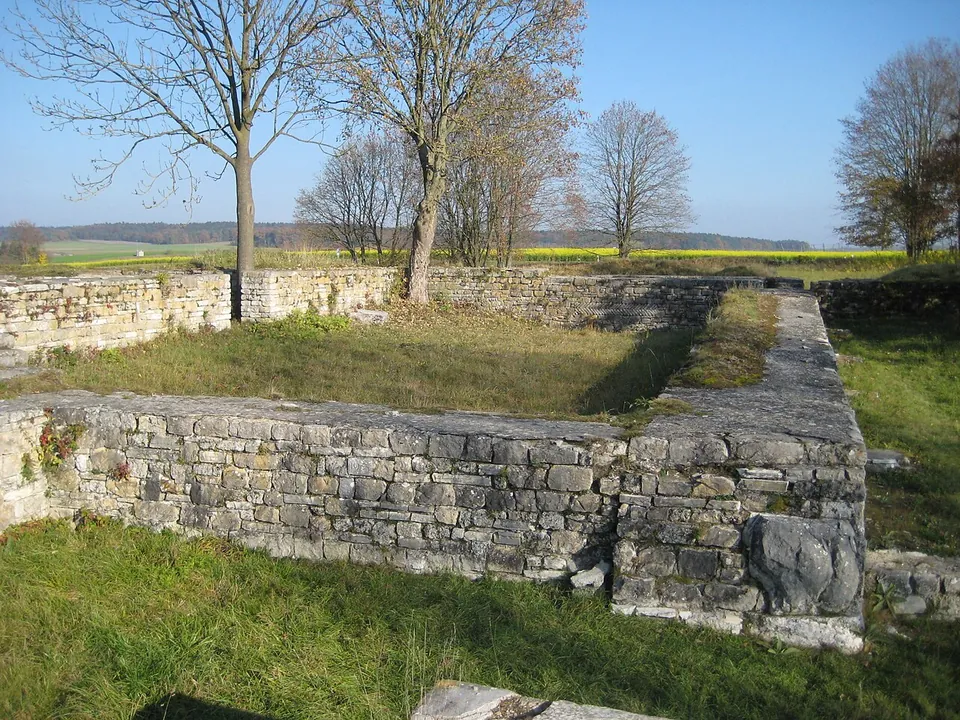
Photo: WolfgangRieger · Public domain · Commons
31 km · fort · Bavaria
Castra Abusina
The fort covered about 1.8 hectares, 147 by 125 metres (de.wikipedia), and its ground is now a small archaeological park in which the main buildings are marked out by low walls.

Straight-line distances.
Sources
Every fact on this page comes from the records below, each used under the licence noted.
| Source | Licence |
|---|---|
| Pleiades 118929 | CC BY |
| Wikidata Q1049798 | CC0 |
| OpenStreetMap node/1281091243 | ODbL |
| Wikipedia (de) — Castra Regina | CC BY-SA 4.0 |
| Wikipedia (de) — Porta praetoria (Regensburg) | CC BY-SA 4.0 |
| Wikipedia (de) — Historisches Museum Regensburg | CC BY-SA 4.0 |
| Wikipedia (it) — Castra Regina | CC BY-SA 4.0 |
| Wikipedia (en) — Regensburg | CC BY-SA 4.0 |
| Wikidata — Porta Praetoria in Regensburg (Q14523653) | licence not recorded |
| Stadt Regensburg — document Legionslagermauer (free access) | licence not recorded |
| Stadt Regensburg — Welterbe Donaulimes | licence not recorded |
| Stadt Regensburg — Historisches Museum, hours and admission (the operator) | licence not recorded |
| Infozentrum DOMPLATZ 5 — tours of the document Niedermünster and the Porta Praetoria (the operator) | licence not recorded |
| Stadt Regensburg — document Neupfarrplatz (the operator) | licence not recorded |