What is there today
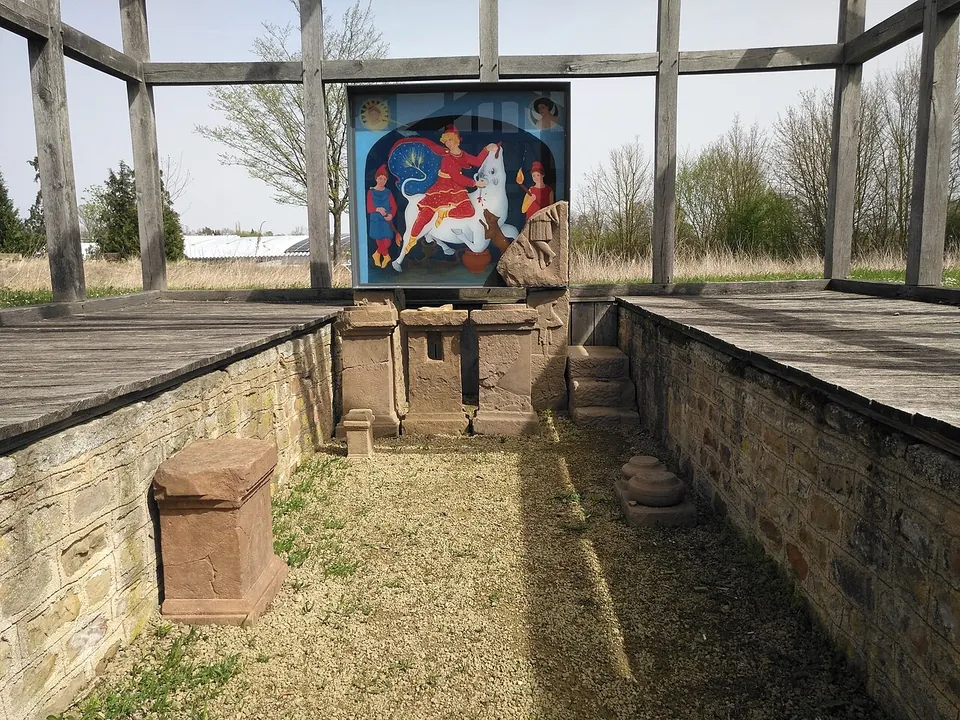
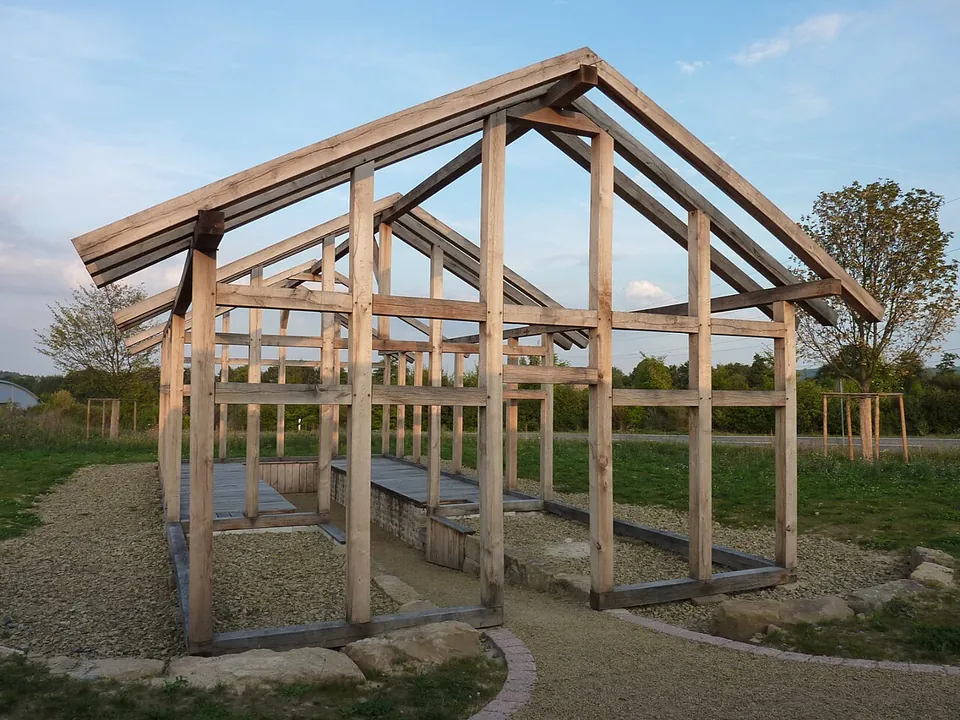
The excavated ground that was not built over is now an open-air site, the Archäologische Freilichtanlage, in the Ochsenwiesen/Steinäcker industrial estate south of the river Zaber (the operator). Its centrepiece is Mithraeum II, conserved, with part of its original half-timbered building reconstructed to show how big the sanctuary was (the operator). The temple was about 14 m long and 5.5 m wide: a small anteroom led into the cult room, which had raised benches along both sides for the initiates (fr.wikipedia).
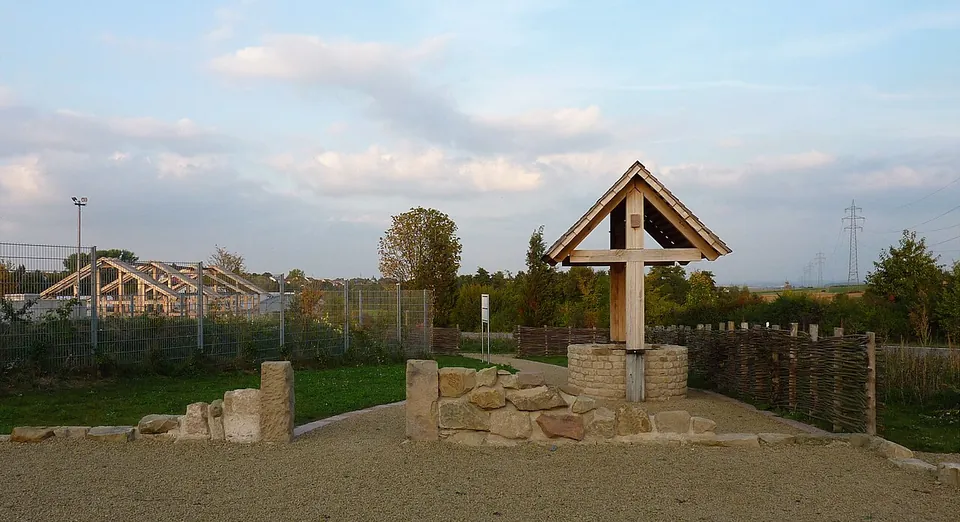
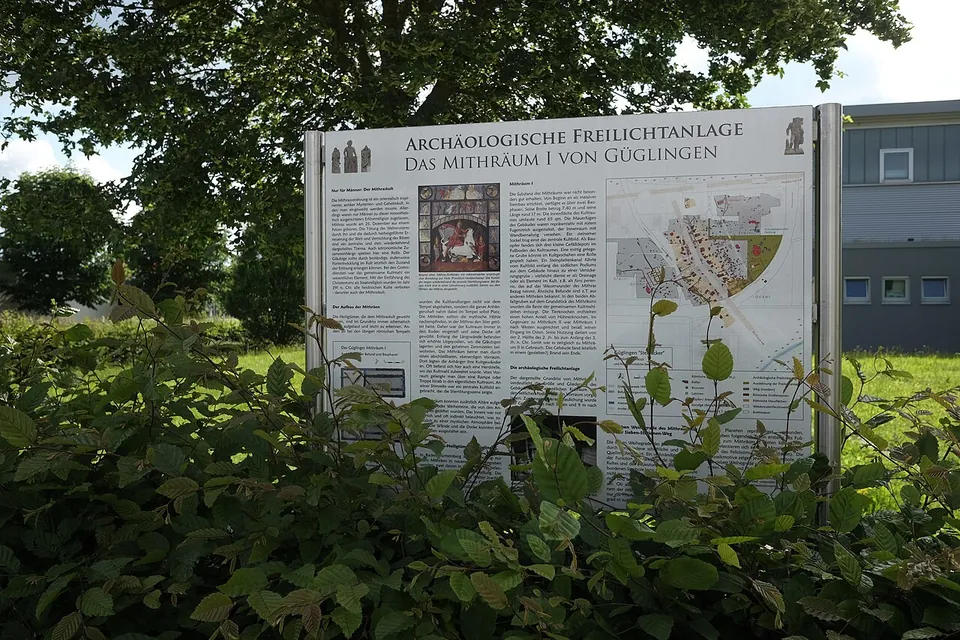
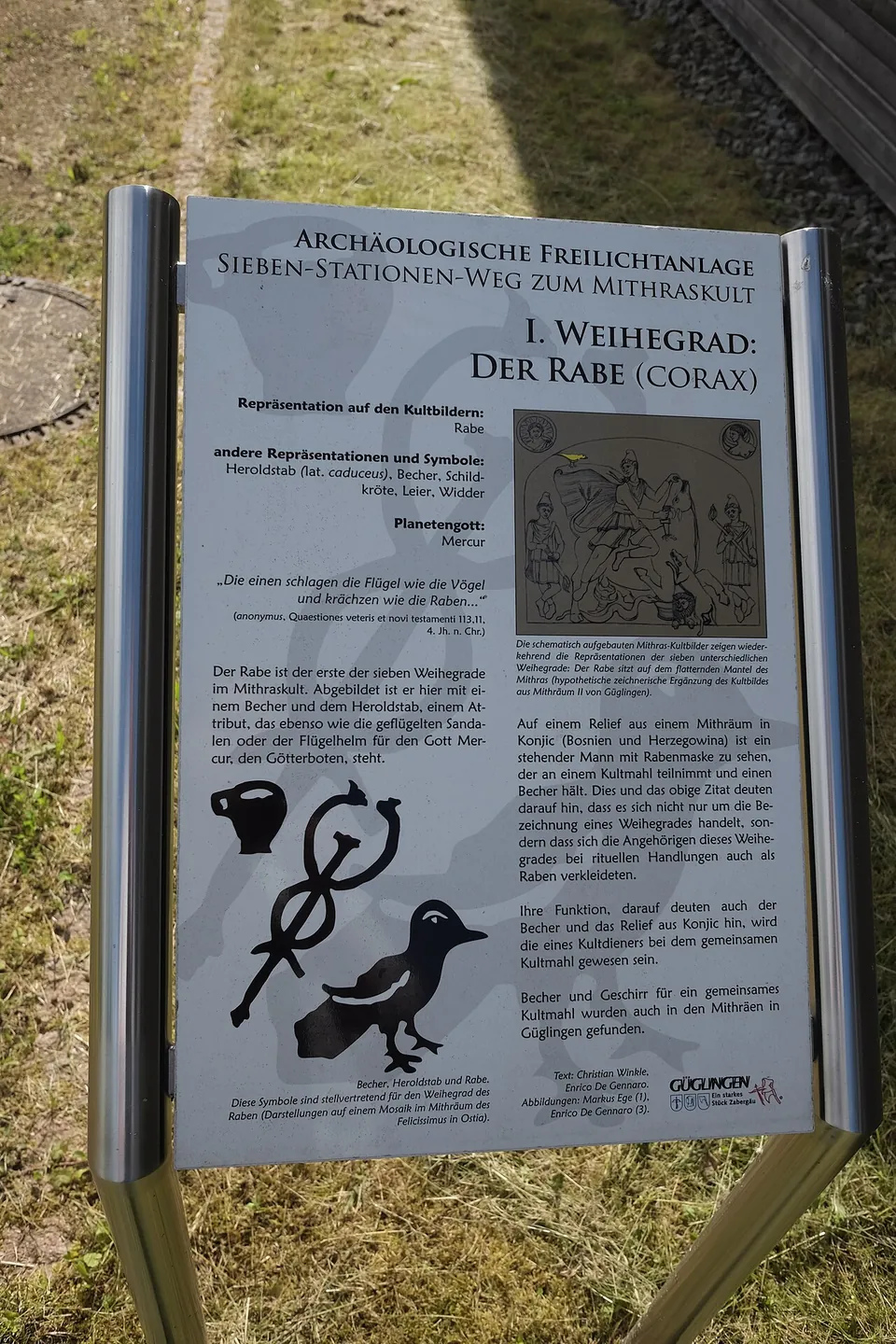
A path of seven stations, one for each grade of initiation into the Mithras cult, begins at the ground plan of Mithraeum I (the operator). Around them, outlines of the strip houses and parts of the old lanes show how the village was laid out, and in the fenced yard of one house a well has been conserved and rebuilt (the operator). Since 2017 a panorama wall 56.5 m long and 5 m high has shown more than 70 scenes of life in the settlement; the operator calls it probably the largest archaeological outdoor panorama in Germany.
The finds are not on site. They are in the Römermuseum in the old town hall, about 600 m away as the crow flies, in the town centre (OpenStreetMap), on three floors (de.wikipedia): the Roman Zabergäu, the village, and Roman religion, which ends in a walk-in reconstruction of Mithraeum II with its finds (the operator). The ground floor also holds a water basin with reliefs of scenes from the Odyssey from the Roman villa at Güglingen-Frauenzimmern, which the operator describes as unique north of the Alps.
Is it worth the trip?
On its own the open-air site is a short, free stop: what stands is a reconstruction around the conserved remains of the temple, with outlines and boards, in a commercial estate. It earns its place as one half of a visit with the museum, where the finds and the rebuilt interior of the temple make sense of what you saw on the ground. If you are near Heilbronn on a Saturday, Sunday or public holiday and the cult of Mithras interests you, the pair is well worth a few hours. On an ordinary weekday the museum is shut to individual visitors, and the open-air site alone does not justify a long journey.
Getting there
The open-air site is open all year and free. The operator recommends parking on Emil-Weber-Straße, from where it is a short walk; the car parks mapped nearer the site are private or for shop customers (OpenStreetMap). A bus stop, Güglingen Ochsenwiesen, is mapped about 240 m away (OpenStreetMap). Buses reach Güglingen from Lauffen am Neckar station (lines 661, 663 or 664) and from Heilbronn Hauptbahnhof (line 661) (the operator).
The Römermuseum, Marktstraße 18, opens on Saturdays, Sundays and public holidays from 11.00 to 17.00, last tickets 16.30, and is closed on 1 January, Good Friday, 1 November and 24, 25 and 31 December. A ticket is €4; under-18s, students and some other groups pay €3, a family ticket is €10, and under-sixes go free. A public guided tour runs at 15.00 on the first Sunday of the month (€4 on top of the reduced ticket), and a family tour on the third Sunday; groups can book weekday visits on Tuesdays and Wednesdays at least two weeks ahead. The audio guide is in German, English and French (roemermuseum-gueglingen.de, read 30 October 2026; the museum changed its hours on 1 August 2026, so check before travelling).
Visiting details
- Opening hours
- Open-air site: open all year, freely accessible. Römermuseum (Marktstraße 18, in the town centre): Saturday, Sunday and public holidays 11.00–17.00, last tickets 16.30; closed 1 January, Good Friday, 1 November and 24, 25 and 31 December.
- Tickets
- Open-air site free. Römermuseum €4; €3 for under-18s, students, trainees, the unemployed, conscripts and the severely disabled (70% or more), and per person in booked groups of 10 or more; family ticket (two adults and their children) €10; free under 6 and for Museums-PASS-Musées holders. Public guided tour on the first Sunday of the month at 15.00 (€4 on top of the reduced ticket), family tour on the third Sunday at 15.00.
- Parking
- The operator sends visitors to Emil-Weber-Straße, where there is enough parking and from where the open-air site is reached on foot. The car parks mapped about 170 m away are private or for shop customers (OpenStreetMap).
Before you go
- Since 1 August 2026 the Römermuseum opens only at weekends and on public holidays; on weekdays it takes only booked groups (Tuesday and Wednesday, at least two weeks ahead). The open-air site itself is open every day.
Hours and prices checked 30 October 2026 on the operator's own site. Confirm before travelling.
History
The village’s Roman name is not recorded. It lay on a branch road that probably led to the fort at Walheim, in the province of Germania Superior (de.wikipedia). It was probably founded between AD 120 and 150 and laid out along a north–south main street 8 to 10 m wide. An estimated 50 to 80 houses stood gable-end to the street, nearly all half-timbered, most with a cellar at the front and wells, latrines and pottery kilns in the yards behind. A public bath of 20 × 30 m stood on the western edge and the two mithraea on the eastern edge, and a street shrine is thought to have stood at a crossroads, with Jupiter-giant columns and a statue of Hercules (de.wikipedia), almost life-size (the operator). The village flourished after the middle of the 2nd century and seems to have declined in the 3rd; burn traces in the cellars suggest it was destroyed and abandoned around the middle of that century. Traces of Alamannic settlement on its edges run into the 5th century, and newer research suggests Germanic newcomers were living in the village from about 200 (de.wikipedia).
Mithraeum I, found in 1999, was a stone temple about 11 by 7.5 m that burned down and was covered over again after excavation. Mithraeum II, found in 2002–2004, was built mostly of timber and probably also burned; it yielded statuettes of Mithras, Cautes and Cautopates, oil lamps and two iron swords (fr.wikipedia). The operator notes that it was unusually well preserved, its interior fittings largely intact.
Roman foundations, hypocausts, pottery kilns and a paved road were already being dug up on the Steinäcker field in the 19th century; accounts give 1838 (de.wikipedia) or 1841 (fr.wikipedia) for the first excavation. In the late 19th century the site was read as a large villa estate, because Roman villages were then unknown (de.wikipedia). Rescue digs for a bypass and the new industrial estate in 1999–2000 showed it to be a village, and the state heritage office excavated 4.5 hectares between 2001 and 2005, which makes it one of the best-researched Roman settlements in south-west Germany. The whole village is estimated to have covered about 10 hectares (de.wikipedia).
More photographs
Nearby
27 km · villa · Baden-Württemberg
Villa rustica in the Kanzlerwald
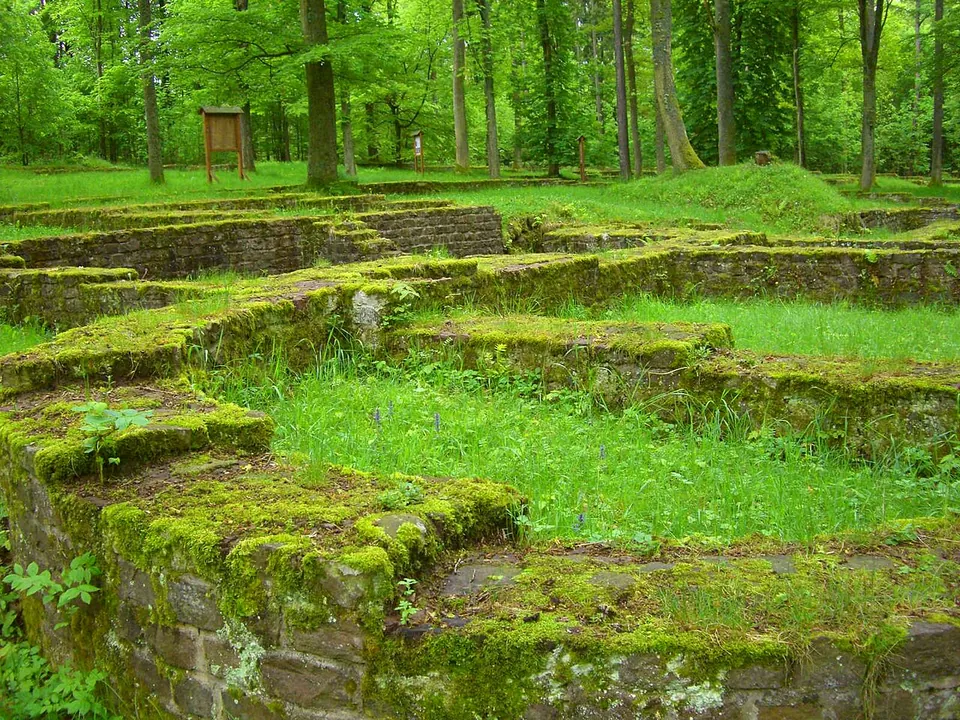
The estate survives as ground plans: low, conserved sandstone walls, capped with mortar, laid out on the forest floor among the trees.


Straight-line distances.
Sources
Every fact on this page comes from the records below, each used under the licence noted.
| Source | Licence |
|---|---|
| Pleiades 338703437 | CC BY |
| Wikidata Q130013443 | CC0 |
| OpenStreetMap relation/6328020 | ODbL |
| Römermuseum Güglingen — the Archäologische Freilichtanlage (the operator) | licence not recorded |
| Römermuseum Güglingen — opening hours (the operator) | licence not recorded |
| Römermuseum Güglingen — admission and guided tours (the operator) | licence not recorded |
| Römermuseum Güglingen — new opening hours from 1 August 2026 (the operator) | licence not recorded |
| Römermuseum Güglingen — getting there by bus and train (the operator) | licence not recorded |
| Römermuseum Güglingen — second floor, Roman religion and the Mithras cult (the operator) | licence not recorded |
| Römermuseum Güglingen — ground floor, the Roman Zabergäu (the operator) | licence not recorded |
| Wikipedia (de) — Vicus von Güglingen | CC BY-SA 4.0 |
| Wikipedia (fr) — Mithraea de Güglingen | CC BY-SA 4.0 |
| Wikidata — Archäologische Freilichtanlage Güglingen (Q1454518) | licence not recorded |