

What is there today
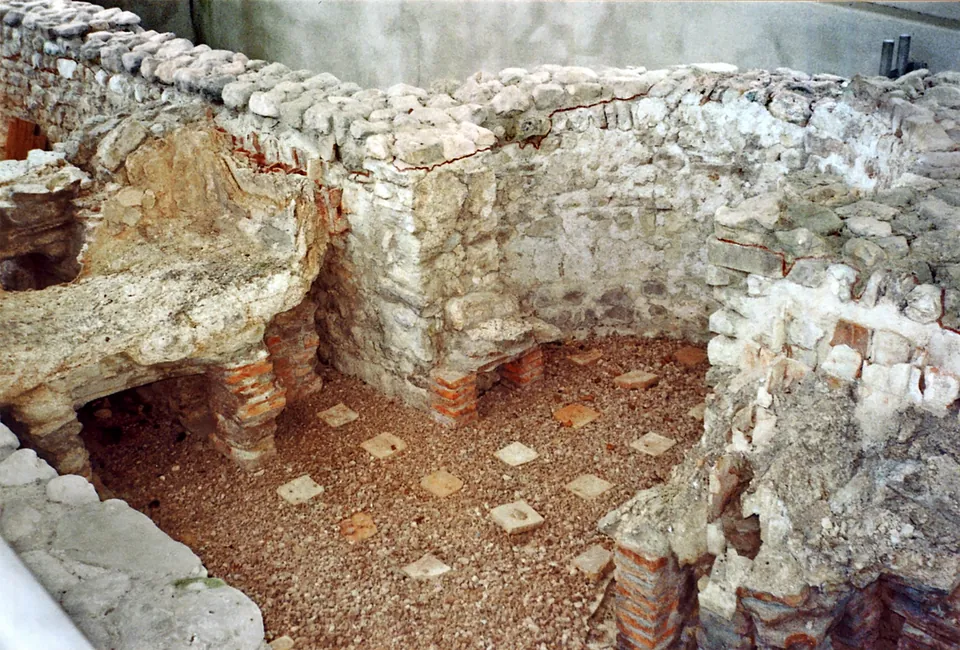
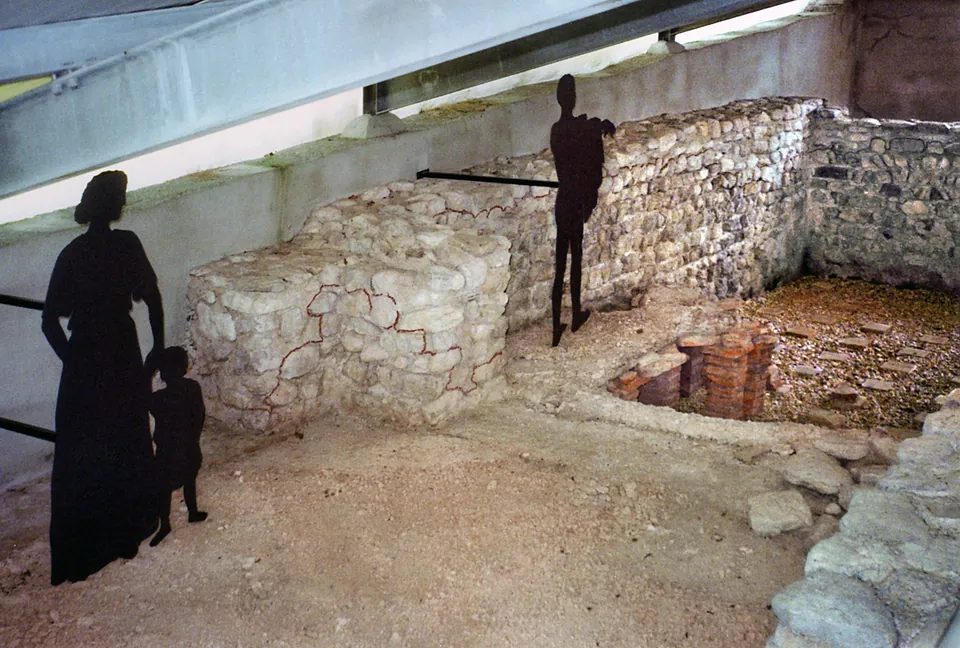
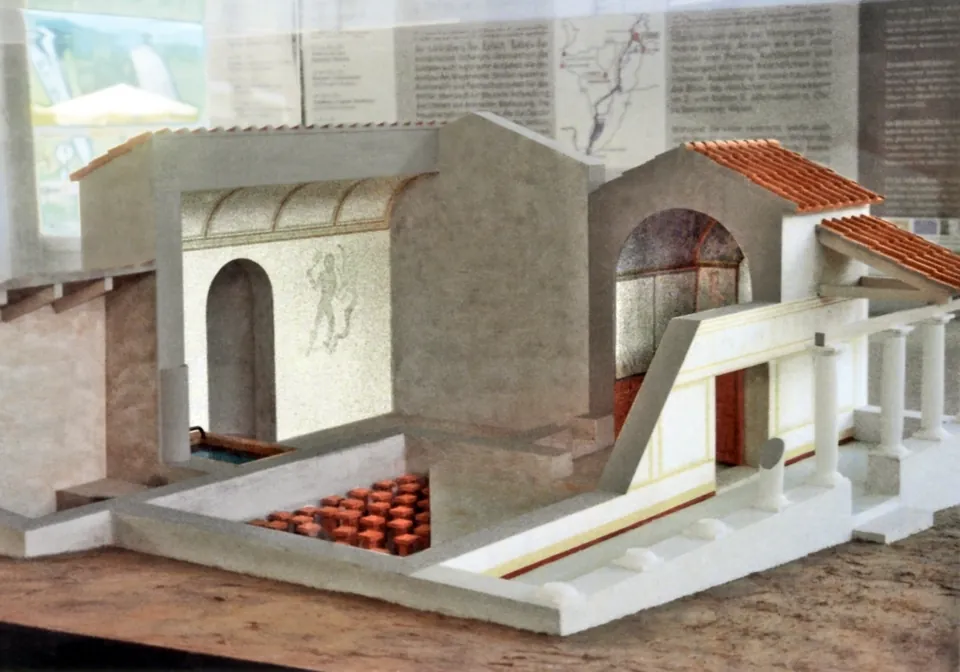
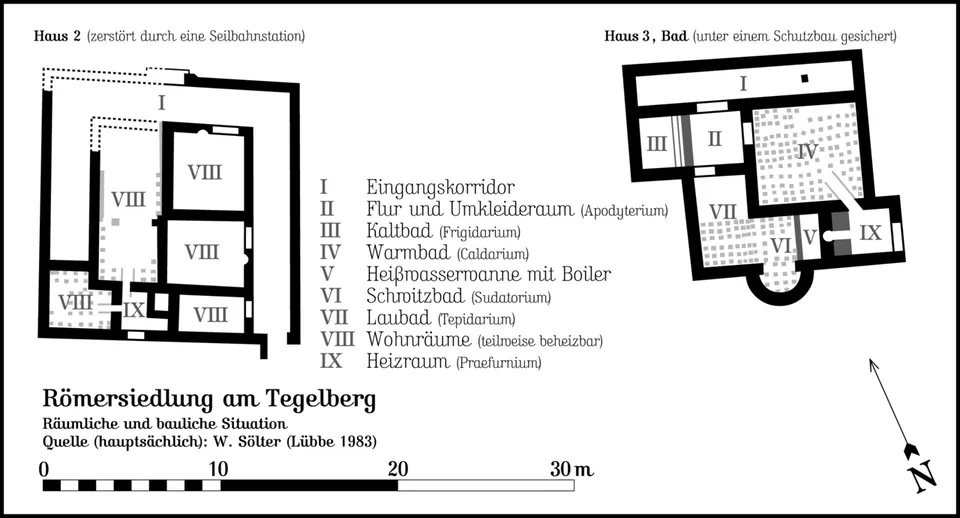
The bath house is the thing to see. Excavated in 1967–68 and roofed over in 1996, it is a compact building of about 12.4 by 13.8 m, not counting its apse, and most of it was left in place for visitors (de.wikipedia). What you look at is the lower part of the rooms: low rubble walls, the apse, a hot-water tub standing on heating pillars with flue tiles surviving at its narrow ends, and part of the underfloor heating (de.wikipedia). Some of the pillar tiles damaged by years of weather were replaced with new ones (de.wikipedia), and only the masonry above a red line marked in the mortar joints was rebuilt (the photographers’ descriptions on Commons). The columned entrance porch was filled in again and stays buried (de.wikipedia). The state’s museum portal mentions a small presentation with the remains, and in 2015 a cut-away model of the bath stood in the shelter (Museen in Bayern; Commons).
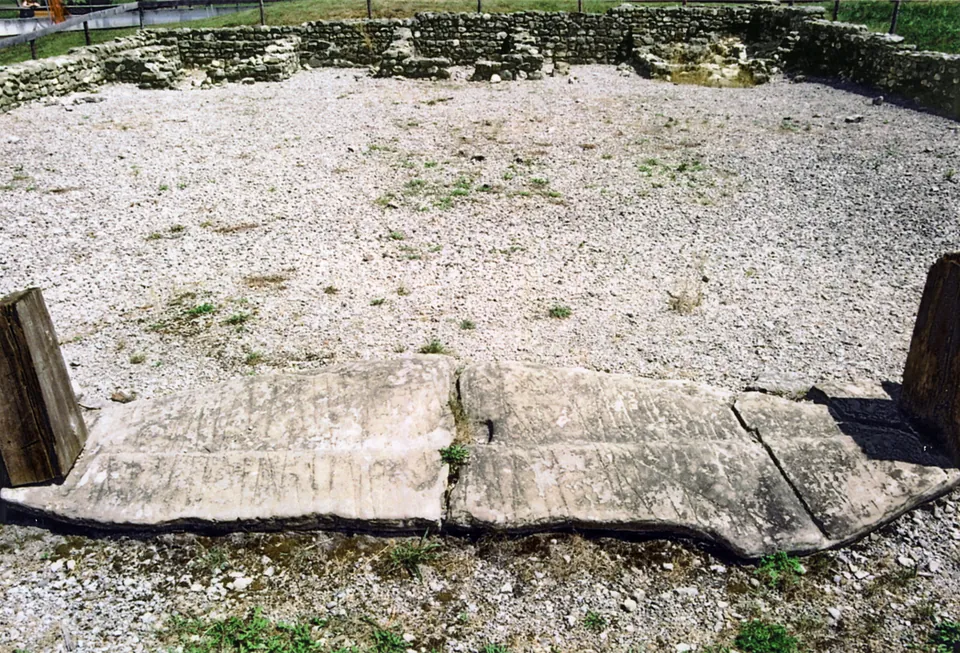
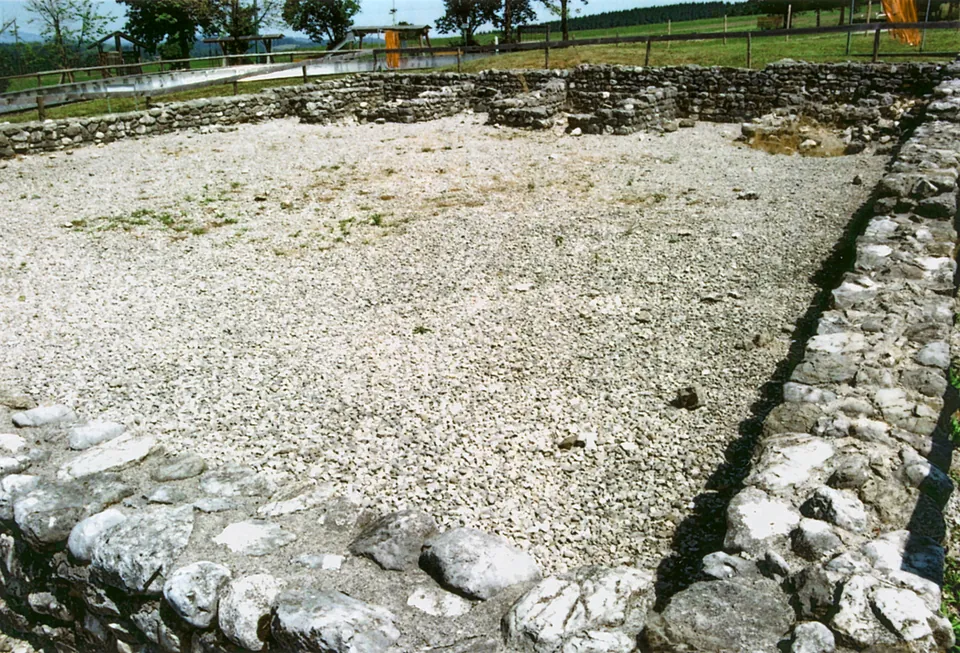
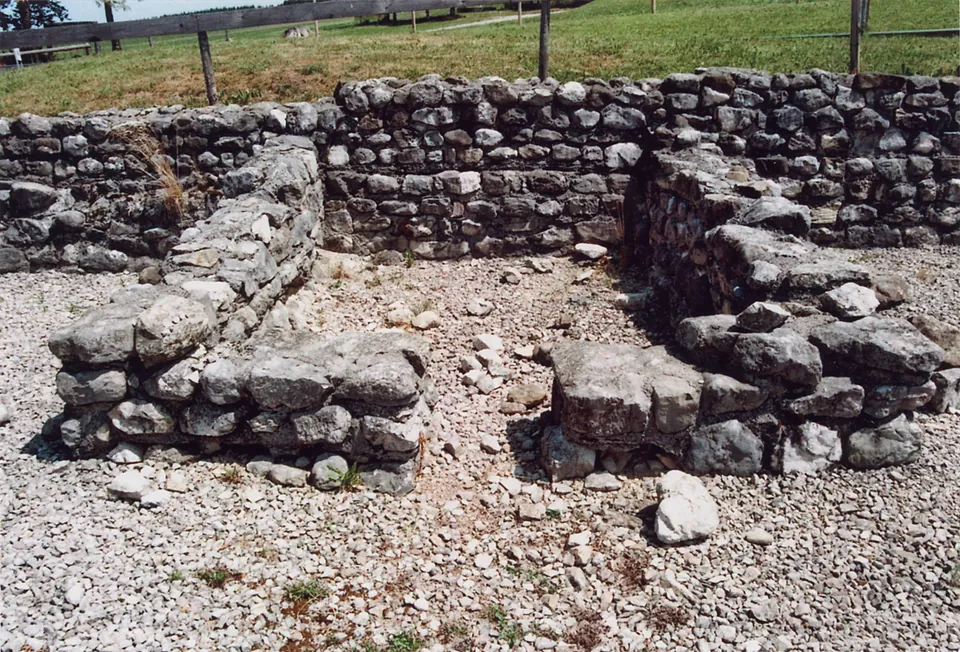
A short way off, the farm building (Haus 1) has been conserved at foundation level: a walled, gravelled yard with three drying kilns built against its back wall, probably for drying flax, a one-room house against its side and the original threshold stone of an entrance wide enough for a cart (de.wikipedia). It sits, in Wikipedia’s words, a little lost in the run-out of the summer toboggan run.
Two things are not here. The painted wall plaster that made the site known well beyond Bavaria (the municipality) was lifted and is shown, partly reconstructed, in the Archäologische Staatssammlung in Munich, and the dwelling (Haus 2) was destroyed to build the valley station (de.wikipedia).
Is it worth the trip?
Not as a journey of its own. The remains are small and low, and the best of what was found is in Munich. But it is free, listed as always accessible and right beside the car park and bus stop of the Tegelbergbahn, so anyone riding the cable car or visiting Neuschwanstein nearby can make it a short stop. The bath is the reason: Wikipedia calls its remains exceptionally well preserved, and the heating under its floor and tub is there to be seen in place.
Getting there
The site is at Tegelbergstraße 33 in Schwangau, about 2 km south-east of the village (Museen in Bayern), at the valley station of the Tegelbergbahn. The station’s car park and a second car park run by the Tegelbergbahn are both within about 80 m of the site, both charging a fee, and the bus stop “Schwangau, Tegelbergbahn” is about 35 m away (OpenStreetMap). The centre of Füssen is about 4 km away in a straight line.
The state’s museum portal lists the site as always accessible (Museen in Bayern, entry last updated February 2024, read 30 October 2026), and entry is free (de.wikipedia; OpenStreetMap). The municipality’s own page gives no hours or charges.
Visiting details
- Opening hours
- Listed as always accessible.
- Tickets
- Free.
- Parking
- The remains lie at the car park of the Tegelbergbahn valley station (OSM way/26515725, about 20 m away, a pay car park); a second pay car park run by the Tegelbergbahn is mapped about 80 m away (OSM way/958569777). The bus stop "Schwangau, Tegelbergbahn" is about 35 m away (OSM node/4793483423).
Before you go
- The painted wall plaster that made the site famous is not here. It was lifted after excavation and is shown, partly reconstructed, in the Archäologische Staatssammlung in Munich.
- The farm building lies in the run-out of the summer toboggan run.
Hours and prices checked 30 October 2026 on the operator's own site. Confirm before travelling.
History
The site was found in 1934, when a water pipe was being laid for Schwangau and the head teacher Hans Popp picked Roman tiles out of the spoil. In 1935 his trial trenches found foundations or brick rubble at 15 places, and he excavated the whole farm building. On 21 June 1966 a digger building the cable-car valley station struck walls and painted plaster; work was stopped, and rescue excavations uncovered the dwelling in 1966 and the bath in 1967–68 (de.wikipedia).
The buildings went up around the middle of the 2nd century AD on terraces and platforms along the gently falling foot of the Hornburg (de.wikipedia; the municipality). A coin of Antoninus Pius (138–161) dates the bath to the second half of that century. Already in antiquity a landslide buried parts of the buildings in rubble and clay, which is what preserved the paintings. The area was abandoned in the 3rd century, either after the landslide or in one of the Germanic attacks at the end of that century (de.wikipedia).
The bath was painted twice. Its last coat, eggshell-thin, is dominated by a mid-dark blue divided by broad red lines into fields filled with geometric patterns, plants, animals, gods and bath attendants; the ceiling of the changing room showed the abduction of Ganymede. The fragments went to Munich in more than 700 fruit crates. There the cold-water room could be reconstructed completely with its paintings, which is how it is known to have had a barrel vault and a small round-headed window looking west as far as the Schlossberg at Füssen (de.wikipedia).
What the place was is still debated. Many publications call it an unusually extensive villa rustica, as the municipality does. The excavator Günther Krahe allowed that the three buildings dug so far could belong to a wealthy villa, but thought the other find spots pointed to a far more widely built-up area than such estates had. The spot had little else in its favour as a place to live - its climate is harsh, with winter sun for only a few afternoon hours - and the settlers were apparently drawn by the ore of the Tegelberg: large amounts of slag have been found around Füssen, and ore was still being dug here in the Middle Ages (de.wikipedia). The Roman settlement of Foetes, at Füssen to the south-west, is still largely unexplored (de.wikipedia).
The bath’s survival was hard won. For decades it stood in the open: a shelter was refused, partly because cable-car gondolas pass directly overhead, and frost broke up floors and plaster every winter until the shelter was built in 1996. When a summer toboggan run was planned across the farm building, its route was changed together with the operator, and the building’s foundations were conserved in 1998 (de.wikipedia).
More photographs




Nearby
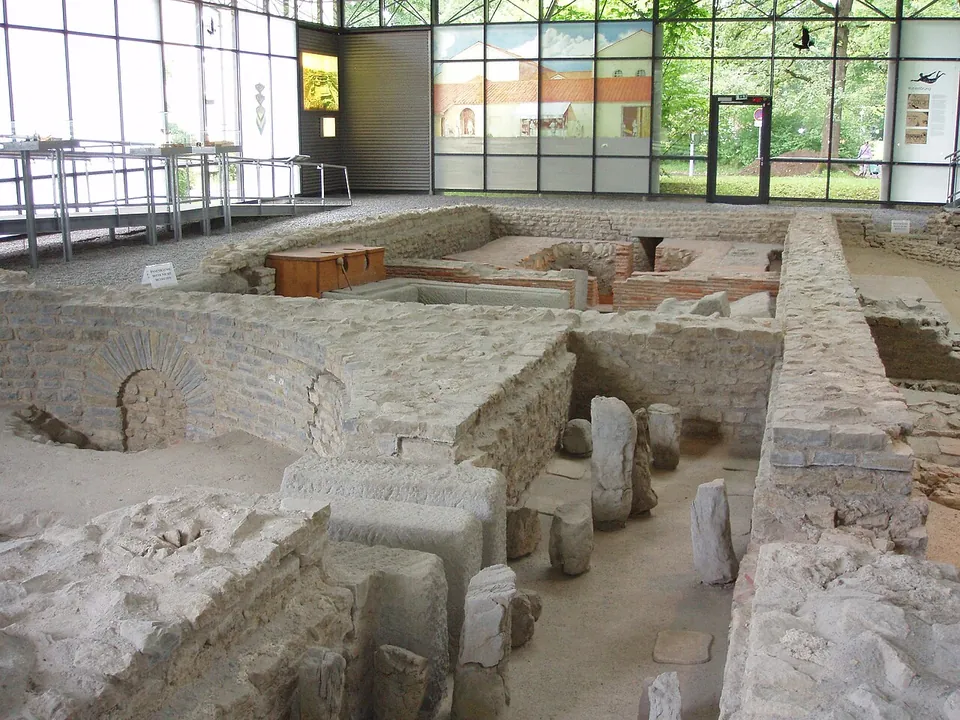
Photo: Xocolatl · Public domain · Commons
37 km · city · Bavaria
Cambodunum
The Archäologischer Park Cambodunum shows three parts of the Roman town: the Gallo-Roman temple district, the Small Baths (Kleine Thermen) and the forum with its basilica.

Straight-line distances.
Sources
Every fact on this page comes from the records below, each used under the licence noted.
| Source | Licence |
|---|---|
| Wikidata Q1720523 | CC0 |
| OpenStreetMap way/90473664 | ODbL |
| Wikipedia (de) — Römersiedlung Tegelberg | CC BY-SA 4.0 |
| Gemeinde Schwangau — Römervilla am Tegelberg (the municipality, which looks after the site) | licence not recorded |
| Museen in Bayern — Römervilla Schwangau (Landesstelle für die nichtstaatlichen Museen in Bayern) | licence not recorded |