

What is there today
The Archäologischer Park Cambodunum shows three parts of the Roman town: the Gallo-Roman temple district, the Small Baths (Kleine Thermen) and the forum with its basilica. The first two are the ticketed museum areas, about 300 m apart, each with its own entrance and ticket desk; the forum and basilica lie in a park that is open to everyone (Kempten Tourismus; OpenStreetMap). A self-guided tour of the grounds has 15 stations, and an app adds film sequences and 360-degree panoramas of the Roman town (Kempten Tourismus).
The Small Baths
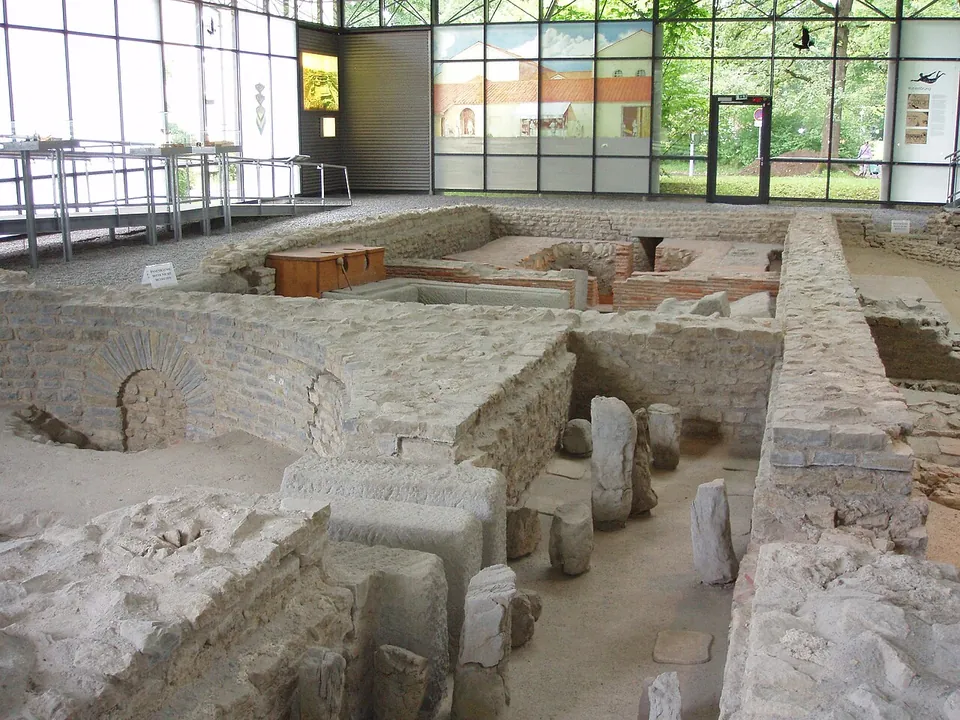
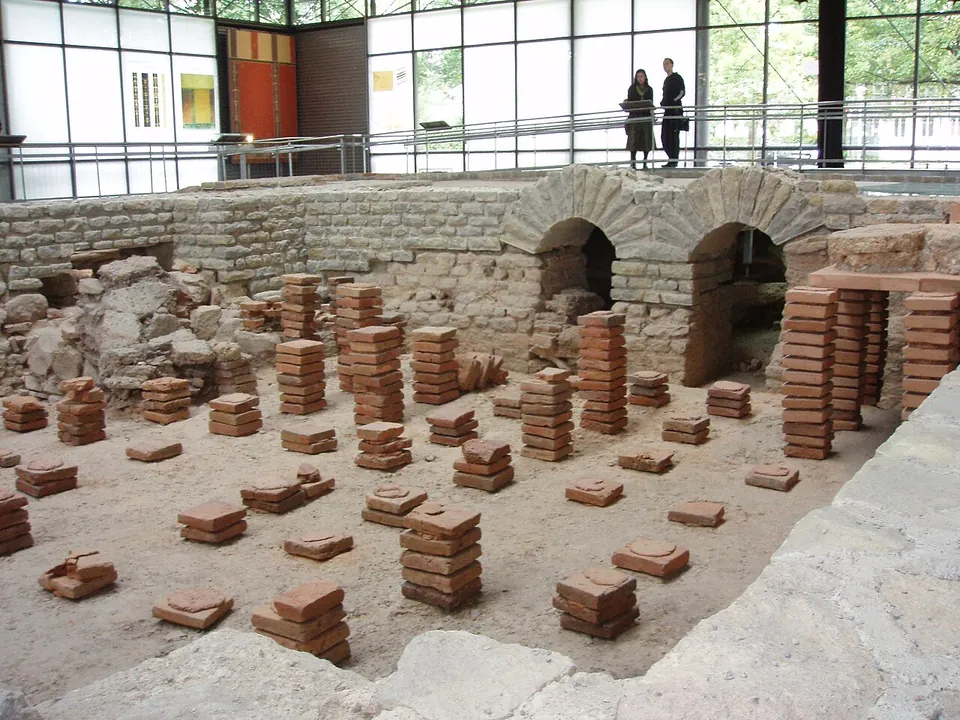
The Kleine Thermen are the part of the park where the Roman masonry itself is on show. The remains are presented inside a protective exhibition building (Kempten Tourismus), with the walls and the tile stacks of the underfloor heating open to view. The bath was laid out in a row, with the hot, warm and cold rooms one behind the other; a sweat bath, further furnace rooms and a latrine were added later. At first it could only be entered from the large building next door, read as the lodging house (praetorium) of the forum, which suggests it belonged to the governor’s residence (de.wikipedia). The bath is dated to the late Claudian or early Neronian period, and three phases of it in timber are known (de.wikipedia).
The temple district and the Temple of Hercules
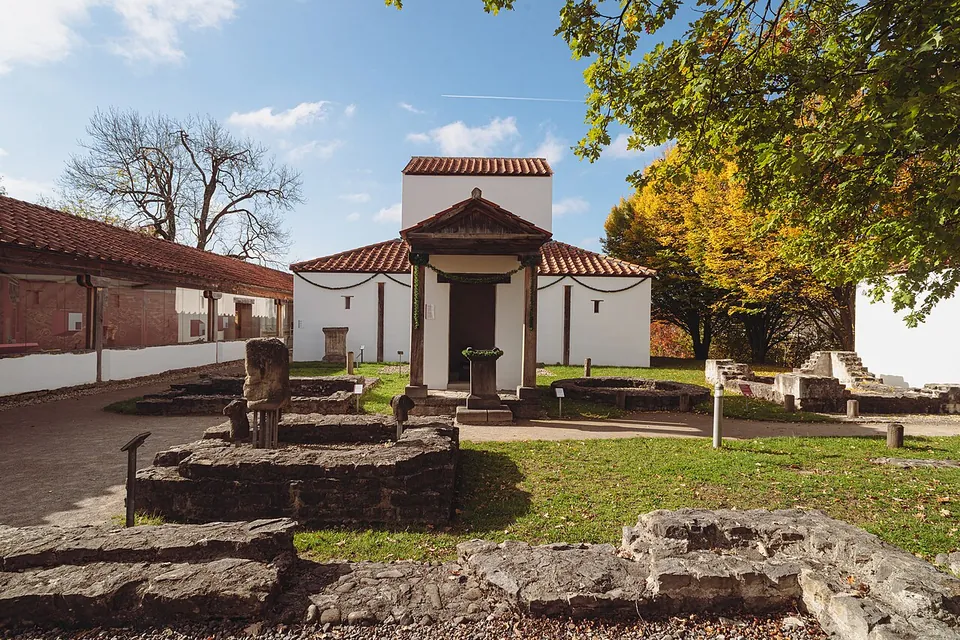
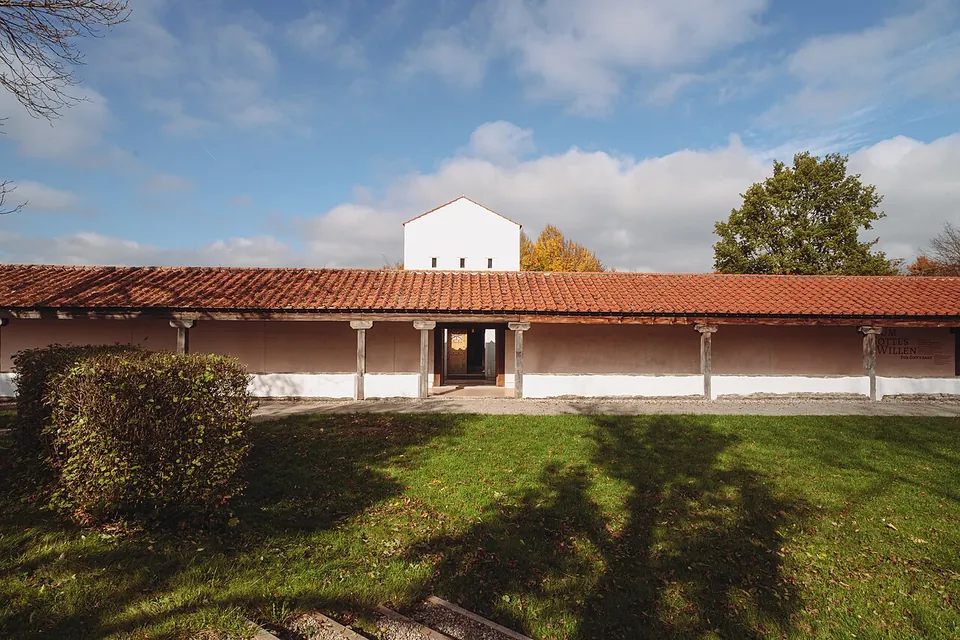
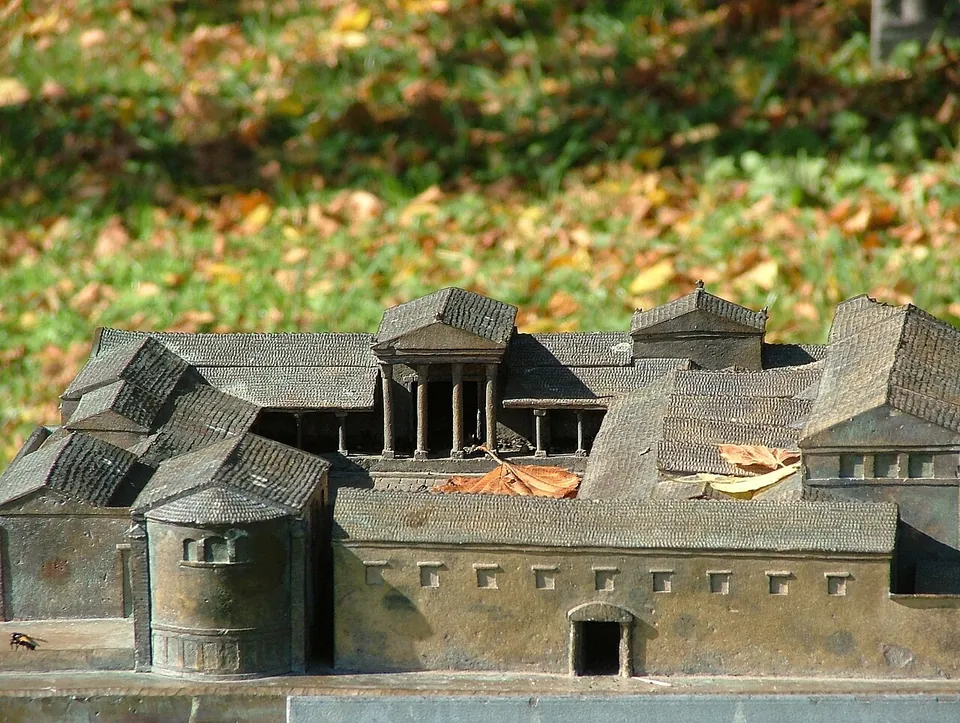
In the north-west of the town, close to the steep drop to the Iller, excavators found a sacred precinct of twelve buildings, which need not all have stood at the same time. It was closed off towards the town by a U-shaped double hall (de.wikipedia). Five of the temples and the double hall have been rebuilt at full size. These are reconstructions in the full sense: when they were built in 1983–85, the last ancient remains were in most places removed and the buildings raised over concrete foundations, so almost none of the Roman fabric survives here (de.wikipedia, Archäologischer Park Cambodunum).
The building with the raised central tower is the Temple of Hercules, a Gallo-Roman ambulatory temple: a central room surrounded by a corridor. It was rebuilt with a closed corridor rather than an open colonnade, because the excavated outer walls showed only two timber supports on each side, too few to carry a roof, and because of the snow loads of the Allgäu. Altars and dedications in the precinct point to the worship of Mercury, Hercules and Epona (de.wikipedia, Archäologischer Park Cambodunum). From the end of the temple hall there is a view over Kempten towards the Alps in good weather (Kempten Tourismus).
The forum and basilica
The forum was the centre of the town: the square held market days and meetings, and courts sat in the basilica (Kempten Tourismus). Excavation has traced a free-standing basilica, at first 49.5 by 25 m, and a walled sacred precinct of 600 by 800 Roman feet, about 179 by 238 m, with a large altar at its centre (de.wikipedia). Today this part lies in parkland and is free to walk into.
Next to the temple district are a café (the Taberna) and a Roman-themed playground (Kempten Tourismus).
Is it worth the trip?
If you are in Kempten, yes, and it suits families well. Be clear about what you are seeing, though. The white temples are 1980s rebuildings on modern foundations, a picture of what the precinct may have looked like rather than surviving Roman buildings, and much of the rest of the Roman town was lost to building work while it was being excavated between 1912 and 1935, against international protest (de.wikipedia). The genuine Roman fabric is in the Small Baths. As a visit it is easy and cheap: it is in town, on a bus route, €5 for adults and free for anyone under 18 and for students.
It is not a site to plan a long detour around on its own, but it is an easy stop on a trip through the Allgäu.
Getting there
The park is on the high east bank of the Iller in the district of Kempten-Ost, signposted from the town. The temple district entrance is at Cambodunumweg 3 and the Small Baths at Merktstraße 1. From Kempten’s main station, bus R8 stops at Schumacherring/APC; from the central bus interchange (ZUM), line 11 runs to Kaufbeurer Straße/Augarten and line 12 to Lenzfrieder Straße/Kieswerk. There is no car park of the park’s own: the operator recommends the car parks at Illerdamm 10 and on Brodkorbweg, 5 to 15 minutes’ walk away (apc-kempten.de).
The baths and the temple district are open Tuesday to Sunday, 10.00 to 17.00, from 15 March to 15 November, including public holidays in that period, and closed on Mondays. Admission is €5; children and young people up to 17, school pupils and students go free, and reduced tickets are €2.50. Everyone gets in free on the first Sunday of the month. A public tour (in German) runs every Sunday at 11.00 and costs adults €3 on top of admission (apc-kempten.de and Kempten Tourismus, read 30 October 2026 — check before travelling). Dogs are not allowed in the museum areas.
Visiting details
- Opening hours
- Tuesday to Sunday 10.00–17.00, from 15 March to 15 November (2026 season). Open on public holidays in the season, including Good Friday, Easter, 1 May, Ascension, Whit Monday, Corpus Christi, 15 August, 3 October and 1 November. Closed on Mondays and from mid-November to mid-March.
- Tickets
- €5 for the Small Baths and the temple district; €2.50 reduced (disabled visitors, the unemployed and some other groups, with proof) and for groups of 10 or more; free for children and young people up to 17, school pupils and students. Free for everyone on the first Sunday of the month. Annual card €15. The forum and basilica lie in a public park and are free.
- Parking
- The park has no car park of its own; the operator points to the Illerdamm car park (Illerdamm 10) and the car park on Brodkorbweg, 5 to 15 minutes' walk. OSM maps a free public car park about 70 m from the point (way/237044521).
Before you go
- The baths and the temple district are closed on Mondays and from mid-November to mid-March.
- Dogs are not allowed in the museum areas (assistance dogs excepted); children under 10 need an adult with them.
Hours and prices checked 30 October 2026 on the operator's own site. Confirm before travelling.
History
Strabo mentions the place as Kandobounon, the chief town of the Estiones, a Vindelician tribe that came under Roman rule in 15 BC with the Alpine campaigns of Drusus and Tiberius. No settlement of that period has yet been found on the site, however. The first timber buildings date from the reign of Tiberius and the first stone ones from the time of Claudius at the earliest (de.wikipedia). The name is Celtic, from words for a bend and a fort, and Kempten’s own name comes straight from it.
The town grew in the 1st century on its roads, to Italy over the Alpine passes, to Bregenz on Lake Constance and north along the Iller to the Danube. It was one of the most important Roman towns in Raetia and probably its first capital, before Augsburg; Kempten counts with Trier and Cologne among the oldest towns in Germany because of the early written record (de.wikipedia). Beside the Small Baths it had a much larger bath complex of 4,200 m² northeast of the forum, built towards the end of the 1st century. Little new building is attested after the reign of Antoninus Pius.
Under pressure from Germanic raids, the town on the Lindenberg was given up by the end of the 3rd century at the latest. The people moved to a much smaller, walled settlement on a terrace below the Burghalde ridge by the river, and on the ridge itself a detachment of the legio III Italica was most probably stationed, as part of the late Roman frontier along the Danube, Iller and Rhine. The late Roman place was called Cambidanum. Soldiers were still there at the start of the 5th century, and the garrison was probably given up by the middle of it (de.wikipedia).
Systematic excavation began in 1885, led by the merchant August Ullrich, and was continued by the Bavarian state office for monuments under Paul Reinecke from 1912 to 1935. Published dates for the park’s opening differ: the article on the town gives October 1987 for its first section, the temple district, and the article on the park says it has been open to the public since 1983 (both de.wikipedia).
More photographs


Nearby
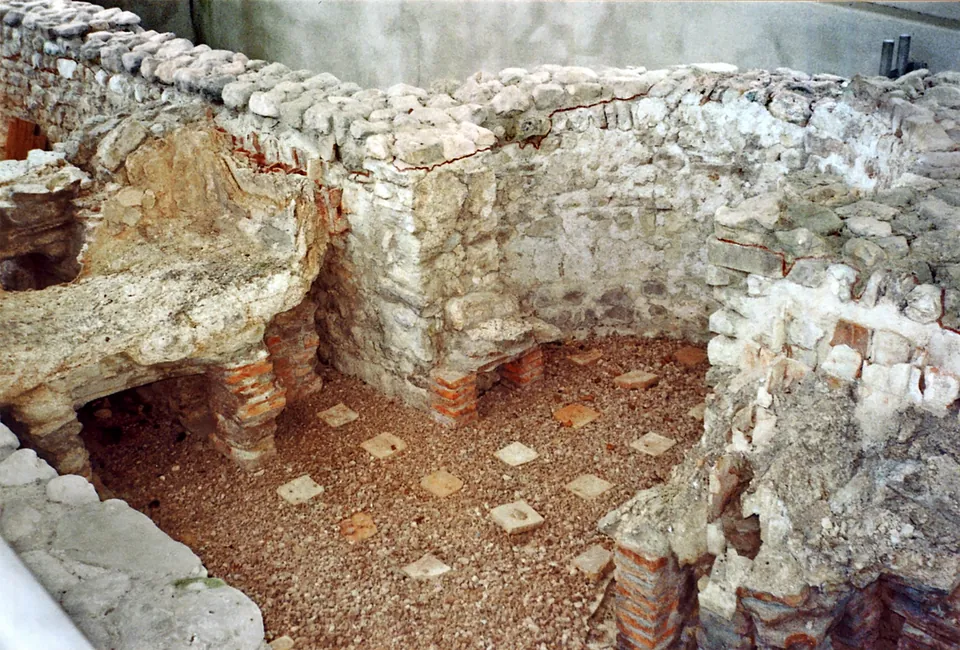
Photo: Libellchen · CC BY-SA 3.0 · Commons
Photo: Werner Doenni · CC BY-SA 3.0 · Commons
46 km · fort · Bavaria
Caelius Mons
The fort itself is almost entirely built over by the village (de.wikipedia).


Straight-line distances.
Sources
Every fact on this page comes from the records below, each used under the licence noted.
| Source | Licence |
|---|---|
| Pleiades 187335 | CC BY |
| Wikidata Q1028166 | CC0 |
| OpenStreetMap relation/5402710 | ODbL |
| Wikipedia (de) — Cambodunum | CC BY-SA 4.0 |
| Wikipedia (de) — Archäologischer Park Cambodunum | CC BY-SA 4.0 |
| Wikidata — Archäologischer Park Cambodunum (Q636787) | licence not recorded |
| Wikidata — Kleine Thermen Cambodunum (Q132224823) | licence not recorded |
| Wikidata — Temple of Hercules (Q132351254) | licence not recorded |
| Archäologischer Park Cambodunum — visitor information, hours and admission (the operator) | licence not recorded |
| Archäologischer Park Cambodunum — home page (the operator) | licence not recorded |
| Kempten Tourismus — Cambodunum Archaeological Park (the city's tourist office, which sells the tickets online) | licence not recorded |