

Amphipolis was a Greek city on the river Strymon that Rome made the capital of a district of Macedonia and a station on the Via Egnatia; in late antiquity it became a bishop’s seat with four large basilicas. Its walls, its Early Christian churches and the mosaics of a Roman villa are what remains of those centuries.
What is there today
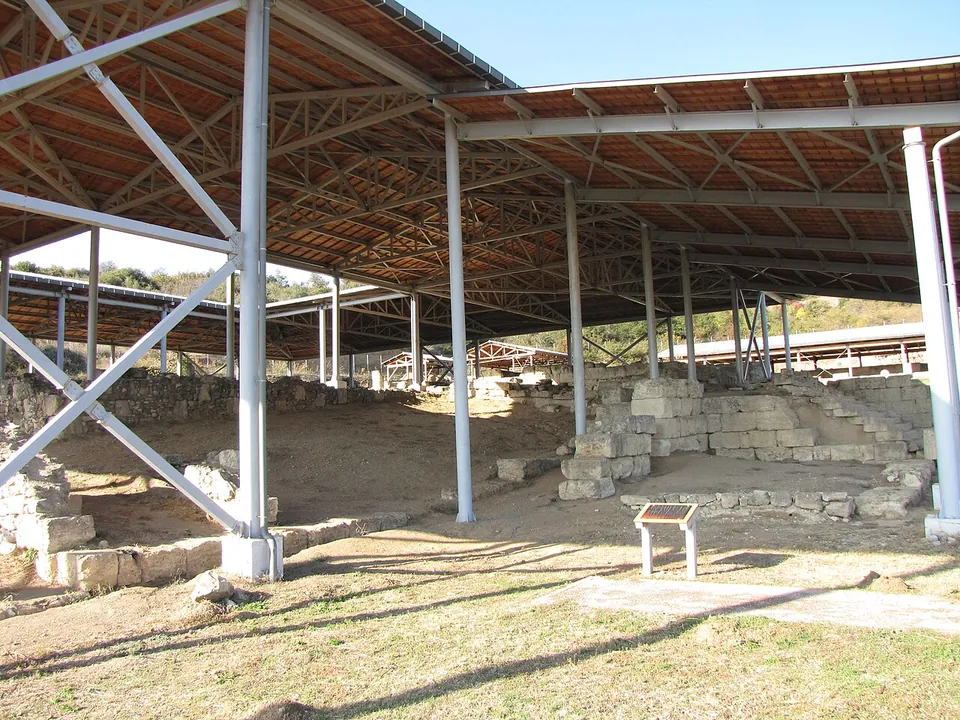
The Archaeological Park takes in the city wall, parts of the acropolis, houses, tombs and monuments of the Hellenistic and Roman period, and the museum beside it shows the finds, among them those from the Early Christian basilicas (the national tourism organisation).
The walls are among the most imposing in Macedonia. They go back to the city’s foundation, but their later building phases belong to the Roman imperial period; the northern stretch survives in many places to a height of 7–8 m. In the south wall, Gate D, the “Gate of Augustus”, was probably the city’s official entrance in Roman times, beside the Via Egnatia; it is flanked by two marble bases of bronze statues, inscribed in honour of the deified Augustus and the proconsul Lucius Calpurnius Piso (the Ministry).
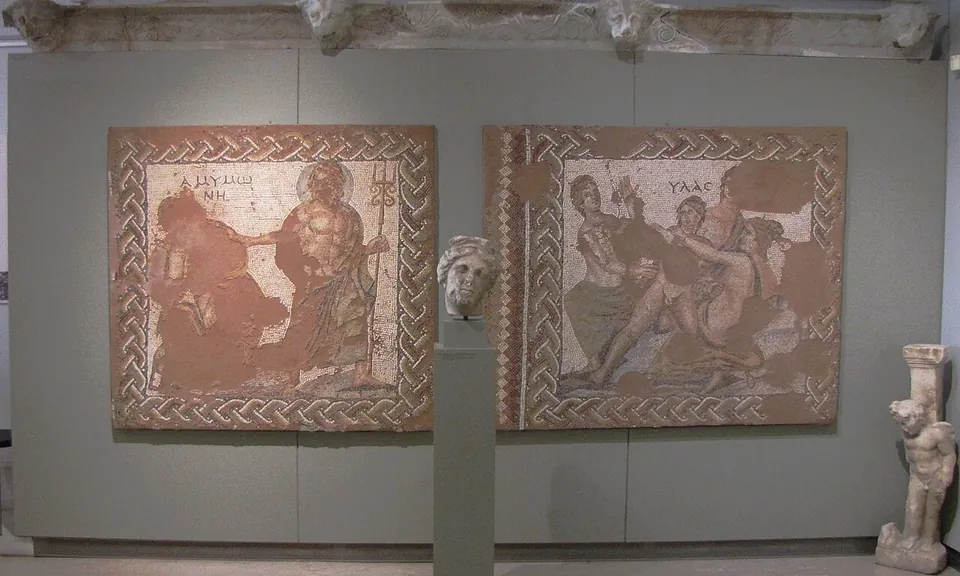
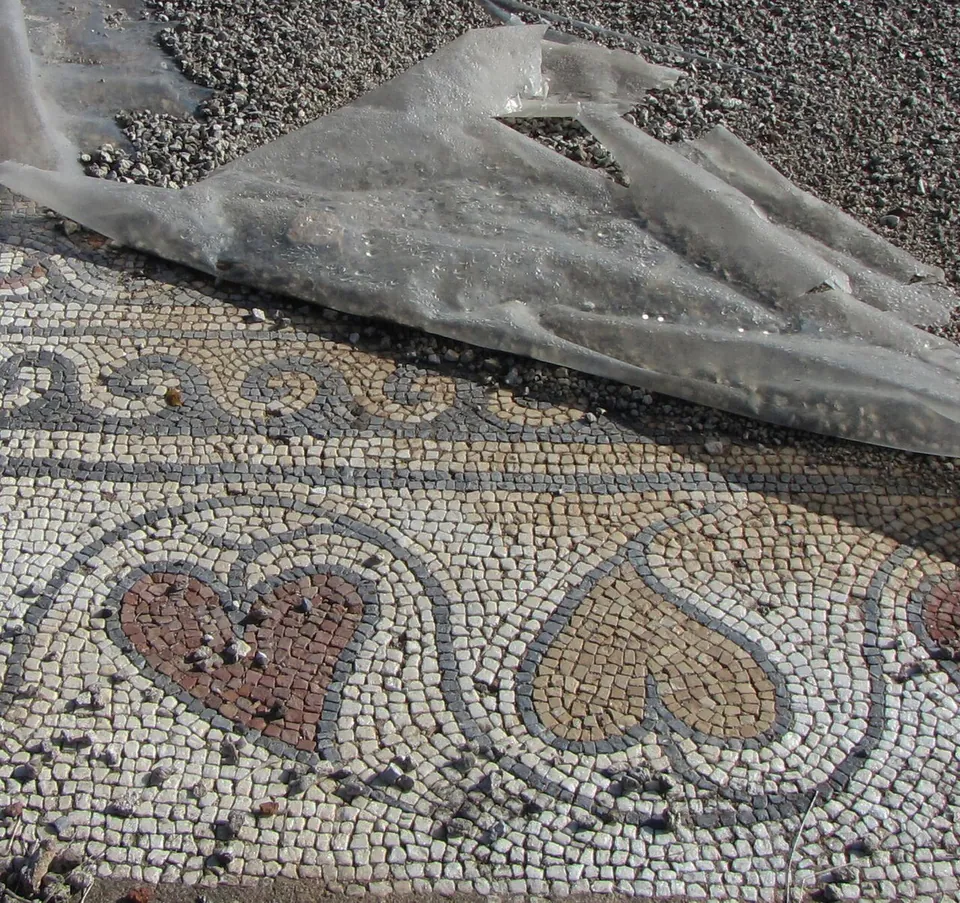
The Roman villa, south-west of the acropolis, dates from the 2nd or 3rd century AD. Its floors were laid with mosaics including the Abduction of Europa, Poseidon and Amymone, and Hylas and the Nymphs (the Ministry); two of them are now on display (the photograph at the top of this page).
The Early Christian town shrank to the old acropolis, about 40 hectares inside a new wall some 2,200 m long, built largely of reused stone. Within it, excavation has found four basilicas, known as A to D, built between the later 5th and the first half of the 6th century: the largest, Basilica A, has two narthexes and a spacious atrium, Basilica C is known for its mosaic floors and Basilica D for its carved decoration. A centrally planned church of the early 6th century, with a hexagonal core, is the most imposing Early Christian monument of the city, and a large building east of one of the basilicas is taken for the bishop’s palace (the Ministry).
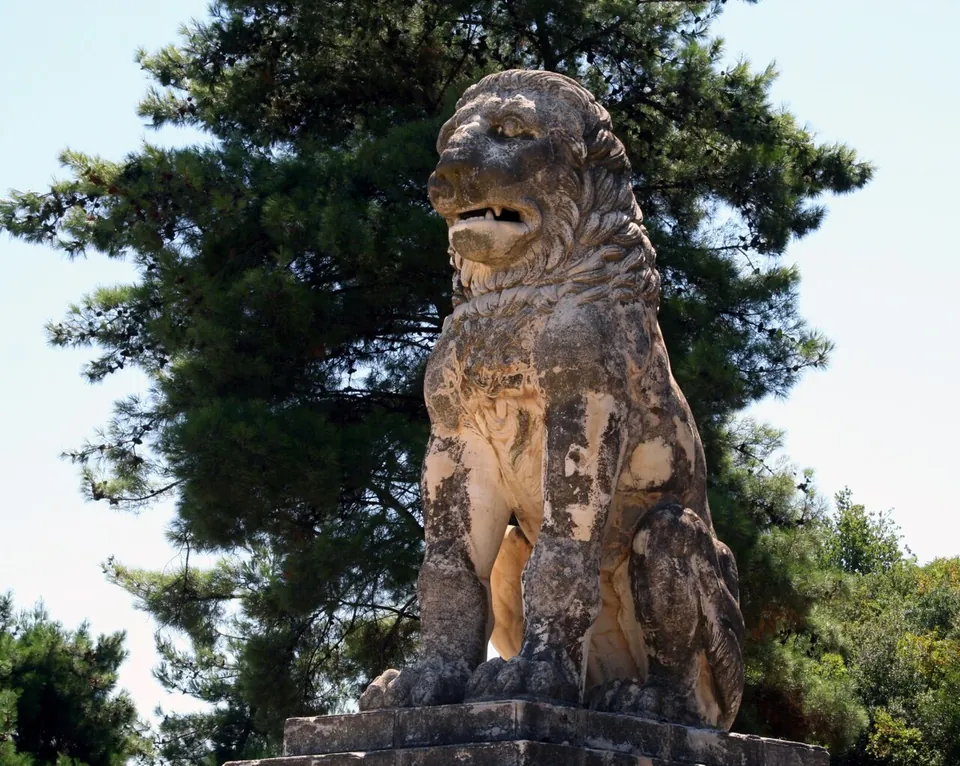
The gymnasium, in the south-east of the city, was probably founded in the late Classical era and stayed in use until the 1st century AD (the Ministry). Outside the walls stand the Kasta Tumulus, excavated in 2011–2014, and, on the far bank of the Strymon, the Lion of Amphipolis, a 5.3 m funerary monument of the late 4th century BC; the date of the Kasta tomb is debated (the Ministry).
Is it worth the trip?
Yes, if late antiquity interests you: the Early Christian basilicas are the strongest reason to come, and the museum completes the story with the Roman villa’s mosaics. The purely Roman layer is thinner - the rebuilt walls, the Gate of Augustus and the villa. Expect a large, spread-out site rather than a single monument, and check the hours before you go, because the published ones differ.
Getting there
Ancient Amphipolis is about 60 km south-east of Serres (the Ministry). The museum is five minutes on foot from the centre of the modern village of Amphipolis; KTEL buses from Serres or Drama stop at “Diastavrosi”, and the drive takes 50 minutes from Serres and an hour and ten from Thessaloniki (the operator). The museum and the site are signposted (the national tourism organisation).
A ticket is €10, reduced €5; the operator lists it for the museum and the national tourism organisation for the park and museum together. Entry is free on 6 March, 18 April, 18 May, the last weekend of September, 28 October, and on the first and third Sunday of each month from November to March. Published hours differ: the operator gives daily 08.00–20.00 from April to August, closing earlier through the autumn, and 08.30–15.30 from November to March; the national tourism organisation gives 08.30–15.00 daily. It is closed on 1 January, 25 March, 1 May, Easter Sunday and 25–26 December (hh.gr and visitgreece.gr, read 9 October 2026 — check before travelling).
Visiting details
- Opening hours
- Published hours differ. The operator gives, for the museum, daily 08.00–20.00 from 1 April to 31 August, closing earlier through the autumn (18.00 by late October), and 08.30–15.30 from 1 November to 31 March, last entry 20 minutes before closing; the national tourism organisation gives 08.30–15.00 daily for the archaeological park and museum. Closed 1 January, 25 March, 1 May, Easter Sunday and 25–26 December (the operator).
- Tickets
- €10; reduced €5. The operator lists the price for the museum; the national tourism organisation gives the same price for the archaeological park and museum together. Free on 6 March, 18 April, 18 May, the last weekend of September and 28 October, and on the first and third Sunday of each month from November to March.
- Parking
- The operator lists parking at the museum; a car park is also mapped about 210 m from the point (OSM node/11286292369).
Hours and prices checked 9 October 2026 on the operator's own site. Confirm before travelling.
History
The Athenians founded Amphipolis in 437 BC, and Philip II of Macedon took it in 357 BC. After Rome’s victory at Pydna in 168 BC, the last Macedonian king, Perseus, tried to hold out here; the Roman general Aemilius Paullus then settled in the city, where the formal surrender of Macedonia took place, and Amphipolis became the capital of the first of the four districts into which Macedonia was divided. When Macedonia became a Roman province in 148 BC, Amphipolis was declared a free city (the Ministry).
It prospered under Rome, minted its own coins, and lay on the Via Egnatia. In the mid-1st century BC Thracians attacked it and destroyed buildings. St Paul passed through in 49/50 on his way from Philippi to Thessaloniki. The city probably became a bishop’s seat as early as the 5th century, though a bishop is first recorded in 553. A cross-wall built at the end of the Early Christian period, in the late 6th or 7th century, and a small church of after the mid-6th century are its latest remains; the city was then gradually abandoned, and it is last mentioned in 739 (the Ministry).
More photographs

Nearby
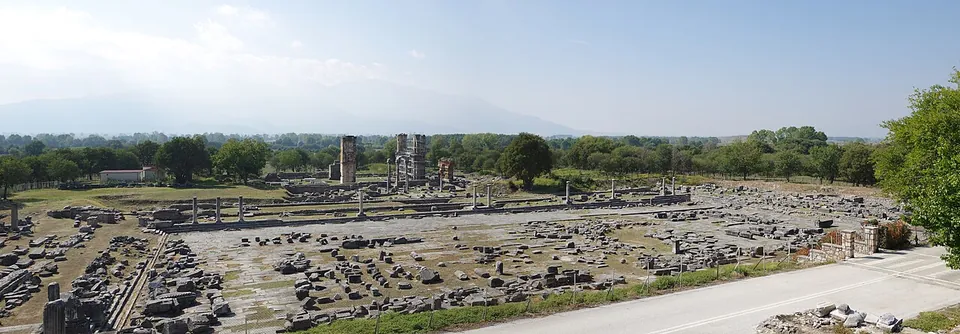
Photo: Berthold Werner · CC BY-SA 3.0 · Commons
43 km · city · Kavala
Philippi
The forum was laid out on two terraces on either side of the main road, the Via Egnatia, and built in several phases between the emperors Claudius (41–54) and Antoninus Pius (138–161).

Straight-line distances.
Sources
Every fact on this page comes from the records below, each used under the licence noted.
| Source | Licence |
|---|---|
| Pleiades 501347 | CC BY |
| Wikidata Q217414 | CC0 |
| OpenStreetMap way/161541017 | ODbL |
| Ministry of Culture and Sports — Cultural Route of the Via Egnatia, Amphipolis | licence not recorded |
| Hellenic Heritage (H.O.C.R.E.D., for the Ministry of Culture) — Archaeological Museum of Amphipolis, hours and tickets | licence not recorded |
| Visit Greece (Greek National Tourism Organisation) — Archaeological Park & Archaeological Museum of Amphipolis | licence not recorded |
| Wikipedia (en) — Amphipolis | CC BY-SA 4.0 |
| Wikipedia (de) — Amphipolis | CC BY-SA 4.0 |
| Wikipedia (el) — Αμφίπολη | CC BY-SA 4.0 |