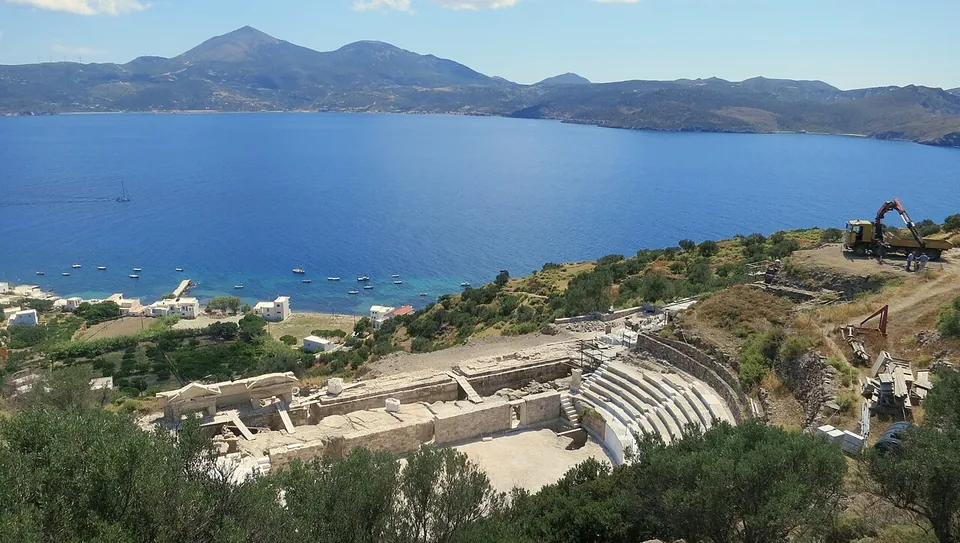
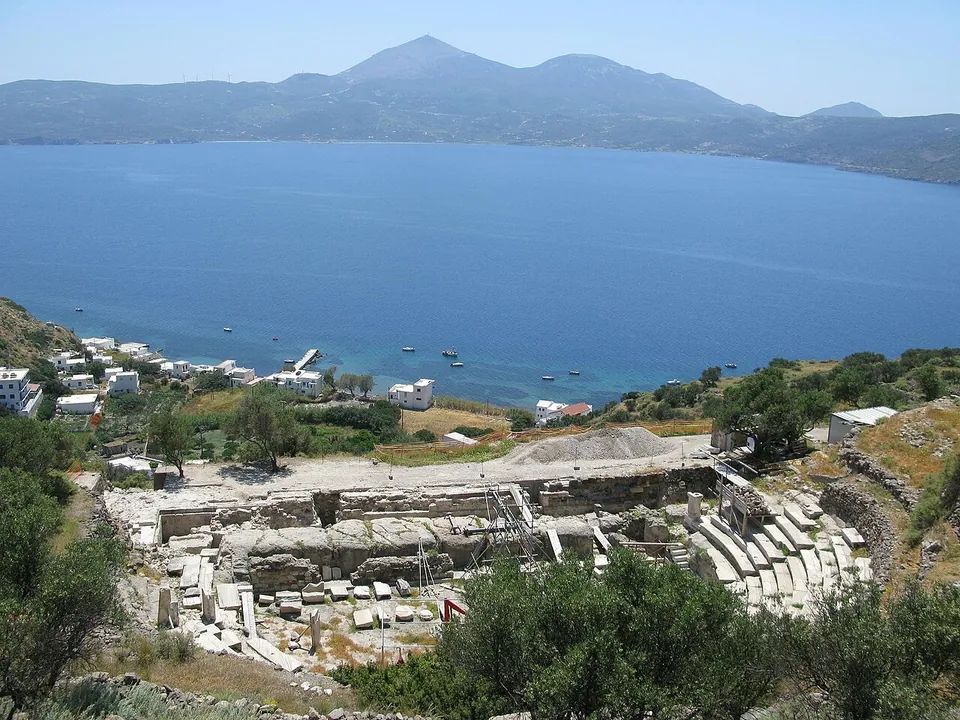


The theatre of ancient Melos is a marble theatre of the Roman period, built between the 1st and 4th centuries AD on the hillside above the ancient harbour, today the village of Klima, looking out over the bay of Milos. Though only part of it has been excavated, the site’s board counts it among the best-preserved ancient theatres in the Cyclades (the site’s board; el.wikipedia).
What is there today
The seating, horseshoe-shaped, is mostly laid on the natural slope of volcanic tufa; its ends rest on strong retaining walls of squared stone blocks with a core of rubble and mortar. The excavated part, the lower rows, seats about 800 people and is thought to be about a tenth of the whole; eight marble stairways divide it into seven sections of marble seats (the site’s board).
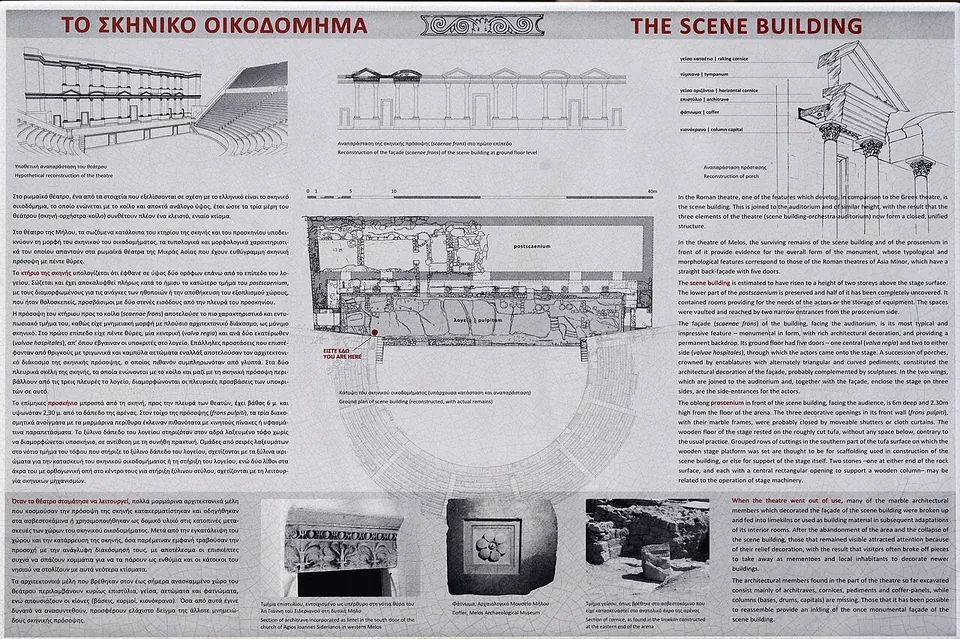
The scene building follows the Roman theatres of Asia Minor, with a straight front pierced by five doors. It is thought to have risen two storeys above the stage, and the lower part of its back rooms is preserved. In front of it, the stage was 6 m deep and stood 2.30 m above the floor of the orchestra, which the plan marks as an arena. Of the rich marble front, with its porches and alternating triangular and curved pediments, mostly architraves, cornices, pediments and coffered panels have been found, but no columns; the pieces that could be put back together give an idea of it (the site’s board).
The theatre reopened to the public in July 2016, after six years of restoration work (Greek Travel Pages).
Is it worth the trip?
Yes, if you are on Milos: a Roman marble theatre on a slope above the bay, with the catacombs about 200 m to the east, so the two make one visit (the site’s board; en.wikipedia, Catacombs of Milos). No operator publishes opening hours or a fee for the theatre, so check locally before making a special trip.
Getting there
The theatre lies on the slope between the villages of Trypiti and Klima (el.wikipedia). An unpaved road passes beside it, two free car parks are mapped about 220 m away, and the bus stop named “Katakombes (Arch. Theatro)”, for the catacombs and the theatre, about 210 m away (OpenStreetMap).
Visiting details
- Tickets
- Unknown
- Parking
- Two free car parks are mapped about 220 m away ("Free Parking Klima", OSM way/1074833739, and "Free Parking Katakombes", way/172558844), and the bus stop "Κατακόμβες (Αρχ. Θέατρο)" about 210 m away (node/2975069942). No operator publishes hours or a fee for the theatre.
History
In the Hellenistic period, from the late 4th to the 1st century BC, the hillside seems to have held a cemetery with underground tomb chambers. The theatre was built there in stages over a long time, probably with changes of design along the way, with the features of the theatres of Rome’s eastern provinces, a type that grew out of the Greek theatre. It went out of use probably in the 4th century, but its buildings served as homes and workshops until the end of the 6th or the beginning of the 7th century. The tombs cut into the wall of the arena belong to that time, and probably also two lime kilns built in the orchestra and the stage, in which much of the marble of the stage front was burned. A piece of the architrave now serves as the lintel of a church door, at Agios Ioannis Siderianos in western Milos. A Jesuit monk passing through recognised the site in 1735 (the site’s board).
Sources
Every fact on this page comes from the records below, each used under the licence noted.
| Source | Licence |
|---|---|
| Pleiades 528335956 | CC BY |
| Wikidata Q38184737 | CC0 |
| OpenStreetMap way/295376331 | ODbL |
| The site's boards "Theatre" and "The scene building", photographed 2023 (Wikimedia Commons) | licence not recorded |
| The site's board "The scene building" (Wikimedia Commons) | licence not recorded |
| Greek Travel Pages — "Ancient Milos Theatre Gets Makeover, Back as a 'Beacon of Culture'", 14 July 2016 | licence not recorded |
| Wikipedia (el) — Αρχαίο θέατρο Μήλου | CC BY-SA 4.0 |
| Wikipedia (en) — Achaia (Roman province) | CC BY-SA 4.0 |
