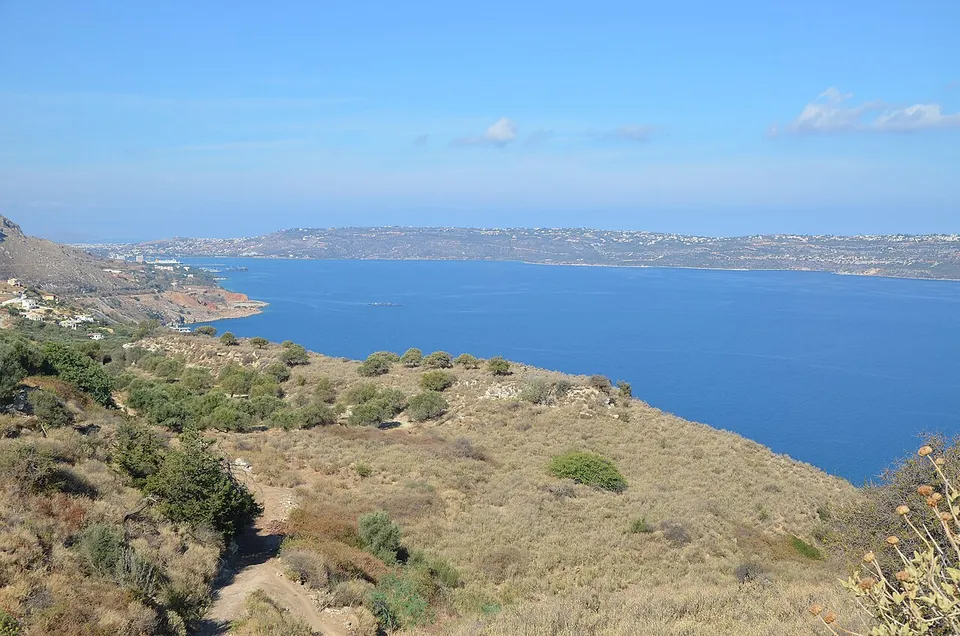
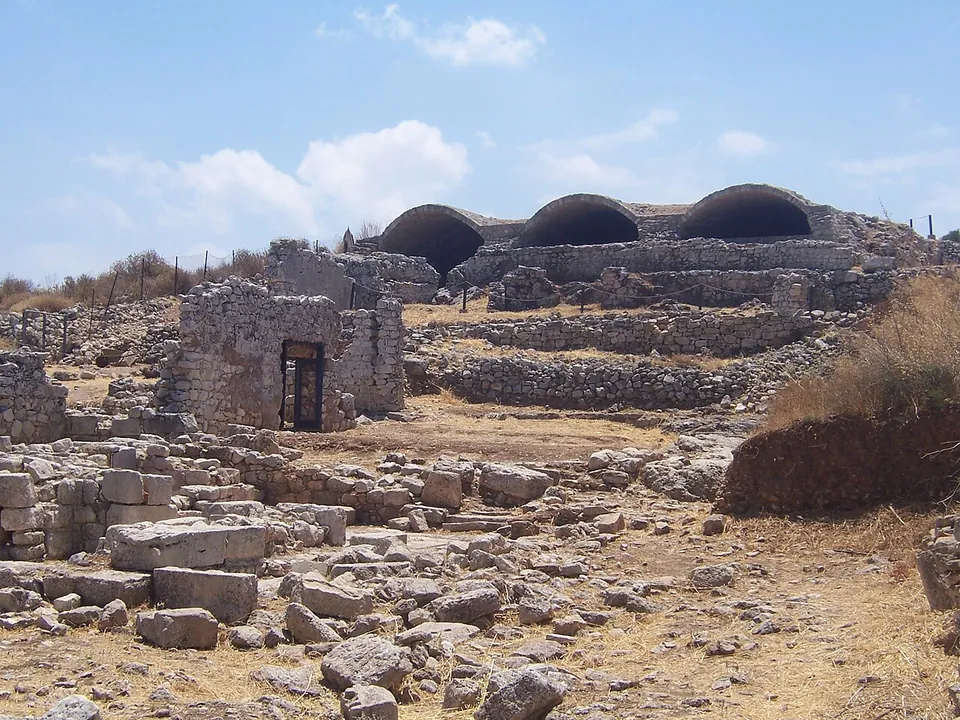
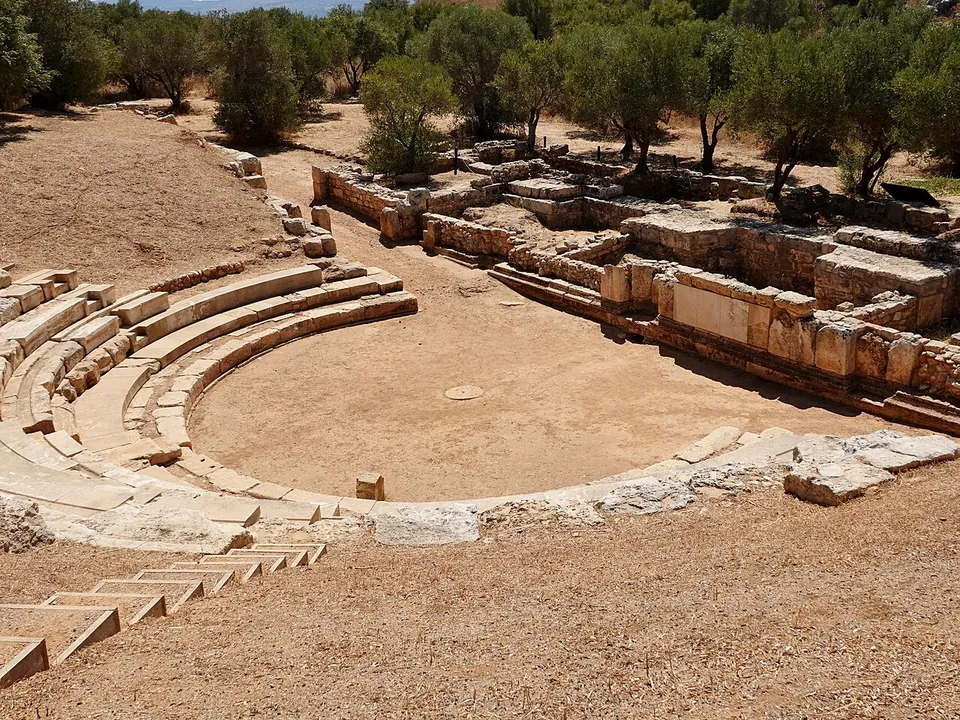
Aptera was one of the powerful city-states of Crete, on a plateau about 150 m above Souda Bay, 13 km east of Chania (en.wikipedia; de.wikipedia). It came under Rome without a fight and prospered again in the 1st and 2nd centuries AD: its great vaulted Roman cisterns are the most imposing thing on the site, with Roman baths, a villa and a theatre around them (el.wikipedia; the operator).
What is there today
The cisterns are the city’s most impressive monuments, and they are Roman, though the earliest may go back to the Hellenistic period. The larger, L-shaped one is 55.80 m long and 25 m wide and held about 3,050 m³ of water; its vaulted roof is gone. The second has three compartments under three vaults, partly cut into the rock, and held about 2,900 m³; after the city was abandoned the monks used it, probably as a granary. Both were fed through openings in their roofs and from smaller cisterns round the city, and they supplied mainly the bath buildings just to the north (el.wikipedia).
The baths were built in the early 1st century, and unusually for their time no mosaic was found in them (el.wikipedia).
The villa with peristyle, partly excavated, is a house of the late 1st century BC or early 1st century AD built round a colonnaded courtyard with Doric columns, probably destroyed by the earthquake of 364–365. A small statue of Aphrodite, a marble bust of Hermes, coins and everyday pottery were found in its courtyard (el.wikipedia).
The theatre, in a hollow on the south-east of the site, is about 55 m across with an orchestra of 18 m and seats cut in stone; it is in poor condition because it was quarried for building stone in the 19th century (el.wikipedia). De.wikipedia calls it Roman and notes that the orchestra and parts of the seating survive.
Elsewhere on the plateau are a two-part temple of the 5th century BC, parts of Doric temples, stretches of the city wall of the 3rd century BC, and the monastery of St John the Theologian, founded by the 12th century and in use until 1964 (en.wikipedia; de.wikipedia). A Turkish fort of 1867 on the eastern edge looks out over Souda Bay (de.wikipedia).
Is it worth the trip?
Yes, if you are near Chania. The Roman cisterns are the most imposing monuments of the city (el.wikipedia), the view over Souda Bay with the White Mountains behind is part of the visit (en.wikipedia), and it is only 25 minutes’ drive from Chania (the operator). A ticket is €10; it is closed on Tuesdays (the operator).
Getting there
The site is on the plateau above the village of Megala Chorafia, near Souda, 25 minutes by car from Chania (the operator; de.wikipedia). Free car parks for visitors are mapped near the cisterns (OpenStreetMap), and the operator lists parking at the site.
It opens daily except Tuesday, 08.00–20.00 from 1 April to 31 August, closing earlier through September and October (18.00 by the second half of October), and 08.30–15.30 from 1 November to 31 March. Last entry is 20 minutes before closing; it is shut on 1 January, 25 March, 1 May, Easter Sunday and 25–26 December. A ticket is €10, reduced €5, and entry is free on 6 March, 18 April, 18 May, the last weekend of September, 28 October, and on the first and third Sunday of each month from November to March (hh.gr, read 9 October 2026 — check before travelling). There are toilets and parking (the operator).
Visiting details
- Opening hours
- Daily except Tuesday, 08.00–20.00 from 1 April to 31 August, then closing earlier through the autumn (19.30 in early September, 18.00 by late October); 08.30–15.30 from 1 November to 31 March. Last entry 20 minutes before closing. Closed 1 January, 25 March, 1 May, Easter Sunday and 25–26 December.
- Tickets
- €10; reduced €5. Free on 6 March, 18 April, 18 May, the last weekend of September and 28 October, and on the first and third Sunday of each month from November to March.
- Parking
- Free car parks for visitors are mapped about 120 m and 210 m from the point (OSM way/1205970340, way/1205970339, fee=no).
Hours and prices checked 9 October 2026 on the operator's own site. Confirm before travelling.
History
Aptera is named on Linear B tablets of the 14th–13th centuries BC, and myth placed here the contest in which the Muses beat the Sirens, who lost their wing feathers: the name means “without wings” (en.wikipedia). The city-state was powerful into Hellenistic times, when it began to decline, and was drawn into the Cretan wars of the 3rd century BC (en.wikipedia; de.wikipedia).
When Metellus conquered Crete between 67 and 63 BC, Aptera surrendered without a fight, as Kydonia did, and the Romans rewarded it with low taxes. Its decline had begun before Rome came, as it fell under Kydonia’s influence, but excavation shows a new flowering in the 1st and 2nd centuries AD, when the great cisterns were built for a large population. Under Rome old cults went on and new ones appeared: a Roman-period statue of Dionysus, statues of Aphrodite and Hermes in the villa, and the worship of Isis, which certainly grew in the Roman period. A small temple of Demeter and Persephone was found in 1958 (el.wikipedia; de.wikipedia dates it to the early 1st century BC).
En.wikipedia has the city destroyed by an earthquake in the 7th century; de.wikipedia has it destroyed and plundered by the Saracens in 824 (published accounts differ). By the 12th century a monastery stood on the site (en.wikipedia).
Nearby
41 km · site · Chania
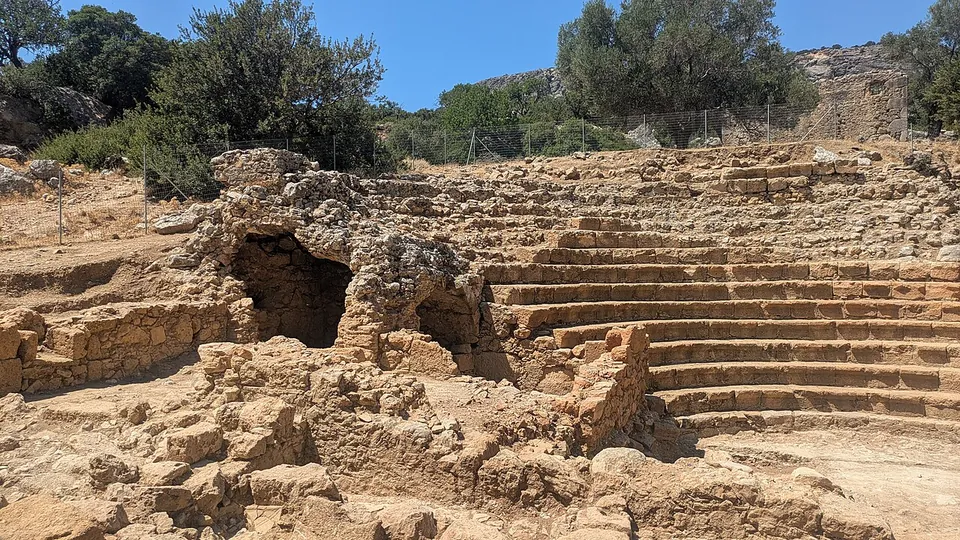
Lissos
The sanctuary of Asklepios, which you reach first on the path from Sougia, stands on a terrace against the rock.


Straight-line distances.
Sources
Every fact on this page comes from the records below, each used under the licence noted.
| Source | Licence |
|---|---|
| Pleiades 589704 | CC BY |
| Wikidata Q622234 | CC0 |
| OpenStreetMap way/27225814 | ODbL |
| Hellenic Heritage (H.O.C.R.E.D., for the Ministry of Culture) — Aptera, hours and tickets | licence not recorded |
| Wikipedia (el) — Άπτερα | CC BY-SA 4.0 |
| Wikipedia (de) — Aptera | CC BY-SA 4.0 |
| Wikipedia (en) — Aptera (Greece) | CC BY-SA 4.0 |
| Wikipedia (en) — Crete and Cyrenaica | CC BY-SA 4.0 |