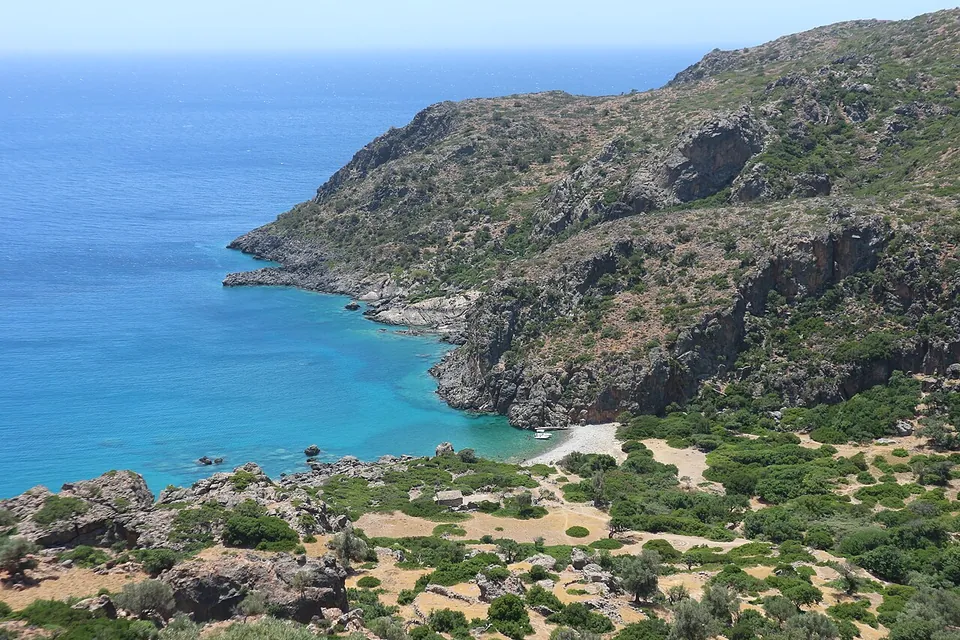
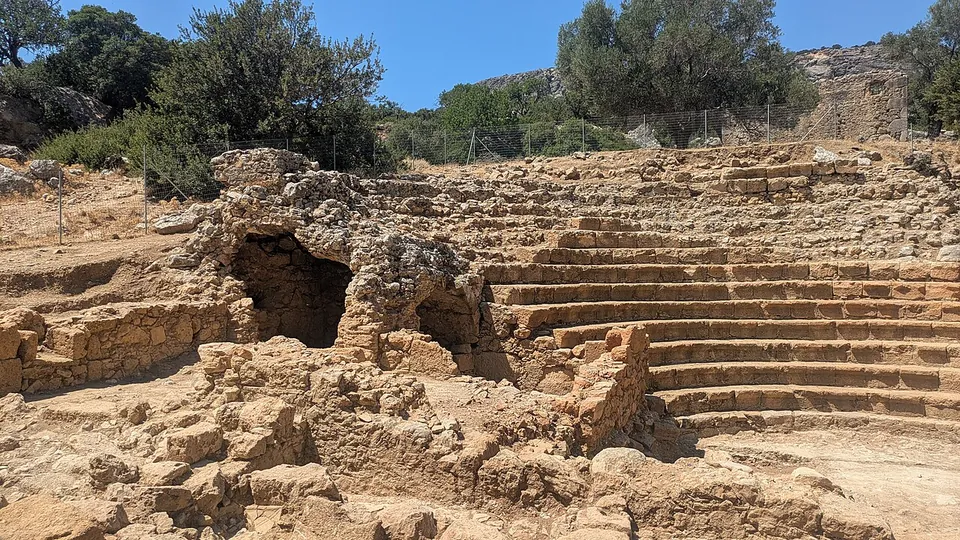
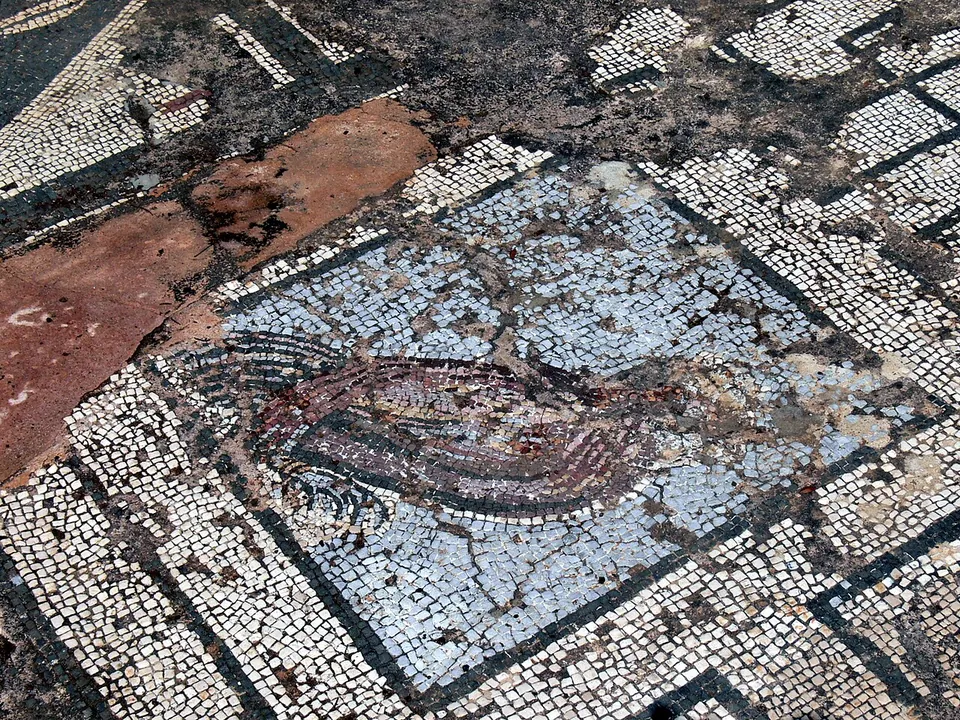


Lissos was a harbour town and healing sanctuary in a remote bay on the south-west coast of Crete, which you can reach only on foot or by boat. Under Rome it was a popular healing spa (de.wikipedia). A visit takes in the temple of Asklepios with the mosaic floor laid in Roman times, a small theatre of the 1st century uncovered in 2022–23, the foundations of Roman baths, and a hillside of vaulted tomb houses (de.wikipedia; en.wikipedia).
What is there today
The sanctuary of Asklepios, which you reach first on the path from Sougia, stands on a terrace against the rock. Its temple of the 3rd century BC, about 6.5 × 11 m, was remodelled in Roman times, probably in the 1st century, and the mosaic floor of about 5 × 6 m laid then is still in place. The base of the cult statue survives, and the sacred spring still rises beneath the temple. West of it are the foundations of the priests’ houses and of lodgings for pilgrims (de.wikipedia).
The theatre, about 45 m south of the church of Agios Kirykos, dates from the 1st century. With a diameter of 23.4 m and 14 rows of seats over a vaulted passage, it is small enough that it may have been an odeon or a council house rather than a theatre. It was excavated in 2022–23 (de.wikipedia; en.wikipedia).
The town. West of the theatre stands the best-preserved building of the Greek and Roman town, the so-called “Tower”, and a little east of the theatre lie the foundations of baths. Down by the shore, the coast has risen by about 6.7 m since antiquity. The old harbour basin is now dry land, and a 25 m length of its pier lies some 90 m from the beach (de.wikipedia).
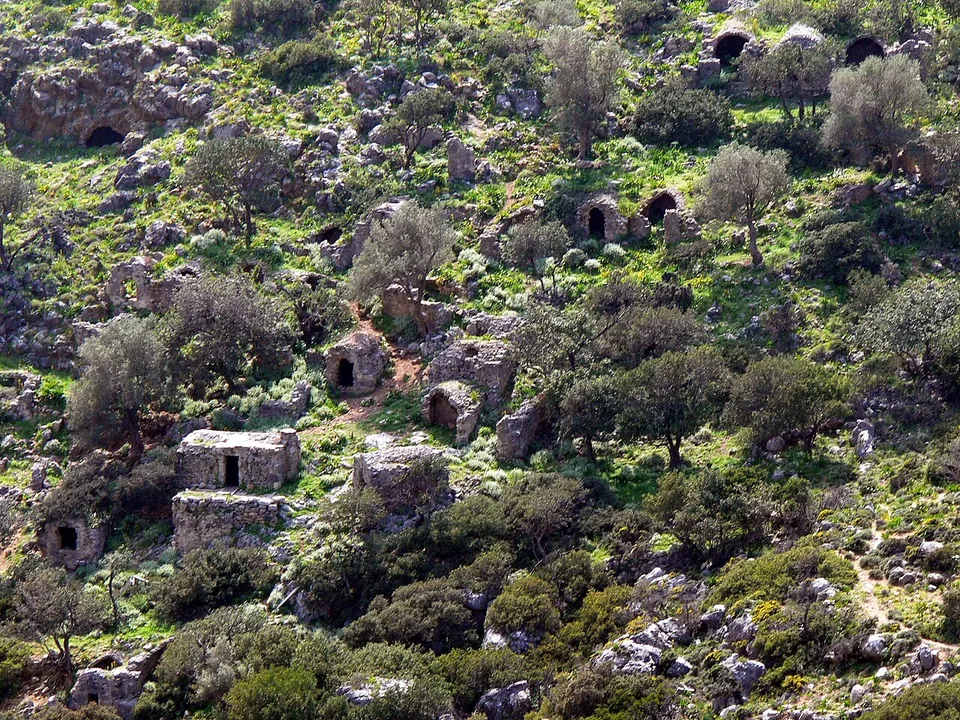
The cemetery on the western slope holds 118 tomb houses: small barrel-vaulted buildings, most about 1.5 × 2 m, three of them two storeys high (de.wikipedia). en.wikipedia calls it the Roman necropolis.
The churches. The 14th-century church of Agios Kirykos, painted with frescoes, was built over a three-aisled basilica of the 6th century, and part of the basilica’s mosaic floor can be seen outside its side door. The church of the Panagia, by the shore, also stands on an early Byzantine basilica, partly preserved, and has a sarcophagus lid with a Medusa head built into its wall (de.wikipedia).
Is it worth the trip?
Yes, if you like walking. It is 1.5 hours on foot each way from Sougia, and it shows a Cretan healing sanctuary in its own valley, with its Roman mosaic floor in place, a theatre only recently uncovered and a hillside of tomb houses (de.wikipedia; en.wikipedia). Nobody lives there now, and the beach is coarse pebbles (en.wikipedia), so bring what you need for the day.
Getting there
No road reaches Lissos. From the harbour of Sougia it is about 1.5 hours on foot, the first part through the Lissos gorge, and from Paleochora about 3 hours on the E4 long-distance path. In the summer half of the year boat trips run from both villages (de.wikipedia). No operator publishes opening hours or a fee for the site.
Visiting details
- Tickets
- Unknown
- Parking
- No road reaches the bay. Walk about 1.5 hours from the harbour of Sougia, the first part through the Lissos gorge, or about 3 hours from Paleochora on the E4 long-distance path; in the summer half of the year boat trips run from both (de.wikipedia). Boats land at the bay (OSM node/9164316050), and a spring is mapped at the site (node/2397610379). No operator publishes hours or a fee.
History
Lissos was settled from Classical times, and it struck its own coins, and around 300 BC it joined its neighbours in a league, the Oreioi, which made a treaty with Magas, king of Cyrene (de.wikipedia; en.wikipedia). In Roman times people came to take the cure (de.wikipedia). A boulder falling from the cliff, probably in the great earthquake of 21 July 365, destroyed the temple of Asklepios and buried fragments of 40 statues. Among them were the cult statues of Asklepios and Hygieia, now in the Archaeological Museum of Chania. In Christian times Lissos was the seat of a bishop, and two basilicas were built there in the 5th or 6th century. The temple was excavated by Nikolaos Platon from 1957 (de.wikipedia).
More photographs

Nearby
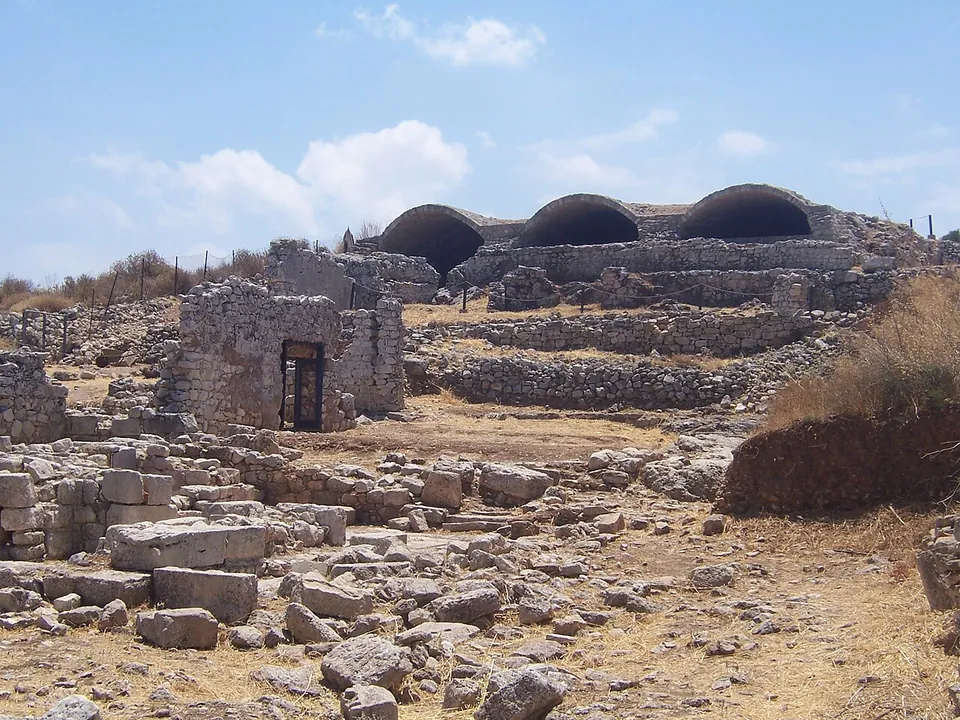
Photo: Aeleftherios · CC BY-SA 3.0 · Commons
41 km · city · Chania
Aptera
The cisterns are the city's most impressive monuments, and they are Roman, though the earliest may go back to the Hellenistic period.

Straight-line distances.
Sources
Every fact on this page comes from the records below, each used under the licence noted.
| Source | Licence |
|---|---|
| Pleiades 589914 | CC BY |
| Wikidata Q266558 | CC0 |
| OpenStreetMap node/312517594 | ODbL |
| Wikipedia (de) — Lisos (Kreta) | CC BY-SA 4.0 |
| Wikipedia (en) — Lissus (Crete) | CC BY-SA 4.0 |
| Wikipedia (el) — Λισσός | CC BY-SA 4.0 |
| Wikipedia (en) — Crete and Cyrenaica | CC BY-SA 4.0 |