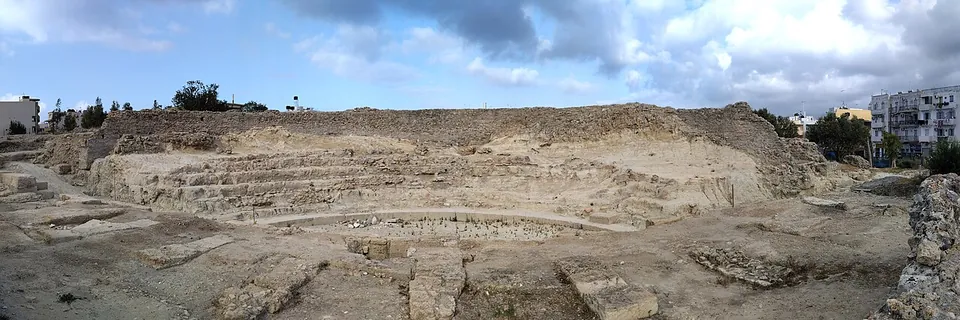
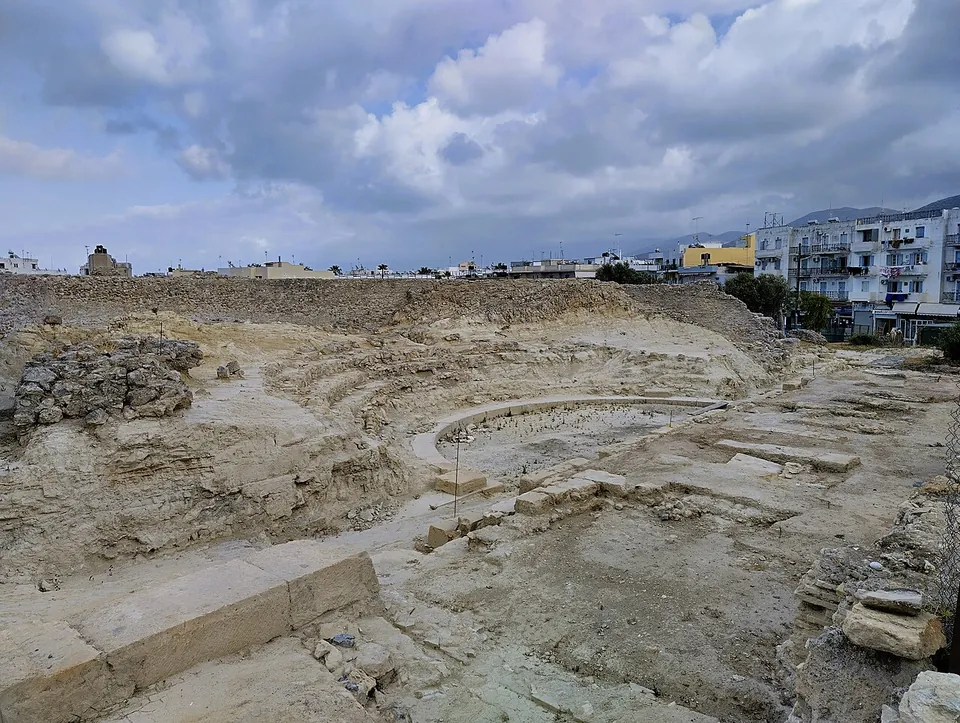


The Roman theatre of Hersonissos was built in the 1st century AD and stands at the edge of the resort town of Limenas Chersonissou, on the side towards Heraklion. The resort grew over the ancient harbour town of Chersonasos (Diazoma; en.wikipedia). After years of excavation and restoration, it opened to the public for the first time with a performance on 29 August 2026 (the Municipality of Hersonissos).
What is there today
The excavation has uncovered the tiers of seats curving round the orchestra, and the remains of the stage building in front of them (the photographs of 2024). Diazoma names the retaining wall of the seating as the main surviving element: stones and concrete faced with square bricks, about 3 m high, propped by at least ten buttresses and pillars.
The theatre was built with a stage front 43 m long, plain, with a central doorway, small semicircular niches and half-columns. Its colonnaded portico had rounded ends and measured 83 by 30 m (Diazoma; the Municipality).
More of the ancient town survives around the harbour. On the seaside street stands a pyramid-shaped Roman fountain with mosaics of fishing scenes, and traces of the Roman harbour, mostly under water, can be seen in places. On the hill behind the port are the ruins of an early Christian basilica with floor mosaics (en.wikipedia).
Is it worth the trip?
Yes, if you are staying on the coast east of Heraklion: it is a Roman theatre newly opened in a resort town, with more Roman and early Christian remains around the harbour (the Municipality; en.wikipedia). It opened only in late August 2026 and no operator yet publishes when it can be visited, so check locally before you go.
Getting there
The theatre is at the edge of Limenas Chersonissou, on the side towards Heraklion (Diazoma), about 25 km east of Heraklion (en.wikipedia). Free car parks are mapped about 120 m away and bus stops about 150 m away (OpenStreetMap). No operator publishes opening hours or a fee.
Visiting details
- Tickets
- Unknown
- Parking
- At the edge of Limenas Chersonissou, on the side towards Heraklion (diazoma.gr). Free car parks are mapped about 120 m away (OSM way/362236092, fee=no) and bus stops about 150 m away (node/975329738). No operator publishes hours or a fee.
History
Chersonasos was the harbour of Lyttos and had a temple of Britomartis (en.wikipedia). Under Rome it had a harbour with piers and covered ship sheds, fountains with mosaics, water brought by an aqueduct from Lyttos, and a theatre (el.wikipedia). It became a bishopric early, in the province of Creta et Cyrenaica (en.wikipedia). Onorio Belli left a drawing of the theatre almost intact as it stood in his day (the Municipality). The site was cleaned and trial trenches were dug in 1995, the 1.6 ha site was expropriated in 2004, a geophysical survey followed in 2008, and the restoration began in July 2021 (Diazoma; the Municipality).
Nearby
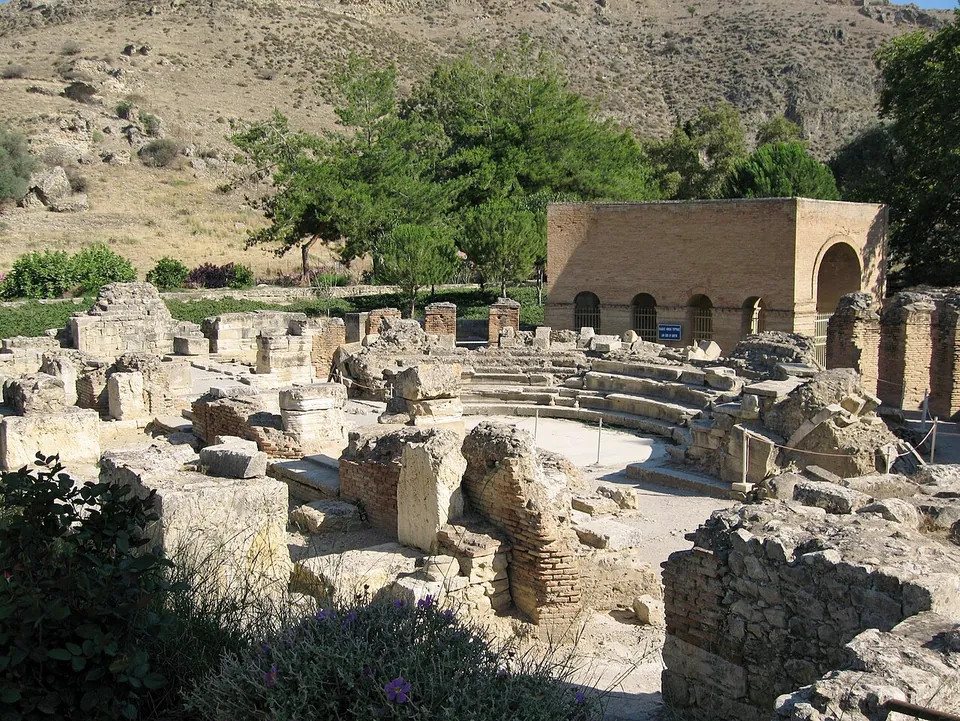
Photo: Olaf Tausch · CC BY-SA 3.0 · Commons
49 km · city · Heraklion
Gortyn
The odeon, by the entrance, is Roman, of the 1st century AD (Pleiades); en.wikipedia attributes it to Trajan.

Straight-line distances.
Sources
Every fact on this page comes from the records below, each used under the licence noted.
| Source | Licence |
|---|---|
| Wikidata Q38381071 | CC0 |
| OpenStreetMap node/9223149055 | ODbL |
| Diazoma — Roman theatre of Hersonissos | licence not recorded |
| Municipality of Hersonissos — "THRAYSMATA: Euripides" at the Ancient Theatre of Hersonissos (press release, August 2026) | licence not recorded |
| Municipality of Hersonissos — The Roman theatre | licence not recorded |
| Wikipedia (en) — Hersonissos | CC BY-SA 4.0 |
| Wikipedia (en) — Chersonasus | CC BY-SA 4.0 |
| Wikipedia (el) — Χερσόνησος Ηρακλείου | CC BY-SA 4.0 |
| Wikipedia (en) — Crete and Cyrenaica | CC BY-SA 4.0 |