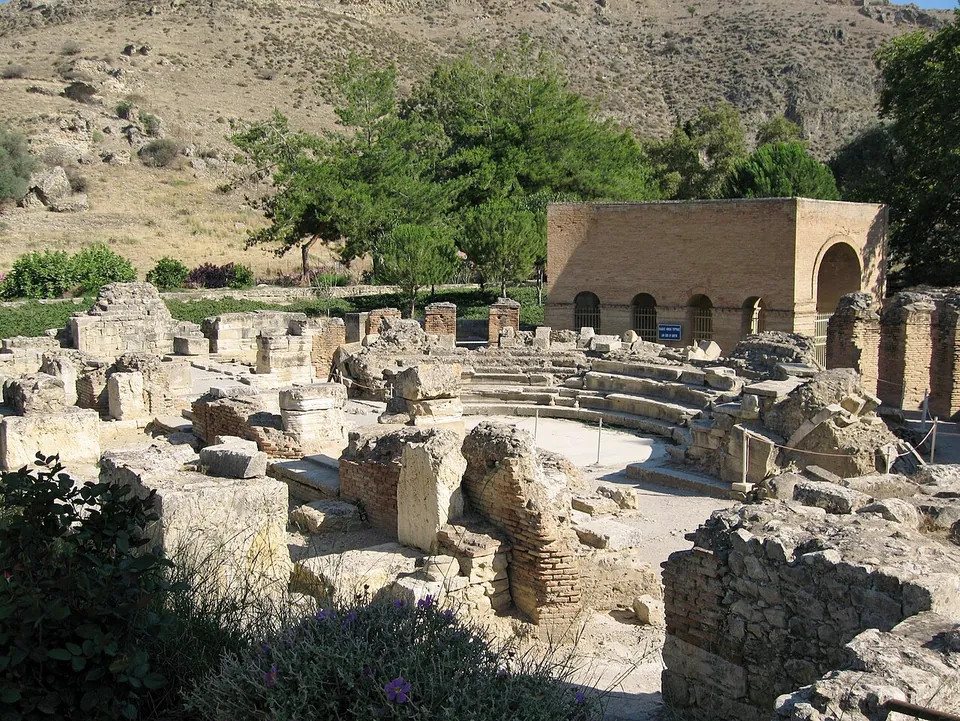
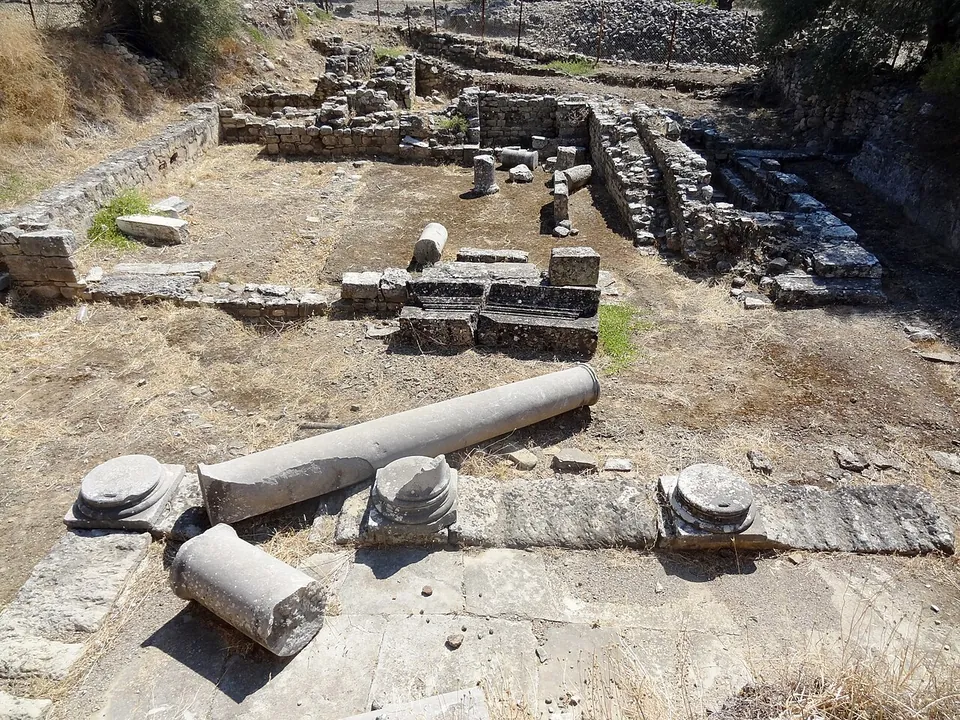
Gortyn was the Roman capital of Crete and Cyrenaica, a province that also took in the region of Cyrenaica in today’s Libya (en.wikipedia; the operator). In the valley of the Messara you walk among the Roman governor’s seat, a Roman odeon, a temple of the Egyptian gods and the great early Christian church of Saint Titus, and see the Gortyn Law Code, the oldest law code in Europe, built into the odeon’s wall (the operator).
What is there today
The odeon, by the entrance, is Roman, of the 1st century AD (Pleiades); en.wikipedia attributes it to Trajan. Built into it are the stones of the Great Inscription, the civil law of Gortyn carved in the Doric dialect around 450 BC, which the operator calls the oldest and most complete legislative code in Europe. The stones had been reused twice, first in a Hellenistic building and then in the Roman odeon, and a modern shelter now protects them (en.wikipedia; the operator).
The Praetorium, the seat of the Roman governor of Crete, is the heart of Roman Gortyn. It was built in the 1st century AD and much altered over the next eight centuries (en.wikipedia; Pleiades); the operator dates it to the 2nd century. Around it, between the agora and the temple of Pythian Apollo, lie the Roman baths, an honorary arch and the sanctuary of the Egyptian gods, with cult statues of Isis, Serapis and Anubis (en.wikipedia). The operator dates the sanctuary to the 1st–2nd century AD and notes it is the only one in Crete.
A Roman theatre of the 2nd century lies about 900 m away (Pleiades); en.wikipedia describes it with two entrances and a semicircular orchestra whose outline can still be traced.
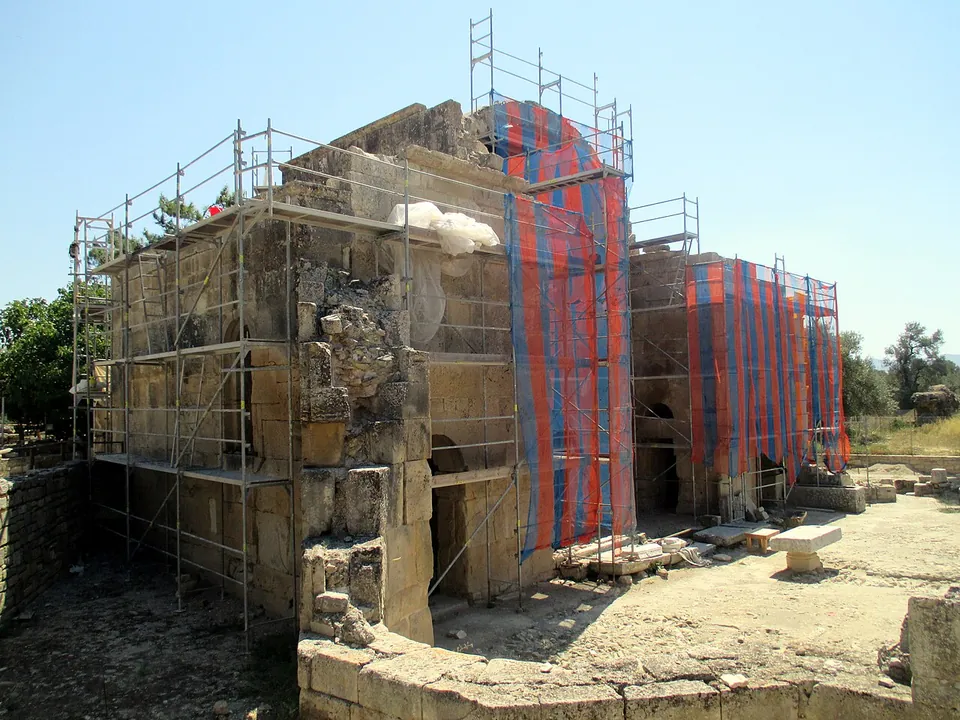
The basilica of Saint Titus, the first bishop of Crete, was built in the 6th century with large squared stones on a cross plan with a dome on four pillars; it stands to its full height only around the sanctuary (en.wikipedia), and in 2015 it was under scaffolding (the photograph).
Is it worth the trip?
Yes. This was Rome’s capital for Crete and Cyrenaica, and the governor’s seat, the odeon, the temples and the baths are on view, with the Law Code and the basilica of Saint Titus as further reasons to come (the operator; en.wikipedia). It is 50 minutes by car from Heraklion, and a ticket is €10 (the operator).
Getting there
The site is at Ampelouzos near Agioi Deka, 50 minutes by car or about an hour by intercity bus from Heraklion (the operator). The bus stops at “Gortys”, about 190 m from the entrance, and a free car park is mapped about 220 m away (OpenStreetMap).
It opens daily, 08.00–20.00 from 1 April to 31 August, closing earlier through September and October (18.00 by the second half of October), and 08.30–15.30 from 1 November to 31 March. Last entry is 20 minutes before closing; it is shut on 1 January, 25 March, 1 May, Easter Sunday and 25–26 December. A ticket is €10, reduced €5, and entry is free on 6 March, 18 April, 18 May, the last weekend of September, 28 October, and on the first and third Sunday of each month from November to March (hh.gr, read 9 October 2026 — check before travelling). There is a café, a shop and toilets (the operator).
Visiting details
- Opening hours
- Daily, 08.00–20.00 from 1 April to 31 August, then closing earlier through the autumn (19.30 in early September, 18.00 by late October); 08.30–15.30 from 1 November to 31 March. Last entry 20 minutes before closing. Closed 1 January, 25 March, 1 May, Easter Sunday and 25–26 December.
- Tickets
- €10; reduced €5. Free on 6 March, 18 April, 18 May, the last weekend of September and 28 October, and on the first and third Sunday of each month from November to March.
- Parking
- A free car park for visitors, about 50 places, is mapped about 220 m from the odeon (OSM way/377174257, fee=no); the intercity bus stops at "Gortys", about 190 m away (node/5178668625).
Hours and prices checked 9 October 2026 on the operator's own site. Confirm before travelling.
History
Gortyn was inhabited from the Neolithic, and in the Hellenistic period it became the most powerful city of Crete (en.wikipedia). Allied with Rome, it escaped the destruction that Quintus Caecilius Metellus brought to other Cretan cities in 68 BC, rose under Roman rule to be capital of the joint province of Crete and Cyrenaica, and from the 4th century was capital of a separate province of Crete. Arab invaders destroyed it around 828 (en.wikipedia). Italian archaeologists began excavating in 1884, the year the Law Code was found (en.wikipedia).
Nearby
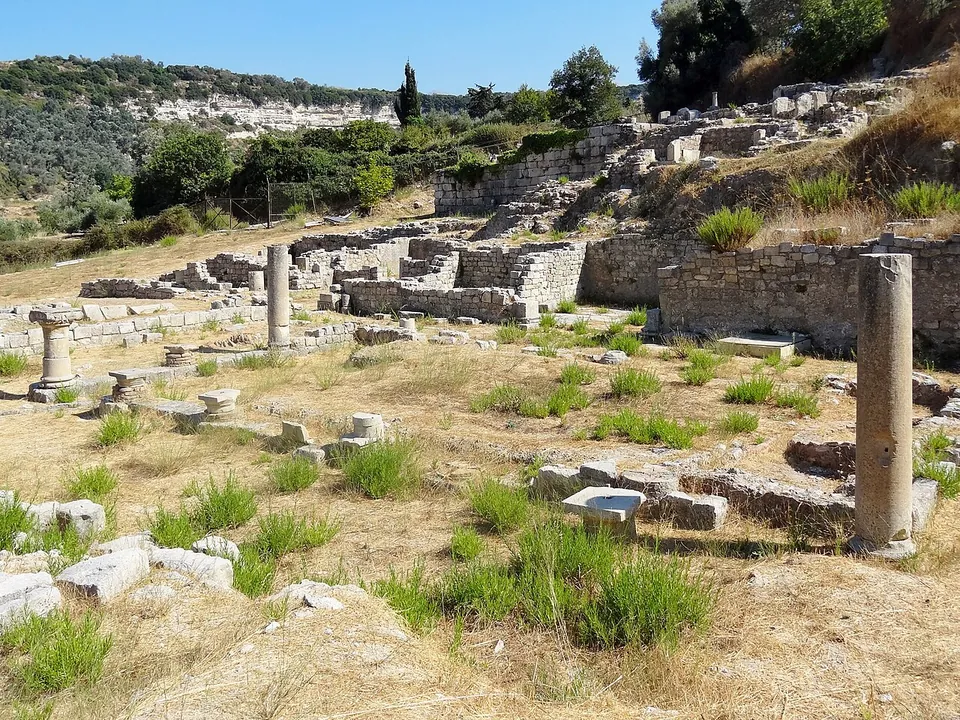
Photo: Olaf Tausch · CC BY 3.0 · Commons
39 km · city · Rethymno
Eleutherna
The city spread over two main hills, Prines and Nisi, and the excavated areas are linked by the paths of the "Eleuthernian Grove", with resting places and signs in Greek and English (the museum).
49 km · theatre · Heraklion
Roman Theatre of Hersonissos
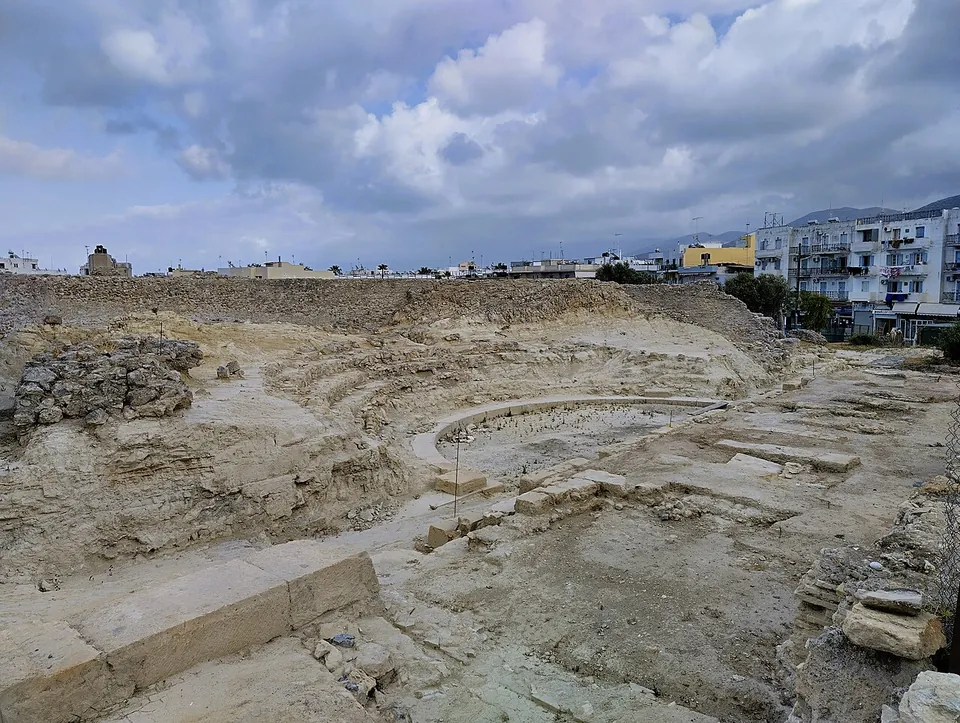
The excavation has uncovered the tiers of seats curving round the orchestra, and the remains of the stage building in front of them (the photographs of 2024).


Straight-line distances.
Sources
Every fact on this page comes from the records below, each used under the licence noted.
| Source | Licence |
|---|---|
| Pleiades 589796 | CC BY |
| Wikidata Q1136193 | CC0 |
| OpenStreetMap relation/2376972 | ODbL |
| Hellenic Heritage (H.O.C.R.E.D., for the Ministry of Culture) — Gortys, hours and tickets | licence not recorded |
| Wikipedia (en) — Gortyn | CC BY-SA 4.0 |
| Wikipedia (de) — Gortyn | CC BY-SA 4.0 |
| Wikipedia (en) — Crete and Cyrenaica | CC BY-SA 4.0 |