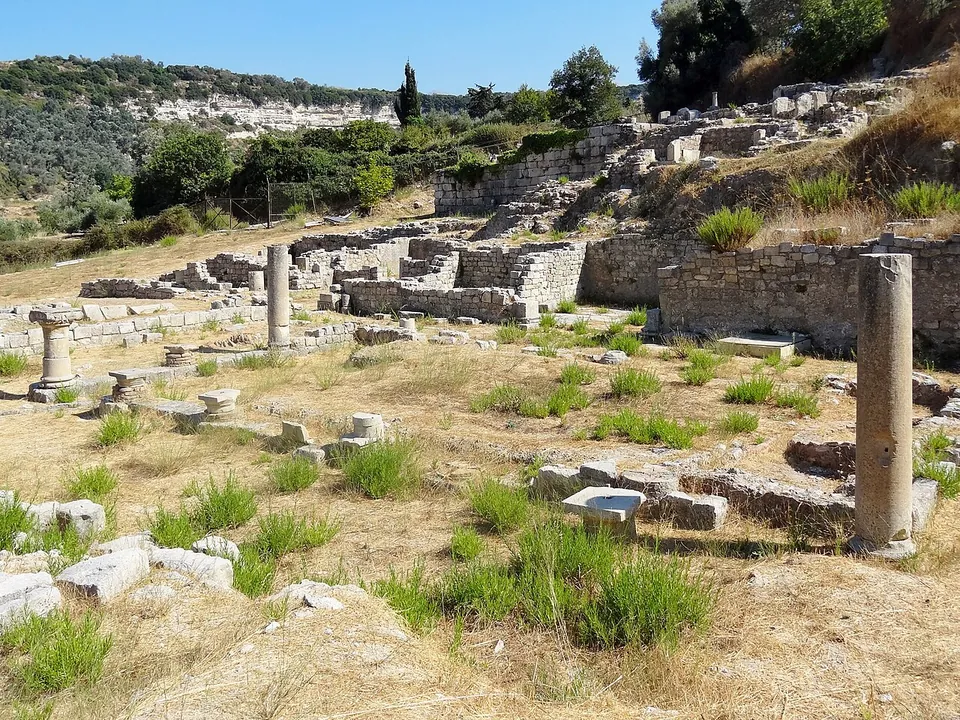


Eleutherna was a city-state on a spur of Mount Ida in central Crete. Rome took it in 67 BC, by treachery after a siege, and under the empire it prospered, with villas, baths and public buildings, until the catastrophic earthquake of 365 (de.wikipedia; en.wikipedia; el.wikipedia). Today it is an archaeological park of footpaths linking the excavated areas over several hills, with a modern museum nearby (the museum).
What is there today
The city spread over two main hills, Prines and Nisi, and the excavated areas are linked by the paths of the “Eleuthernian Grove”, with resting places and signs in Greek and English (the museum).
Katsivelos, at the eastern foot of Prines hill, is where the Roman city has been uncovered. Excavators found Hellenistic retaining walls; Roman buildings, among them three houses destroyed by the earthquake of AD 365 and a bath house with two furnaces; a stone-paved street; and a large public building, probably Hellenistic but still in use in the 1st and 2nd centuries AD. Over a Hellenistic cemetery stands a Christian basilica dedicated to the Archangel Michael, built in AD 420–450 and destroyed in the 7th century, now under a stepped shelter (the museum). It had three aisles and rich mosaic decoration (el.wikipedia).
Pyrgi, the northern height of Prines hill, was the city’s centre throughout its history, with buildings from the Late Bronze Age to Byzantine times, among them Roman and late Roman ones (the museum). Under Rome a bath house and an aqueduct were built here (en.wikipedia). Part of a fortification tower stands on top, with two vast rock-cut water cisterns below it (the museum).
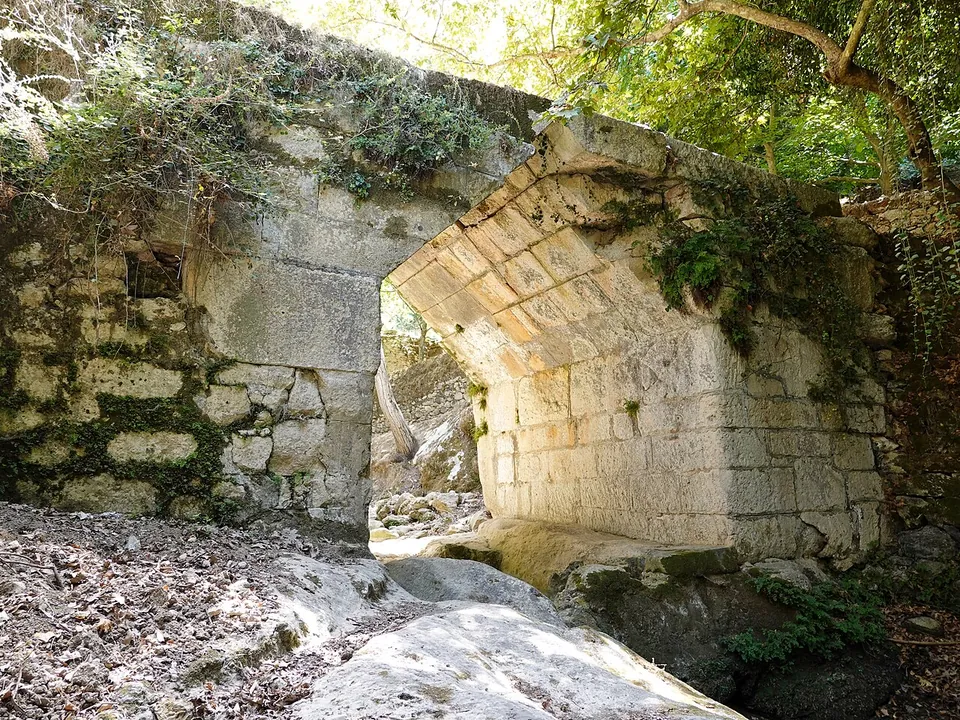
Orthi Petra, on the west slope, is the cemetery that made Eleutherna famous, used from the 9th to the 7th century BC and now under a curved shelter; part of it lies beneath houses and streets of the Hellenistic and Roman city (the museum). Further out are a large limestone quarry, mostly Roman cemeteries below it, and an ancient stone bridge north of Prines hill (the museum).
Is it worth the trip?
Yes, if you like your ruins in a landscape: this is a walk through olive groves and ravines between excavated sectors, not a single monument, and the museum (opened in 2016) holds the finds (the museum; en.wikipedia). For Rome specifically, the Roman houses and bath house at Katsivelos and the late Roman basilica beside them are the core; the city’s famous discoveries, at Orthi Petra, are Greek and centuries older. Check what is open before you go (see the warning above).
Getting there
Eleutherna is about 30 minutes by car from Rethymno (the operator). The site lies about 1 km south of the modern village of Eleftherna, on the hill by the village of Archaia Eleutherna (en.wikipedia; the museum), and paths lead from it to the museum (the museum). The operator lists parking at the museum.
The museum opens daily except Tuesday, 10.00–18.00 from April to October and 08.30–15.30 from November to March. Tickets are €10 for the archaeological site and €10 for the museum, reduced €5 each; entry is free on 6 March, 18 April, 18 May, the last weekend of September, 28 October, and on the first and third Sunday of each month from November to March (hh.gr, read 9 October 2026 — check before travelling). The museum’s own website gives lower prices and says the Orthi Petra cemetery is closed in winter and “temporarily closed” now.
Visiting details
- Opening hours
- The museum: daily except Tuesday, 10.00–18.00 from 1 April to 31 October and 08.30–15.30 from 1 November to 31 March; last entry 20 minutes before closing. Closed 1 January, 25 March, 1 May, Easter Sunday and 25–26 December. The operator publishes no separate hours for the archaeological site.
- Tickets
- Archaeological site €10, reduced €5; museum €10, reduced €5. Free on 6 March, 18 April, 18 May, the last weekend of September and 28 October, and on the first and third Sunday of each month from November to March.
- Parking
- The operator lists parking at the museum; none is mapped in OpenStreetMap near the site.
Before you go
- The museum's own website says the Orthi Petra cemetery is closed to the public in winter, usually open in summer, and "temporarily closed" (read 9 October 2026). Ask at the museum before walking out to it.
Hours and prices checked 9 October 2026 on the operator's own site. Confirm before travelling.
History
Dorians settled the steep ridge in the 9th century BC, at a crossroads between Kydonia and Knossos and between the coast and the great cave sanctuary on Mount Ida (en.wikipedia; el.wikipedia). In 220 BC Eleutherna set off the Lyttian War by accusing the Rhodians of murdering its leader Timarchus (en.wikipedia).
When Rome conquered Crete in 68/67 BC, Quintus Caecilius Metellus took the city by deceit: according to Cassius Dio, some of its own residents soaked a brick tower that had held out against him with vinegar at night, making it brittle, and Metellus then extorted large sums from the inhabitants (en.wikipedia; de.wikipedia). Under Roman rule Hellenistic buildings were probably levelled for new building programmes, an inscription of AD 4–6 honours Agrippa Postumus, and villas, baths and public buildings show a prosperous city through the imperial period, until the earthquake of 365 (en.wikipedia; el.wikipedia).
Eleutherna became the seat of a bishop, and a basilica was built under bishop Euphratas: in AD 420–450 by the excavators’ dating, though en.wikipedia places his basilica in the mid-7th century (the museum; de.wikipedia; en.wikipedia). Arab raids in the 8th century and another earthquake in 796 led to the city’s abandonment (en.wikipedia; el.wikipedia). The University of Crete has excavated the site systematically since the mid-1980s (en.wikipedia; el.wikipedia).
Nearby
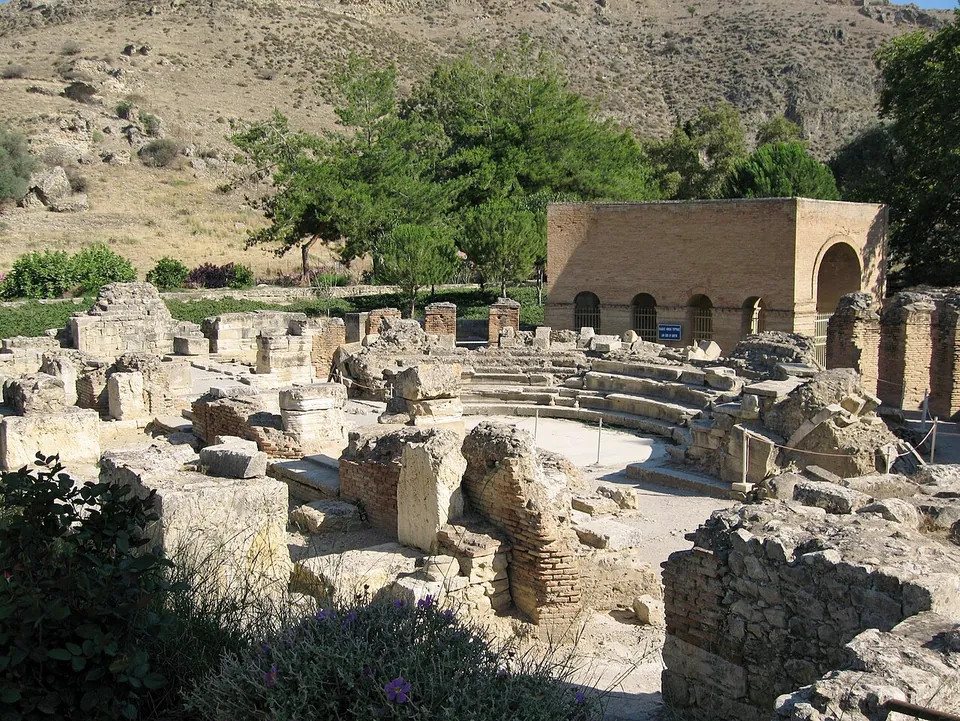
Photo: Olaf Tausch · CC BY-SA 3.0 · Commons
39 km · city · Heraklion
Gortyn
The odeon, by the entrance, is Roman, of the 1st century AD (Pleiades); en.wikipedia attributes it to Trajan.

Straight-line distances.
Sources
Every fact on this page comes from the records below, each used under the licence noted.
| Source | Licence |
|---|---|
| Pleiades 589772 | CC BY |
| Wikidata Q1328347 | CC0 |
| Vici.org 2941 | CC BY-SA (text), CC0 (metadata) |
| OpenStreetMap way/351716711 | ODbL |
| Museum of Ancient Eleutherna (University of Crete) — Archaeological site | licence not recorded |
| Museum of Ancient Eleutherna — Contact and opening times | licence not recorded |
| Hellenic Heritage (H.O.C.R.E.D., for the Ministry of Culture) — Museum of Ancient Eleutherna, hours and tickets | licence not recorded |
| Wikipedia (en) — Eleutherna | CC BY-SA 4.0 |
| Wikipedia (el) — Αρχαία Ελεύθερνα | CC BY-SA 4.0 |
| Wikipedia (de) — Eleutherna | CC BY-SA 4.0 |
| Wikipedia (en) — Crete and Cyrenaica | CC BY-SA 4.0 |