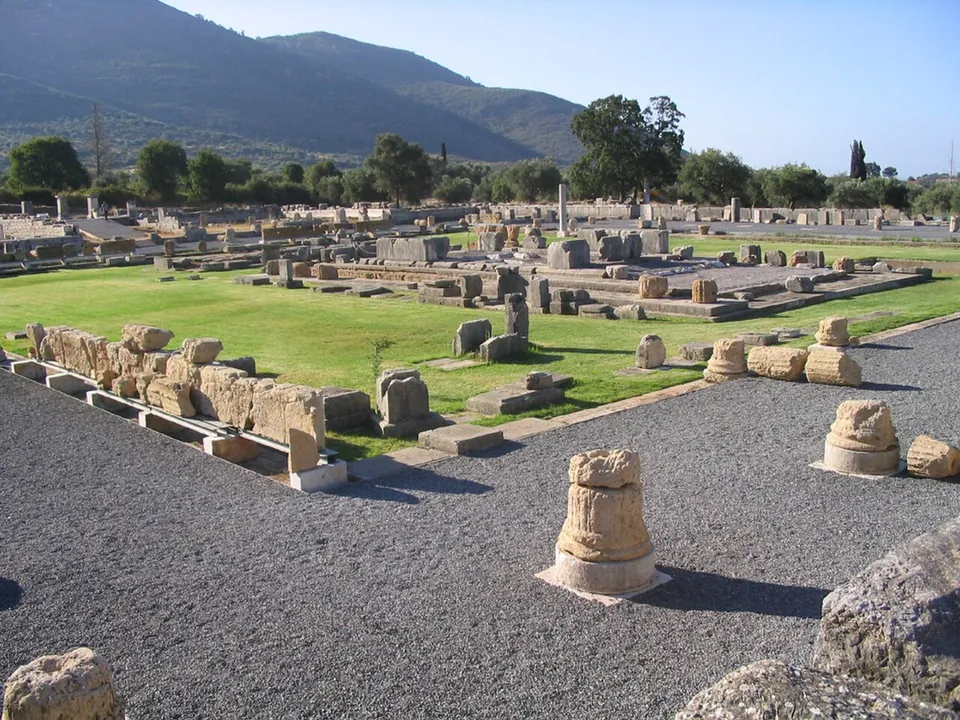
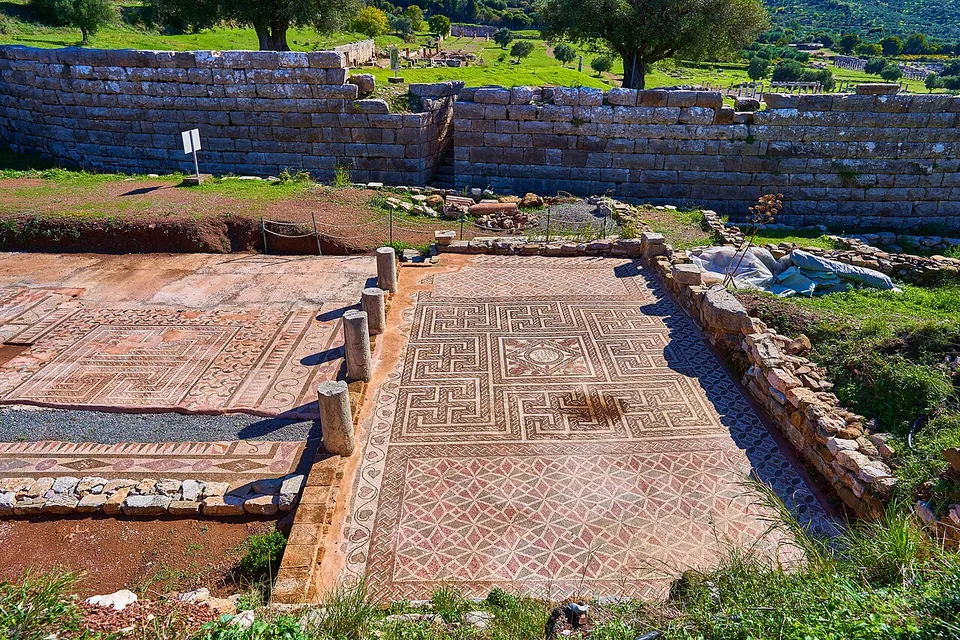


Messene is a Greek city, founded in 369 BC by the Theban general Epaminondas: its walls, theatre, stadium and sanctuaries have been uncovered, and many of its buildings rebuilt to a large degree (the operator; the UNESCO description). The city flourished long after the Classical period (en.wikipedia), and its Roman layer is houses with mosaic floors, games in honour of the emperors and, beside the theatre, a late Roman building that the site’s board reads as an early house church (the UNESCO description; the site’s board).
What is there today
The excavated park covers 400 stremmata, about a third of the ancient city. Most of the public buildings that the traveller Pausanias recorded have been uncovered: the odeon, the Asclepieion, the stadium with its heroon, the sanctuary of Zeus, the gymnasium, the theatre, the ecclesiasterion and the Fountain of Arsinoe (the operator). The walls, with their towers and gates, still run for 9.5 km around the city and Mount Ithome (the UNESCO description). en.wikipedia notes that the most substantial restored remains are Hellenistic and Roman.
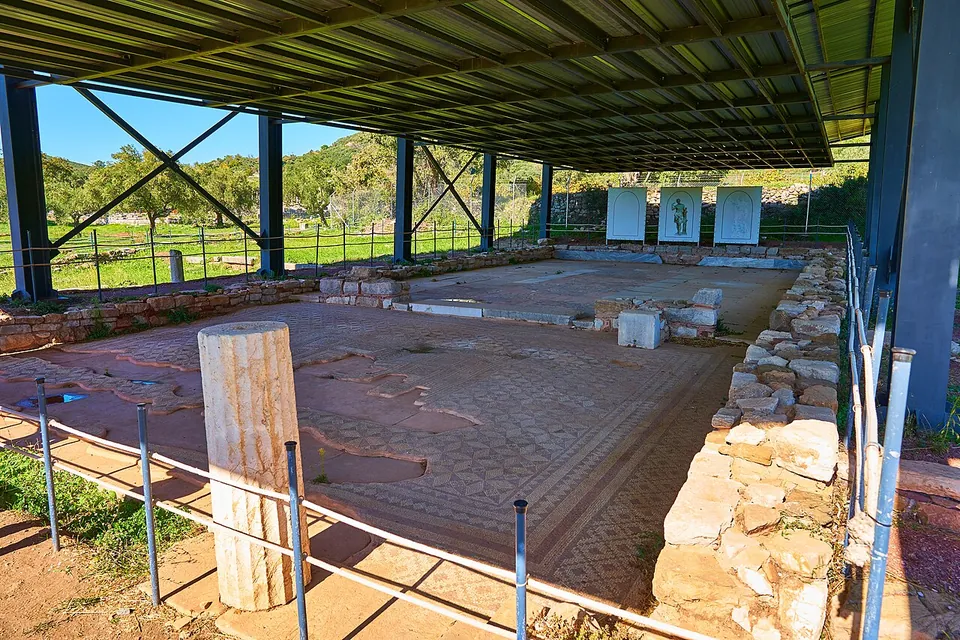
What is Roman. Luxurious Roman houses with mosaic floors stand within the city’s grid; in the stadium, games were held for Asklepios, Zeus Ithomatas and the Sebastoi, the Roman emperors; and the Saithid Mausoleum, a reconstructed monumental tomb, dates from the 1st century BC to the 1st century AD (the UNESCO description). One Roman house has its vestibule and audience hall under a protective roof (Wikidata; the photograph and its description).
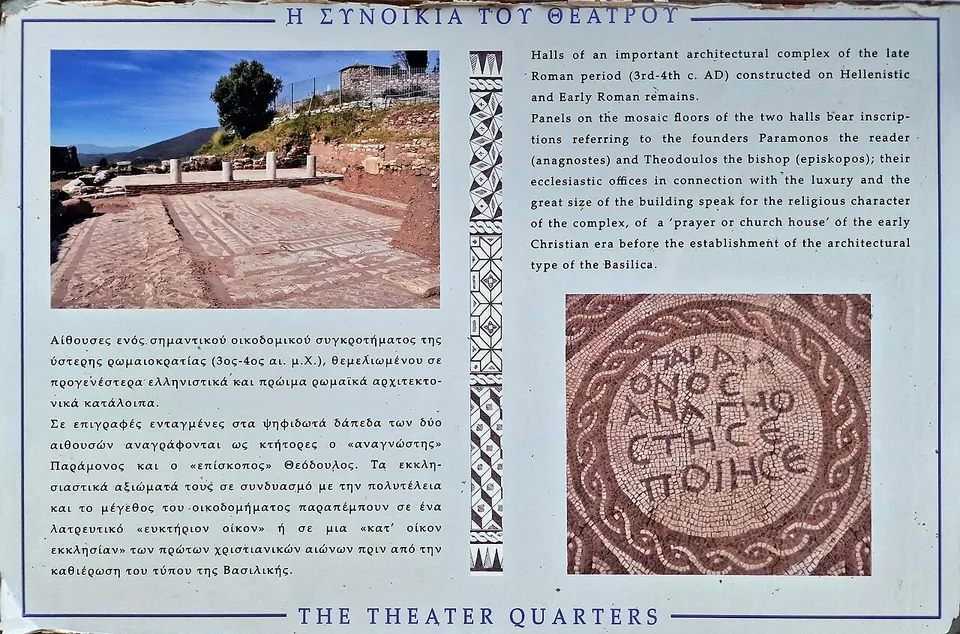
The Theater Quarters, beside the theatre, are the halls of an important building of the late Roman period, the 3rd–4th century AD, raised on Hellenistic and early Roman remains. Inscriptions in their mosaic floors name the founders, Paramonos the reader and Theodoulos the bishop, and the site’s board reads the building, from those church titles and its size and luxury, as a house of prayer or church of the early Christian era, from before the basilica became the form of a church.
Is it worth the trip?
Yes, though not for Rome above all: this is a Greek city of rare completeness, set in open country below Mount Ithome, and the Roman houses and the mosaics of the late Roman halls are part of a long visit rather than its reason (the UNESCO description; the site’s board). The ticket is €15, and the site is 40 minutes by car from Kalamata (the operator).
Getting there
The site lies at the village of Ancient Messene, 40 minutes by car from Kalamata (the operator).
It opens daily, 08.00–20.00 from 1 April to 31 August, closing earlier through September and October (18.00 by the second half of October). From 1 November to 31 March it opens 08.30–15.30 and is closed on Tuesdays. Last entry is 20 minutes before closing; it is shut on 1 January, 25 March, 1 May, Easter Sunday and 25–26 December. A ticket is €15, reduced €8, and entry is free on 6 March, 18 April, 18 May, the last weekend of September, 28 October, and on the first and third Sunday of each month from November to March (hh.gr, read 9 October 2026 — check before travelling). There is a café, a shop, toilets and parking (the operator).
Visiting details
- Opening hours
- Daily, 08.00–20.00 from 1 April to 31 August, then closing earlier through the autumn (19.30 in early September, 18.00 by late October); from 1 November to 31 March 08.30–15.30, closed on Tuesdays. Last entry 20 minutes before closing. Closed 1 January, 25 March, 1 May, Easter Sunday and 25–26 December.
- Tickets
- €15; reduced €8. Free on 6 March, 18 April, 18 May, the last weekend of September and 28 October, and on the first and third Sunday of each month from November to March.
- Parking
- The site is at the village of Ancient Messene (Mavrommati), 40 minutes by car from Kalamata; the operator lists parking.
Hours and prices checked 9 October 2026 on the operator's own site. Confirm before travelling.
History
Epaminondas founded Messene in 369 BC, after Thebes had defeated Sparta at Leuctra, as the capital of the free Messenians, whom Sparta had held as helots for some four centuries (the UNESCO description; en.wikipedia). Late Roman Messene was badly hit by the great Crete earthquake of AD 365, and from the beginning of the 5th century it was rebuilt as a Christian city and the seat of a bishop; it fell into a deep crisis in the 7th and 8th centuries, but a village lived on at the site into modern times (en.wikipedia). The present excavations began in 1987 (the operator), and en.wikipedia names Petros Themelis as the director of the systematic excavation.
More photographs

Nearby
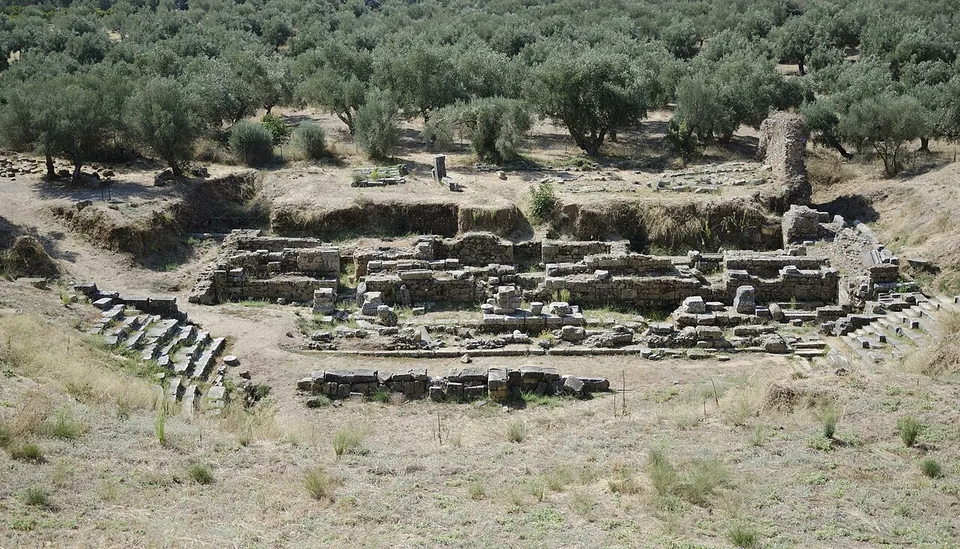
Photo: Peulle · CC BY-SA 4.0 · Commons
46 km · city · Laconia
Sparta
The modern town built over it, natural disasters and raids have left few traces of ancient Sparta; most of what has been found is on the acropolis, a low, broad hill that was the political, religious and economic centre of the city (el.wikipedia).

Straight-line distances.
Sources
Every fact on this page comes from the records below, each used under the licence noted.
| Source | Licence |
|---|---|
| Pleiades 570479 | CC BY |
| Wikidata Q1022117 | CC0 |
| Vici.org 11203 | CC BY-SA (text), CC0 (metadata) |
| OpenStreetMap way/280618725 | ODbL |
| Hellenic Heritage (H.O.C.R.E.D., for the Ministry of Culture) — Ancient Messene, hours and tickets | licence not recorded |
| UNESCO World Heritage Centre — Tentative List, "The archaeological site of Ancient Messene", as submitted by Greece | licence not recorded |
| The site's board "The Theater Quarters", photographed 2023 (Wikimedia Commons) | licence not recorded |
| Wikipedia (en) — Messene | CC BY-SA 4.0 |
| Wikipedia (en) — Achaia (Roman province) | CC BY-SA 4.0 |