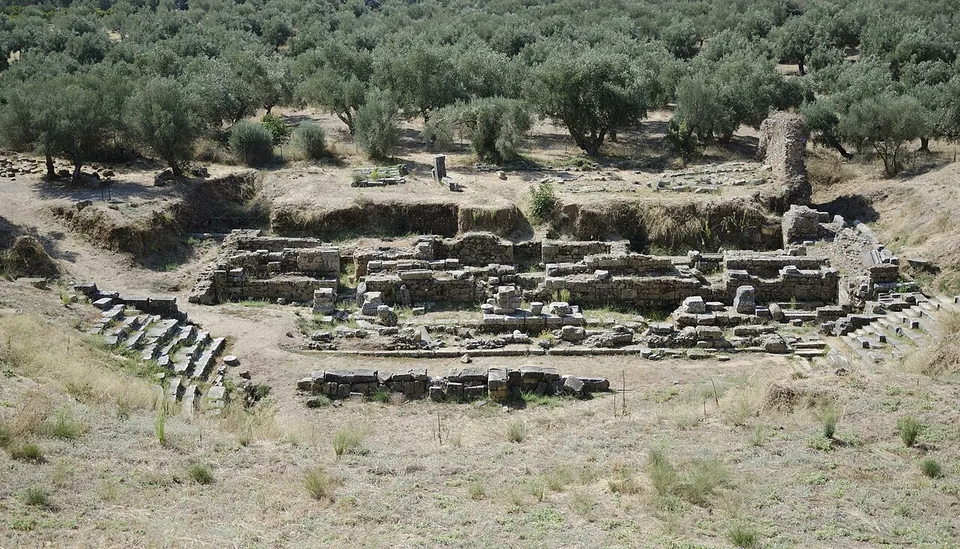
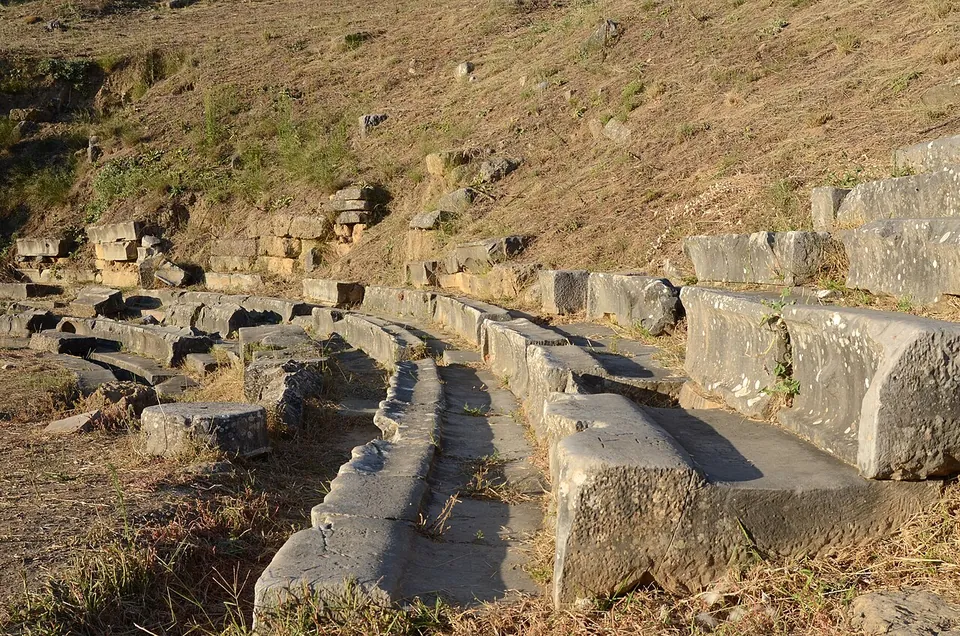
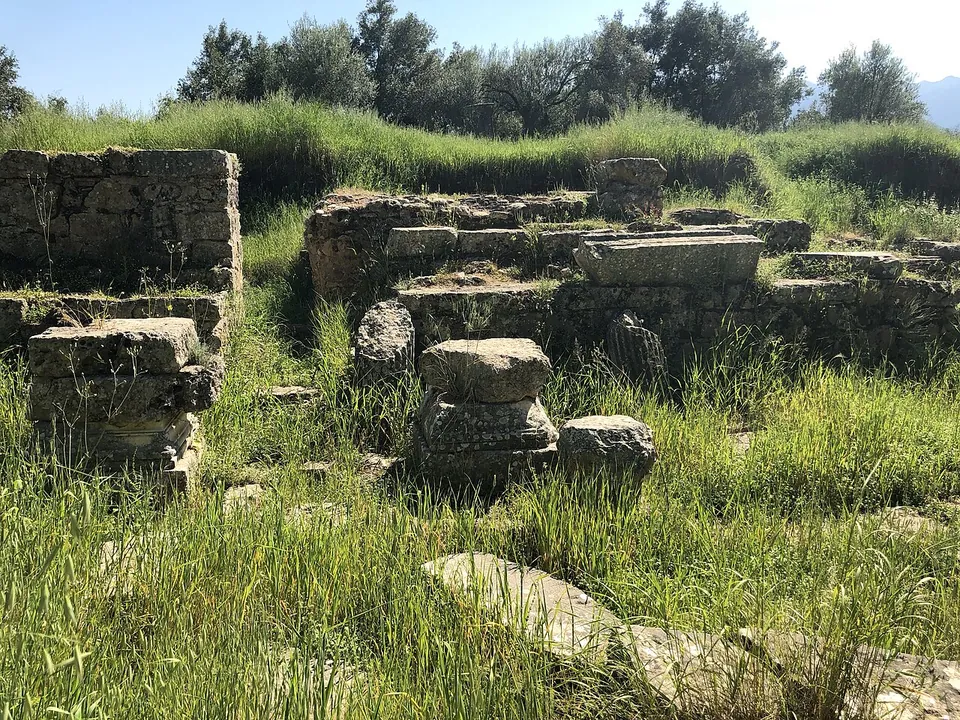
Ancient Sparta lies under and around the modern town, and little of the famous city-state survives: the largest remains are Roman. On the low acropolis hill north of the town stands a large theatre built at the start of Roman rule and given a marble stage by the emperor Vespasian, with remains of the late Roman wall that enclosed the hill (el.wikipedia; the operator).
What is there today
The modern town built over it, natural disasters and raids have left few traces of ancient Sparta; most of what has been found is on the acropolis, a low, broad hill that was the political, religious and economic centre of the city (el.wikipedia). The site takes in the hill and the height of Palaeokastro to the east, and the operator lists the Roman theatre, part of the Temple of Athena Chalkioikos, traces of an Archaic colonnade, the remains of a monumental colonnade of the 2nd century AD, the so-called Circular Building, a Byzantine church and the basilica of Saint Nikon, and the late Roman fortification wall. The Circular Building is a retaining wall of Greek origin round a natural rise, partly restored in the Roman period (en.wikipedia; el.wikipedia).
The theatre, on the south-west slope of the acropolis, was built of local white marble around 30–20 BC, at the turn from the Hellenistic to the Roman period, and has been linked with Eurycles, the ruler of Sparta who was a friend of the emperor Augustus. At the end of the 1st century AD it was given a permanent marble stage of the Corinthian order, a gift of the emperor Vespasian; before that its stage was a wooden one on wheels, kept in a shed in the western entrance passage. The seating, about 140 m across, is estimated to have held up to 16,000 people, and the horseshoe-shaped orchestra is about 25 m across. It was used until the 4th century AD (el.wikipedia, theatre). The orchestra was paved in alternating white and red marble, and honorary inscriptions survive in the eastern entrance passage (el.wikipedia, Sparta). The British School at Athens has excavated it in several campaigns since 1906, but it is not fully dug (el.wikipedia, theatre).
The late Roman wall: its remains have been uncovered at the foot of the acropolis, behind the town’s stadium. After the earthquake of 375 and under the threat of Gothic raids, the Spartans built a high wall enclosing only the acropolis (el.wikipedia, Sparta); en.wikipedia dates part of it probably to the years after the Gothic raid of 262, and the operator gives the 3rd–4th century.
In the town, five minutes’ walk from the central square, the House of Mosaics shows two floors from neighbouring Roman villas: the Abduction of Europa, of the second half of the 3rd century AD, and Orpheus playing the lyre, of the early 4th. Protected since the end of the 19th century by a shelter, they were reopened to the public in 2020. Entry is free; it opens 09.00–14.00, except on Tuesdays (the operator).
Is it worth the trip?
Yes, if you are in the Peloponnese and curious about what became of Sparta: the answer is a Roman city, and its theatre is the main monument on the hill. Greek Wikipedia counts it among the largest theatres of the ancient world. Do not expect the warrior state: Thucydides himself predicted that Sparta would leave little to see (en.wikipedia). Entry to the acropolis and to the House of Mosaics is free (the operator).
Getting there
The acropolis is on the northern edge of the modern town: 12 minutes on foot from the central square, 4 minutes from the statue of Leonidas on Konstantinou Palaiologou Street, or 5 minutes by car from the square (the operator). Roadside parking is mapped about 290 m from the acropolis (OpenStreetMap).
The site opens daily, 08.00–20.00 from 1 April to 31 August, closing earlier through September and October (18.00 by the second half of October), and 08.30–15.30 from 1 November to 31 March. Last entry is 20 minutes before closing; it is shut on 1 January, 25 March, 1 May, Easter Sunday and 25–26 December. Entry is free (hh.gr, read 9 October 2026 — check before travelling). The House of Mosaics, at the corner of Konstantinou Palaiologou and Dioskouron streets, opens 09.00–14.00 except on Tuesdays, also free (the operator).
Visiting details
- Opening hours
- Daily, 08.00–20.00 from 1 April to 31 August, then closing earlier through the autumn (19.30 in early September, 18.00 by late October); 08.30–15.30 from 1 November to 31 March. Last entry 20 minutes before closing. Closed 1 January, 25 March, 1 May, Easter Sunday and 25–26 December.
- Tickets
- Free.
- Parking
- Roadside parking is mapped about 290 m from the acropolis point (OSM node/3701228155); the site is a 12-minute walk from the central square of Sparta.
Hours and prices checked 9 October 2026 on the operator's own site. Confirm before travelling.
History
Sparta lost its independence in 192 BC, and in 146 BC Greece was conquered by the Roman general Lucius Mummius (en.wikipedia; el.wikipedia). Under Rome Sparta was a free city, some of the old institutions of Lycurgus were restored, and it became a tourist attraction for the Roman elite, who came to watch its “exotic” customs (en.wikipedia; el.wikipedia). In 214 the emperor Caracalla raised a unit of 500 Spartans for his campaign against Parthia (en.wikipedia).
The city was damaged by the earthquake of 375, walled its acropolis, and was sacked by the Goths under Alaric in 396 by en.wikipedia’s date, 394 by el.wikipedia’s. It then declined, and in the Middle Ages much of its population moved to nearby Mystras (en.wikipedia). A Byzantine settlement grew up on the site of the theatre from the 10th to the 14th century (el.wikipedia, theatre).
Nearby
37 km · theatre · Laconia
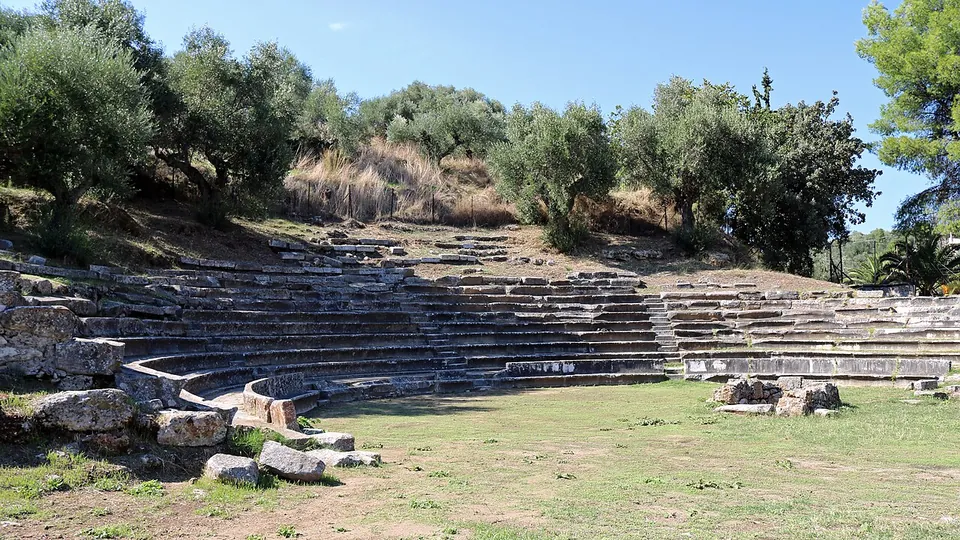
Roman Theatre of Gytheion
Of the marble seating, six full rows survive and parts of the seventh and eighth; the retaining walls on the north and east sides are of tufa.
46 km · site · Messenia
Messene
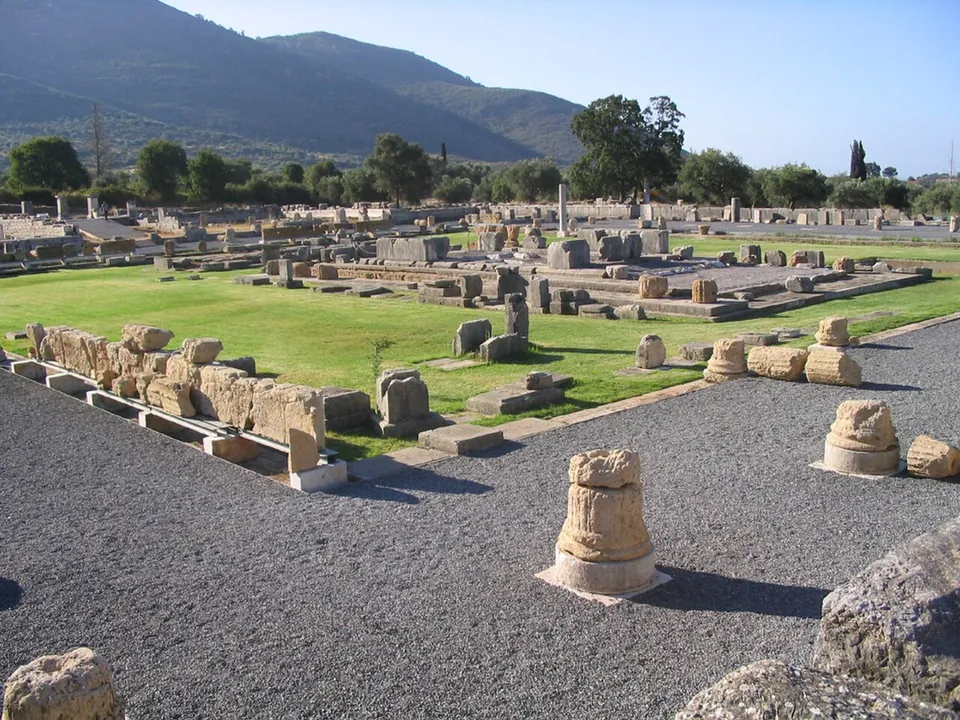
The excavated park covers 400 stremmata, about a third of the ancient city.


Straight-line distances.
Sources
Every fact on this page comes from the records below, each used under the licence noted.
| Source | Licence |
|---|---|
| Pleiades 570685 | CC BY |
| Wikidata Q5690 | CC0 |
| Hellenic Heritage (H.O.C.R.E.D., for the Ministry of Culture) — Acropolis of Ancient Sparta, hours and admission | licence not recorded |
| Hellenic Heritage (H.O.C.R.E.D., for the Ministry of Culture) — House of Mosaics, Sparta, hours and admission | licence not recorded |
| Wikipedia (el) — Αρχαίο θέατρο Σπάρτης | CC BY-SA 4.0 |
| Wikipedia (el) — Αρχαία Σπάρτη | CC BY-SA 4.0 |
| Wikipedia (en) — Sparta | CC BY-SA 4.0 |
| Wikipedia (en) — Achaia (Roman province) | CC BY-SA 4.0 |