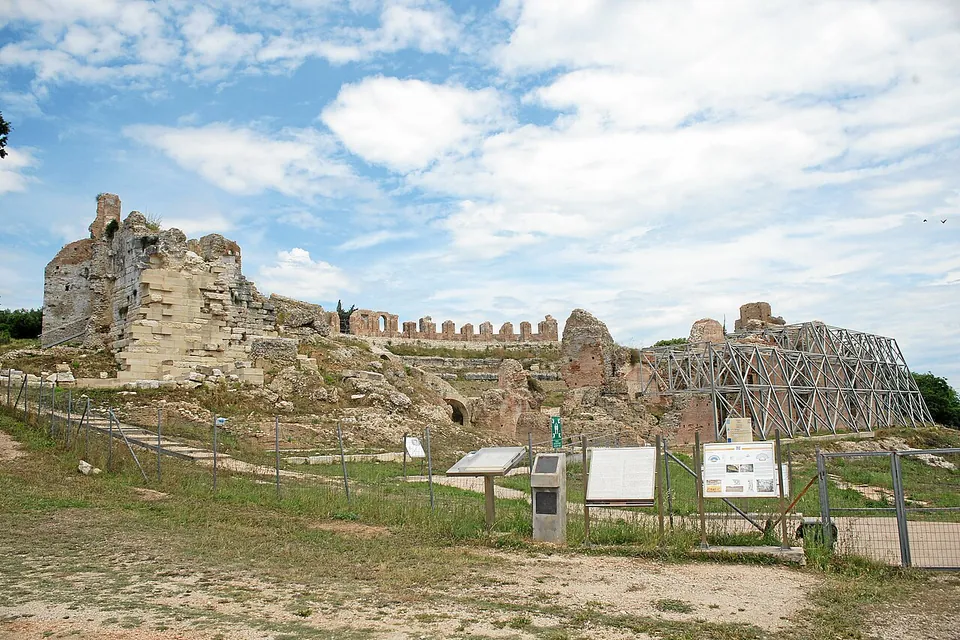
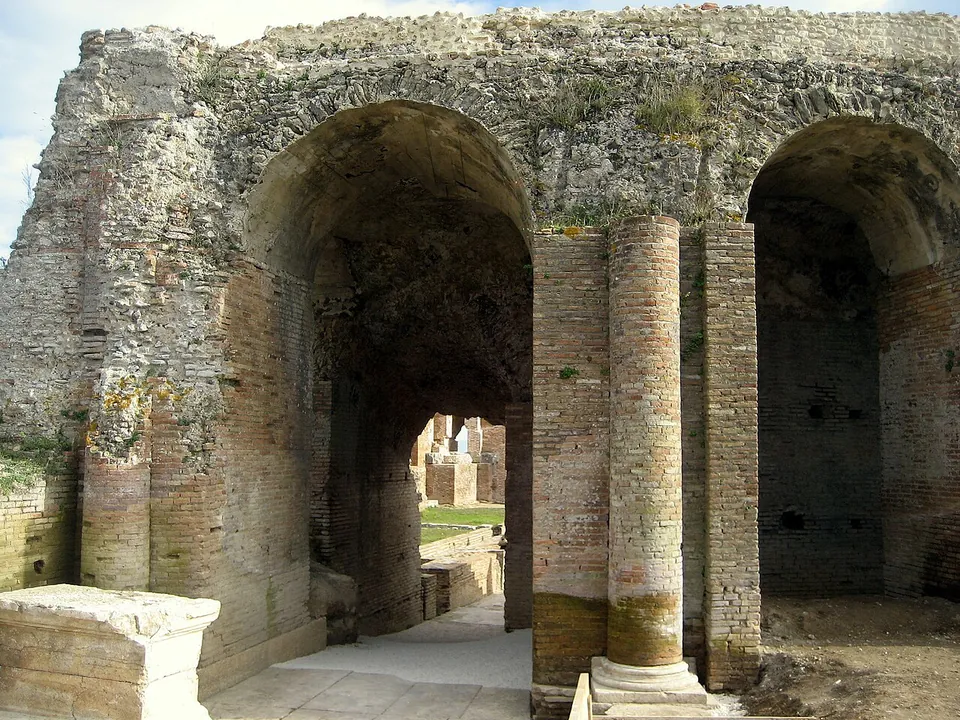
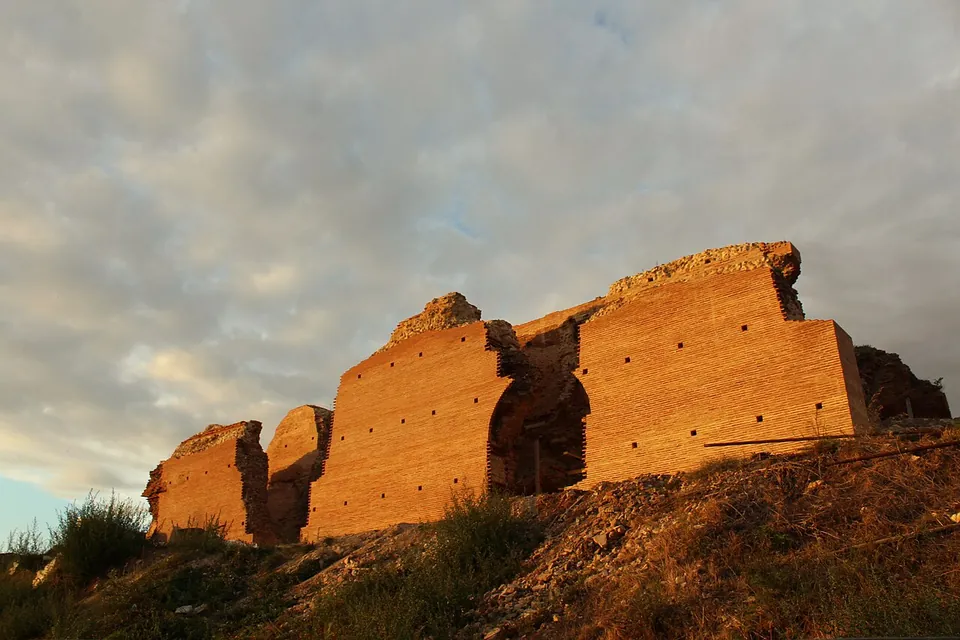


Nicopolis, the “City of Victory”, was founded by Octavian, the future Augustus, to mark his victory over Mark Antony and Cleopatra in the naval battle of Actium in 31 BC, and it became the capital of the Roman province of Epirus (the operator; en.wikipedia). Its ruins are among the largest archaeological sites in Greece: a great theatre, an odeon, baths, a stadium, the victory monument of Augustus, and the basilicas of the Christian city with their mosaic floors (the operator; en.wikipedia).
What is there today
The great theatre had 77 rows of seats (en.wikipedia), and its high brick walls still stand (the photographs), about 100 m from the stadium (OpenStreetMap), where the Actian Games were held. The stadium, of the time just after the city’s foundation, has two rounded ends, and must have held at least 10,000 spectators; its north side was built against a hill (en.wikipedia).
The odeon, the baths, the nymphaeum or great fountain at the end of the aqueduct, and the villa of Manius Antoninus with its fine mosaic are among the other buildings of the Roman city (en.wikipedia; the operator). On a hill to the north, where his own tent had stood during the battle, Octavian built a monument and sanctuary to Apollo, decorated with the rams of captured warships (en.wikipedia); el.wikipedia records that it was excavated and presented in 2006–2009.
The Christian city. From around 460 six basilicas were built, several with high-quality floor mosaics from a local workshop; Basilica B, of Bishop Alkison, was the largest, and Basilica A, of Bishop Doumetios, has an extensive series of mosaics (en.wikipedia). In the late 5th or 6th century new walls of brick, mortar and rubble enclosed only about a sixth of the old city (en.wikipedia); they have been cleaned and presented to visitors, along with the two bishops’ basilicas (el.wikipedia).
Is it worth the trip?
Yes. This is a city founded by Rome’s first emperor, and one of the largest archaeological sites in Greece, with standing theatres, a stadium and the walls and mosaics of the Christian city (the operator; en.wikipedia). It is 11 minutes by car from Preveza and a ticket is €10 (the operator). The ruins are spread out, so allow time, and combine them with the arches of the aqueduct at Agios Georgios, about 30 km to the north (de.wikipedia, Aquädukt von Nikopolis).
Getting there
The site is at the 8th km of the old national road from Preveza to Ioannina, 11 minutes by car or 55 minutes on foot from the KTEL bus station in Preveza (the operator). A free car park is mapped by the theatre (OpenStreetMap).
From 1 April to 31 October it opens daily except Tuesdays, 08.00–20.00 to the end of August and closing earlier through September and October (18.00 by the second half of October); from 1 November to 31 March it opens daily, 08.30–15.30. Last entry is 20 minutes before closing; it is shut on 1 January, 25 March, 1 May, Easter Sunday and 25–26 December. A ticket is €10, reduced €5, and entry is free on 6 March, 18 April, 18 May, the last weekend of September, 28 October, and on the first and third Sunday of each month from November to March (hh.gr, read 9 October 2026 — check before travelling). There are toilets and parking (the operator).
Visiting details
- Opening hours
- From 1 April to 31 October daily except Tuesdays, 08.00–20.00 to the end of August, then closing earlier through the autumn (19.30 in early September, 18.00 by late October); from 1 November to 31 March daily, 08.30–15.30. Last entry 20 minutes before closing. Closed 1 January, 25 March, 1 May, Easter Sunday and 25–26 December.
- Tickets
- €10; reduced €5. Free on 6 March, 18 April, 18 May, the last weekend of September and 28 October, and on the first and third Sunday of each month from November to March.
- Parking
- The site is at the 8th km of the old national road from Preveza to Ioannina, 11 minutes by car from Preveza; the operator lists parking, and a free car park is mapped about 90 m from the theatre (OSM way/836726405).
Hours and prices checked 9 October 2026 on the operator's own site. Confirm before travelling.
History
Published dates for the foundation range from 31 to 29 BC. The city was peopled by moving the inhabitants of towns across Epirus and the neighbouring regions, together with Roman colonists, and in its first five years or so work went ahead on its walls, theatre, stadium, gymnasium and odeon (the operator; en.wikipedia). The emperor Nero competed in the Actian Games here in 66 and won the chariot race; the Stoic philosopher Epictetus founded his school here around 94, and Hadrian visited in 128 (en.wikipedia; the operator). Around 110 Trajan made Nicopolis the capital of the new province of Epirus, and from 293 it was capital of Epirus Vetus (en.wikipedia).
The city escaped the Goths in 268 behind hasty repairs to its walls, but the Vandals took it in 474. Its people withdrew into the new, smaller walled area, which Justinian renovated around 555, while the bishops built their basilicas. The last known bishop attended a council in 787, and in the Middle Ages Preveza took the city’s place (en.wikipedia).
Nearby
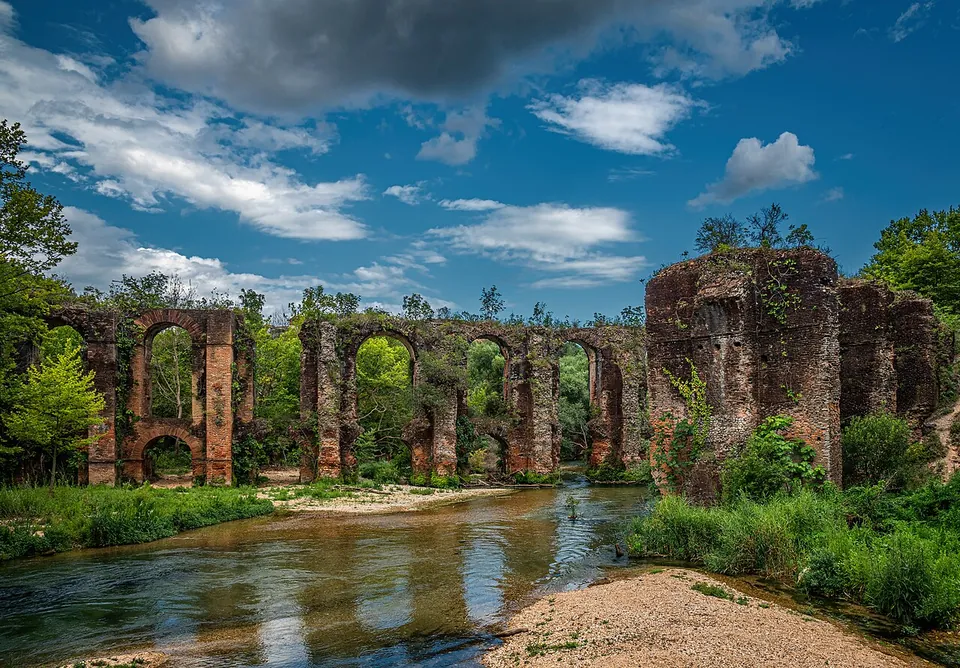
Photo: Jennikann · CC BY-SA 4.0 · Commons
29 km · aqueduct · Preveza
Roman Aqueduct of Nicopolis
The two bridges carried the water over the Louros about 200 m north-west of the village church, which stands where the spring rises and where, in antiquity, a collecting basin fed the channel.

Straight-line distances.
Sources
Every fact on this page comes from the records below, each used under the licence noted.
| Source | Licence |
|---|---|
| Pleiades 531013 | CC BY |
| Wikidata Q943637 | CC0 |
| OpenStreetMap way/86003372 | ODbL |
| Hellenic Heritage (H.O.C.R.E.D., for the Ministry of Culture) — Nicopolis, hours and tickets | licence not recorded |
| Wikipedia (en) — Nicopolis | CC BY-SA 4.0 |
| Wikipedia (de) — Aquädukt von Nikopolis | CC BY-SA 4.0 |
| Wikipedia (el) — Αρχαία Νικόπολη | CC BY-SA 4.0 |