

Thasos was a Greek city founded by settlers from Paros on the island of the same name, and its ruins lie in and above the island’s main town, Limenas (Pleiades; de.wikipedia). The city stayed loyal to Rome and kept its own institutions under the emperors, who added their mark to its centre: a monument to Augustus in the agora, a theatre turned into an arena for gladiators, and a triple arch later dedicated to Caracalla (de.wikipedia). The agora is free and open at all times (the Ministry).
What is there today
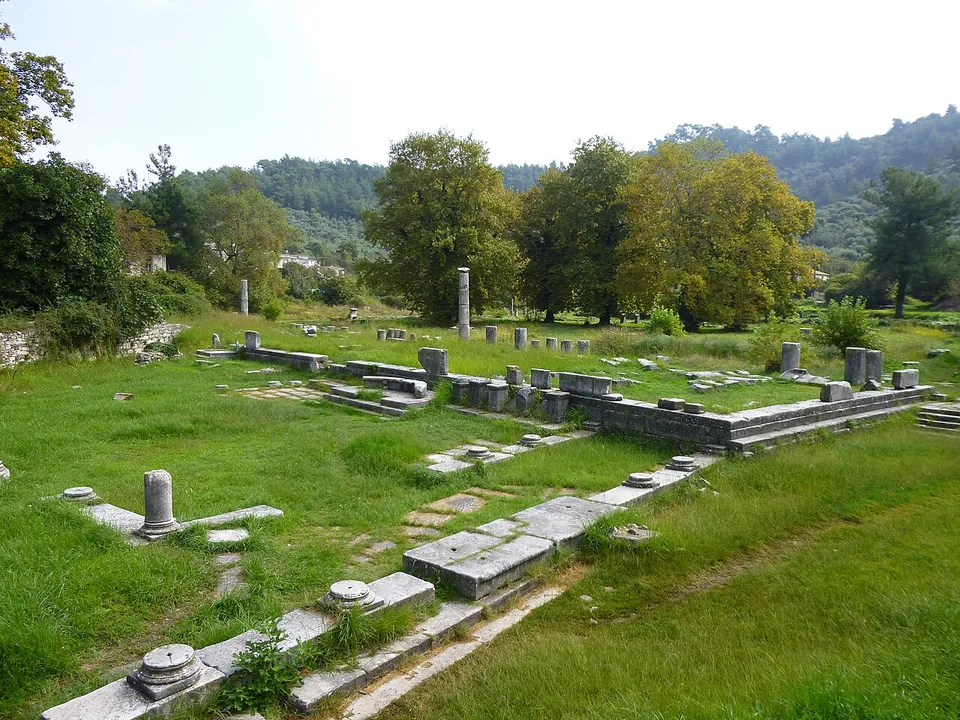
The agora, in the middle of the town, was laid out in the 4th century BC and took on the form still visible today then; under Augustus a monument to the emperor and his family, Lucius Caesar above all, was set up in its centre. At its west corner a marble-paved, colonnaded square with an exedra was built, the gift of a citizen named Komis, and to the south-west the Five Exedrae, semicircular marble benches with bronze statues raised in the middle (de.wikipedia).
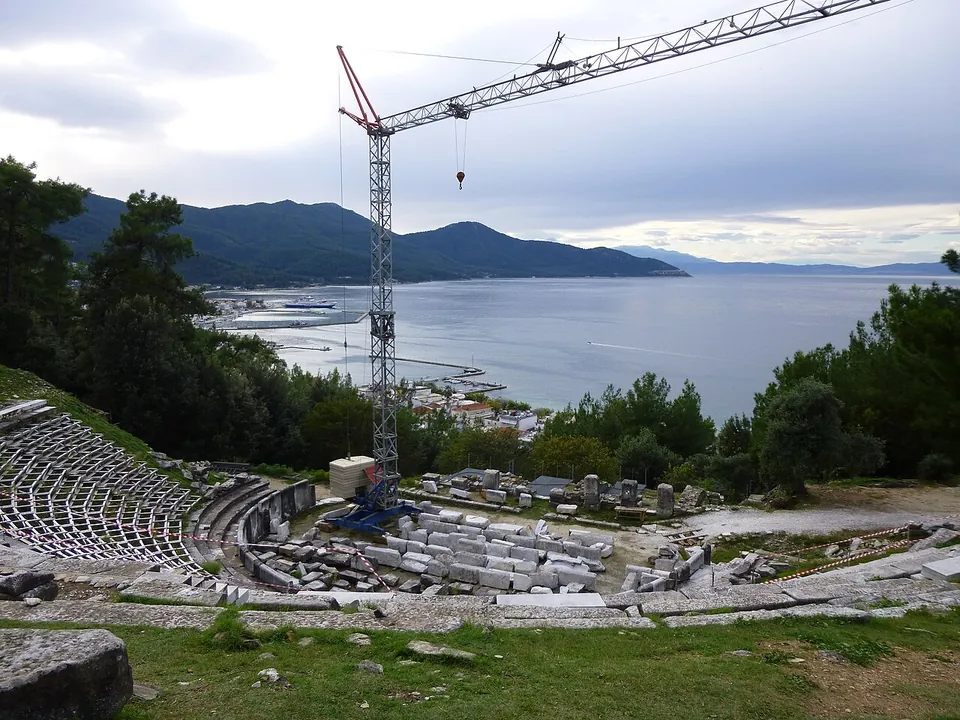
The theatre, on the slope above the harbour, was rebuilt in the time after Hadrian, who probably visited Thasos, for shows with wild animals and gladiator fights: its orchestra became an arena, around 140 a citizen named Heragoras set a balustrade with a protective grille at the foot of the seats, and the stage building was renewed (de.wikipedia). After eleven years of restoration, in which its rows of seats were rebuilt with the island’s white marble, it was due to reopen to visitors in mid-May 2024, with work still going on in the orchestra (Proto Thema, April 2024).
The arch. At the south end of the main street a three-bayed monumental arch, 17 m wide with a central opening 10 m high, was raised in the second half of the 2nd century and later dedicated to Caracalla and his family (de.wikipedia). The sources do not say how much of it can be seen today.
Is it worth the trip?
Yes, if you are on Thasos: the agora is free and open in the middle of the town, and the city’s walls, gates and theatre lie on the hill above (de.wikipedia; OpenStreetMap). Most of what you see is Greek, with Rome’s mark in the agora’s monuments and in the theatre’s arena (the Ministry; de.wikipedia).
Getting there
The ancient city lies in and above Limenas, the island’s main town, and the agora is in the town centre (the Ministry; de.wikipedia). The theatre is reached by footpaths up the slope above the old harbour (OpenStreetMap). The agora is free, and the open-air city can be visited at any time (the Ministry, read 10 October 2026).
Visiting details
- Opening hours
- The ancient city is an open-air site, always open; the agora is free (the Ministry of Culture's guide). The theatre was due to reopen to visitors in mid-May 2024 after its restoration (Proto Thema, reporting the Ephorate, April 2024); no operator publishes its hours.
- Tickets
- Free (the agora).
- Parking
- The ancient city lies in and above the island's main town, Limenas; the theatre is on the slope above the old harbour, reached by footpaths (OSM way/1481200275, way/126796536). No car park or bus stop is mapped at the theatre.
Hours and prices checked 10 October 2026 on the operator's own site. Confirm before travelling.
History
Settlers from Paros founded the city around 680 BC (de.wikipedia). After Rome defeated Philip V of Macedon, Thasos became Rome’s ally, probably with the title of friend of the Roman people, and it stayed loyal even when Mithridates VI took much of the Roman east. Under the empire it kept its old offices and cults, adding the cult of the emperors, and its lands on the mainland were enlarged in the early 1st century AD by a rich Roman’s bequest. Raids in the second half of the 3rd century destroyed many buildings, and in the 4th and 5th centuries the town was rebuilt on a new plan, with rich houses and churches taking the place of the old public buildings (de.wikipedia).
Nearby
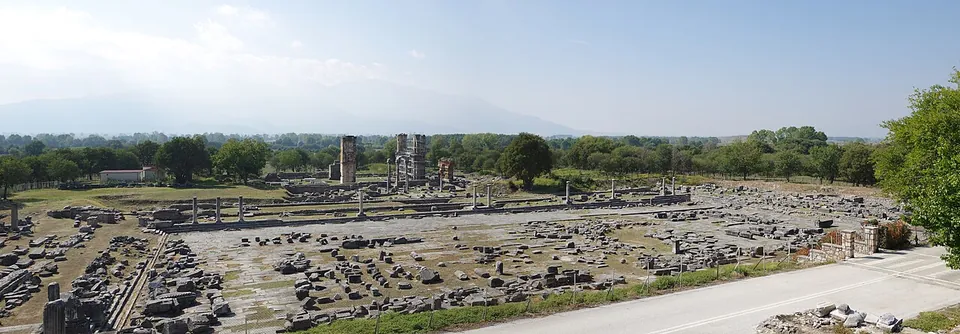
Photo: Berthold Werner · CC BY-SA 3.0 · Commons
44 km · city · Kavala
Philippi
The forum was laid out on two terraces on either side of the main road, the Via Egnatia, and built in several phases between the emperors Claudius (41–54) and Antoninus Pius (138–161).

Straight-line distances.
Sources
Every fact on this page comes from the records below, each used under the licence noted.
| Source | Licence |
|---|---|
| Pleiades 501634 | CC BY |
| Wikidata Q2409204 | CC0 |
| OpenStreetMap way/158227269 | ODbL |
| Ministry of Culture and Sports (Odysseus) — The Ancient Agora of Thassos, information | licence not recorded |
| Ministry of Culture and Sports (Odysseus) — Ancient city of Thasos, information | licence not recorded |
| Wikipedia (de) — Thasos (Antike) | CC BY-SA 4.0 |
| Proto Thema — the ancient theatre of Thasos restored after 11 years, 22 April 2024 | licence not recorded |