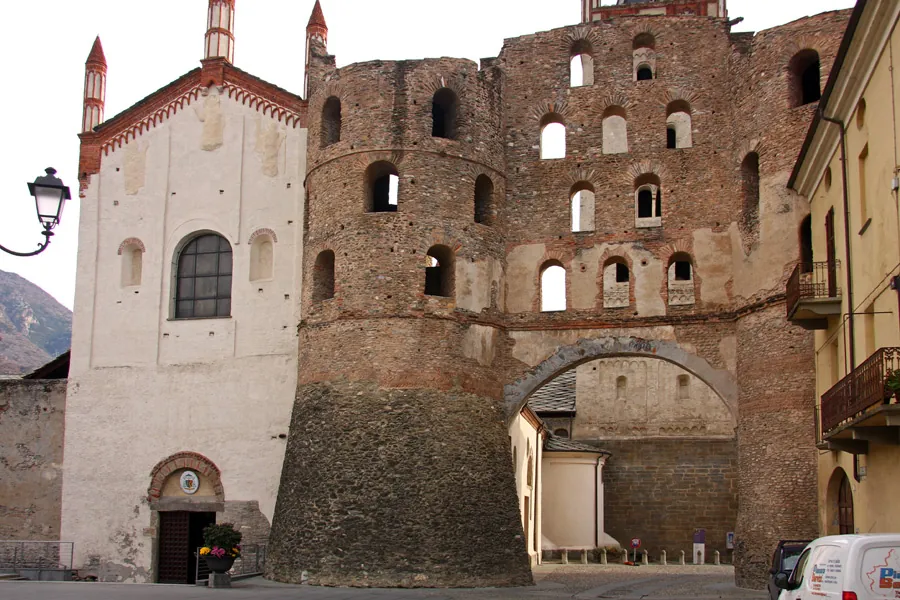
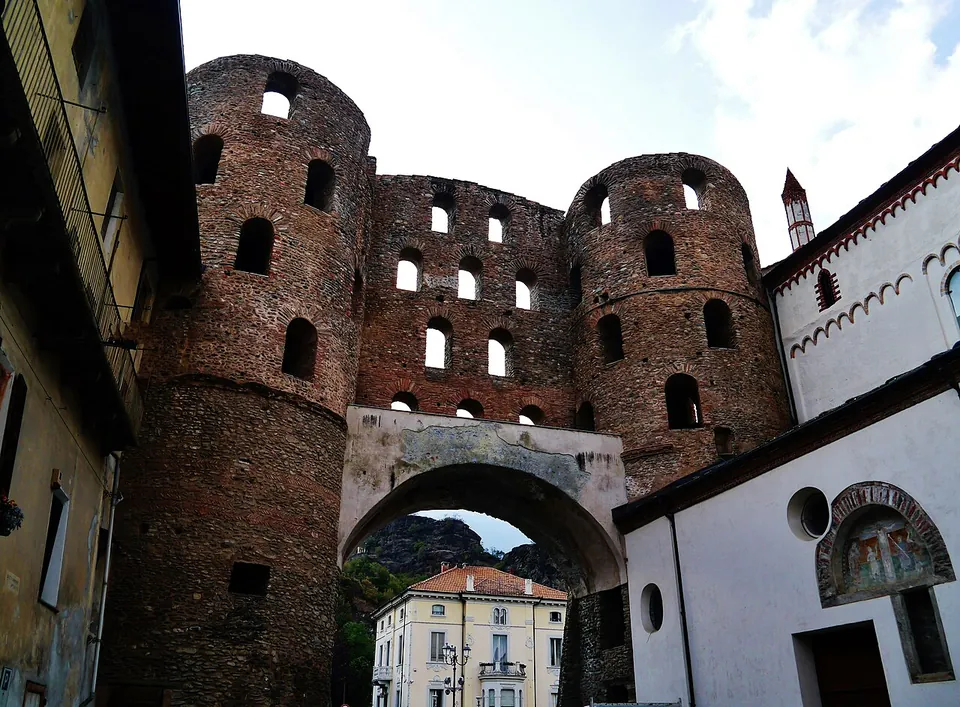
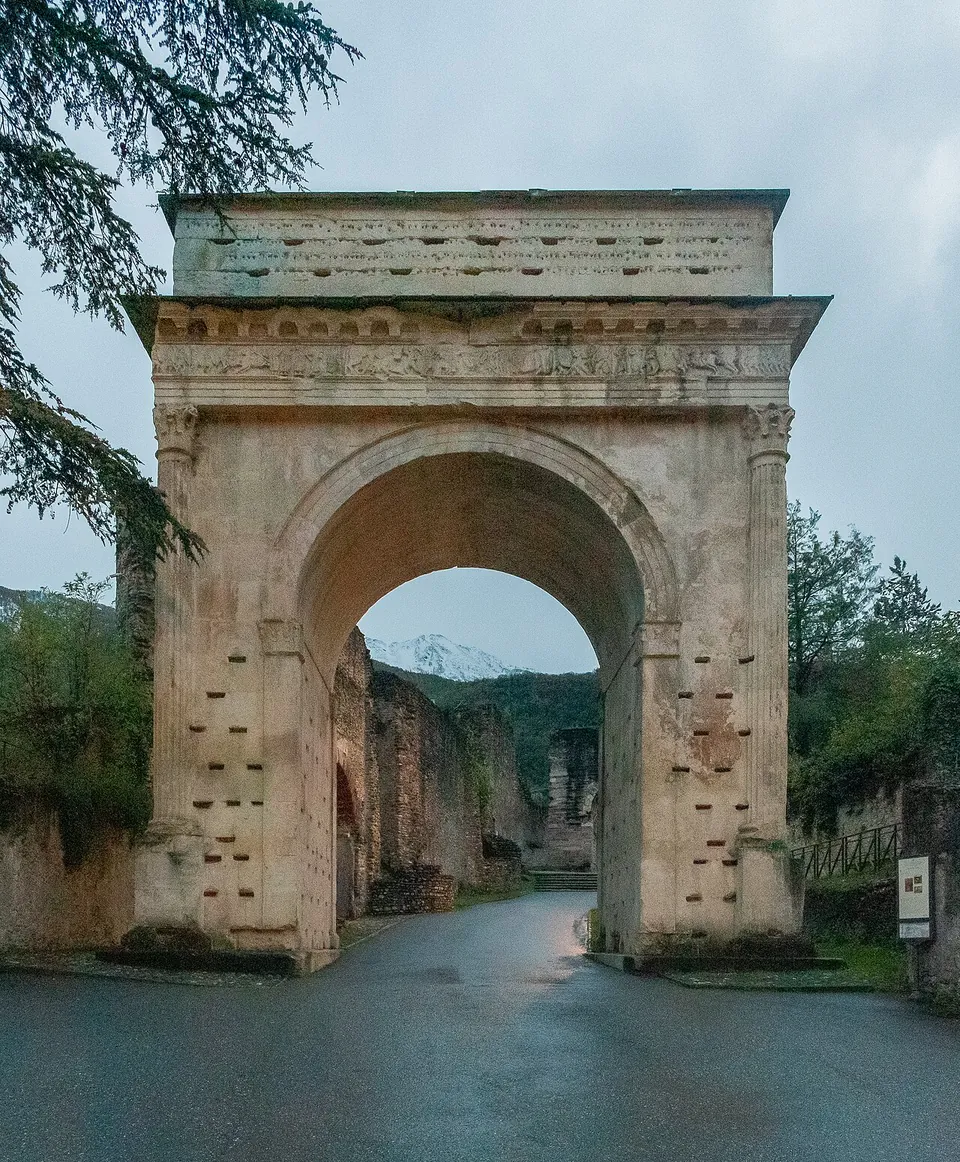


Porta Savoia (de.wikipedia uses the French form, Porte de Savoie) is the gate the Romans built into the new walls of Segusio, today’s Susa in Piedmont, in the 3rd century AD, and it is still well preserved: two round towers and the wall between them, pierced by rows of arched windows, standing over the street into the old town. About 200 m away stands Susa’s other Roman landmark, the marble Arch of Augustus of 9–8 BC, which de.wikipedia calls the best-preserved monument of its kind in northern Italy.
What is there today
The gate is two cylindrical towers with a central block between them over the carriageway. The lower part of each tower stands about 6 m above today’s ground; above it, single arched windows are set in staggered rows, three or four storeys of them in the towers and four rows in the central block. The levels were presumably divided by timber floors, and the central rows matched wooden connecting balconies; none of that timber survives (it.wikipedia). OpenStreetMap records the gate as 18 m high.
The passage you walk through is not Roman. In 1750 the original gate frame was removed and the opening widened and raised, so that the new arch fills the whole space between the towers, and the right-hand tower, seen from the town, was given a conical masonry casing (de.wikipedia; it.wikipedia). The cathedral of San Giusto, founded in the 11th century, stands next to the gate (de.wikipedia). In Piazza Savoia, which the gate faces, the remains of the temple of the Roman forum, uncovered when the square was redeveloped in 2005–2008, are on view (Ministry of Culture). Of the town’s other Roman gate, on the east side towards Turin, only a fragment built into other buildings survives (de.wikipedia).
The Arch of Augustus
The arch stands on a rise at the western edge of the town, on the line of the ancient road over the Alps, outside the circuit of walls, which was only built in the 3rd century AD (de.wikipedia; it.wikipedia). It has a single archway and measures 11.93 m wide and 7.30 m deep; published heights are 13.1–13.3 m. It is built of white marble from the nearby Foresto quarries on bases of grey stone (de.wikipedia; it.wikipedia). A fluted column with a Corinthian capital stands at each corner, and above them a carved frieze about 33 m long runs round all four sides: on the north, a sacrifice of a pig, a ram and a bull, with the animals shown far larger than the men leading them; on the south, a second sacrifice, usually taken to be performed by the local king Cottius; on the west, representatives of the fourteen communities named in the inscription. The east side is worn past reading. The dedication to Augustus runs across the attic on both main faces; its gilded bronze letters were stripped long ago, and it is now read from the recesses that held them (it.wikipedia).
The opening is aligned with the summit of the Rocciamelone, the highest mountain of the Susa valley (it.wikipedia; de.wikipedia). The arch shares one archaeological area with the arches of the aqueduct and the castle, in whose courtyard excavation has exposed structures of the palace of the Roman governor (Ministry of Culture).
Is it worth the trip?
The two together are worth a stop. The gate takes a few minutes: it is a street gate in a working town square, not a monument you go inside, and the archway itself is the 1750 one. The arch rewards a longer look: de.wikipedia calls it the oldest arch on which a sculpted frieze was used as decoration, and it was put up to celebrate an alliance between Rome and an Alpine king rather than a conquest (it.wikipedia). Add the aqueduct arches beside it, the governor’s palace under the castle and the amphitheatre (see Segusio – Susa), and Roman Susa fills a morning on foot. The road through Susa leads on to the Mont Cenis and Montgenèvre passes into France (de.wikipedia), so it is also an easy break on the way over the Alps.
Getting there
The gate is in the centre of Susa, on Piazza Savoia beside the cathedral (it.wikipedia). Free street-side parking is mapped about 60 m away, with public toilets and drinking water within about 50 m and the town’s Museo civico some 160 m off; the Arch of Augustus is about 200 m from the gate (OpenStreetMap). No bus stop or station is mapped close to the gate.
There is nothing to pay and no opening time: the gate spans a public street, and the Ministry of Culture lists the area of the arch and the aqueduct as always accessible, with no booking needed (cultura.gov.it, read 20 October 2026). Hours and tickets for the amphitheatre and the castle are on the Segusio – Susa page.
Visiting details
- Opening hours
- The gate spans a public square and street and can be seen at any time. The Ministry of Culture lists the area of the Arch of Augustus and the aqueduct as always accessible.
- Tickets
- Nothing to pay at the gate, which is a public street. The Ministry's page for the Susa archaeological areas lists no charge for the arch and aqueduct area and says no booking is needed.
- Parking
- Free street-side parking about 60 m from the gate, two stretches of 16 and 14 spaces (OSM way/1275045108 and way/1275045107).
Before you go
- No bus stop or railway station is mapped within a few hundred metres of the gate.
Hours and prices checked 20 October 2026 on the operator's own site. Confirm before travelling.
History
Cottius, the local king, made an alliance with Augustus in 13 BC, and in 9–8 BC he had the arch built in the emperor’s honour (it.wikipedia). Its inscription names him as Marcus Julius Cottius, son of King Donnus, prefect of fourteen Alpine communities (en.wikipedia), and the arch is described as celebrating that pact rather than a victory (it.wikipedia). Segusio was the capital of the Roman province of the Cottian Alps (Ministry of Culture).
In the 3rd century AD Segusio received new walls, of which extensive remains survive, with two gates on the road from Italy into Gaul; the western one is Porta Savoia (de.wikipedia). The name is medieval: it faced Savoy, reached over the Mont Cenis, which made it the town’s most important gate in the Middle Ages, on a branch of the Via Francigena; the name “del Paradiso” comes from the cathedral’s cemetery beside it (it.wikipedia; de.wikipedia). The cathedral was founded next to the gate in the 11th century, in the time of Adelaide of Susa (de.wikipedia), and the gateway was rebuilt in 1750. The arch was restored for its two-thousandth anniversary in 1990–1992 under the archaeological superintendency of Piedmont (it.wikipedia).
Sources
Every fact on this page comes from the records below, each used under the licence noted.
| Source | Licence |
|---|---|
| Wikidata Q15695819 | CC0 |
| OpenStreetMap way/290506097 | ODbL |
| Wikipedia (it) — Porta Savoia | CC BY-SA 4.0 |
| Wikipedia (de) — Porte de Savoie | CC BY-SA 4.0 |
| Pleiades — Arch of Augustus (Susa) | licence not recorded |
| Wikidata — Arch of Augustus, Susa (Q1892101) | licence not recorded |
| Wikipedia (de) — Augustusbogen (Susa) | CC BY-SA 4.0 |
| Wikipedia (it) — Arco di Augusto (Susa) | CC BY-SA 4.0 |
| Wikipedia (en) — Arch of Augustus (Susa) | CC BY-SA 4.0 |
| Ministero della cultura — Aree archeologiche del castello e dell'anfiteatro romano di Susa (the operator) | licence not recorded |