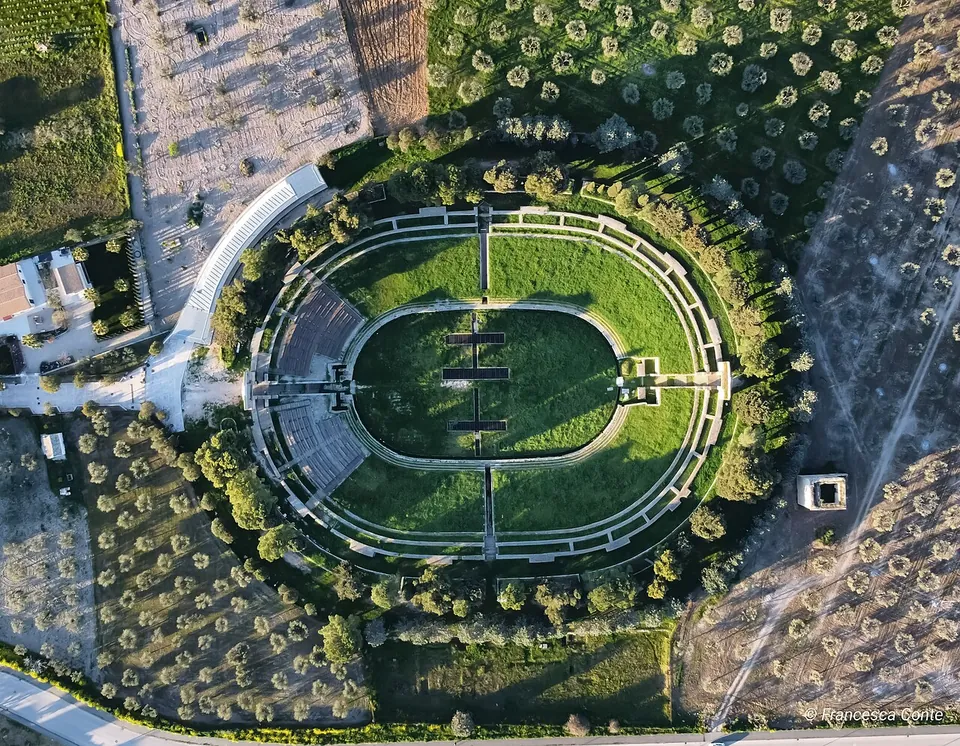


The Roman amphitheatre of Lucera is an arena for gladiator fights and animal hunts that a local magistrate built at his own expense in honour of the emperor Augustus, on the eastern edge of Lucera, in the province of Foggia in Apulia. It held an estimated 16,000 to 18,000 spectators (the Ministry of Culture; the Comune di Lucera).
It is closed at the moment. The Ministry of Culture lists it as temporarily closed with no reopening date, and the local press reported in October 2026 that it will stay shut for fire-safety works until at least the end of the year.
What is there today
The amphitheatre sits in a natural hollow, dug out into a rough oval, with part of the seating laid on the slope (fr.wikipedia). Published figures put the outer oval at 127 to 130 metres by about 95, and the arena at 70 to 75 metres by 40 to 43 (the Comune, the Ministry of Culture, fr.wikipedia, FAI).
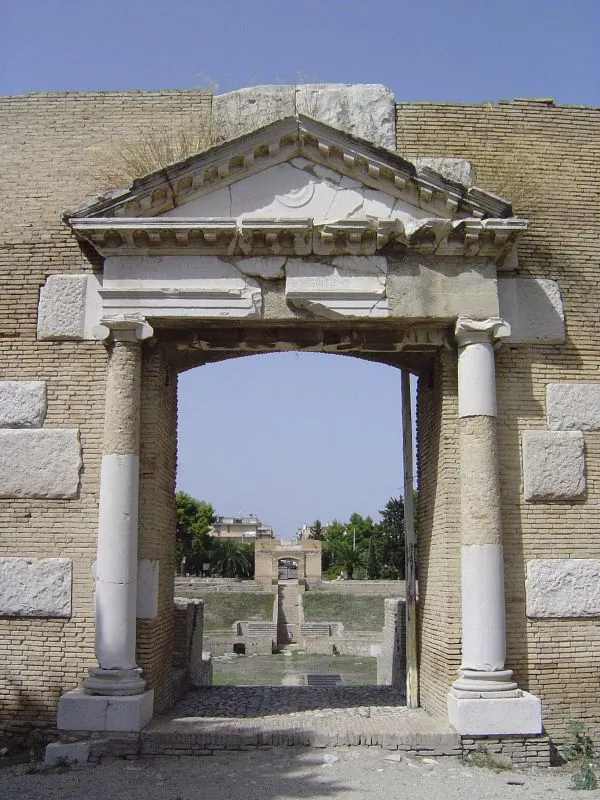
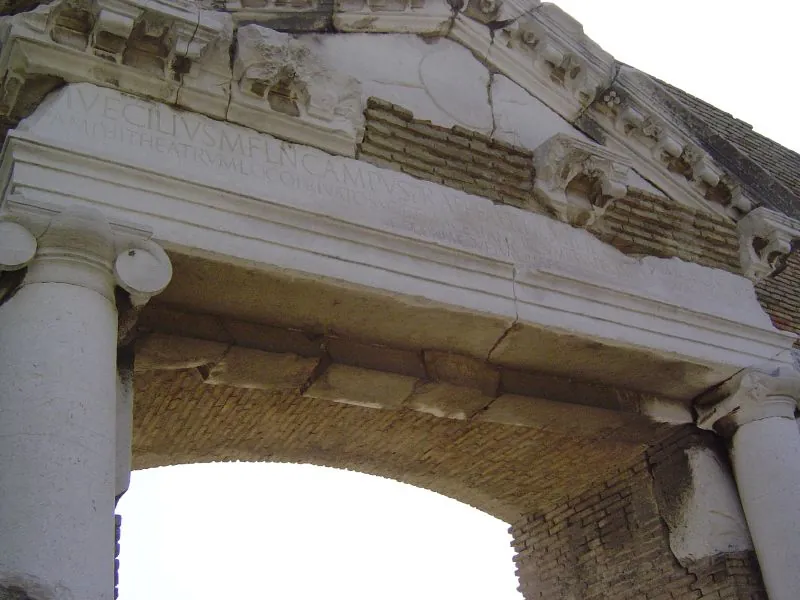
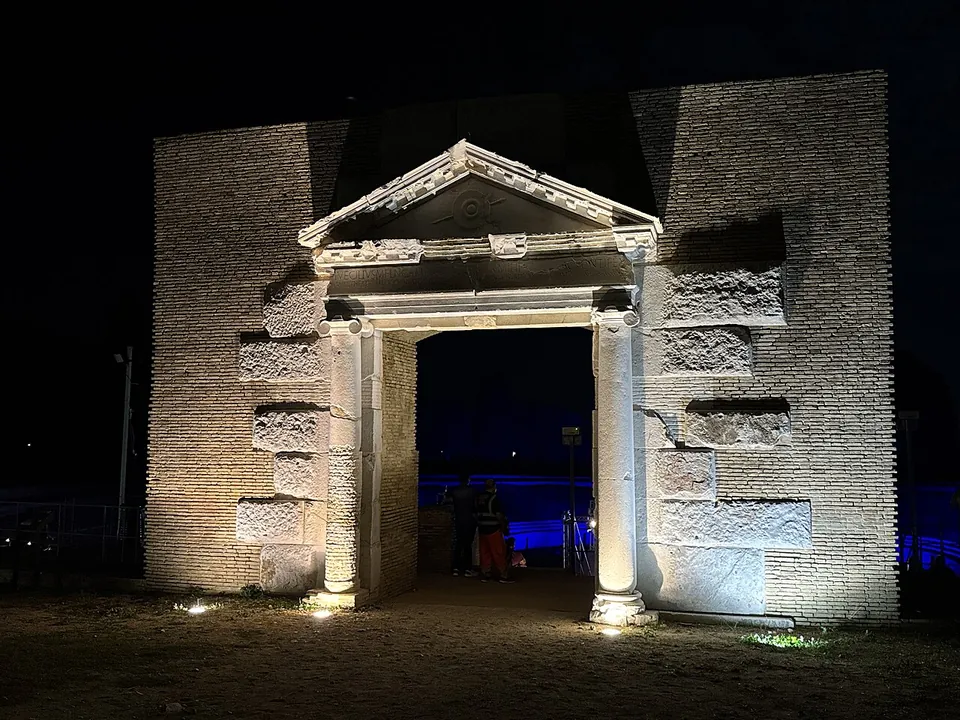
The things to look at are the two main portals on the long axis, one facing the town and one facing Foggia. Each is framed by Ionic columns under a lintel and pediment, and the lintels carry the inscription that names Marcus Vecilius Campus, the man who paid for the building (it.wikipedia; the Comune). Inside, the arena is ringed by a drain and by the podium wall, which has four openings into the arena. Beneath the floor runs a service gallery that widens into three rectangular pits, each about 16 to 18 metres long and 4 metres deep (fr.wikipedia). At the foot of the stairways, the rooms where the athletes were prepared (spoliaria) still show stretches of the original net-patterned stonework (opus reticulatum; the Comune).
Much of what stands was put back together. The excavations that began in 1932 ended in a restoration in the 1940s that reassembled its architectural pieces (the Comune; FAI), and it was criticised as excessive in the 1950s (fr.wikipedia). A further restoration in 2006–2009 added modern stepped seating for about a thousand people in the western curve, so the arena can be used for concerts and plays (the Comune).
Is it worth the trip?
Not right now. While it is closed, a trip made for the amphitheatre alone ends at the gate, and local press reports that on ordinary days the arena can be seen only through the bars of the entrance gate. The exceptions are the evening events the town allows in the arena (Luceraweb).
Once it reopens, it is worth a stop if you are in Lucera anyway. It is an early amphitheatre, counted among the oldest in southern Italy (it.wikipedia), the portals still carry the builder’s inscription, and the ticket costs €3. Just remember that much of what you see was reassembled in the twentieth century, and is not a ruin left as it was found.
Getting there
The entrance is at the far end of Viale Augusto. Coming by car on the SS 17 you can reach it without driving through the town. Turn right at the first roundabout into the town, onto Via delle Porte Antiche, then follow Viale Giovanni Paolo II to the amphitheatre at its end. From the town centre the one-way route is Via Aldo Moro, Via Napoleone Battaglia and then Viale Augusto (the Comune). A bus stop, “L4 viale Augusto 99 (Anfiteatro)”, is mapped about 200 metres away (OpenStreetMap).
The Ministry of Culture’s page lists a full ticket at €3 and a reduced one at €1. University students and groups of more than 25 pay €2. When the site is open, the ticket office keeps 09.00–16.30 from Tuesday to Sunday and is closed on Mondays. That page was read on 22 October 2026 and was last updated in December 2025. Before travelling, check with the town’s tourist office on 0881 541662 (the Comune).
Visiting details
- Opening hours
- Temporarily closed. When it is open, the ticket office keeps 09.00–16.30 Tuesday to Sunday and is closed on Mondays.
- Tickets
- €3; €1 reduced; €2 for university students (on showing their student record book) and for groups of more than 25.
Before you go
- The Ministry of Culture lists the amphitheatre as temporarily closed and gives no reopening date. The local paper Luceraweb reported on 11 October 2026 that it is closed for fire-safety works following the structural renovation, and that a decision of the town council puts visits and events back to 2027.
- Outside evening events, local press reports that the arena can be seen only through the bars of the entrance gate.
Hours and prices checked 22 October 2026 on the operator's own site. Confirm before travelling.
History
After the Roman conquest in 314 BC, Luceria became a colony with Latin rights and later a municipium. It had its most prosperous period under Augustus, when the town gained many new public buildings (it.wikipedia). The amphitheatre was one of them, built between 27 BC and AD 14 (the Ministry of Culture). Marcus Vecilius Campus was a duumvir of the town, a military tribune and prefect of the engineers. He built it on his own land and at his own cost, and dedicated it to Augustus and to the colony (it.wikipedia; the Comune). Augustus received the title Pater Patriae in 2 BC. The inscription does not use it, which suggests the building was opened before then (fr.wikipedia). It was built over an existing quarter of the Republican town, with houses and workshops on a wide street, which were demolished to make room for it (FAI).
It was rebuilt in places, in brick, by the end of the 1st century AD or early in the 2nd (the Ministry of Culture). The three pits under the arena are lined with brick, unlike the original building, and may date from this phase. What they were for is debated. Jean-Pierre Golvin reads them as part of a system for flooding the arena with a thin layer of water for aquatic shows. The Italian archaeologist Franco Schettini thought they were service rooms that held lifts (fr.wikipedia). The Comune’s text says they held services, animals and stage machinery.
The building was in decline by the 3rd century AD and was used as a quarry (FAI). It was probably damaged when the emperor Constans II took the town in 663, and afterwards it gradually silted up (it.wikipedia). The first significant remains came to light on 13 October 1932. The excavation was directed first by Quintino Quagliati and then by Renato Bartoccini (it.wikipedia). Published dates for the end of the restoration differ between 1945 and 1948. In 2016, 23,619 people voted for the amphitheatre in FAI’s “I Luoghi del Cuore” census. The vote let the town enter FAI’s funding call, and a project it submitted received €27,000 from FAI and the bank Intesa Sanpaolo, topped up by the town; the work was presented in March 2022 (FAI). In February 2025 the mayor closed the amphitheatre so that a larger urban-regeneration project could begin work on the arena and the galleries beneath it (Lucera by Night).
More photographs

Nearby
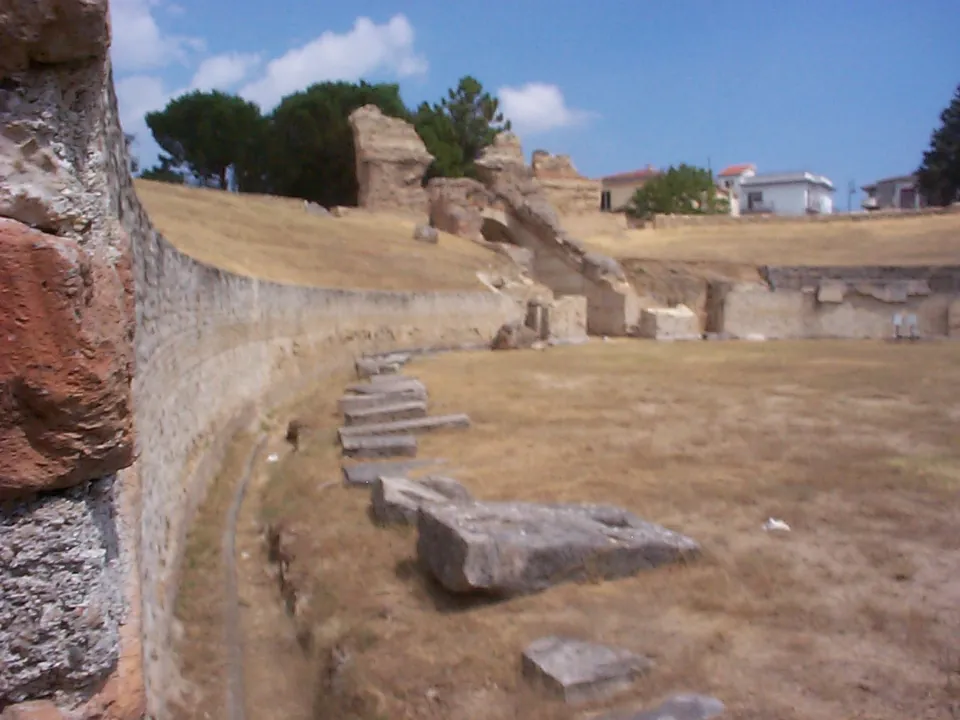
Photo: Vicoduomo at English Wikipedia · Public domain · Commons

Straight-line distances.
Sources
Every fact on this page comes from the records below, each used under the licence noted.
| Source | Licence |
|---|---|
| Pleiades 373085765 | CC BY |
| Wikidata Q2844414 | CC0 |
| Vici.org 4237 | CC BY-SA (text), CC0 (metadata) |
| OpenStreetMap way/32215446 | ODbL |
| Wikipedia (it) — Anfiteatro romano di Lucera | CC BY-SA 4.0 |
| Wikipedia (fr) — Amphithéâtre de Lucera | CC BY-SA 4.0 |
| Ministero della Cultura — Anfiteatro augusteo di Lucera (hours, tickets, closure) | licence not recorded |
| Comune di Lucera — Anfiteatro romano augusteo (archived copy of 26 November 2025) | licence not recorded |
| FAI — Anfiteatro augusteo di Lucera, the 2022 restoration | licence not recorded |
| Lucera by Night — the mayor closes the amphitheatre for works (15 February 2025) | licence not recorded |
| Luceraweb — "L'anfiteatro è sempre chiuso: perchè?" (11 October 2026) | licence not recorded |