

What is there today
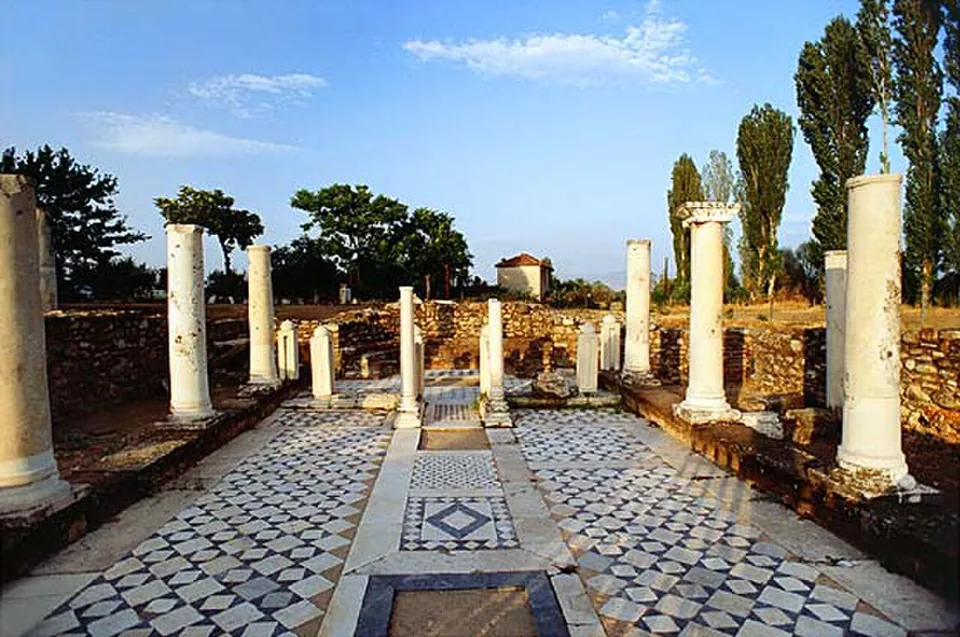
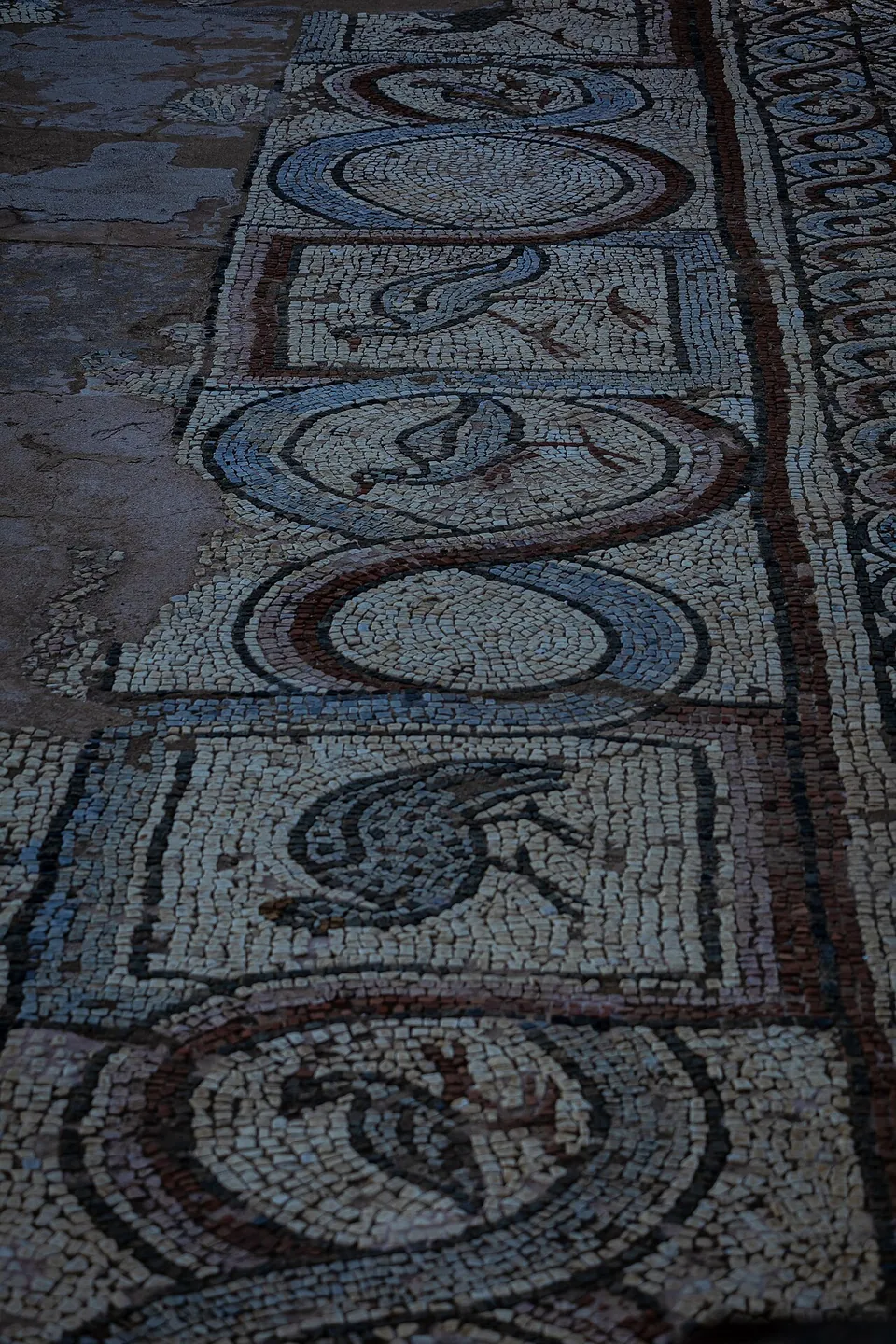
The site covers 4 hectares, of which 1,300 m² are covered with mosaics. The operator lists seven investigated and presented buildings: the portico of a courtroom, the baths and the theatre, all of the Roman 2nd century AD; the episcopal residence and the small and great basilicas of the early Christian period (4th–6th century); and a city fountain of the time of Justinian, dated 562. A small exhibition on the site shows finds of the 1st to the 6th century, with a model of the theatre (the operator).
The theatre
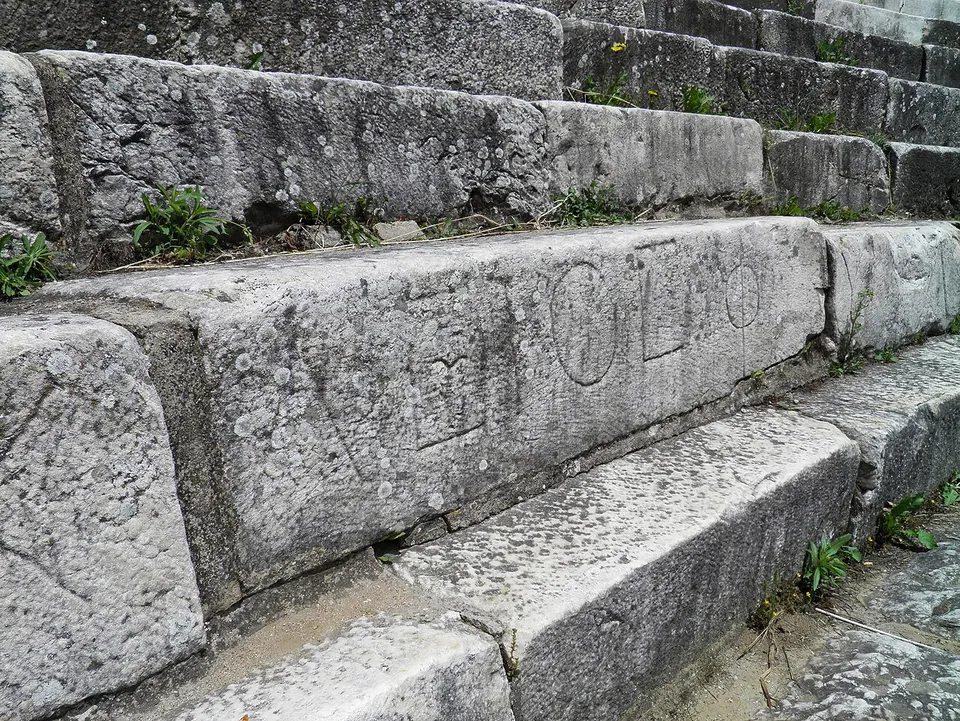
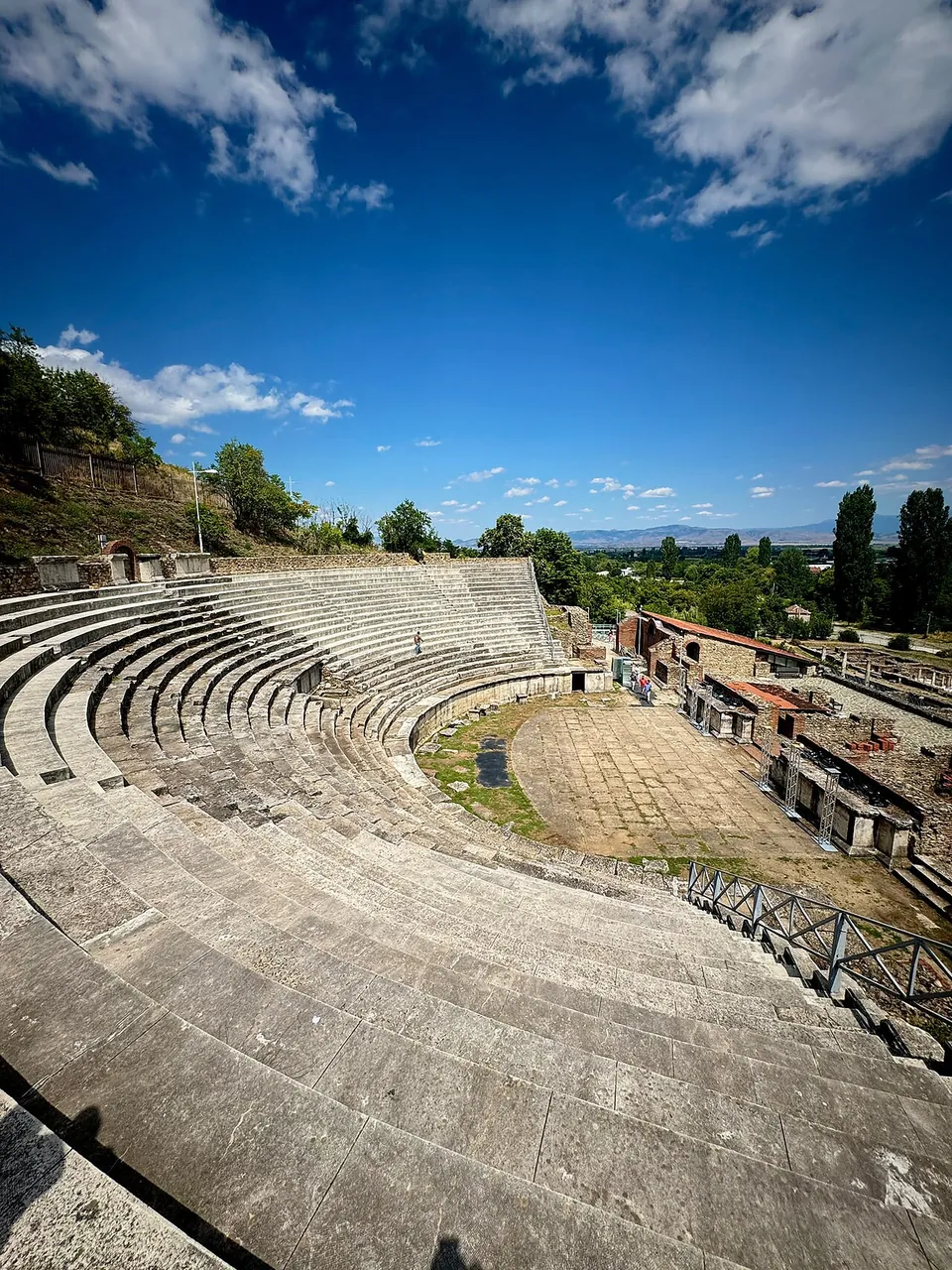
The theatre is Roman, of the 2nd century AD, and has been conserved and partly reconstructed (the operator). Some of its seats are carved with Greek letters (the photograph below).
Is it worth the trip?
Yes. Its theatre is one of North Macedonia’s three Roman theatres, with those of Scupi and Stobi (en.wikipedia, Ancient Theatre of Ohrid), and the site is easy to reach, on the edge of Bitola, with its mosaics in place. The operator counts more than 50,000 visitors a year.
Getting there
The ruins lie 2 km south of Bitola (en.wikipedia), at the foot of Mount Baba (mk.wikipedia). A car park is mapped about 110 m from the site’s point, near Bukovska street, and free toilets about 90 m from it (OpenStreetMap).
The institute that runs the site publishes no opening hours or ticket price for Heraclea itself. Its museum in town opens April to October 08.00–20.00 and October to March 08.00–18.00, charges 180 denars, about €2.90, for foreign visitors and 100 (about €1.60) for Macedonian citizens, and is free for everyone on the 1st of each month (muzejbitola.mk, read 29 September 2026). OpenStreetMap maps the site as fenced with access for paying customers.
Visiting details
- Opening hours
- The operator publishes no opening hours for the site itself. Its museum in Bitola opens April to October 08.00–20.00 and October to March 08.00–18.00.
- Tickets
- The operator publishes no ticket price for the site itself; OpenStreetMap maps it as fenced, with access for paying customers. Its museum in Bitola charges 180 MKD (about €2.90) for foreign visitors and 100 MKD (about €1.60) for Macedonian citizens, with reductions for students, pensioners and children, and is free for everyone on the 1st of each month.
- Parking
- A car park is mapped about 110 m from the point, near Bukovska street (OpenStreetMap).
Hours and prices checked 29 September 2026 on the operator's own site. Confirm before travelling.
History
Philip II of Macedon founded Heraclea in the middle of the 4th century BC (Pleiades). It stood in a fertile plain and grew into an important crossroads on the Via Egnatia, the road from Dyrrachium to the Bosphorus, from which another road ran diagonally to Stobi and on to Serdica (mk.wikipedia). The site holds several settlements one above another: a late Bronze and early Iron Age settlement, then the Hellenistic, the Roman and finally the early Byzantine city (hr.wikipedia).
In the early Christian period Heraclea was an important bishop’s seat, and some of its bishops are named at the church councils of Serdica and neighbouring towns. The city was abandoned gradually in the 6th century, after an earthquake and Slavic invasions (en.wikipedia).
Excavation began in the 19th century, when Bitola was a centre of European Turkey and the Sultan issued permits that let foreign diplomats dig and take the finds home. Systematic work followed in the 20th century, and since 1975 it has been led by the Bitola institute itself (the operator).
More photographs


Nearby
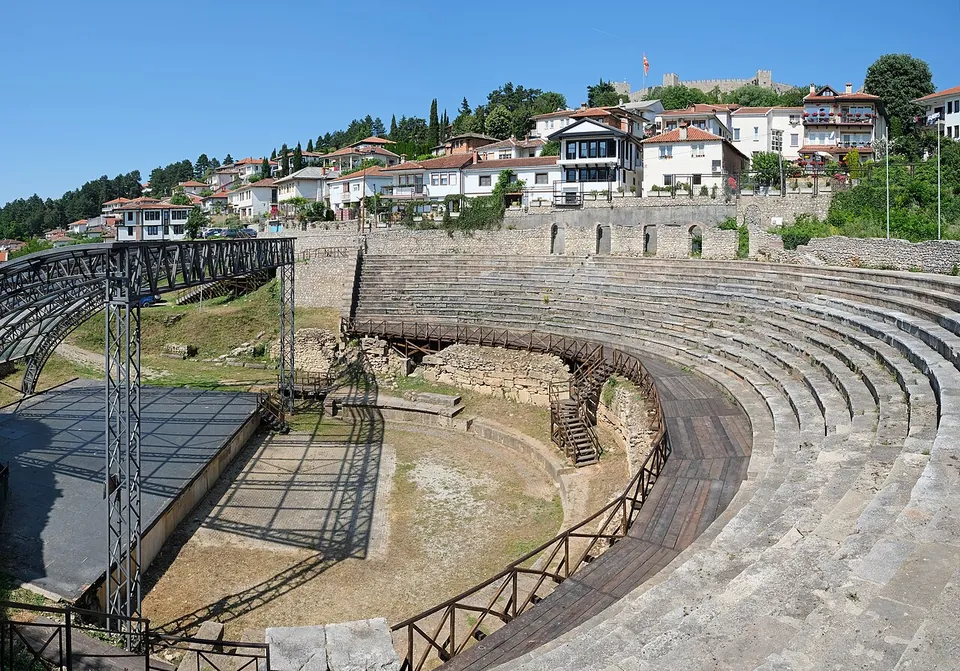
Photo: kallerna · CC BY-SA 4.0 · Commons
47 km · city · Municipality of Ohrid
Lychnidos – Ohrid
The theatre was built at the end of the 3rd or the beginning of the 2nd century BC.

Straight-line distances.
Sources
Every fact on this page comes from the records below, each used under the licence noted.
| Source | Licence |
|---|---|
| Pleiades 481861 | CC BY |
| Wikidata Q1142395 | CC0 |
| Vici.org 2104 | CC BY-SA (text), CC0 (metadata) |
| OpenStreetMap way/37956139 | ODbL |
| NI Institute and Museum Bitola (the operator) — Heraclea Lyncestis | licence not recorded |
| NI Institute and Museum Bitola (the operator) — visitor information | licence not recorded |
| Wikipedia (en) — Heraclea Lyncestis | CC BY-SA 4.0 |
| Wikipedia (mk) — Хераклеја Линкестис | CC BY-SA 4.0 |
| Wikipedia (hr) — Heraclea Lyncestis | CC BY-SA 4.0 |
| Wikipedia (en) — Macedonian denar (exchange rate) | CC BY-SA 4.0 |
| Wikipedia (en) — Ancient Theatre of Ohrid (the three Roman theatres) | CC BY-SA 4.0 |