

What is there today
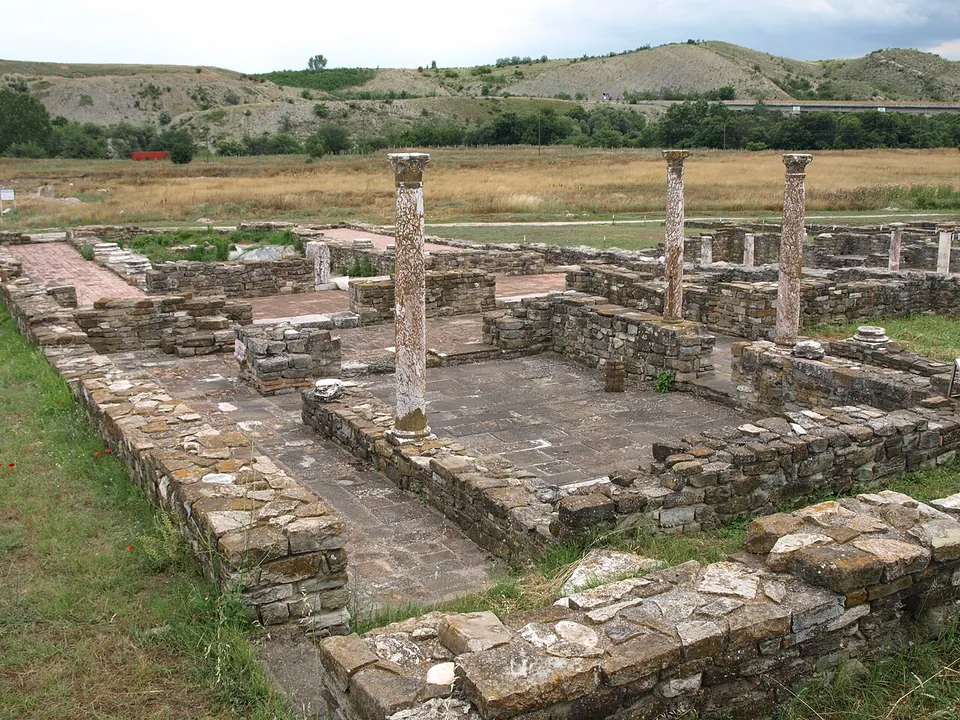
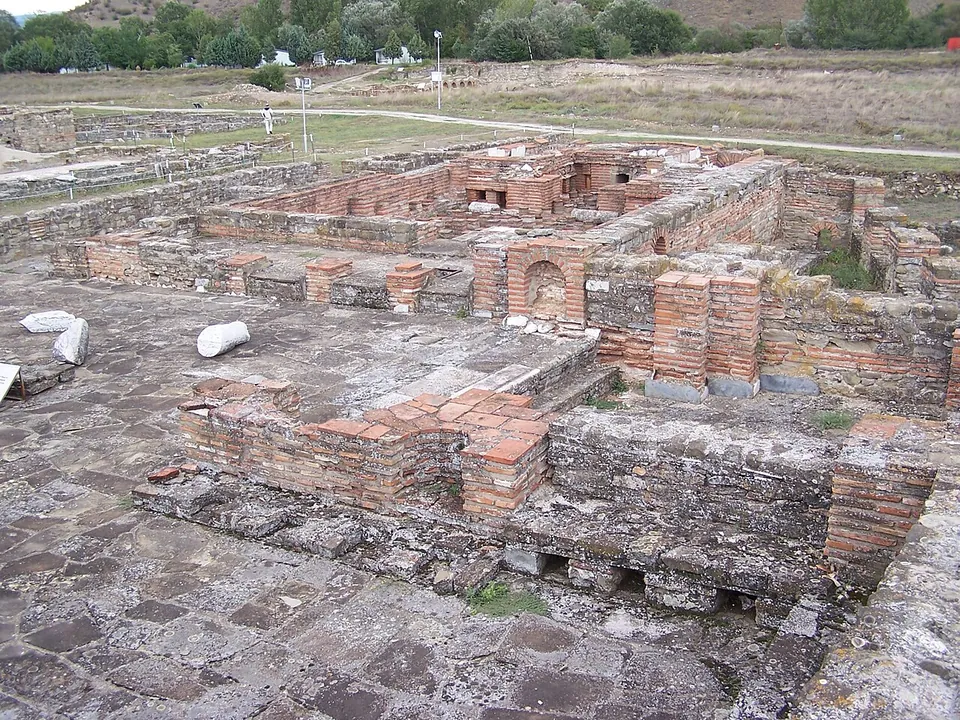
The archaeological site covers 16 hectares; the town stood on three walled terraces that step down to the Crna (mk.wikipedia), and its excavated and restored buildings form an open-air museum (de.wikipedia). The operator’s plan of the town names 26 buildings, among them the episcopal basilica, the Theodosian palace, the houses of Peristerius and of Polycharmos, the synagogue-basilica, the Large and Small Baths, the Domus Fulonica, the Via Sacra and the city walls. The floor mosaics are covered from November to April to protect them from the weather (the operator).
The theatre
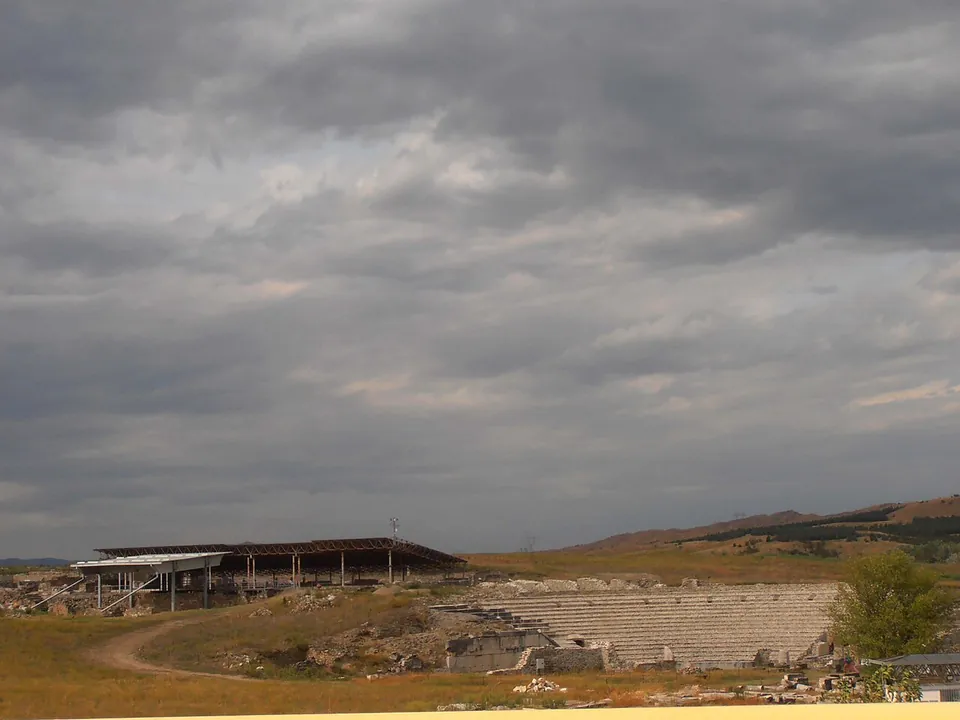
The theatre is on the southern edge of the town and, unlike most ancient theatres in the region, was not dug into a hillside: its seating stands on a massive system of radial and circular walls. Building began at the end of the 1st century AD, stalled, and was finished in the first half of the 2nd, after the model of the Roman theatres of Asia Minor. It held about 7,000 spectators on more than thirty rows of marble seats, and put on plays, mime and choral performances as well as gladiatorial fights and fights with wild beasts. Some seats are carved with the names of the people and families who reserved them, and the holes for the posts of the net that protected the front rows during the dangerous spectacles can still be seen (the operator).
Is it worth the trip?
Yes. Its ruins are described as the most important ancient remains in North Macedonia (de.wikipedia) and as the country’s best-known archaeological site (hr.wikipedia). It is staffed, with guides every day, and sits right beside the main motorway. Visit between May and October if you want to see the mosaics; from November to April they are covered.
Getting there
Stobi lies directly north of the A1 motorway, south of the village of Gradsko (de.wikipedia). The operator gives journey times from Skopje of about 55 minutes by car, 1 hour 30 minutes by bus and 1 hour 50 minutes by train, and from Thessaloniki of about 1 hour 55 minutes by car, without naming the stop or station. A car park is mapped about 210 m from the site (OpenStreetMap).
The site is open 08.00–16.00, with last entry at 15.30. A ticket is 300 denars, about €4.90, from April to October and 250 denars (about €4.10) in winter; children, pupils and pensioners pay 60, students 90, and under-sixes go free. Entry is free for everyone on the first Sunday of every month (stobi.mk, read 29 September 2026).
Visiting details
- Opening hours
- The site is open 08.00–16.00, last entry 15.30; guides are available 08.00–16.00 every day.
- Tickets
- Adults 300 MKD (about €4.90) from 1 April to 31 October and 250 MKD (about €4.10) from 1 November to 31 March; children and pupils aged 6–18 and pensioners 60 MKD (about €1), students 90 MKD (about €1.50), under-6s free. Free for everyone on the first Sunday of every month and on a few set days (18 April, 18 May, the third Saturday of October, 23–26 September).
- Parking
- A surface car park is mapped about 210 m from the point (OpenStreetMap).
Before you go
- The mosaics are covered from November to April because of the weather (the operator).
- In summer bring a hat and water; food may not be taken onto the site (the operator).
Hours and prices checked 29 September 2026 on the operator's own site. Confirm before travelling.
History
Stobi was a town of Paeonia, later conquered by Macedon; in early times the seat of the Paeonian kings was Bylazora, and it later moved to Stobi (en.wikipedia). With Macedonia it came under Roman rule in the 2nd century BC (de.wikipedia). The city stood where the Erigon, the modern Crna, flows into the Axios, the Vardar, on the main road from the Danube to the Aegean, which made it important for trade and war (en.wikipedia); in the Roman period another road ran up the Crna valley to join the Via Egnatia at Heraclea Lyncestis (mk.wikipedia). It prospered especially in the peaceful 1st and 2nd centuries, became the capital of the Roman province of Macedonia Salutaris, and at the end of the 6th century came under the Slavs (hr. and en.wikipedia). Cemeteries of the Hellenistic, Roman, Byzantine and Slavic periods lie on the slopes around the town (mk.wikipedia).
More photographs

Nearby
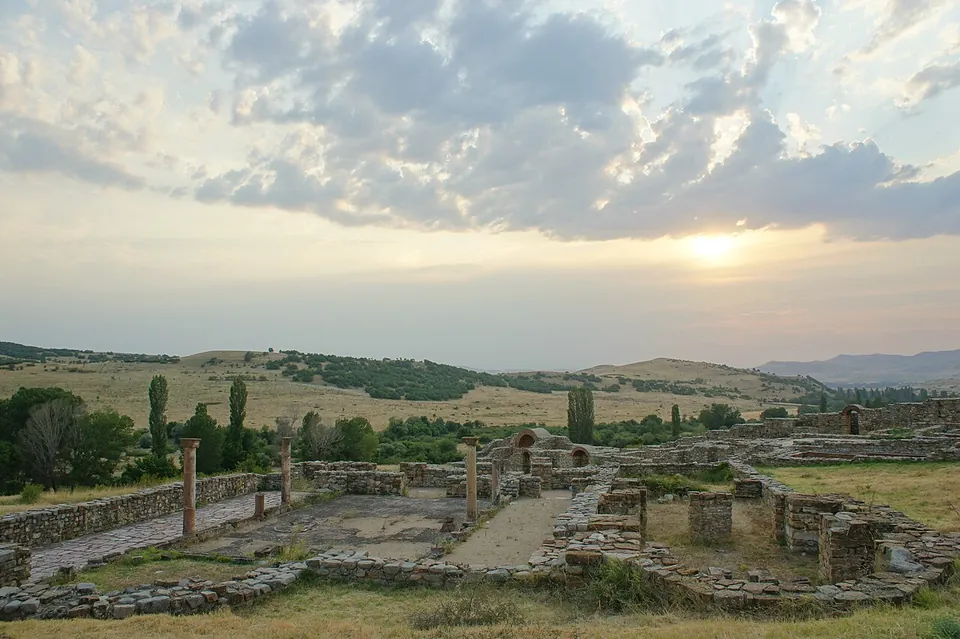
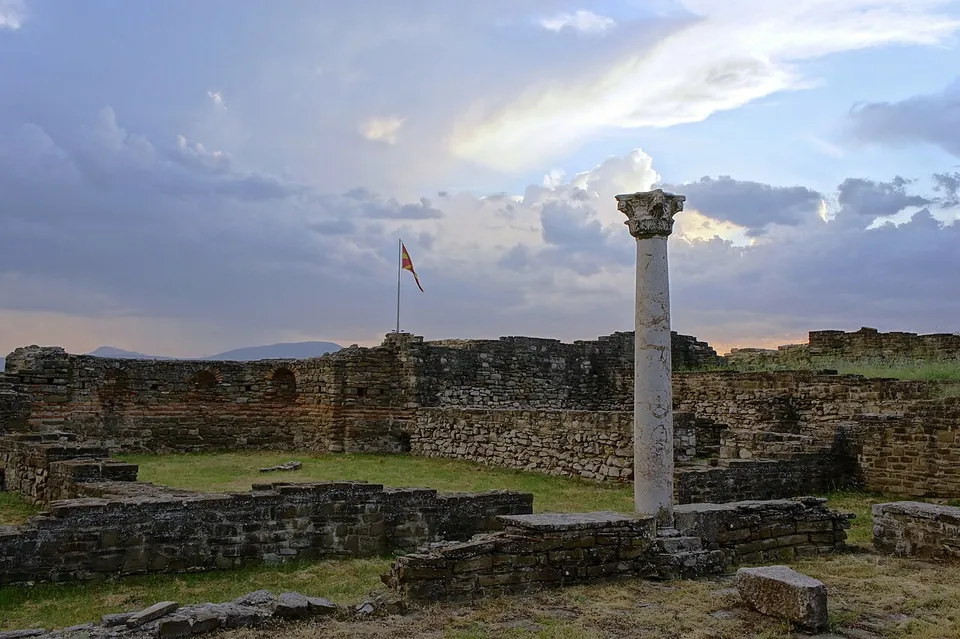
Photo: Stotosenik · CC BY-SA 3.0 · Commons
38 km · city · Municipality of Karbinci
Bargala
Excavation, begun in 1966, has uncovered the trapezoidal circuit of the town with its seven towers and two gates (en.wikipedia); the photographs show stone walls banded with brick, standing in places to more than head height, with brick arches.

Straight-line distances.
Sources
Every fact on this page comes from the records below, each used under the licence noted.
| Source | Licence |
|---|---|
| Pleiades 491731 | CC BY |
| Wikidata Q1371168 | CC0 |
| OpenStreetMap way/209092691 | ODbL |
| NU Stobi (the operator) — tickets and opening hours | licence not recorded |
| NU Stobi (the operator) — directions | licence not recorded |
| NU Stobi (the operator) — the theatre | licence not recorded |
| Wikipedia (en) — Stobi | CC BY-SA 4.0 |
| Wikipedia (de) — Stobi | CC BY-SA 4.0 |
| Wikipedia (mk) — Стоби | CC BY-SA 4.0 |
| Wikipedia (hr) — Stobi | CC BY-SA 4.0 |
| Wikipedia (en) — Macedonian denar (exchange rate) | CC BY-SA 4.0 |