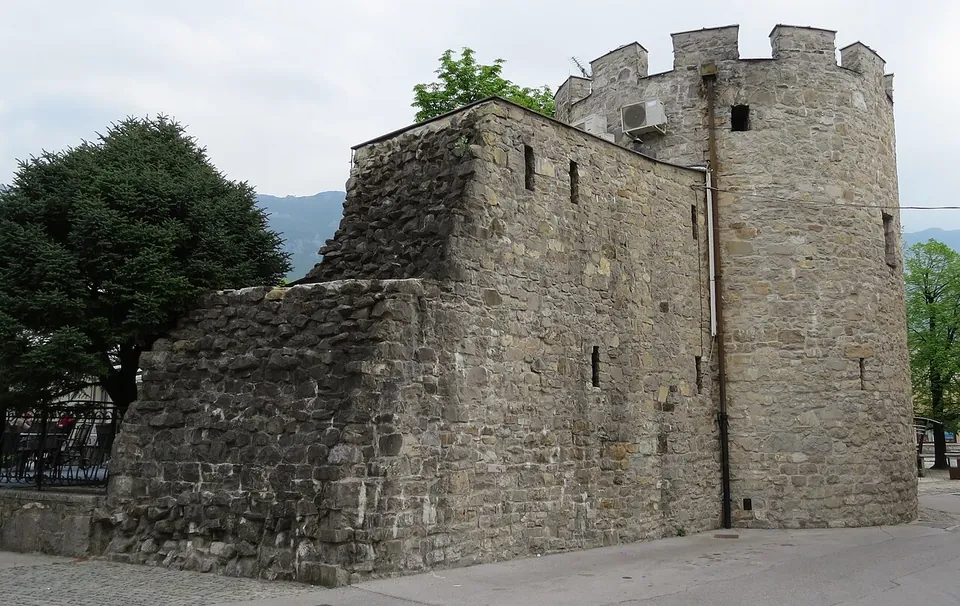
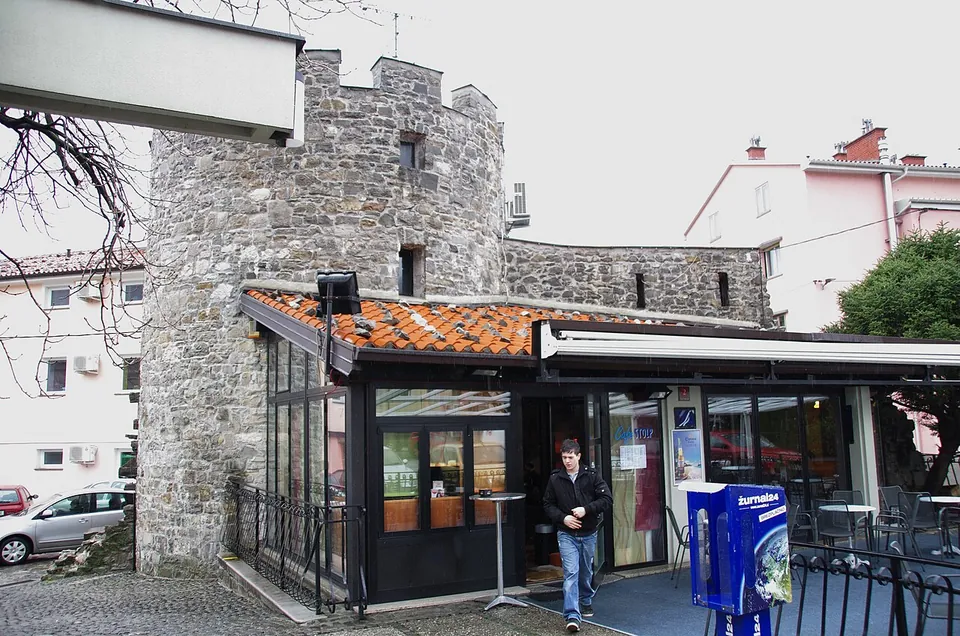
Castra ad Fluvium Frigidum, “the fortress by the cold river”, was a late Roman fort that was the centre of the Claustra Alpium Iuliarum, a Roman defensive system of walls and towers running from the Gail valley in Austria to the Učka range in Croatia (en.wikipedia). Its wall and several of its towers still stand in the middle of Ajdovščina, among streets, squares and cafés.
What is there today
The fort was an irregular polygon about 220 m wide and 160 m long, with a wall 3.4 m thick and fourteen square towers, at least 6 m high, ringed by a ditch (en.wikipedia). The heritage register gives the wall as 608 m round. Seven towers and part of the wall survive (en.wikipedia), built into the old town rather than fenced off in a park: one tower has a café at its foot and another stands beside a paved street (photographs). Excavations have turned up graves, a small bath with a caldarium and, in September 2016, an eleventh tower (en.wikipedia). The tourism board describes four open-air displays of excavated remains on Lavrič Square.
The permanent exhibition “Fluvio frigido – Castra – Flovius – Ajdovščina” in the Ajdovščina Museum Collection covers the town’s story from prehistory to the early Middle Ages (Vipava Valley tourism board).
Is it worth the trip?
Yes, as a stop rather than a destination. The remains stand in the open with no charge recorded, it is an easy stop if you are in the Vipava valley, and the towers and wall are Roman fort masonry. But this is a town with a fort in it: you walk from tower to tower between modern buildings, and some are put to other uses. The guided walk is the way to make sense of it; it is not cheap, though, and the museum opens only at weekends.
Getting there
The fort lies in the centre of Ajdovščina. Free surface car parks are within about 100–150 m of the point (OpenStreetMap), and the nearest bus stop is about 220 m away. The tourist information centre, where the guided walks start, is at Prešernova 9, about 150 m from the point.
The ruins can be seen at any time and no charge is recorded for them. The Ajdovščina Museum Collection, Prešernova ulica 24, is open Saturday and Sunday 13.00–18.00 and closed on 1 January, Easter, 1 November and 25 December; its admission price is not published on the pages read. A two-hour guided walk of six points in the old town, including the longest preserved Roman wall in Slovenia, leaves the tourist information centre every Wednesday and Sunday at 10.00: €39 for adults, €29 for seniors and students, €17 for children 5 to 15, under 5 free, minimum three people, booked 48 hours ahead (Vipava Valley tourism board, read 4 November 2026).
Visiting details
- Opening hours
- The remains stand in the open in the old town and can be seen at any time. The Ajdovščina Museum Collection (Prešernova ulica 24), with the permanent archaeological exhibition, is open Saturday and Sunday 13.00–18.00 and closed Monday to Friday; it is also closed on 1 January, Easter, 1 November and 25 December. Guided walks of the ruins leave from the tourist information centre (Prešernova 9) every Wednesday and Sunday at 10.00 and last two hours.
- Tickets
- No entry charge is recorded for the ruins, which are part of the town's streets and squares. The museum's admission is not published on the pages read. The scheduled guided walk is €39 for adults, €29 for seniors and students and €17 for children 5–15 (under 5 free); a Roman tunic can be rented for €12. Minimum 3 people, booking 48 hours ahead.
- Parking
- Free surface car parks 97 m and 139 m from the point (OpenStreetMap, fee=no); the second has 30 spaces.
Before you go
- The museum is open at weekends only, and its ticket price could not be found.
- The wall is built into the town; towers have been converted to other uses, and one holds a café.
Hours and prices checked 4 November 2026 on the operator's own site. Confirm before travelling.
History
The fort was built in the early 270s on the site of an Early Roman settlement, beside the meeting of the Hubelj and the Lokavšček in the Vipava valley, on the Via Gemina from Aquileia to Emona (en.wikipedia). It had a permanent garrison and a commander, and is listed in the Notitia Dignitatum. The Itinerarium Burdigalense records it as a relay station, mutatio Castra.
In 394 the armies of Theodosius I and Eugenius met at the Frigidus. The fort’s role in that battle was peripheral: it probably served only to camp Eugenius’s infantry (en.wikipedia). In 451 it was demolished by Attila (en.wikipedia). The late medieval market town of Ajdovščina grew on the fort’s ground, which is why the wall and towers are now part of the town.
Nearby
16 km · fort · Ajdovščina
Ad Pirum
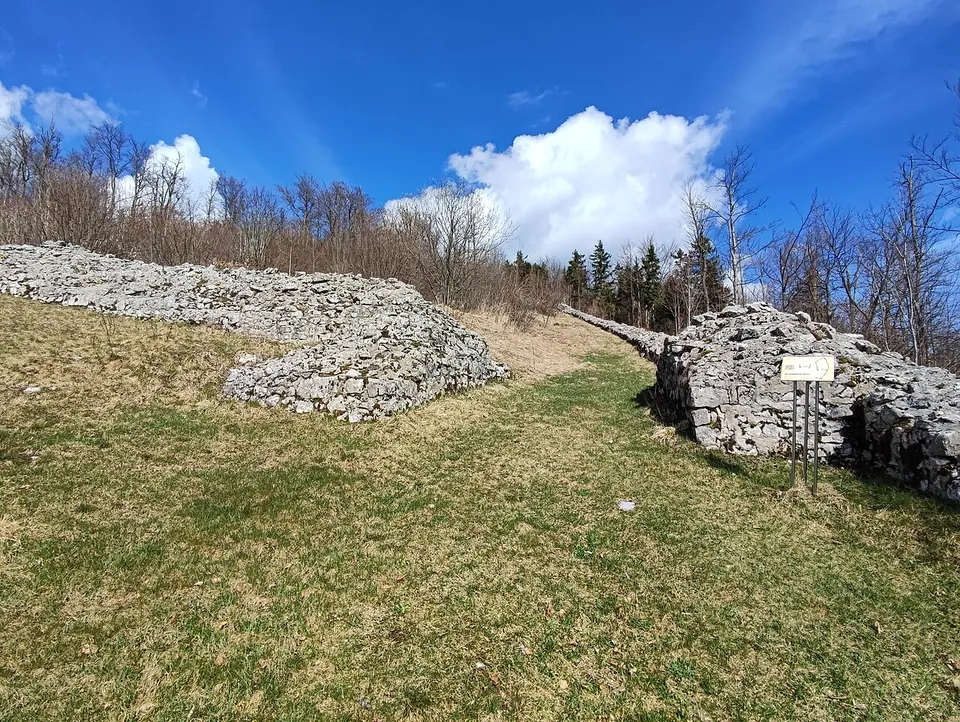
The fort follows the ground in an irregular oval, 250 m long and up to 75 m wide.
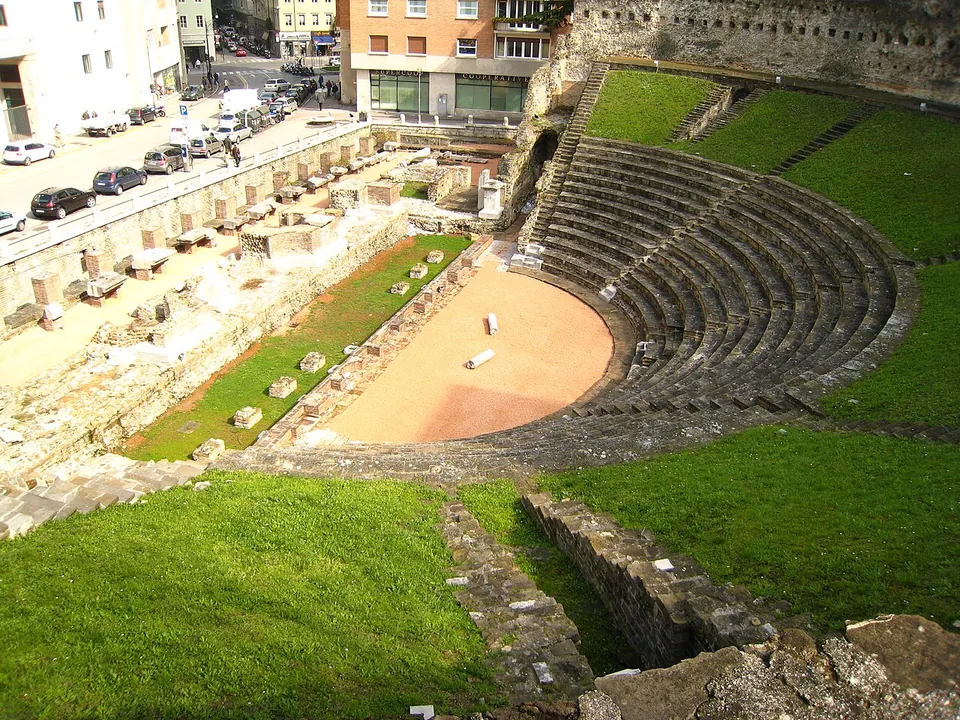
Photo: Tiesse · Public domain · Commons
29 km · theatre · Friuli-Venezia Giulia
Roman Theatre of Trieste
The seating (cavea) rests on the slope of the hill above a semicircular orchestra, with part of the stage building in front of it; the theatre was restored and partly rebuilt after it was excavated (the Soprintendenza).
Photo: Tiesse · Public domain · Commons
29 km · city · Friuli-Venezia Giulia
Tergeste – Trieste
Four of these remains are stops of their own: the theatre, the forum basilica on San Giusto hill, the Arco di Riccardo and the Antiquarium of via di Donota, the last of them closed at present.


Straight-line distances.
Sources
Every fact on this page comes from the records below, each used under the licence noted.
| Source | Licence |
|---|---|
| Pleiades 197276 | CC BY |
| Wikidata Q28969759 | CC0 |
| Vici.org 2890 | CC BY-SA (text), CC0 (metadata) |
| OpenStreetMap way/891720708 | ODbL |
| Zavod za turizem Vipavska dolina — Secrets of the Roman Fortress Castra (guided walk, prices, schedule) | licence not recorded |
| Zavod za turizem Vipavska dolina — The Roman Fortress Castra | licence not recorded |
| Zavod za turizem Vipavska dolina — Ajdovščina Museum Collection (hours, address, exhibition) | licence not recorded |
| Register nepremične kulturne dediščine, unit 3 (Ministrstvo za kulturo RS, CC BY 4.0) | licence not recorded |
| Wikipedia (en) — Castra ad Fluvium Frigidum | CC BY-SA 4.0 |
| Wikipedia (it) — Castra ad Fluvium Frigidum | CC BY-SA 4.0 |